

 Deutsch
 Español
 Suomi
Suomi Français
 Bahasa Indonesia
 Italiano
 日本語
日本語 Português
 Tagalog

1. What is L-citrulline?
L-citrulline is a naturally occurring amino acid. It is called “non-essential” because the body can make it, and “non-proteinogenic” because it is not used to build proteins in the same way as amino acids such as leucine or lysine.
Its name has a neat origin: citrulline was first isolated from watermelon, whose botanical family name includes Citrullus. Watermelon is still one of the best-known food sources of citrulline.
As a supplement, L-citrulline is usually sold as a plain powder or capsule. People mainly take it because it can increase the body’s supply of arginine, another amino acid that helps make nitric oxide. Nitric oxide relaxes blood vessels, which is why citrulline often comes up in conversations about exercise “pump,” blood flow, and fatigue.
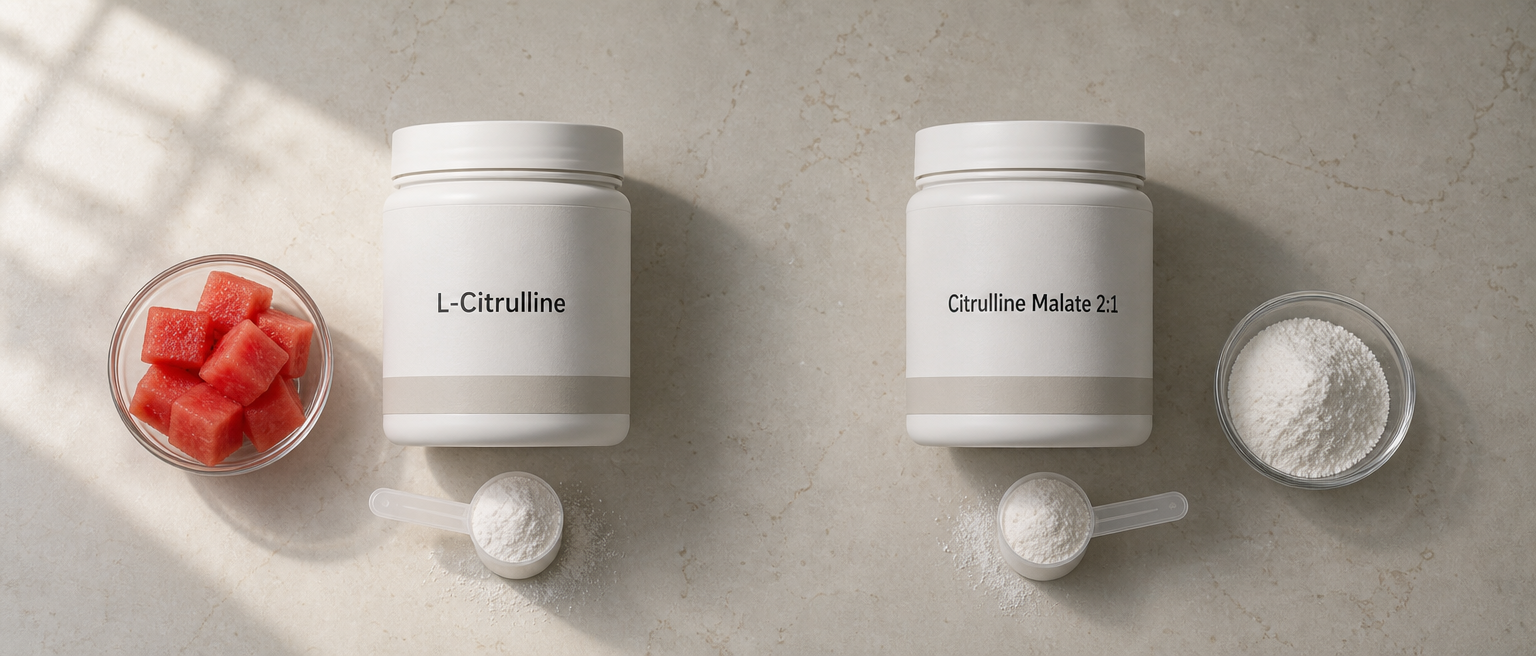
2. What is citrulline malate?
Citrulline malate combines L-citrulline with malate. Malate is connected to the citric acid cycle, the process cells use to turn food into usable energy.
The simplest way to think about it is:
- L-citrulline = the amino acid by itself
- Citrulline malate = L-citrulline plus malate
So citrulline malate is not a completely separate substance. It contains citrulline, but the grams listed on the label are not the same as grams of pure L-citrulline.
That difference is easy to miss. The NIH Office of Dietary Supplements notes that standard citrulline malate is 56.64% citrulline by weight. In plain English, 8 grams of standard citrulline malate would provide about 4.5 grams of actual citrulline, not 8 grams.
Some products list ratios such as 2:1 citrulline malate, meaning two parts citrulline to one part malate. Others use less clear wording, and some research has raised concerns that certain commercial products may not match their claimed ratios. This is one of the main reasons the two supplements are so often confused.
3. How they work in the body
Both forms follow the same main pathway because both supply citrulline.
When you take L-citrulline, much of it avoids heavy breakdown in the gut and liver. It then moves through the blood and is converted into arginine, especially in the kidneys and other tissues. This is useful because taking arginine directly is not always the most efficient way to raise blood arginine; the gut and liver break down a large share of oral arginine before it reaches circulation.
Once arginine levels rise, the body can use arginine to make nitric oxide. Nitric oxide helps blood vessels widen. In an exercise setting, that is why people link citrulline with better blood flow, more repetitions, or less fatigue.
Citrulline may also be involved in ammonia handling through the urea cycle. During hard exercise, ammonia can build up as a by-product of amino acid and energy metabolism. Citrulline sits close to this pathway, which is another reason researchers have studied it for fatigue.
Citrulline malate adds one extra possibility. The malate portion may feed into energy-producing pathways such as the citric acid cycle and the malate-aspartate shuttle. The idea is biologically plausible, but “may” is the important word here. Clinical studies have not firmly shown that malate adds a meaningful performance advantage over citrulline alone.
4. What the evidence says
The clearest evidence is for the mechanism: L-citrulline raises arginine availability more reliably than oral arginine in healthy adults. That applies whether the citrulline comes from pure L-citrulline or from citrulline malate.
For performance, the picture is less tidy.
 L-citrulline can raise arginine availability, which supports the nitric oxide pathway.
 Citrulline malate studies show small possible performance benefits, but certainty is low.
 Matched-dose comparisons do not clearly show one form is superior.
A 2021 review of eight placebo-controlled studies found that 6–8 grams of citrulline malate taken 40–60 minutes before strength training increased total repetitions by about three reps on average. That is potentially useful, but not dramatic.
A broader recent meta-analysis found small exercise-performance improvements with citrulline malate, especially with acute single-dose use, but rated the certainty of evidence as low to very low.
Official NIH guidance remains cautious, stating that current research does not provide strong support for citrulline or citrulline malate as exercise-performance enhancers.
The most helpful studies for the “which is better?” question are direct comparisons. In one acute trial, trained young adults took either pure L-citrulline, citrulline malate with the same citrulline dose plus malate, or placebo before performance testing. Neither form improved the tested outcomes versus placebo. In a six-week trial in resistance-trained men, citrulline malate improved some bench-press repetition results compared with placebo, but there was no clear significant advantage over pure L-citrulline on the main between-form comparison.
In short: citrulline malate has more of the classic pre-workout research behind it, but when the citrulline dose is matched, it does not clearly outperform pure L-citrulline.
5. Practical considerations
If you want dose clarity, pure L-citrulline is the simpler choice. A label that says 6 grams of L-citrulline usually means 6 grams of L-citrulline.
Citrulline malate takes a little more label reading. You need to know the ratio and the actual amount of citrulline it delivers. For example, 6 grams of a 2:1 citrulline malate product should provide about 4 grams of citrulline and 2 grams of malate, assuming the label is accurate. But 6 grams of standard citrulline malate by weight may provide closer to 3.4 grams of citrulline.
For exercise use, many studies give citrulline or citrulline malate about 40–60 minutes before training. Acute L-citrulline research also supports the idea that blood citrulline rises within about an hour after dosing.
Should you take both together? In most cases, that simply means you are taking more total citrulline plus some malate. There is not convincing evidence that stacking pure L-citrulline with citrulline malate is uniquely better than getting a well-measured dose from one form.
6. Safety
Short-term citrulline use appears generally well tolerated in healthy adults. Human studies have used single L-citrulline doses up to 15 grams without major tolerability problems, and the NIH notes that short-term studies up to 6 grams per day for four weeks found no adverse effects.
The most common issue is mild stomach discomfort, especially at higher doses or when taken too close to intense training.
People who are pregnant, breastfeeding, managing cardiovascular or kidney conditions, or using blood pressure or nitrate-related medicines should check with a healthcare professional before using citrulline supplements. Long-term safety is not as well studied as short-term use.