

 Deutsch
 Español
 Suomi
Suomi Français
 Bahasa Indonesia
 Italiano
 日本語
日本語 Português
 Tagalog
Summary
Beetroot is a food, juice, and supplement source of inorganic nitrate, which the body can convert through the nitrate-nitrite-nitric oxide pathway. The best-supported uses are endurance-related exercise support and modest blood-pressure lowering, especially when nitrate intake is standardized.
Research is stronger for nitrate-standardized beetroot juice or concentrated shots than for generic powders. Evidence for vascular function, exercise economy, and muscle endurance is promising but less uniform, while claims for strength, power, cognition, or universal athletic enhancement are much less consistent. Source, timing, product quality, and the oral microbiome can all affect real-world results.
Quick Facts
What is it useful for?
It is most useful for endurance-related exercise support and modest blood-pressure lowering. Effects in other areas are less consistent.
Supplement types
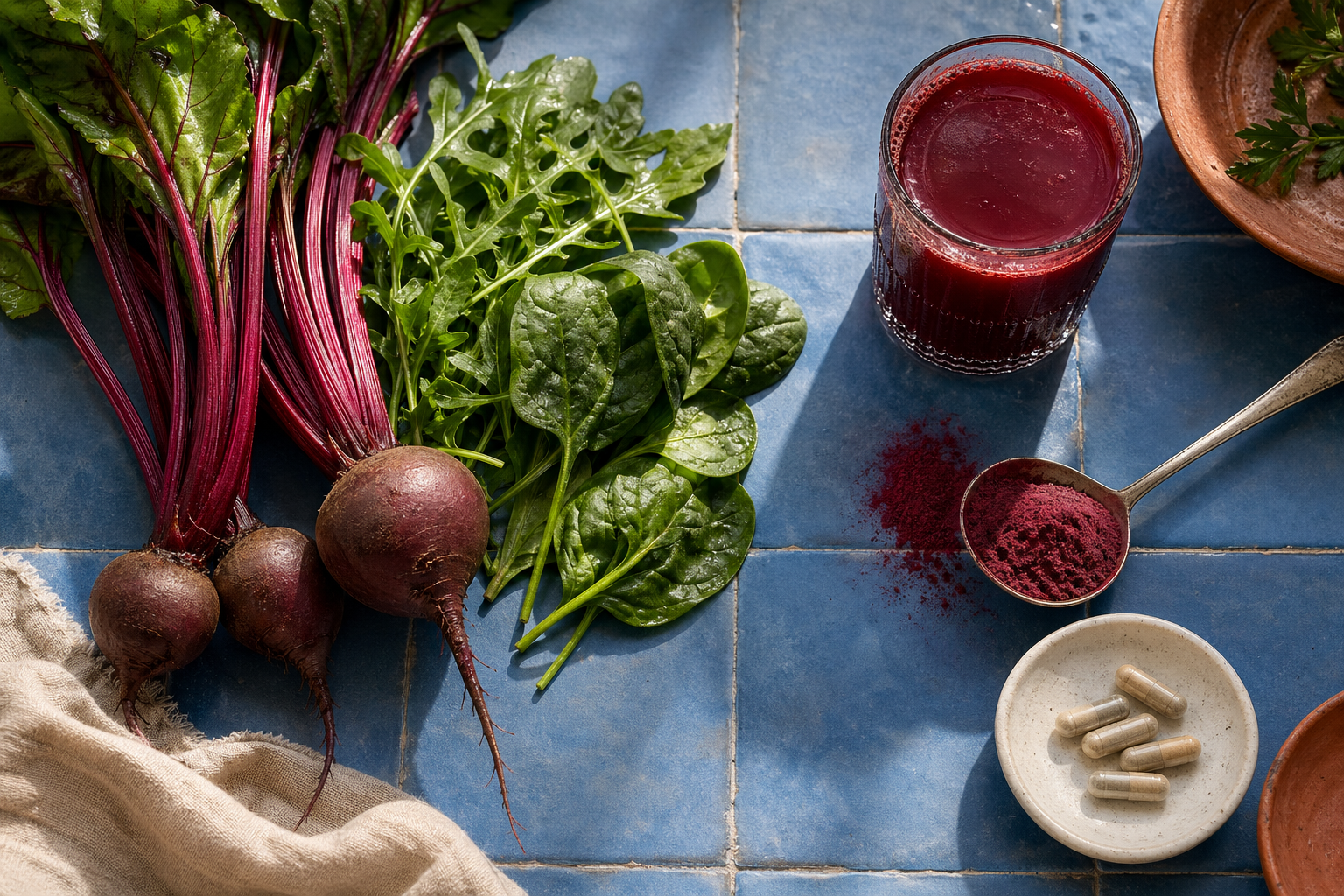
Common forms include beetroot juice, concentrated shots, powders, capsules, gels, nitrate salts, and nitrate-rich whole foods such as leafy greens.
Interactions
Its vascular effects may add to other blood-pressure-lowering products or antihypertensive medication, and antibacterial mouthwash can reduce nitrate activation.
Side effects
Short-term use is usually well tolerated, but red or pink urine, stomach upset, and oxalate-related concerns can occur in some contexts.
Other possible benefits
Research also suggests possible benefits for vascular function, exercise economy, and muscle endurance, though results are mixed.
Regulatory status
In the US it may be sold as a food or supplement with limited claims, while the EU allows sales but restricts health claims to authorised uses.
What We Already Know About It
Core pathway. The main established mechanism is the nitrate-nitrite-nitric oxide pathway. After ingestion, nitrate is absorbed and recirculated into saliva, where oral bacteria reduce part of it to nitrite. Nitrite can then contribute to nitric oxide production, especially in lower-oxygen conditions, helping explain why beetroot is studied for blood flow, vascular tone, oxygen efficiency during exercise, and blood-pressure effects. This also explains why strongly suppressing oral bacteria can reduce effectiveness. (PubMed — Oral microbiome, nitrate, and blood pressure review; PubMed — Antibacterial mouthwash intervention study)
Best-supported uses. Endurance-related exercise performance has the most consistent sports literature, with benefits typically described as modest rather than dramatic. Blood-pressure lowering, particularly in people with hypertension, is also reasonably supported. Evidence for muscular endurance is suggestive but less uniform, while evidence for maximal strength, explosive power, and cognitive benefits is weaker or mixed. Highly trained elite athletes may also see less benefit than recreationally active people. (Sports Medicine — Umbrella review on dietary nitrate and exercise performance; PubMed — Review on dietary nitrate and muscular performance; PubMed — Meta-analysis in arterial hypertension)
What remains uncertain. Source and matrix may matter, and whole-food sources like leafy greens can match or exceed beetroot for nitrate while being harder to standardize. Product variability, baseline diet, training status, and microbiome differences all add noise to outcomes. That leaves a practical picture: promising and useful in the right setting, but not simple or perfectly interchangeable across all products and users. (Frontiers in Nutrition — Source differences mini-review; PubMed — Review of vegetable nitrate sources; Foods — Beetroot supplement product analysis)
Summary of Relevant Scientific Research
Endurance performance signal — Sports Medicine
The 2025 umbrella review of 20 systematic reviews found the most consistent ergogenic signal in endurance-related outcomes, including time-to-exhaustion and some aerobic measures, while making clear that nitrate is not a universal sports enhancer. (Sports Medicine — Dietary Nitrate Supplementation and Exercise Performance)
High-intensity results are mixed — PubMed systematic review/meta-analysis
A 2023 review reported small positive effects in some short-duration, high-intensity tests, but the overall picture remained variable. Benefits may appear in certain sprint or repeated-effort settings rather than across every protocol. (PubMed — Dietary nitrate in short-duration high-intensity exercise)
Muscular endurance may improve more than strength — PubMed systematic review/meta-analysis
Randomized trial evidence suggests nitrate can help some endurance-oriented muscle tasks and fatigue resistance, but it does not support treating beetroot as a dependable maximal-strength booster. (PubMed — Effect of dietary nitrate ingestion on muscular performance)
Blood pressure lowering in hypertension — PubMed meta-analysis
Among non-sports applications, one of the better-supported findings is modest blood-pressure reduction from beetroot juice-derived nitrate in adults with arterial hypertension, although studies differed in dose, duration, and participants. (PubMed — Beetroot juice nitrate and blood pressure in hypertension)
Timing, mouth bacteria, and source matter — NIH ODS, PubMed, and Frontiers in Nutrition
Practical guidance points to around 5–11 mmol nitrate taken roughly 2.5–3 hours before exercise, while oral-microbiome and source-difference studies show that activation depends on mouth bacteria and that equal nitrate doses from different sources may not behave identically. (NIH ODS — Exercise and Athletic Performance Fact Sheet; PubMed — Pharmacokinetics of dietary nitrate; Frontiers in Nutrition — Source differences mini-review)
Beliefs, Myths & Unproven Claims
Beetroot boosts every kind of performance
The evidence does not support a blanket claim of across-the-board athletic enhancement. The strongest signal is for endurance-related exercise, exercise economy, and some repeated high-intensity efforts, while strength, pure power, and cognitive outcomes are much less consistent. (Sports Medicine — Umbrella review on dietary nitrate and exercise performance; PubMed — High-intensity exercise review; PubMed — Beetroot review)
All beetroot products are interchangeable
Commercial analyses found substantial variability in nitrate content and labeling quality across products, including differences between similar product types. A generic beet powder without verified nitrate content should not be assumed to match a standardized shot used in research. (Medicine & Science in Sports & Exercise — Beet juice nitrate variability analysis; Foods — Beetroot supplement product analysis)
More nitrate is always better
Available evidence does not show a simple linear dose-response. NIH guidance highlights that moderate doses may outperform lower doses, but much higher doses do not clearly deliver extra benefit, suggesting a plateau rather than endless improvement. (NIH ODS — Exercise and Athletic Performance Fact Sheet)
Source never matters
Beetroot juice, nitrate salts, and nitrate-rich vegetables should not automatically be treated as identical. Beetroot also supplies betalains, polyphenols, potassium, and a distinct food matrix, so source context may influence real-world effects even when nitrate amounts look similar on paper. (Frontiers in Nutrition — Source differences mini-review; PubMed — Review of nitrate-rich food sources)
Detailed Research Observations
Food origin and modern supplement interest
Beetroot is first a food rather than a classic medicinal herb with a strong monograph tradition. The modern supplement case is driven mainly by contemporary nitrate physiology, not by a long clinically validated traditional-medicine record. That distinction matters because consumer narratives often blur normal culinary use, folk belief, and trial-based evidence. In this case, the strongest rationale is biochemical and clinical: beetroot is a rich source of inorganic nitrate that can support nitric-oxide biology, while also supplying pigments and polyphenols that may or may not contribute independent effects. (PubMed — Beetroot review; NIH ODS — Exercise and Athletic Performance Fact Sheet)
Why the oral microbiome can change outcomes
The nitrate-nitrite-nitric oxide pathway depends partly on the mouth. After nitrate is consumed, some of it is concentrated in saliva and reduced by oral bacteria to nitrite, which can then be converted further to nitric oxide. This makes the oral microbiome functionally part of the supplement pathway rather than an unrelated detail. One of the most practical findings in the field is that strong antibacterial mouthwash can interfere with this conversion. A human intervention study showed that mouthwash blunted the pathway and increased blood pressure in treated hypertensive adults, while broader review evidence supports the oral microbiome's role in vascular responses to dietary nitrate. (PubMed — Oral microbiome, nitrate, and blood pressure review; PubMed — Antibacterial mouthwash intervention study)
Performance benefits are strongest in endurance settings
The clearest sports evidence supports endurance-related performance and exercise economy rather than universal improvement across all training styles. The 2025 umbrella review of 20 systematic reviews with meta-analyses found the most consistent benefits in endurance-type outcomes such as time-to-exhaustion and some aerobic measures. NIH guidance also notes that benefits may be more likely in recreationally active people than in elite athletes, who may have less room for measurable physiological improvement. This helps explain why some users notice an effect while others do not. (Sports Medicine — Umbrella review on dietary nitrate and exercise performance; NIH ODS — Exercise and Athletic Performance Fact Sheet)
Short-duration, high-intensity exercise studies do show some positive results, but effect sizes are smaller and less consistent than the endurance literature. Reviews on muscular performance suggest possible benefits for muscular endurance or fatigue resistance, without justifying a broad claim that nitrate is a reliable maximal-strength enhancer. Consumers often combine endurance, sprinting, strength, and power into one category, but the evidence does not. (PubMed — High-intensity exercise review; PubMed — Muscular performance review)
Blood-pressure effects are supported but not guaranteed
Outside sport, blood-pressure lowering is one of the stronger reasons adults consider beetroot or nitrate supplements. A 2022 meta-analysis concluded that nitrate derived from beetroot juice lowers blood pressure in patients with arterial hypertension. That makes this one of the better-supported non-sports uses, but the intervention literature is still heterogeneous. Doses, treatment lengths, medication status, and source forms vary substantially across trials, which makes the real-world effect less predictable than marketing often implies. (PubMed — Beetroot juice nitrate and blood pressure in hypertension)
The nuance matters because not every nitrate-rich intervention produces the same result in every study. At least one randomized trial using leafy greens or potassium nitrate did not find a significant change in ambulatory systolic blood pressure compared with placebo. A balanced interpretation is that blood-pressure benefits are plausible and supported, but they are not guaranteed across every source form, protocol, or patient context. (PubMed — Leafy greens or potassium nitrate blood pressure trial)
Forms, source differences, and label quality matter
The best-supported supplemental formats are nitrate-standardized beetroot juice and concentrated shots because they offer more predictable dosing than loosely defined powders or food portions. Other forms used in studies include powders, capsules, gels, nitrate salts, and nitrate-rich vegetables. Leafy greens such as spinach, rocket, lettuce, and Swiss chard can provide as much or more nitrate than beetroot, but the amount can vary by species, season, storage, and agricultural conditions. Beetroot juice is popular largely because it is practical to standardize around exercise. (NIH ODS — Exercise and Athletic Performance Fact Sheet; PubMed — Review of nitrate-rich food sources; PMC — Nitrate content in vegetables and related discussion)
Direct source comparisons also suggest that equal nitrate doses from beetroot juice and nitrate salts may not always behave identically, potentially because beetroot supplies betalains, polyphenols, potassium, and a different food matrix. On top of that, commercial analyses have found moderate-to-large variability in nitrate content, nitrite content, antioxidant capacity, and label quality across beetroot supplements. In practice, the word beetroot on a label does not reliably tell you how much nitrate a product delivers. (Frontiers in Nutrition — Source differences mini-review; Medicine & Science in Sports & Exercise — Beet juice variability analysis; Foods — Beetroot supplement product analysis)
Timing, dose plateau, and special-population caution
Pharmacokinetic work helps explain why most studies use beetroot about 2.5 to 3 hours before exercise rather than immediately beforehand. Nitrate and nitrite rise over hours, not minutes, so taking a shot right before training may be less effective. Study patterns summarized by NIH commonly use about 5–11 mmol nitrate, often from roughly 500 mL juice or a smaller concentrated shot, either acutely before exercise or daily for a short loading period. Importantly, higher intake is not automatically better, and the available evidence suggests a performance plateau rather than endless benefit from escalating doses. (PubMed — Pharmacokinetics of dietary nitrate; NIH ODS — Exercise and Athletic Performance Fact Sheet)
Evidence is much thinner for long-term daily high-dose use, pregnancy, infancy-related exposure issues, and condition-specific use in people with complex medical therapy. Pregnancy papers discuss possible pros and cons rather than supporting routine supplementation, EFSA has highlighted age-specific nitrate considerations in infants and young children, and beetroot can add oxalate load that may matter for people with a calcium oxalate stone history. These are important gaps where caution is more justified than enthusiasm. (PubMed — Pregnancy and nitrate discussion; EFSA — Nitrate considerations in infants and young children; PMC — Oxalate and kidney stone context)
Regulatory Status (EU and US)
United States
In the United States, beetroot products can be marketed either as conventional foods or as dietary supplements. Under FDA structure/function claim rules, sellers may describe effects on normal body structure or function if claims are truthful and substantiated, but they cannot legally claim to diagnose, treat, cure, or prevent disease without drug approval. (FDA — Structure/function claims guidance; NIH ODS — Exercise and Athletic Performance Fact Sheet)
European Union
In the EU, health claims are more tightly controlled through the EU Register. Products may be legally sold, but only authorised health claims may be used and only under their stated conditions of use. This means availability and approved claim status are not the same thing. (European Commission — EU Register of nutrition and health claims)
Safety benchmark
EFSA has reaffirmed an acceptable daily intake of 3.7 mg/kg body weight/day for nitrate. This benchmark comes from additive risk assessment and is not a direct ban on vegetable nitrate exposure or short-term sports use, but it remains a useful reference point for concentrated products. (EFSA — Re-evaluation of nitrates and nitrate ADI)
Dosage and Standardization
Typical studied dose: about 5–11 mmol nitrate taken 2.5–3 hours before exercise, often from ~500 mL beetroot juice or a smaller nitrate-standardized shot.
Use pattern: some studies load daily for several days before an event. Higher doses do not clearly add benefit, and blood-pressure studies are too varied to support one standard consumer dose.
Safety And Interactions
Short-term use: Beetroot juice or nitrate use appears generally well tolerated in healthy adults at typical study doses. The best-documented side effects are mild gastrointestinal discomfort and harmless red or pink urine. Evidence for long-term daily high-dose use is much thinner than for short-term use. (NIH ODS — Exercise and Athletic Performance Fact Sheet; PubMed — Beetroot review)
Interactions and cautions: Additional blood-pressure lowering is a plausible concern for people who already have low blood pressure or use antihypertensive medication. Strong antibacterial mouthwash can also blunt nitrate activation by interfering with oral bacteria. Extra caution is advised in pregnancy, in infant and young-child nitrate contexts, and in people with a history of calcium oxalate kidney stones because beetroot can add oxalate load. (PubMed — Beetroot juice nitrate and blood pressure in hypertension; PubMed — Oral microbiome, nitrate, and blood pressure review; PubMed — Antibacterial mouthwash intervention study; PubMed — Pregnancy and nitrate discussion; EFSA — Nitrate considerations in infants and young children; PMC — Oxalate and kidney stone context)
Conclusion
The current evidence supports beetroot and nitrate supplementation as useful, but not magical. The strongest findings are for modest improvements in endurance-related exercise performance and modest blood-pressure lowering, especially when nitrate dose is standardized and timing is appropriate. That makes beetroot juice or concentrated shots the best-supported practical forms, while generic beet powders and loosely defined blends are harder to evaluate because actual nitrate delivery is often uncertain.
Benefits are not universal across all exercise types, and effectiveness can vary with training status, oral microbiome effects, product quality, and source differences. Overall evidence is moderate to strong for selected uses, but still limited for blanket claims, long-term daily high-dose use, and several special populations.
Disclaimer
Disclaimer: We attempt to do our best to find relevant, accurate and most up to date information available in both, the public domain and in the clinical and medical research community. We recommend reviewing scientific sources for official information on the subject. This post is not intended as medical advice. Each individual person's health conditions vary and we advise to consult a doctor before taking any supplements.