

 Deutsch
 Español
 Suomi
Suomi Français
 Bahasa Indonesia
 Italiano
 日本語
日本語 Português
 Tagalog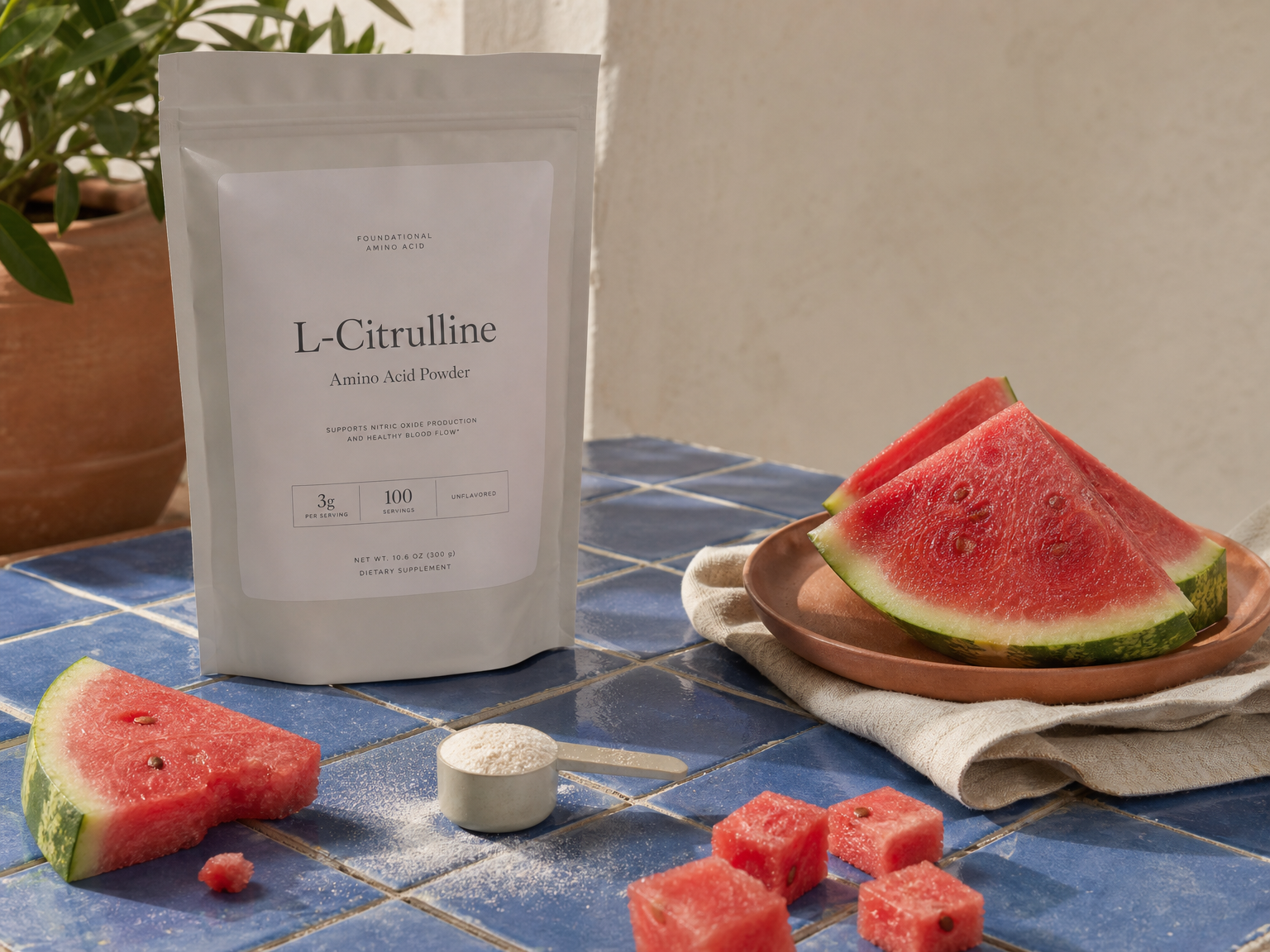

1. What is L-citrulline?
L-citrulline is an amino acid, but it is not mainly used to build muscle tissue directly in the way many protein-building amino acids are. Its main role is in several metabolic pathways that help the body manage waste products and support blood-flow signaling.
Your body makes L-citrulline, mostly in the small intestine. You also get small amounts from food. Watermelon is the best-known source, and it contains more citrulline than most common foods.
Because the body can make it, L-citrulline is described as “nonessential.” That term can sound misleading. It does not mean citrulline is unimportant; it means healthy people usually do not need to get it from food or supplements to prevent a classic deficiency disease.
2. What does the body use it for?
L-citrulline has two main jobs that are worth understanding.
First, it plays a role in the urea cycle. This is the system your body uses to turn excess nitrogen — a by-product of protein metabolism — into urea, which can then leave the body in urine. Put simply, citrulline helps your body safely deal with waste from amino acid metabolism.
Second, citrulline helps make L-arginine. The kidneys convert much of the body’s citrulline into arginine, and arginine can then be used to make nitric oxide. Nitric oxide is a signaling molecule that helps blood vessels relax, which is why citrulline is so often promoted for blood flow, exercise performance, and vascular health.
One reason citrulline is interesting is that it can raise blood arginine levels more reliably than taking arginine itself in some situations. Oral arginine is broken down more extensively before it reaches the bloodstream.
3. Is L-citrulline required — and can you be deficient?
For most healthy adults, L-citrulline is not considered a required dietary nutrient in the same way as vitamin C, iron, or essential amino acids. There is no common “L-citrulline deficiency” diagnosis caused simply by not eating enough watermelon or not taking a supplement.
Low citrulline levels can be medically important, but usually for different reasons. Very low or abnormal citrulline may be seen with rare inherited urea-cycle disorders, certain metabolic diseases, or serious intestinal disease in which the small intestine is not making citrulline normally. These are medical issues, not everyday supplement gaps.
So if someone feels tired, weak, or disappointed with their exercise performance, L-citrulline deficiency would not be the first assumption. More common factors — sleep, iron status, calorie intake, training load, medications, or blood pressure — should be looked at first.
4. What benefits may L-citrulline have?
The most plausible benefits come from citrulline’s ability to raise arginine and nitric oxide availability. That does not prove every claim, but it does explain why researchers have studied it.
- Exercise performance: Some studies suggest citrulline, especially citrulline malate, may modestly help with high-repetition resistance exercise, fatigue, or muscle soreness. Results are not consistent, and the benefits are not dramatic. It seems more promising for repeated hard efforts than for a single strength test or broad endurance performance.
- Blood flow and blood pressure: Because nitric oxide helps blood vessels relax, citrulline may slightly improve some markers of vascular function or blood pressure in certain groups. Evidence is mixed, and it should not replace prescribed treatment for high blood pressure.
- Erectile function: A small clinical study found that L-citrulline improved erection hardness in some men with mild erectile dysfunction. That is interesting, but the evidence is far less established than it is for approved erectile dysfunction medicines.
- Muscle gain and fat loss: These claims are common, but they are not strongly proven. Citrulline may help someone train a little harder in certain workouts, but that is not the same as directly causing major muscle gain or fat loss.
- Endurance sport: Claims of major endurance improvements are not well supported overall. Some studies show possible small effects in specific tests, while others show little or no benefit.
 The mechanism is plausible: citrulline can raise arginine and nitric oxide availability.
 Effects appear most relevant to repeated hard efforts, fatigue, and blood-flow-related goals.
 Results are mixed for blood pressure, endurance, muscle gain, fat loss, and sexual performance.
A practical way to think about L-citrulline is this: it may support some of the conditions around performance — blood flow, perceived fatigue, and repeated-effort capacity — but it is not a shortcut around training, nutrition, sleep, or recovery.

5. What foods contain L-citrulline?
Watermelon is the standout food source. NIH guidance notes that one cup of diced seedless watermelon contains about 365 mg of citrulline. The rind contains citrulline too, although most people do not eat much of it.
Other foods in the same broad plant family — such as cucumber, melon, pumpkin, squash, and gourds — can contain citrulline, but usually in smaller or more variable amounts.
The dose difference is worth keeping in mind. Supplement studies often use multi-gram doses, commonly several grams per day. Food usually provides citrulline in the hundreds of milligrams, not in the same range as typical sports supplement trials. Watermelon is healthy and hydrating, but eating it may not reproduce the effects of a concentrated supplement dose.
6. Supplement forms, dose and cautions
L-citrulline supplements usually come as either pure L-citrulline or citrulline malate. Citrulline malate combines citrulline with malic acid. Labels can be confusing: 1 gram of citrulline malate does not equal 1 gram of pure citrulline. According to NIH guidance, 1 gram of citrulline malate provides about 566 mg of citrulline.
Common research doses vary by purpose, but exercise studies often use several grams before training. Because products differ, check whether the label lists the amount of L-citrulline itself or the total citrulline malate blend.
L-citrulline appears to be generally well tolerated in short-term studies. The most common downside reported is mild digestive upset, such as stomach discomfort.
The main caution is blood pressure. Because citrulline may affect nitric oxide and blood vessel relaxation, it could add to the effects of blood-pressure-lowering medicines, nitrates, or erectile dysfunction drugs such as PDE-5 inhibitors. Anyone taking these should speak with a clinician before using citrulline.
People who are pregnant or breastfeeding, have kidney disease, have a diagnosed urea-cycle disorder, are preparing for surgery, or take regular medication should also check first. And as with all supplements, quality varies: choose products from reputable brands that use third-party testing where possible.