

 Deutsch
 Español
 Suomi
Suomi Français
 Bahasa Indonesia
 Italiano
 日本語
日本語 Português
 Tagalog
Summary
L-citrulline is a nonessential amino acid used to raise arginine and support nitric oxide, blood flow, and vascular function. It is sold as pure L-citrulline or as citrulline malate, and watermelon is the best-known food source. The biochemical rationale is strong because oral citrulline can raise arginine efficiently.
Human outcome data are more selective. Vascular support and modest blood-pressure effects look more promising than exercise performance, where controlled studies often show mixed or null results. Citrulline malate is not clearly superior to matched L-citrulline, food sources are much lower dose than study protocols, and label accuracy can materially affect what consumers actually get.
Quick Facts
What is it useful for?
It may support nitric-oxide-related blood flow, vascular function, and modest blood-pressure improvement. Exercise benefits are inconsistent.
Supplement types
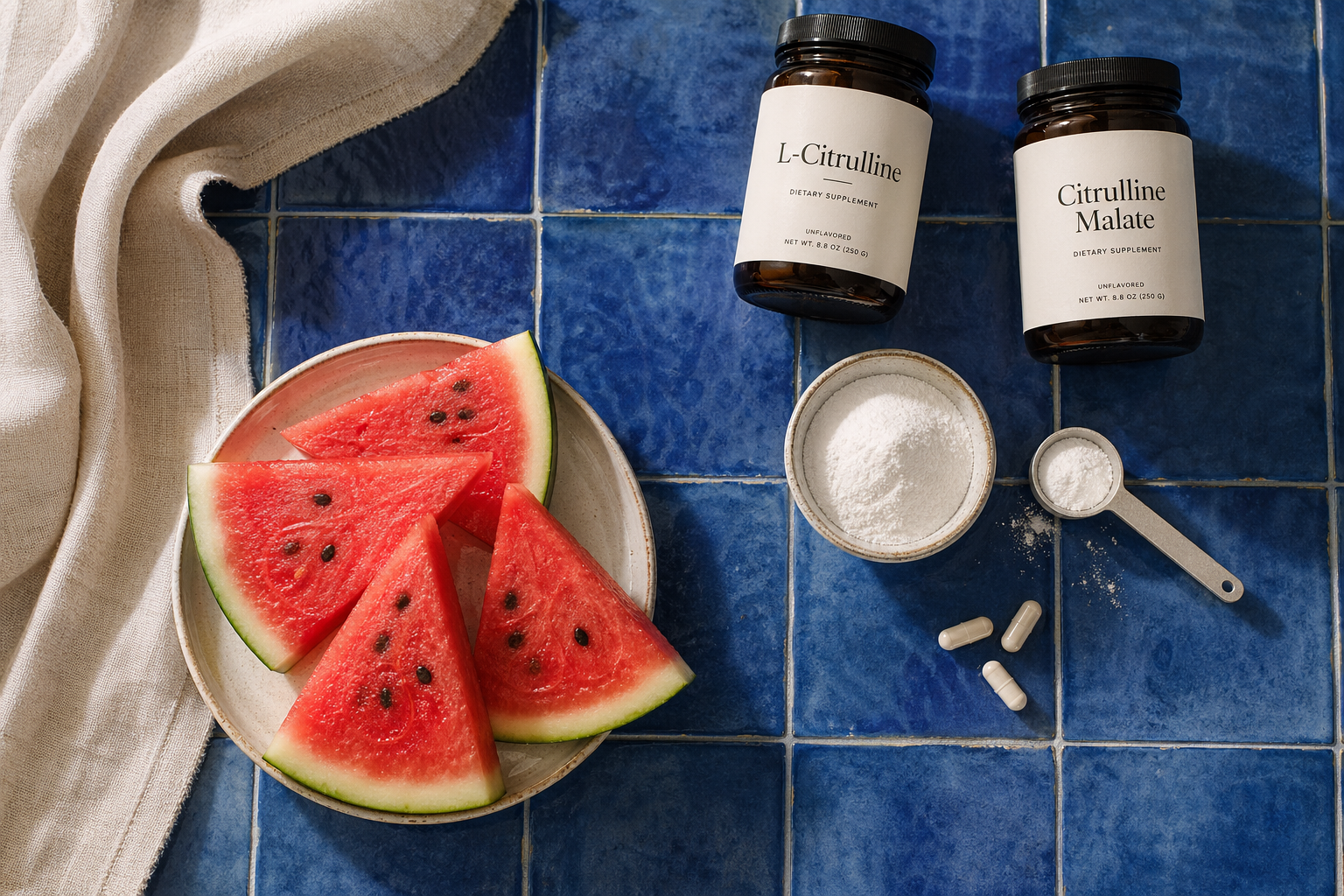
The main forms are pure L-citrulline and citrulline malate. Watermelon foods and extracts are lower-dose dietary sources.
Interactions
Additive vasodilation is plausible with arginine, beetroot or nitrate-rich products, antihypertensive drugs, nitrates, and PDE5 inhibitors.
Side effects
Short-term use is usually well tolerated. Gastrointestinal discomfort is the most likely dose-related complaint.
Other possible benefits
Small studies suggest possible support for vascular function, blood pressure, and mild erectile dysfunction, but these are not proven treatment effects.
Regulatory status
Sold as supplements in the U.S. and EU, but EFSA did not authorize a citrulline malate recovery claim and FDA does not pre-approve effectiveness.
What We Already Know About It
Arginine precursor. L-citrulline is mainly valued because it serves as a precursor to arginine, which the body uses to make nitric oxide, a signaling molecule involved in blood-vessel dilation and blood flow. Compared with oral arginine, citrulline appears to avoid more of the intestinal and liver metabolism that can limit direct arginine supplementation, so it can raise circulating arginine more efficiently in many settings. This biochemical advantage explains why citrulline has a strong rationale for vascular support and exercise-related use rather than being just another amino acid. (Moinard et al. — Pharmacokinetic and pharmacodynamic properties of oral L-citrulline and L-arginine; NIH ODS — Exercise and Athletic Performance Fact Sheet)
Form and dose context. Pure L-citrulline delivers a straightforward amino-acid dose, while citrulline malate combines citrulline with malic acid. Malate has a theoretical role in energy metabolism, but current evidence does not clearly show that citrulline malate outperforms matched pure L-citrulline. Watermelon is the best-known natural source, yet normal servings provide far less citrulline than the multi-gram amounts used in supplement studies. That helps explain why mechanism is clearer than outcomes: vascular effects appear more credible than broad exercise claims, and real-world results can depend heavily on actual dose, timing, and product composition. (Chappell et al. — Critical review of citrulline malate supplementation and exercise performance; USDA — Watermelon and citrulline report; NIH ODS — Exercise and Athletic Performance Fact Sheet)
Summary of Relevant Scientific Research
Oral citrulline raises arginine efficiently — Moinard et al.
In healthy adults, oral L-citrulline increased plasma arginine across repeated dosing schedules, supporting the idea that citrulline bypasses some of the intestinal and liver metabolism that limits oral arginine. This was mechanistic evidence rather than proof of better exercise or cardiovascular outcomes, but it strongly supports the basic rationale for citrulline supplementation. (Moinard et al. — Pharmacokinetic and pharmacodynamic properties of oral L-citrulline and L-arginine)
Vascular support looks more promising than broad cardiometabolic change — Schwedhelm et al., Figueroa et al., Bondonno et al.
Reviews and meta-analytic work conclude that citrulline is better positioned than oral arginine to raise arginine and nitric-oxide availability, and they report modest benefits for vascular function and blood pressure in some adults, especially those with elevated vascular risk. These sources do not support citrulline as a stand-alone treatment for hypertension or as a broad metabolic solution. (Schwedhelm et al. — L-citrulline Supplementation: Impact on Cardiometabolic Health; Figueroa et al. — Review on blood pressure effects of citrulline and watermelon; Bondonno et al. — Meta-analysis on L-citrulline and watermelon intake)
Exercise results remain mixed — Chappell et al., Gonzalez et al.
Critical review and controlled trial evidence challenges the idea that citrulline reliably improves acute resistance performance. Some studies report better repetitions or less fatigue, but several trials found little or no meaningful benefit for repetitions, force, power, velocity, soreness, swelling, or subjective energy. Review authors also highlighted major methodological inconsistency and uncertainty about real product composition. (Chappell et al. — Critical review of citrulline malate supplementation and exercise performance; Chappell et al. — German Volume Training trial and product analysis; Gonzalez et al. 2017 — Acute citrulline malate and resistance exercise; Gonzalez et al. 2023 — Resistance exercise performance trial)
Form comparison and higher-dose questions are still emerging — Martin-Olmedo et al., pilot work
A newer crossover study compared pure L-citrulline with citrulline malate at matched citrulline delivery, making it directly relevant to the “malate or not” question, but it is too early to claim clear superiority for either form. Separate pilot evidence suggests 12 g citrulline malate may outperform 8 g in some lower-body tasks, though this remains preliminary rather than standard practice. (Martin-Olmedo et al. — Head-to-head trial of L-citrulline and citrulline malate; Pilot study — Higher-dose citrulline malate in resistance exercise)
Sexual-health evidence is interesting but limited — Pérez-Guisado and Jakeman, Shirai et al.
Small human studies suggest possible benefit for mild erectile dysfunction. One pilot trial found improved erection hardness after one month of oral L-citrulline, and another small study reported improved scores when low-dose citrulline was combined with trans-resveratrol in men already using PDE5 inhibitors. These findings are promising but too limited to establish citrulline as a proven treatment. (Pérez-Guisado and Jakeman — L-citrulline supplementation in mild erectile dysfunction; Shirai et al. — L-citrulline plus trans-resveratrol in men using PDE5 inhibitors)
Beliefs, Myths & Unproven Claims
Citrulline malate is automatically better than pure L-citrulline
This is not currently proven. Malate has a theoretical role in energy metabolism, which helps explain the marketing appeal, but modern comparative evidence has not clearly shown that adding malate consistently improves performance when actual citrulline delivery is matched. In practical terms, the amount of citrulline delivered may matter more than the word “malate” on the front label. (Martin-Olmedo et al. — Head-to-head trial of L-citrulline and citrulline malate; Chappell et al. — Critical review of citrulline malate supplementation and exercise performance)
A 2:1 citrulline malate label guarantees the same dose used in research
That assumption is unreliable. Published product analysis found that some commercial products differed substantially from their claimed composition, which means an “8 g citrulline malate” serving may not deliver the amount of citrulline a buyer expects. This label uncertainty is one reason marketing claims and real-world outcomes do not always match study headlines. (Chappell et al. — German Volume Training trial and product analysis; NIH ODS — Exercise and Athletic Performance Fact Sheet)
Watermelon or citrulline is a proven treatment for sports performance, hypertension, or erectile dysfunction
The evidence does not support such broad claims. Watermelon is the best-known food source, but normal servings usually provide far less citrulline than supplement studies use. Small studies in blood pressure and erectile dysfunction are promising, yet they do not justify replacing standard medical care or assuming universal benefit. (NIH ODS — Exercise and Athletic Performance Fact Sheet; Figueroa et al. — Review on blood pressure effects of citrulline and watermelon; Pérez-Guisado and Jakeman — L-citrulline supplementation in mild erectile dysfunction)
Detailed Research Observations
Natural sources are real, but they are usually not dose-equivalent
Citrulline was originally identified in watermelon, and watermelon remains the best-known dietary source in both public-health and research summaries. USDA reporting also notes that the rind is a useful source, not only the red flesh, which matters because consumer discussions often focus only on the edible center of the fruit. The actual citrulline content can vary by cultivar, plant tissue, and processing method, so food content is not perfectly fixed from one product to another. (NIH ODS — Exercise and Athletic Performance Fact Sheet; USDA — Watermelon and citrulline report; Burton-Freeman et al. — Review of watermelon and cardiometabolic health)
The practical limitation is dose. A cup of diced seedless watermelon provides about 365 mg citrulline, which is far below the multi-gram amounts commonly used in supplement studies. That does not make food unhelpful; it simply means that watermelon and supplements serve different goals. Food intake may fit a general nutrition or vascular-support strategy, but normal servings are usually not realistic replacements for research-style pre-workout or clinical dosing unless concentrated products are used. (NIH ODS — Exercise and Athletic Performance Fact Sheet; Bondonno et al. — Meta-analysis on L-citrulline and watermelon intake; Burton-Freeman et al. — Review of watermelon and cardiometabolic health)
The main case for citrulline is pharmacokinetic, not promotional
The key scientific rationale for using citrulline instead of arginine is that oral arginine is partly limited by intestinal and liver metabolism, while citrulline is better able to reach circulation and then be converted to arginine, especially in the kidneys. Human dosing work showed that oral citrulline can meaningfully increase plasma arginine, which supports the nitric-oxide pathway more efficiently than taking arginine directly in many situations. This is why citrulline has a much stronger mechanistic foundation than many pre-workout ingredients marketed mainly on anecdote. (Moinard et al. — Pharmacokinetic and pharmacodynamic properties of oral L-citrulline and L-arginine; Schwedhelm et al. — L-citrulline Supplementation: Impact on Cardiometabolic Health; Mayo Clinic — L-arginine overview)
This mechanism does not automatically guarantee a dramatic “pump,” stronger workouts, or clinically meaningful blood-pressure improvement for every user. What it does establish is that citrulline has a plausible biochemical route to influencing blood flow. The difference between mechanism and outcome is important throughout the literature: raising arginine is fairly well supported, while turning that change into consistent exercise or treatment-level effects is much less certain. (Moinard et al. — Pharmacokinetic and pharmacodynamic properties of oral L-citrulline and L-arginine; NIH ODS — Exercise and Athletic Performance Fact Sheet)
Form names matter less than verified citrulline delivery
Pure L-citrulline gives a straightforward amino-acid dose. Citrulline malate combines citrulline with malic acid and is often promoted with ratios such as 2:1. The problem is that consumers can easily assume those ratio claims are both standardized and meaningful, yet the NIH ODS notes that standard citrulline malate is 56.64% citrulline by weight and that superiority claims for formats such as 2:1 or tri-citrulline malate are not established. That means two products with similar front-label language may not deliver the same amount of active citrulline. (NIH ODS — Exercise and Athletic Performance Fact Sheet; Chappell et al. — Critical review of citrulline malate supplementation and exercise performance)
Published chemical analysis adds a real-world warning to that issue. Some commercial products labeled as 2:1 citrulline malate did not match their claimed composition, which complicates both consumer decision-making and interpretation of positive versus negative trials. In other words, debates about whether malate adds value can be overshadowed by a more basic problem: buyers and even researchers may not always know the true citrulline content of the product being used. (Chappell et al. — German Volume Training trial and product analysis; Chappell et al. — Critical review of citrulline malate supplementation and exercise performance)
Vascular outcomes are the most credible benefit area
Across reviews and meta-analytic work, vascular function and modest blood-pressure reduction are the most consistently promising areas for citrulline. These effects appear most relevant in adults with prehypertension or broader cardiometabolic risk rather than in healthy young adults expecting noticeable everyday changes. The overall picture is not one of dramatic transformation, but of a potentially useful and biologically plausible effect size in selected populations. (Schwedhelm et al. — L-citrulline Supplementation: Impact on Cardiometabolic Health; Figueroa et al. — Review on blood pressure effects of citrulline and watermelon; Bondonno et al. — Meta-analysis on L-citrulline and watermelon intake)
These findings still have clear limits. The evidence does not support presenting citrulline as a replacement for prescribed blood-pressure medication, nor does it support sweeping claims about fat loss or broad cardiometabolic transformation. The most defensible interpretation is narrower: if someone asks where citrulline currently has its best human evidence, vascular support is a stronger answer than guaranteed athletic enhancement. (Figueroa et al. — Review on blood pressure effects of citrulline and watermelon; Bondonno et al. — Meta-analysis on L-citrulline and watermelon intake)
Exercise-performance findings are inconsistent for understandable reasons
Citrulline has become a standard pre-workout ingredient, but controlled trials do not show a simple or universally positive performance effect. Some studies suggest better repetitions or reduced fatigue, yet several randomized trials using doses close to the standard marketed range found no meaningful improvement in upper-body performance, muscle swelling, soreness, force, power, velocity, or oxygenation outcomes. This mixed picture is why exercise claims feel so contradictory in practice. (NIH ODS — Exercise and Athletic Performance Fact Sheet; Gonzalez et al. 2017 — Acute citrulline malate and resistance exercise; Gonzalez et al. 2023 — Resistance exercise performance trial)
Review authors argue that inconsistency is not random. Exercise protocols differ, training status differs, timing differs, and actual product composition may differ from what labels suggest. Emerging pilot work also raises the possibility that common doses such as 8 g citrulline malate may be too low in some settings, since 12 g showed better lower-body repetition results in preliminary work. The fairest reading is not that citrulline never works, but that its exercise effects appear context-dependent, modest, and much less reliable than marketing implies. (Chappell et al. — Critical review of citrulline malate supplementation and exercise performance; Chappell et al. — German Volume Training trial and product analysis; Pilot study — Higher-dose citrulline malate in resistance exercise)
Sexual-health potential exists, but the evidence base remains narrow
Citrulline is sometimes promoted for erectile dysfunction because nitric oxide is relevant to penile blood flow. There is some human evidence behind that concept: a small pilot trial in men with mild erectile dysfunction reported improved erection hardness after one month of oral L-citrulline, and another small crossover study found improved scores when low-dose citrulline was combined with trans-resveratrol in men already using PDE5 inhibitors. These are signal-generating findings rather than proof of a standard therapy. (Pérez-Guisado and Jakeman — L-citrulline supplementation in mild erectile dysfunction; Shirai et al. — L-citrulline plus trans-resveratrol in men using PDE5 inhibitors)
The main reasons for caution are sample size, population selection, and study design. The studies are small, one used a combination product rather than citrulline alone, and the broader evidence base is still limited. That makes the area promising but not established, especially if compared with approved medical treatments. (Pérez-Guisado and Jakeman — L-citrulline supplementation in mild erectile dysfunction; Shirai et al. — L-citrulline plus trans-resveratrol in men using PDE5 inhibitors)
Safety and regulation are shaped as much by evidence gaps as by known harms
Short-term tolerability in studied adults appears generally good, with gastrointestinal discomfort being the most plausible recurring side effect at larger doses. The larger uncertainties are long-term high-dose safety, use in pregnancy and breastfeeding, pediatric use, and product standardization. Those gaps matter because supplements can reach the market even when long-term evidence is incomplete. (NIH ODS — Exercise and Athletic Performance Fact Sheet; AESAN Scientific Committee — Safety assessment of citrulline in food supplements)
From a regulatory standpoint, the ingredient is sold in both the U.S. and Europe, but the legal environment does not amount to proof of effectiveness. In the U.S., FDA does not pre-approve dietary supplements for effectiveness before sale. In the EU, health claims require authorization, and EFSA gave an unfavorable opinion on a citrulline malate claim for faster recovery from muscle fatigue. The result is a market where availability is broad, but the strongest legal and scientific support is narrower than much of the marketing language suggests. (FDA — FDA 101: Dietary Supplements; EFSA — Opinion on citrulline malate and recovery from muscle fatigue)
Regulatory Status (EU and US)
European Union
In the EU, supplements can be sold without every marketing statement being an authorized health claim. Health claims must be scientifically substantiated within the EU framework and register. For citrulline malate specifically, EFSA reached an unfavorable conclusion on a claim related to faster recovery from muscle fatigue after exercise, which means that kind of claim does not have the backing required for authorized use. (EFSA — Opinion on citrulline malate and recovery from muscle fatigue; European Commission — Nutrition and health claims framework; European Commission — EU Register of nutrition and health claims)
United States
In the U.S., L-citrulline products are generally marketed as dietary supplements. FDA does not pre-approve most supplements for safety or effectiveness before sale. Companies may use structure/function claims if they are truthful and not misleading, but claims to diagnose, treat, cure, or prevent disease would move a product into drug territory. In practical terms, citrulline is widely sold in both regions, but availability should not be confused with approved proof for recovery, hypertension, erectile dysfunction, or exercise performance. (FDA — FDA 101: Dietary Supplements; FDA — Structure/function claims)
Dosage and Standardization
Studied ranges: Pure L-citrulline is commonly used at 3–6 g/day for vascular studies and 6–8 g acutely for exercise.
Citrulline malate: 8 g about 40–60 minutes before exercise is common; 12 g remains preliminary, and food sources are far lower dose.
Safety And Interactions
Short-term safety in studied adults appears generally good. The most likely adverse effect is gastrointestinal discomfort, especially with larger acute doses. Serious toxicity has not been a recurring finding at commonly studied doses, but that should not be treated as proof of long-term high-dose safety. (NIH ODS — Exercise and Athletic Performance Fact Sheet; AESAN Scientific Committee — Safety assessment of citrulline in food supplements)
Interaction concerns are plausible because citrulline can support nitric-oxide-mediated vasodilation. Additive blood-pressure lowering may occur with antihypertensive drugs, nitrates, PDE5 inhibitors, and other vasodilatory supplements such as arginine or nitrate-rich products. The evidence for these interactions is based more on mechanism and limited human context than on large direct safety trials. (Schwedhelm et al. — L-citrulline Supplementation: Impact on Cardiometabolic Health; Shirai et al. — L-citrulline plus trans-resveratrol in men using PDE5 inhibitors; Mayo Clinic — L-arginine overview)
The biggest evidence gaps concern pregnancy, breastfeeding, pediatric use, and long-term supplementation. People with complex cardiovascular disease, very low blood pressure, or significant kidney or liver issues should be cautious, and conservative guidance is appropriate unless use is supervised by a clinician. (AESAN Scientific Committee — Safety assessment of citrulline in food supplements; NIH ODS — Exercise and Athletic Performance Fact Sheet)
Conclusion
L-citrulline and citrulline malate have a credible biochemical rationale and some human evidence behind them. The best-established point is that citrulline raises arginine efficiently and therefore makes sense as a nitric-oxide-related nutrient. From there, the evidence becomes more selective: vascular function and modest blood-pressure support are the most promising benefit areas, while exercise-performance claims are much less dependable.
For most readers, the key practical lesson is to focus less on form names and more on dose delivery, label accuracy, and realistic expectations. Watermelon is a meaningful food source, but normal servings do not usually match study doses. Overall, the evidence is moderate for mechanism, modest for vascular benefits, mixed for exercise, and limited for erectile-function support.
Disclaimer
Disclaimer: We attempt to do our best to find relevant, accurate and most up to date information available in both, the public domain and in the clinical and medical research community. We recommend reviewing scientific sources for official information on the subject. This post is not intended as medical advice. Each individual person's health conditions vary and we advise to consult a doctor before taking any supplements.