

 Deutsch
 Español
 Suomi
Suomi Français
 Bahasa Indonesia
 Italiano
 日本語
日本語 Português
 Tagalog
Summary
Beta-alanine is a non-essential, non-protein-forming amino acid used mainly to raise muscle carnosine, a compound that helps buffer acidity during hard exercise. Because this effect depends on repeated loading, beta-alanine is not an instant stimulant or classic pre-workout boost.
The best evidence supports small performance benefits in some high-intensity efforts lasting about 1 to 4 minutes after several weeks of daily use. Evidence is much weaker or inconsistent for pure strength, repeated sprint ability, longer endurance, and body-composition change. Supplements provide free beta-alanine in a more concentrated and predictable form than food, and the main downside is temporary tingling, especially with larger single doses.
Quick Facts
What is it useful for?
Evidence best supports a modest improvement in some high-intensity efforts lasting about 1 to 4 minutes after several weeks of loading, not as an acute pre-workout boost.
Supplement types
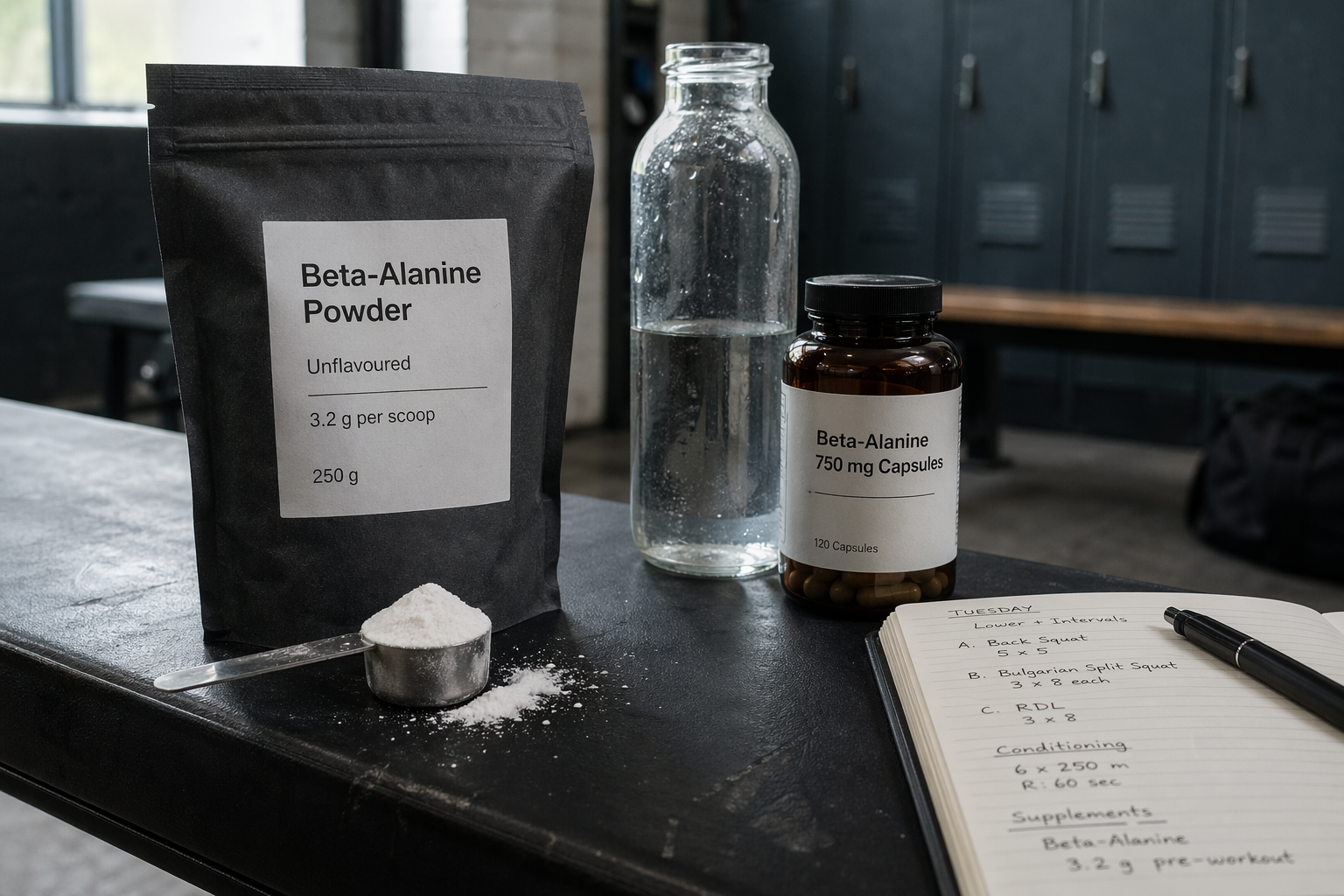
Most products contain free beta-alanine in powder or capsules. Sustained-release tablets or controlled-release powders are mainly used to reduce tingling and alter absorption.
Interactions
Documented interactions are limited. A theoretical concern about taurine competition has not appeared important at typical human doses, but evidence remains sparse.
Side effects
The main side effect is temporary paresthesia, often felt as tingling or prickling, especially with larger single doses or faster-absorbing products.
Other possible benefits
Early research suggests possible benefits for exercise capacity in some older adults and increased muscle carnosine in COPD, but these uses remain preliminary.
Regulatory status
In the US it is sold as a dietary supplement amino acid. In the EU, beta-alanine does not have authorised performance health claims.
What We Already Know About It
Core mechanism. Beta-alanine is a non-protein-forming amino acid and the rate-limiting precursor to carnosine in skeletal muscle. Carnosine helps buffer hydrogen ions that build up during hard exercise, which can delay the drop in muscle pH associated with fatigue. Repeated supplementation reliably raises muscle carnosine, and cumulative intake over time appears more important than any single large serving. That is why beta-alanine is best understood as a loading supplement rather than an immediate-performance ingredient. (NIH ODS — Exercise and Athletic Performance Fact Sheet; Frontiers in Physiology — Muscle Carnosine Response Review; ISSN Position Stand on Beta-Alanine)
Performance translation. The buffering mechanism fits best with high-intensity exercise lasting roughly 60 to 240 seconds, where acidity can be a meaningful limiter. Evidence is therefore strongest for modest benefits in some efforts in that range. Results are weaker or inconsistent for maximal strength, very short sprint efforts, repeated sprint ability, VO2max, longer endurance work, and body-composition outcomes. In practice, the physiology is well supported, but the real-world performance benefit is narrower than broad supplement marketing often suggests. (PubMed Central — Beta-Alanine Meta-Analysis; PubMed Central — Aerobic–Anaerobic Transition Review; PubMed — Body Composition Review; PubMed Central — Repeated Sprint Ability Meta-Analysis)
Summary of Relevant Scientific Research
Raises Muscle Carnosine Through Loading — NIH Office of Dietary Supplements
The NIH evidence summary describes beta-alanine as the rate-limiting precursor to skeletal-muscle carnosine and notes that food intake is usually low. It also explains that free beta-alanine, rather than oral carnosine, is the practical way to raise muscle carnosine, so the supplement works through repeated loading rather than an acute effect. (NIH ODS — Exercise and Athletic Performance Fact Sheet)
Best Results in 60–240 Second Efforts — Meta-analysis
A classic meta-analysis pooling 15 manuscripts found an overall improvement versus placebo, with the clearest benefit in exercise lasting 60 to 240 seconds. It also reported no benefit for efforts under 60 seconds, which sharply narrows the performance context where beta-alanine seems most useful. (PubMed Central — Effects of Beta-Alanine Supplementation on Exercise Performance)
Limited Transfer to Endurance Outcomes — Systematic review and meta-analysis
A later review focused on aerobic–anaerobic transition zones found trivial, non-significant effects on absolute VO2max and limited support for endurance-type outcomes. This suggests that improved buffering in muscle does not automatically translate into better aerobic capacity or broad endurance gains. (PubMed Central — Aerobic–Anaerobic Transition Review)
No Direct Body-Composition Effect — GRADE-assessed review
A systematic review found no meaningful effect on body mass, fat mass, body-fat percentage, or fat-free mass, regardless of dose, duration, or whether exercise was included. That places a clear limit on claims that beta-alanine directly builds muscle or burns fat. (PubMed — Body Composition Systematic Review)
Preliminary Signals Beyond Young Athletes — Older adults review and COPD trial
Small studies in older adults suggest possible improvements in exercise capacity, but not muscle strength or functional performance. A COPD trial using 3.2 g/day for 12 weeks also increased muscle carnosine, supporting the mechanism outside sport while still leaving these uses preliminary. (Fisiología del Ejercicio — Older Adults Review; PubMed — COPD Muscle Carnosine Trial)
Beliefs, Myths & Unproven Claims
It Works Like Caffeine
Beta-alanine is often included in pre-workouts, but it is not a stimulant and does not provide an immediate psychoactive boost. Its main effect depends on raising muscle carnosine over days to weeks, so a one-off pre-workout serving is not the core use case. (ISSN Position Stand on Beta-Alanine)
You Need the Tingles for It to Work
The evidence does not support tingling as a marker of effectiveness. Paresthesia mainly reflects single-dose size and absorption rate, while the real driver of muscle carnosine loading is cumulative intake over time. (Frontiers in Physiology — Muscle Carnosine Response Review; ISSN Position Stand on Beta-Alanine)
It Helps Every Kind of Training
Beta-alanine is not a universal performance enhancer for all sprint, HIIT, endurance, and strength formats. Evidence is strongest only for some high-intensity efforts in the 1 to 4 minute range, while findings are weak, trivial, or negative for repeated sprint ability, VO2max, pure strength, and body composition. (PubMed Central — Beta-Alanine Meta-Analysis; PubMed Central — Aerobic–Anaerobic Transition Review; PubMed — Body Composition Review; PubMed Central — Repeated Sprint Ability Meta-Analysis)
Eating More Meat Is the Same as Supplementing
Animal foods can contribute some background beta-alanine exposure, mainly through carnosine and related dipeptides, but they do not raise muscle carnosine as predictably or as rapidly as supplemental free beta-alanine. Beta-alanine is also not an essential nutrient with a standard deficiency state in healthy people. (NIH ODS — Exercise and Athletic Performance Fact Sheet; PubMed Central — Review on Food Sources and Beta-Alanine)
Detailed Research Observations
Physiology, Nutrient Status, and Why Supplements Differ From Food
Beta-alanine is a non-essential, non-protein-forming amino acid whose main relevance is that it combines with histidine to form carnosine. In skeletal muscle, carnosine acts as an intracellular buffer, helping manage the rise in hydrogen ions during hard exercise. This is why beta-alanine is better understood as a targeted functional amino acid for sports nutrition than as a classic nutrient with deficiency symptoms in healthy people. Humans can synthesize it endogenously, and there is no widely recognised beta-alanine deficiency state in routine nutrition practice. (NIH ODS — Exercise and Athletic Performance Fact Sheet; ISSN Position Stand on Beta-Alanine; AESAN — Beta-Alanine Food Supplements Assessment)
Food provides some background exposure, mainly through animal foods such as meat, poultry, and fish, but much of that intake comes as carnosine and related dipeptides rather than large amounts of free beta-alanine. The NIH notes that intake may range from essentially none in vegans to about 1 g/day in heavy meat eaters. Supplements differ because they provide free beta-alanine in concentrated, predictable doses that are designed to create a loading effect over time. Oral carnosine itself is not considered an efficient substitute when the goal is to raise muscle carnosine, which is why a steak and a beta-alanine protocol are not interchangeable in practice. (NIH ODS — Exercise and Athletic Performance Fact Sheet; PubMed Central — Review on Food Sources and Beta-Alanine; Frontiers in Physiology — Muscle Carnosine Response Review)
The Best-Supported Performance Window Is Narrower Than Marketing Suggests
The strongest performance support is for modest improvements in exercise tasks lasting roughly 60 to 240 seconds. This duration fits the physiology well because it is long enough for intracellular buffering to matter, but not so long that aerobic capacity becomes the main limiter. The classic meta-analysis found an overall positive effect versus placebo with the clearest benefit in that mid-duration high-intensity range, and the ISSN position stand reaches a similar practical conclusion. Even then, the gains are generally modest rather than transformative. Beta-alanine looks more like a marginal optimizer for the right event demands than a must-have supplement for everyone who trains. (PubMed Central — Effects of Beta-Alanine Supplementation on Exercise Performance; ISSN Position Stand on Beta-Alanine)
The limits are just as important. Beta-alanine does not appear to help very short efforts under about 60 seconds, where phosphagen supply and neuromuscular factors dominate. More recent evidence also does not support a clear benefit for repeated sprint ability. For endurance-type outcomes, the evidence is weak, with trivial and non-significant effects on VO2max, and current meta-analysis data do not support it as a direct fat-loss or muscle-building supplement. Exercise context still matters, and some intermittent protocols such as specific Yo-Yo level-2 formats may respond, but the broader pattern is that results are sport-specific rather than universal. (PubMed Central — Beta-Alanine Meta-Analysis; PubMed Central — Repeated Sprint Ability Meta-Analysis; PubMed Central — Aerobic–Anaerobic Transition Review; PubMed — Body Composition Review; PubMed — Yo-Yo Test Meta-Analysis)
Forms, Release Profiles, and the Meaning of the Tingles
Most consumer products use plain free beta-alanine in powder, capsule, or tablet form, but sustained-release and controlled-release versions are also sold. The best-supported practical difference between these forms is tolerability. Dividing doses or using slower-release products can reduce paresthesia, the familiar tingling or prickling sensation associated with larger single doses. Some formulation studies also suggest differences in acute bioavailability, and one sustained-release high-dose protocol accelerated loading while reducing tingling. Even so, there is little proof that premium forms provide clearly superior long-term performance outcomes for typical users. (PubMed — Sustained-Release High-Dose Study; Pharmaceutics — Controlled-Release Beta-Alanine Study; ISSN Position Stand on Beta-Alanine)
The common consumer shortcut is to treat tingling as proof that a product is strong or working better. The evidence does not support that. Paresthesia is driven mainly by how quickly beta-alanine reaches circulation in a single dose, whereas the key driver of muscle carnosine loading is cumulative intake over time. In practical terms, a lower-tingle product or a divided-dose plan can still work well if it helps the user stick with a loading strategy. The absence of tingling therefore does not mean the supplement is ineffective. (Frontiers in Physiology — Muscle Carnosine Response Review; Pharmaceutics — Controlled-Release Beta-Alanine Study; VKM — Beta-Alanine Risk Assessment)
Emerging Uses, Dosing Nuance, and the Main Evidence Gaps
Outside sports, the evidence is still emerging rather than established. A review in older adults found that daily doses around 2.4 to 3.2 g for 10 to 12 weeks may improve exercise capacity in some cases, but not muscle strength or functional performance. In a COPD trial, 3.2 g/day for 12 weeks significantly increased muscle carnosine. These results support the underlying mechanism beyond young athletes, but they do not yet justify routine clinical use. They are best seen as promising preliminary applications rather than broad therapeutic indications. (Fisiología del Ejercicio — Older Adults Review; PubMed — COPD Muscle Carnosine Trial)
Dosing logic is cumulative, not acute. For healthy adults using beta-alanine for exercise performance, the best-supported range is about 4 to 6 g/day for at least 2 to 4 weeks, usually in divided servings to reduce tingling. A single scoop before one workout is unlikely to do much on its own. One maintenance study reported that about 1.2 g/day could help preserve moderately elevated muscle carnosine after a loading phase, but long-term safety beyond usual study windows remains relatively limited. Evidence is also inadequate for children, pregnancy, and breastfeeding, and formal interaction data remain sparse, so caution is still warranted outside the healthy adult sports context. (ISSN Position Stand on Beta-Alanine; NIH ODS — Exercise and Athletic Performance Fact Sheet; PubMed — Maintenance Dose Study; PubMed Central — Sustained-Release Safety Study; VKM — Beta-Alanine Risk Assessment)
Regulatory Status (EU and US)
United States
In the US, beta-alanine fits the dietary-supplement framework as an amino acid. It can be sold as a dietary ingredient without the kind of premarket efficacy approval required for drugs, but companies cannot legally market it as a treatment or cure for disease. Product quality, claims, and labelling remain the responsibility of manufacturers within the broader supplement system. (FDA — Dietary Supplement Ingredients)
European Union
In the EU, the key issue is health claims. EFSA issued negative opinions on beta-alanine claims related to short-duration high-intensity performance, time to exhaustion, and increased muscle carnosine stores, meaning these are not authorised EU health claims. National assessments add practical context: Spain's AESAN treated paresthesia as the main real-world precaution, and Norway's VKM suggested a symptom-avoidance benchmark of about 5 mg/kg per intake, though that is not an EU-wide legal cap. (EFSA Journal — 2010 Beta-Alanine Opinion; EFSA Journal — 2014 Beta-Alanine Opinion; AESAN — Beta-Alanine Food Supplements Assessment; VKM — Beta-Alanine Risk Assessment)
Dosage and Standardization
Healthy adults: 4 to 6 g/day for at least 2 to 4 weeks, usually split into doses of about 1.6 g to reduce tingling.
Other studied uses: 2.4 to 3.2 g/day in older adults and COPD; about 1.2 g/day has been studied for maintenance after loading.
Safety And Interactions
Main side effect: The best-established safety issue is transient paresthesia, described as tingling, prickling, pins-and-needles, or a flushing-like skin sensation. It is usually mild, tends to occur with larger single doses or faster absorption, and is generally considered unpleasant rather than harmful. Dividing the daily dose or using a sustained-release product can reduce symptoms.
Organ safety: Available human data are reassuring in the short term, with no clinically meaningful liver, kidney, or lipid problems identified over study periods, but very long-term safety is still not fully settled.
Interactions: Formal interaction data are limited. A theoretical concern about taurine transport competition has not appeared important at typical human doses, but the lack of documented interactions does not prove there are none. Extra caution is sensible in pregnancy, breastfeeding, childhood, older age, medical complexity, or when combining multiple supplements or medications.
Conclusion
Beta-alanine is best understood as a targeted sports-nutrition amino acid, not a general wellness nutrient or an all-purpose pre-workout booster. The strongest science shows that it reliably raises muscle carnosine and may modestly improve some high-intensity efforts lasting roughly 1 to 4 minutes when taken daily over several weeks. That is a real effect, but it is narrower than marketing often suggests.
For most readers, the practical takeaway is straightforward: beta-alanine can make sense for specific training goals, especially if workouts involve sustained high-intensity efforts, but it is not essential, not acute-acting, and not magic. Food from animal sources contributes some background intake, yet supplements provide free beta-alanine in far more useful amounts for loading muscle carnosine. Typical dosing is 4 to 6 g/day in divided doses, with temporary tingling as the main side effect. More research is still needed on long-term safety, special populations, and non-sport clinical uses, and European readers should note that performance claims are not authorised by EFSA.
Disclaimer
Disclaimer: We attempt to do our best to find relevant, accurate and most up to date information available in both, the public domain and in the clinical and medical research community. We recommend reviewing scientific sources for official information on the subject. This post is not intended as medical advice. Each individual person's health conditions vary and we advise to consult a doctor before taking any supplements.