

 Deutsch
 Español
 Suomi
Suomi Français
 Bahasa Indonesia
 Italiano
 日本語
日本語 Português
 Tagalog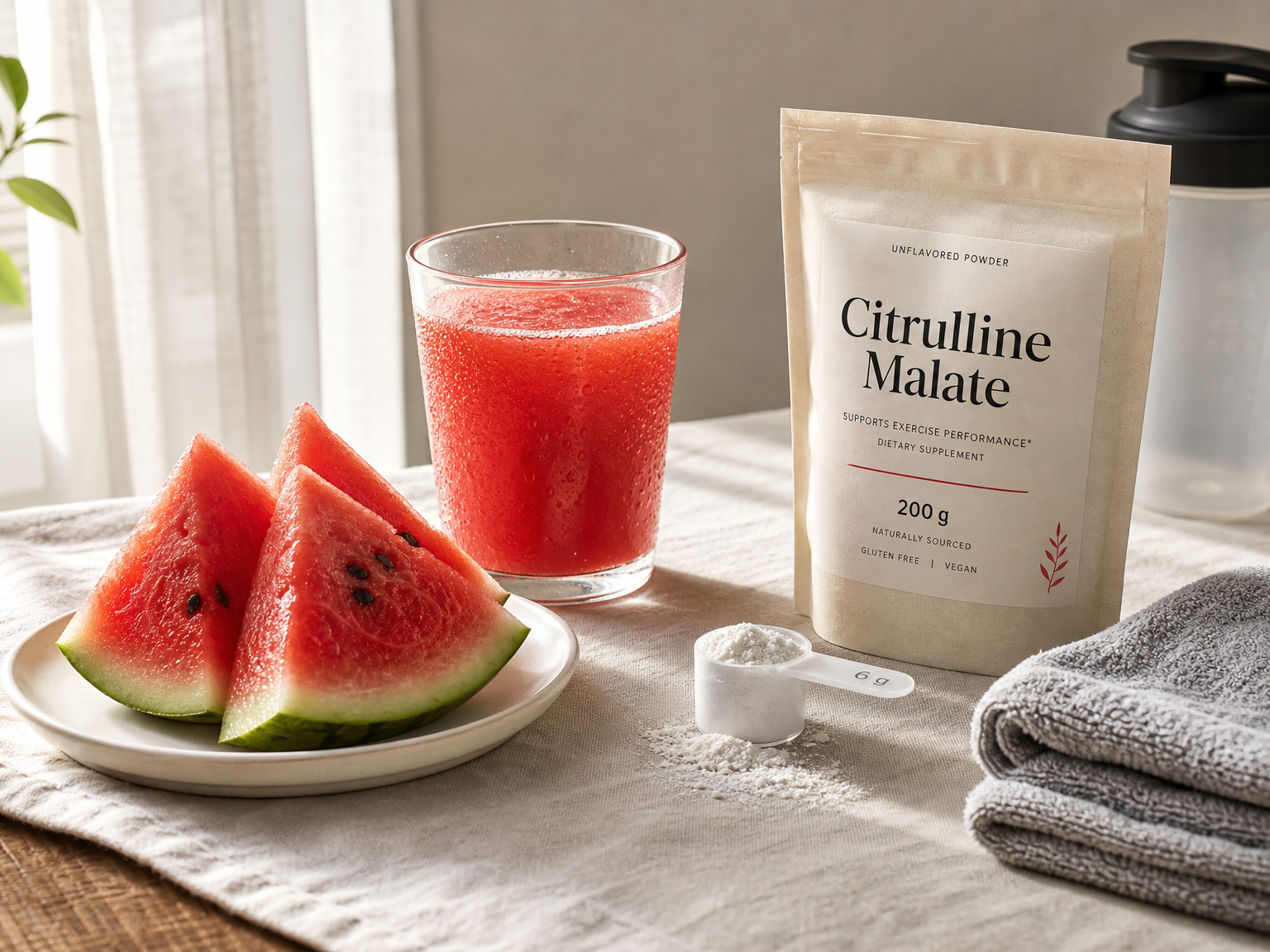

1. What is citrulline malate?
Citrulline malate is a common sports supplement, especially in pre-workout powders. It combines two substances:
- L-citrulline: a nonessential amino acid, meaning your body can make it on its own.
- Malate: a form of malic acid, a compound involved in normal energy-producing pathways.
L-citrulline is a little different from many amino acids because it is not one of the main building blocks used to make body proteins. It acts more like a metabolic helper. It plays a role in the urea cycle, which helps the body deal with ammonia, and it also feeds into the pathway that helps make arginine and nitric oxide.
That is why citrulline malate is often promoted for “pump,” blood flow and workout performance. The idea makes biological sense. The more useful question is whether taking extra citrulline malate reliably leads to meaningful benefits in real people. So far, the answer is: sometimes, modestly, and not for everyone.

2. Is citrulline malate required by the body?
No — not as a food supplement.
Your body does use citrulline-related metabolism, but it does not need you to eat or supplement with citrulline malate. Citrulline is made mainly in the intestine, then carried to the kidneys, where much of it is converted into arginine. Arginine can then be used to make nitric oxide, a molecule that helps blood vessels relax and widen.
The key distinction is that “used by the body” does not mean “must be taken as a supplement.” Vitamin C, for example, has to come from food. Citrulline does not work that way. It is considered nonessential because the body can produce it.
There is also no recognized everyday “citrulline malate deficiency” caused simply by not eating enough citrulline-rich foods. Low blood citrulline can occur in certain medical situations, such as intestinal disease, reduced intestinal cell mass, or rare urea-cycle disorders. In those cases, low citrulline is usually a sign of an underlying health problem, not a typical nutrition gap that most adults need to correct with a pre-workout supplement.
3. How it may work
The main pathway is fairly simple:
- You take citrulline.
- The kidneys convert much of it into arginine.
- Arginine can help produce nitric oxide.
- Nitric oxide helps blood vessels relax, which may improve blood flow.
In theory, better blood flow could help deliver oxygen and nutrients to working muscles and clear some by-products of hard exercise. Citrulline also sits close to the urea cycle, which is one reason it is sometimes discussed in relation to fatigue and ammonia handling.
Malate is included because it is connected to energy metabolism. However, human research has not clearly shown that the malate portion adds a separate, meaningful benefit beyond citrulline itself. Labels also vary, and the amount of actual citrulline in “citrulline malate” depends on the product.
4. What the evidence says about benefits
For exercise performance, the research is mixed. Many studies have used about 8 grams of citrulline malate around 45–60 minutes before training, often in strength or high-intensity exercise settings. A recent systematic review found a small overall performance benefit, especially with acute single-dose use, but the certainty of evidence was low to very low. The effect was not large, and it did not show up consistently across all outcomes.
 Exercise performance may improve slightly in some settings, but it is not a reliable game-changer.
 Muscle fatigue and recovery claims are common, but they are not strongly proven.
 Blood-flow and vascular effects are possible, but studies are small and effects are modest.
A fair summary is:
- Exercise performance: possible small benefit in some settings, but not a reliable game-changer.
- Muscle fatigue and recovery: commonly claimed, but not strongly proven. European regulators have not accepted citrulline malate recovery claims as well substantiated.
- Blood flow and blood pressure: L-citrulline may modestly lower blood pressure in some studies, but it should not be treated as a blood pressure medicine.
- Vascular function: early evidence suggests possible improvements in markers such as flow-mediated dilation, especially in middle-aged or older adults, but studies are small.
- Erectile function: one small study found L-citrulline helped some men with mild erectile dysfunction, but it was short, small and used L-citrulline rather than citrulline malate.
So the strongest claim is not that citrulline malate dramatically “boosts performance.” It is that citrulline can affect nitric oxide and blood flow, and that may translate into modest benefits for some people in some situations.
5. Food sources of citrulline
Watermelon is the best-known food source. The NIH notes that one cup of diced seedless watermelon provides about 365 mg of citrulline. Research reviews also report that watermelon contains citrulline in both the flesh and rind, with the rind sometimes containing as much or more than the sweet red flesh.
Food amounts, however, are much smaller than supplement amounts. A typical supplement serving may provide grams of citrulline malate, while a serving of watermelon provides hundreds of milligrams of citrulline. Watermelon can be an enjoyable dietary source, but it is not a simple one-to-one replacement for the doses used in sports supplement trials.
It is also worth noting that you do not need to “chase” citrulline from food for basic health. For most people, a varied diet and normal body production cover what is needed for everyday metabolism.
6. Practical considerations and cautions
Citrulline malate appears fairly well tolerated in short-term studies, but “well tolerated” does not mean risk-free. Stomach discomfort is the most common issue reported. In one 8 gram citrulline malate lifting study noted by the NIH, several users reported stomach discomfort.
Be more cautious if you:
- Take blood pressure medication, nitrates, vasodilators or erectile dysfunction medication.
- Have low blood pressure or a history of fainting.
- Have kidney disease, significant liver disease or a urea-cycle disorder.
- Are pregnant, breastfeeding or buying it for a teenager.
- Use multi-ingredient pre-workouts, where caffeine and other stimulants may be the bigger issue.
Because citrulline may widen blood vessels and affect blood pressure, it is worth getting medical advice before combining it with medications that have similar effects. Supplement quality also varies, so look for products with clear labelling and, where possible, third-party testing.