

 Deutsch
 Español
 Suomi
Suomi Français
 Bahasa Indonesia
 Italiano
 日本語
日本語 Português
 Tagalog
Summary
Caffeine is a stimulant bioactive compound found naturally in coffee, tea, cacao, guarana, yerba mate, and kola nut, and it is also sold in foods, drinks, and supplements. It is not an essential nutrient, so there is no dietary requirement for it.
The strongest evidence supports improved alertness, reduced sleepiness, and better exercise performance, especially for endurance activity. Benefits for attention and reaction time are more reliable than benefits for memory or complex thinking. Product form matters: capsules and tablets usually offer the most precise dosing, gum may act faster, and pure powders or highly concentrated products carry the greatest overdose risk.
Quick Facts
What is it useful for?
Caffeine is mainly useful for improving alertness, reducing sleepiness, and supporting exercise performance in many adults.
Supplement types
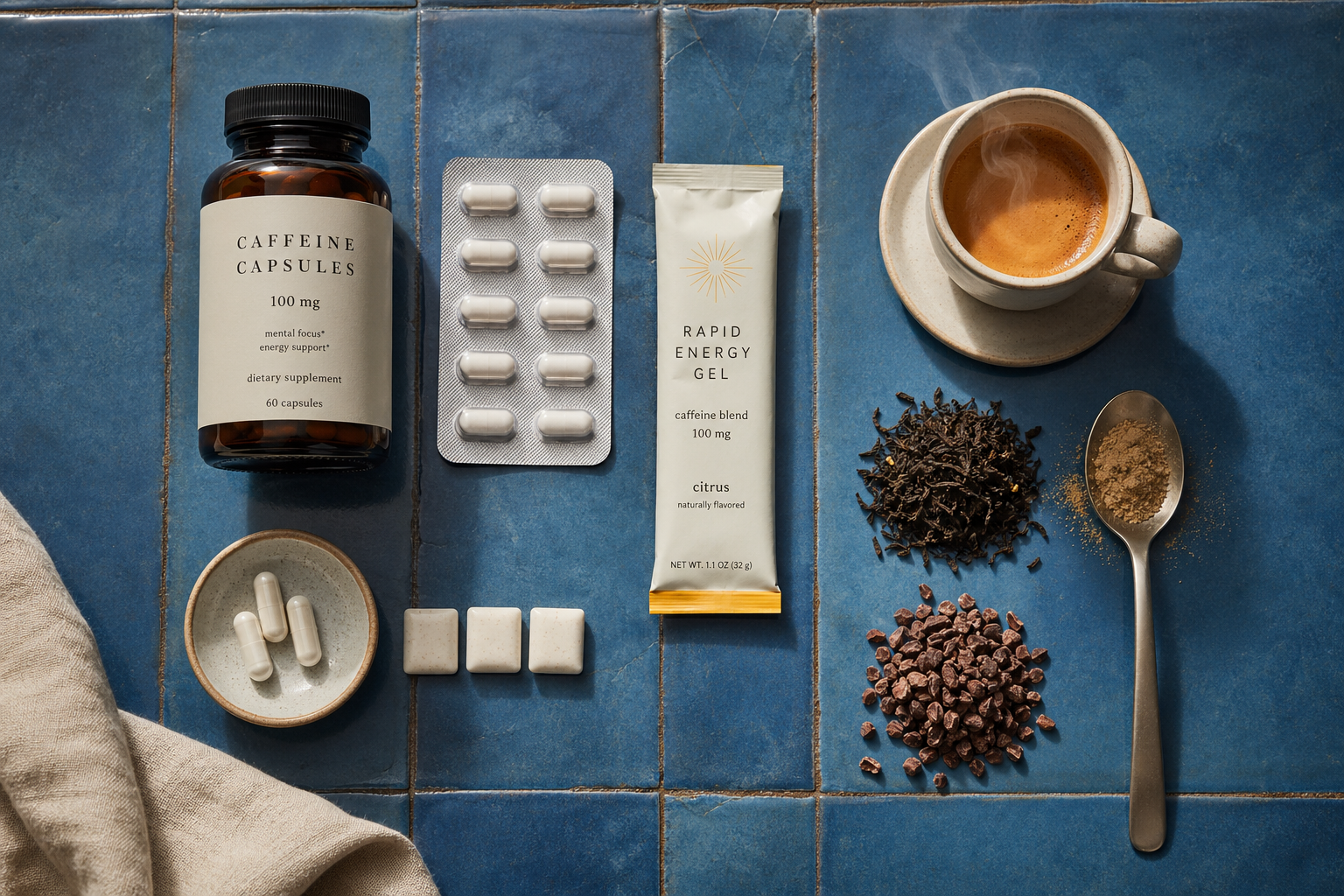
Common forms include capsules, tablets, drinks, gum, gels, powders, chews, and extended-release products.
Interactions
Caffeine can add to stimulant effects from other ingredients and may interact with stimulant drugs, some antibiotics, certain asthma medicines, and some heart medicines.
Side effects
Reported side effects include jitteriness, anxiety, palpitations, stomach upset, and sleep disruption, especially at higher doses or later in the day.
Other possible benefits
Caffeine may modestly improve reaction time and can slightly enhance pain relief when combined with common analgesics.
Regulatory status
In the EU and US, caffeine is allowed in foods and supplements, but safety limits, labeling rules, and health-claim restrictions still apply.
What We Already Know About It
Wakefulness mechanism. The strongest established evidence for caffeine is in alertness, reduced sleepiness, and acute exercise performance. It works mainly by blocking adenosine receptors, which reduces perceived fatigue and promotes wakefulness. That mechanism matches the consistent human findings that modest amounts can improve vigilance, attention, and reaction time, while not reliably enhancing every area of cognition. EFSA Journal — Caffeine and increased alertness; PubMed — Review of caffeine's cognitive and physical effects
Performance support. In sport, caffeine is one of the better-supported ergogenic aids. Major sports nutrition summaries describe benefits most often at about 2 to 6 mg/kg before exercise, with 3 to 6 mg/kg being the most studied range. Endurance performance appears to be the most consistently supported outcome, although effects vary by person, task, and training context. NIH ODS — Exercise and athletic performance fact sheet; PubMed — ISSN position stand on caffeine and exercise
Not an essential nutrient. Official consumer and institutional sources state that caffeine is not nutritionally required and can be omitted from the diet entirely. In practical terms, it is better classified as a pharmacologically active bioactive dietary compound than as a nutrient. MedlinePlus — Caffeine in the diet; NCBI Bookshelf — Caffeine in Food and Dietary Supplements
Form and source matter practically. Current evidence does not clearly show that one natural source is inherently superior to another when caffeine dose is matched. What seems to matter more is onset speed, dose precision, convenience, and safety: capsules are usually more reliable, coffee is more variable, and concentrated products are riskier. PubMed — Coffee as a pre-exercise caffeine source; PubMed — Energy drinks review; PubMed — Energy drink ingredients review
Summary of Relevant Scientific Research
Alertness at meaningful servings — EFSA Journal
EFSA concluded that caffeine has an established cause-and-effect relationship with increased alertness, and tied that evidence-backed claim to products providing at least 75 mg per serving. EFSA Journal — Health claim on increased alertness
Reliable aid for exercise performance — NIH ODS and JISSN
Sports nutrition summaries report that caffeine can enhance athletic performance, most often in the range of about 2 to 6 mg/kg before exercise, with the clearest support for endurance-type activity. NIH ODS — Exercise and athletic performance fact sheet; PubMed — ISSN position stand on caffeine and exercise
Best cognitive effects are narrower than marketing suggests — Neuroscience and Biobehavioral Reviews
A broad review found that low to moderate doses tend to improve alertness, vigilance, attention, and reaction time, while memory and higher-level executive functions show more mixed results. PubMed — Review of caffeine's cognitive, physical and occupational effects
Useful as an analgesic add-on — Cochrane
Cochrane found that adding at least 100 mg caffeine to common analgesics produced a small but statistically significant increase in good pain relief over 4 to 6 hours. PubMed — Cochrane review of caffeine as an analgesic adjuvant
Sleep costs are well documented — Sleep Medicine Reviews
A systematic review and meta-analysis found that caffeine worsens later sleep outcomes overall, reinforcing that its alerting benefits can come with a measurable trade-off if timing is poor. PubMed — Meta-analysis on caffeine and subsequent sleep
Beliefs, Myths & Unproven Claims
Caffeine is a nutrient the body needs
This is not supported. Caffeine is widely consumed, but there is no nutritional requirement for it and people can avoid it without causing a deficiency state. MedlinePlus — Caffeine in the diet; NCBI Bookshelf — Caffeine in Food and Dietary Supplements
Caffeine improves all aspects of thinking
The evidence is narrower. Caffeine consistently helps alertness, vigilance, and reaction time, especially when people are tired, but memory, decision-making, and complex executive tasks are less consistent targets. PubMed — Review of caffeine's cognitive, physical and occupational effects
Natural sources are automatically cleaner or stronger
Current evidence does not clearly prove that guarana, yerba mate, or other plant sources are superior when caffeine dose is matched. Guarana may show small cognitive effects, but the contribution of non-caffeine compounds remains uncertain. PubMed — Guarana systematic review and meta-analysis; PubMed — Energy drinks review
Caffeine cancels alcohol or replaces sleep
It does neither. Consumer health guidance warns that caffeine does not reverse alcohol impairment, and systematic review evidence shows it can worsen later sleep outcomes. MedlinePlus — Caffeine overview; PubMed — Meta-analysis on caffeine and subsequent sleep
Detailed Research Observations
Bioactive compound, not an essential nutrient
Caffeine is a naturally occurring methylxanthine stimulant found in coffee beans, tea leaves, guarana, yerba mate, kola nut, and other plants, and it can also be manufactured for use in foods, beverages, and dietary supplements. The article repeatedly distinguishes caffeine from nutrients because there is no nutritional requirement for it. That makes it more accurate to describe caffeine as a pharmacologically active bioactive dietary compound rather than something the body must obtain to prevent deficiency. This distinction matters for supplement users because caffeine is often sold beside vitamins, minerals, and other nutrients even though its main role is acute nervous-system stimulation rather than nutritional support. NCBI Bookshelf — Caffeine in Food and Dietary Supplements; MedlinePlus — Caffeine in the diet
The best-supported uses are also relatively specific. Caffeine has strong support for increasing alertness, reducing sleepiness, and improving some aspects of exercise performance. In cognitive settings, the evidence is strongest for vigilance, attention, and reaction time, while memory and complex executive function are less dependable targets. That means caffeine is better understood as a wakefulness and performance-support ingredient than as a broad nootropic that uniformly improves every mental task. EFSA Journal — Caffeine and increased alertness; PubMed — Review of caffeine's cognitive, physical and occupational effects; PubMed — ISSN position stand on caffeine and exercise
Dose, timing, and response range matter more than hype
For general alertness, EFSA's approved-claim opinion supports at least 75 mg per serving for increased alertness, while broader safety guidance states that single doses up to 200 mg are generally not a concern for healthy adults. In practice, the article notes that many adults use roughly 40 to 200 mg at a time depending on sensitivity and the task. This shows that effective use is not just about taking more caffeine; the serving size must be meaningful enough to produce the effect, but still matched to tolerance. EFSA Journal — Caffeine and increased alertness; EFSA — Caffeine topic page
For exercise, the most commonly described range is about 2 to 6 mg/kg before activity, with 3 to 6 mg/kg the most consistently studied and effective range. Peak blood concentrations often occur around 45 to 60 minutes after ingestion, though gum may act faster because some absorption occurs through the mouth. The source article also emphasizes that more is not automatically better: higher intakes increase the chance of shakiness, anxiety, or gastrointestinal distress without guaranteeing extra performance benefits. NIH ODS — Exercise and athletic performance fact sheet; PubMed — ISSN position stand on caffeine and exercise; Sheffield Hallam University — Caffeine gum absorption study
Formulation changes onset, precision, and safety
The article treats product form as one of the most practical differences in real-world caffeine use. Capsules and tablets are usually the most dose-reliable options because their labeled amount is generally more predictable. Coffee and brewed tea can still be effective sources, but their caffeine content can vary widely depending on bean or leaf source, roast, brew method, serving size, and preparation. That makes them reasonable for everyday use yet less precise when someone wants a tightly controlled pre-exercise or late-day dose. Gum is notable because it can release caffeine quickly and produce faster early absorption, although the actual delivered amount depends more on chewing behavior than a simple swallowed capsule does. PubMed — Coffee as a pre-exercise caffeine source; Sheffield Hallam University — Caffeine gum absorption study; NIH ODS — Exercise and athletic performance fact sheet
The article also stresses that "natural" sourcing should not be confused with proven superiority. Tea, guarana, yerba mate, and kola nut all provide caffeine, but they also contain other plant compounds that may change the product matrix. Even so, current human evidence does not clearly establish that these sources outperform matched-dose purified caffeine. Guarana may slightly improve response time, but researchers still cannot clearly separate caffeine's effect from the influence of other plant constituents. Likewise, multi-ingredient energy drinks are difficult to interpret because sugar, taurine, B vitamins, herbs, and branding can distract from the fact that caffeine dose is usually the main active factor. PubMed — Guarana systematic review and meta-analysis; PubMed — Energy drinks review; PubMed — Review of energy drink ingredients
Safety benchmarks are useful, but concentrated products change the risk profile
The source article presents a practical safety framework rather than a claim of universal tolerance. For most healthy adults, EFSA and FDA use around 400 mg per day as a benchmark not generally associated with negative effects in most adults, and EFSA also notes that single doses up to 200 mg are generally not considered a safety concern. The article repeatedly cautions that these are not guarantees for every person because sensitivity varies with body size, genetics, medications, pregnancy, sleep state, and habitual use. A dose that feels mild to one adult may feel excessive to another. EFSA — Caffeine topic page; FDA — How much caffeine is too much?
The high-risk exception is pure or highly concentrated caffeine powder or liquid. Official guidance warns that small measuring errors can create toxic or even fatal doses, making these products fundamentally different from ordinary coffee, tea, or standard capsules. MedlinePlus notes that more than about 1,200 mg in a short time can cause serious toxic effects such as seizures, and FDA highlights that a teaspoon of pure powder can approximate the caffeine in about 28 cups of coffee. In other words, the market concern is not only caffeine itself, but formulations that strip away the natural serving limits that usually make accidental overdose less likely. MedlinePlus — Caffeine in the diet; FDA — Warning on pure and highly concentrated caffeine
Sleep trade-offs, tolerance, and withdrawal shape real-world use
Caffeine's short-term benefits need to be balanced against its effect on later sleep. Consumer and institutional sources cited in the article describe rapid absorption, peak blood levels often within about an hour, and effects that can last 4 to 6 hours, with a half-life around 4 to 5 hours in many adults. That timing explains why late-day use can interfere with nighttime sleep even when the same dose feels helpful earlier in the day. The article highlights systematic review evidence showing that caffeine worsens later sleep outcomes overall, making sleep disruption one of the most important practical costs of routine use. NIH ODS — Exercise and athletic performance fact sheet; MedlinePlus — Caffeine overview; PubMed — Meta-analysis on caffeine and subsequent sleep
Habitual use also changes the experience over time. The article notes that regular users often develop tolerance, so the same amount may feel less effective. Withdrawal is well documented and commonly includes headache, fatigue, lower mood, and reduced function, and abrupt cessation can even trigger migraine in susceptible individuals. This is why the source recommends gradual reduction rather than sudden stopping for heavy daily users. Special populations also need more caution: pregnancy and lactation guidance commonly uses 200 mg per day as a ceiling, while pediatric groups advise against routine caffeine use in younger children and against energy drinks for children and adolescents. PubMed — Critical review of caffeine withdrawal; PubMed — Sudden caffeine withdrawal triggers migraine; EFSA — Caffeine topic page; AACAP — Caffeine and children
Regulatory Status (EU and US)
European Union
In the EU, caffeine is allowed in foods and supplements. EFSA has issued influential opinions on both safety and health claims, stating that single doses up to 200 mg and daily intakes up to 400 mg are generally not a safety concern for healthy adults. EFSA also accepted a health-claim basis for increased alertness for products providing at least 75 mg per serving, which means specific claim wording can be supported only under defined conditions. EFSA — Caffeine topic page; EFSA Journal — Caffeine and increased alertness
United States
In the US, caffeine can appear under food and dietary-supplement frameworks rather than being treated as an essential nutrient. FDA consumer guidance says that up to 400 mg per day is not generally associated with negative effects for most adults, while also stressing the serious dangers of pure or highly concentrated caffeine products. The overall regulatory picture in both regions is permissive, but not an endorsement of every product, claim, or formulation. NCBI Bookshelf — Caffeine in Food and Dietary Supplements; FDA — How much caffeine is too much?; FDA — Warning on pure and highly concentrated caffeine
Dosage and Standardization
Alertness: 40–200 mg per dose; at least 75 mg per serving for alertness.
Exercise: About 2–6 mg/kg before exercise, commonly 3–6 mg/kg.
Practical limits: Around 400 mg/day for most healthy adults; pregnancy commonly limited to 200 mg/day.
Safety And Interactions
Common effects: The best-established side effects are jitteriness, nervousness, anxiety, palpitations, gastrointestinal upset, and sleep disruption, with risk increasing as dose rises or when intake occurs later in the day. PubMed — Meta-analysis on caffeine and subsequent sleep; MedlinePlus — Caffeine overview
Upper limits and overdose: Around 400 mg per day is a commonly cited practical benchmark for most healthy adults, and single doses up to 200 mg are generally not considered a concern by EFSA. More than about 1,200 mg in a short time can cause serious toxic effects such as seizures, and pure powders or concentrates are the highest-risk forms because small measuring errors can produce dangerous overdose. EFSA — Caffeine topic page; MedlinePlus — Caffeine in the diet; FDA — Warning on pure and highly concentrated caffeine
Interactions and special groups: Caffeine can interact with stimulant drugs, some antibiotics, certain asthma medicines, and some heart medicines, and it can add to the effects of other stimulant-containing supplements. Pregnancy and lactation guidance commonly uses 200 mg per day as a ceiling not considered a safety concern, while pediatric groups advise against routine caffeine use in younger children and against energy drinks for children and adolescents. MedlinePlus — Caffeine overview; AACAP — Caffeine and children
Conclusion
Caffeine is a pharmacologically active compound rather than an essential nutrient. The strongest evidence supports better alertness, less sleepiness, and acute exercise benefits, especially for endurance-type exercise, while broader cognitive gains are more selective and less consistent.
Form matters in practice: capsules and tablets are usually more dose-precise, gum may act faster, coffee is more variable, and pure powders or concentrates carry disproportionate overdose risk. Overall, caffeine can be useful when dose, timing, and individual sensitivity are managed carefully, but it still has meaningful side-effect, sleep, withdrawal, and overdose concerns.
Disclaimer
Disclaimer: We attempt to do our best to find relevant, accurate and most up to date information available in both, the public domain and in the clinical and medical research community. We recommend reviewing scientific sources for official information on the subject. This post is not intended as medical advice. Each individual person's health conditions vary and we advise to consult a doctor before taking any supplements.