 Deutsch
 Español
 Suomi
Suomi Français
 Bahasa Indonesia
 Italiano
 日本語
日本語 Português
 Tagalog
Summary
Milk thistle is a botanical supplement made from the fruit of Silybum marianum. Its best-known extract, silymarin, is a flavonolignan mixture that includes silibinin, and it is commonly marketed for liver support, detox, blood sugar balance, and antioxidant effects.
Research is most extensive for liver-related uses, but the results are mixed. Some studies report modest improvements in liver enzymes or other indirect markers, while larger and better controlled trials in hepatitis C and nonalcoholic steatohepatitis did not show clear benefit on primary outcomes. Product form matters because teas, powders, standard extracts, and phospholipid complexes differ in composition, absorption, and comparability.
Quick Facts
What is it useful for?
Mainly used for liver-related complaints and liver support. Proven clinical benefit is limited and often based on surrogate markers rather than major clinical outcomes.
Supplement types
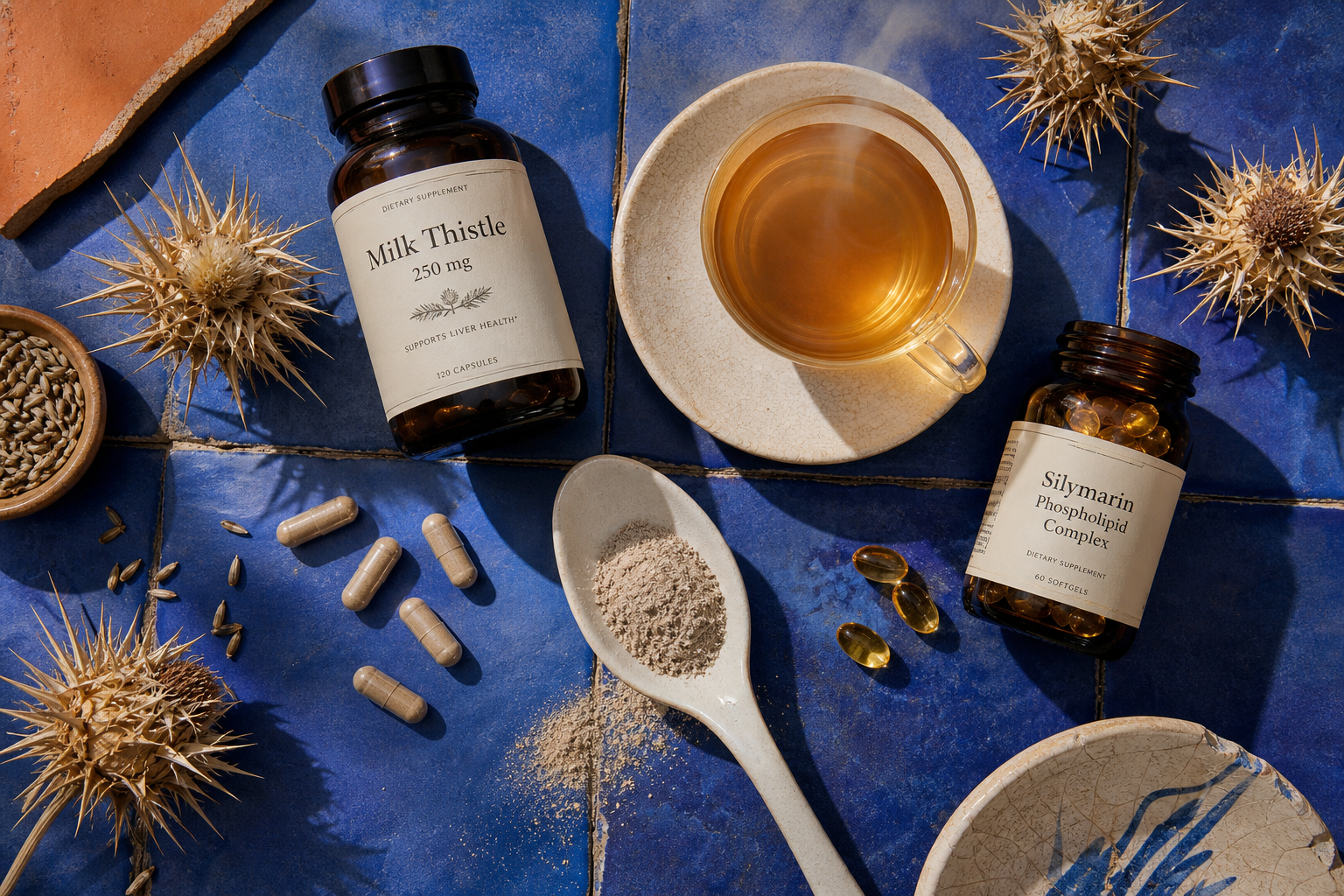
Common forms include seed or fruit powder, tea, tinctures, standardized silymarin extracts, and higher-absorption phospholipid complexes.
Interactions
Interaction risk appears low overall, but caution is sensible with glucose-lowering products, warfarin or other CYP2C9 substrates, sirolimus, some hepatitis C drugs, and narrow-therapeutic-index medicines.
Side effects
Usually mild gastrointestinal effects, headache, itching, or allergy. Ragweed-family sensitivity deserves special attention.
Other possible benefits
Small studies suggest possible effects on blood sugar, inflammation, and lipids, but the evidence is still preliminary and inconsistent.
Regulatory status
In the United States it is sold as a dietary supplement. In the EU it has narrow traditional herbal uses rather than strong modern efficacy approval.
What We Already Know About It
Botanical identity. Milk thistle is a botanical supplement made from the fruit of Silybum marianum, often casually called the seed. The best-known extract fraction is silymarin, a flavonolignan mixture, while silibinin or silybin refers to a major constituent or semipurified fraction within that broader complex. Because labels and studies often blur these terms, product comparisons can become misleading when the exact material is not defined. (FDA dietary supplements overview; NCI PDQ on milk thistle; Nomenclature review on silymarin and silibinin)
Mechanistic picture. Scientific discussion usually centers on antioxidant effects, membrane-related actions, and possible influence on inflammation, transporters, and liver-cell protection. A more firmly established point is that oral bioavailability is limited. Conventional extracts, powders, teas, and enhanced formulations can produce very different exposure, so a larger milligram number does not automatically mean more effect. (Review on milk thistle bioavailability; Pharmacokinetic review of silymarin interactions and disposition)
Clinical certainty. Human research is most extensive for liver-related conditions, but certainty is lower than the volume of marketing suggests. High-quality evidence in chronic hepatitis C, alcoholic liver disease, and biopsy-confirmed NASH is mixed or negative on major outcomes, while some newer analyses suggest only modest changes in liver enzymes or metabolic markers. Overall, milk thistle is better established as a chemically defined herbal category with formulation challenges than as a clearly proven therapy. (Cochrane review on alcoholic and viral liver disease; Randomized NASH trial; Meta-analysis in MASLD and NAFLD; Metabolic effects review)
Summary of Relevant Scientific Research
Overall evidence landscape — NCCIH
NCCIH summarizes studies in alcohol-related liver disease, hepatitis B and C, fatty liver disease, diabetes, and liver injury, but concludes that findings remain conflicting or too limited for firm conclusions. It also describes milk thistle as generally well tolerated while noting gaps for pregnancy and breastfeeding. (NCCIH milk thistle overview)
Traditional use versus modern efficacy — EMA HMPC
The EMA monograph separates traditional herbal use from stronger efficacy claims. It recognizes the fruit as the medicinal part, lists accepted preparation types, and notes that low oral absorption complicates comparisons. A 2024 addendum reported that newer studies did not materially change the earlier conclusions. (EMA herbal monograph; EMA assessment report; EMA 2024 addendum)
Hepatitis C reality check — Cochrane and NIDDK
The clearest negative evidence comes from chronic hepatitis C and related liver disease reviews. Cochrane found no reliable benefit on mortality, complications, or histology, and the large SyNCH trial showed that even high-dose standardized oral silymarin did not outperform placebo on its primary endpoint. (Cochrane review; NIDDK SyNCH trial summary; JAMA SyNCH trial publication)
Fatty liver markers versus outcomes — Trial and meta-analysis
In biopsy-confirmed noncirrhotic NASH, silymarin 700 mg three times daily for 48 weeks did not significantly improve the primary histologic endpoint. Later meta-analytic work in MASLD and NAFLD found reductions in liver enzymes and triglycerides, but these remain indirect markers rather than proof of disease reversal. (Randomized NASH trial; MASLD and NAFLD meta-analysis)
Metabolic signals and formulation effects — Reviews and pharmacokinetic studies
Reviews of diabetes and metabolic trials suggest possible improvements in fasting glucose, HbA1c, inflammation markers, and some lipids, but the trials are small and heterogeneous. Separately, bioavailability studies show that phospholipid complexes can substantially raise silybin exposure, which improves plausibility but does not by itself prove better clinical outcomes. (Type 2 diabetes meta-analysis; Metabolic effects review; Human phospholipid complex study; Softgel phospholipid complex comparison)
Beliefs, Myths & Unproven Claims
Milk thistle is a liver nutrient
This description is misleading. Milk thistle is better classified as a botanical or herbal dietary supplement made from Silybum marianum fruit, not an essential nutrient with a recognized deficiency state or daily requirement. (FDA dietary supplements overview; NCCIH herbs at a glance; NCI PDQ on milk thistle)
All milk thistle products are interchangeable
They are not. Tea, powder, standardized extract, and phospholipid-complex products can differ in plant part processing, constituent profile, and especially bioavailability. Tea should not be assumed equivalent to the standardized extract products used in many studies. (NCI PDQ on milk thistle; Bioavailability review; EMA assessment report)
It detoxes the liver after alcohol or medications
This claim is much stronger than the evidence. High-quality reviews and randomized trials have not shown reliable clinical benefit in alcoholic liver disease, hepatitis C, or biopsy-proven NASH, so traditional popularity should not be confused with modern proof. (Cochrane review; SyNCH trial summary; Randomized NASH trial)
Milk thistle increases breast milk supply
This remains unproven. LactMed describes milk thistle as a purported galactagogue but notes the lack of scientifically valid trials for milk thistle itself, and EFSA did not establish a cause-and-effect relationship for a silymarin product and breast-milk production. (LactMed entry on milk thistle; EFSA opinion on breast-milk production claim)
Detailed Research Observations
Plant identity and terminology shape the evidence
Milk thistle, Silybum marianum, has a long history of traditional use for digestive and liver complaints, often described as spanning roughly 2,000 years. Historical reports also mention food uses, including leaves in salads and the fruit as a coffee substitute. In modern pharmacognosy, the medicinal part is the fruit, sometimes called the achene, although many retail products casually call it the seed. That distinction is not a major practical issue for most shoppers, but it matters for accurate monograph language, labeling, and interpretation of research materials. (NCI PDQ on milk thistle; EMA herbal monograph)
The bigger source of confusion is terminology. Milk thistle is the plant. Silymarin is the flavonolignan-rich extract fraction often standardized in supplements. Silibinin or silybin is a major constituent or semipurified fraction within that broader complex. Reviews note that crude commercial silymarin usually contains at least seven flavonolignans and one flavonoid, so a label saying only “500 mg milk thistle” tells the reader much less than one specifying extract ratio and standardization. This naming problem helps explain why many trials and products are difficult to compare directly. (NCI PDQ on milk thistle; Nomenclature review on silymarin and silibinin)
Preparation type and bioavailability are major practical variables
Milk thistle does not come as one uniform product. Traditional preparations include comminuted fruit for tea and powdered fruit, while modern supplements more often use dry or soft extracts, sometimes standardized to silymarin. The EMA monograph lists multiple preparation types with different solvents, drug-to-extract ratios, and recommended doses. This means that tea, powder, tincture, standardized extract, and phospholipid-complex products should be viewed as different preparations rather than equivalent versions of the same dose. (EMA herbal monograph; NCI PDQ on milk thistle)
Bioavailability is one of the biggest reasons these differences matter. Reviews describe oral silymarin as having low absorption and extensive metabolism, with transporter-mediated efflux and biliary excretion contributing to limited systemic exposure. Because the active constituents are lipophilic, tea should not be assumed equivalent to standardized extract products used in many studies. Phospholipid or phytosome-style products can substantially increase silybin exposure compared with conventional tablets, but that still does not prove better clinical results. The EMA also notes that some enhanced silibinin-phosphatidylcholine complexes were not accepted into the monograph as standard herbal preparations. (Bioavailability review; Pharmacokinetic review; Human phospholipid complex study; Softgel phospholipid complex comparison; EMA assessment report)
Liver research is broad, but major clinical proof is limited
Liver support is the main reason milk thistle is widely used, yet this is also where the evidence is most frequently overstated. NCCIH summarizes trials in alcohol-related liver disease, hepatitis B and C, nonalcoholic fatty liver disease, and toxin-related liver problems as conflicting or insufficient for firm conclusions. The older Cochrane review reached a similar bottom line for alcoholic liver disease and viral hepatitis, finding no reliable benefit on mortality, liver complications, or histology once higher-quality studies were considered. That does not mean milk thistle has no biological activity, but it does mean strong claims of clearly proven liver protection are not supported by the best clinical evidence. (NCCIH milk thistle overview; Cochrane review)
Chronic hepatitis C provides one of the clearest tests of oral silymarin. A meta-analysis of randomized trials found no significant improvement in viral load, liver enzymes, or quality of life, and the multicenter SyNCH trial then tested standardized Legalon extract at 420 mg or 700 mg three times daily for 24 weeks without showing an advantage over placebo on its primary biochemical endpoint. Findings in NASH and broader MASLD or NAFLD are more nuanced: a biopsy-based randomized trial in noncirrhotic NASH was negative on its primary histologic endpoint, while later meta-analysis suggested reductions in ALT, AST, and triglycerides. Those biomarker changes may indicate some physiological effect, but they do not prove reversal of steatohepatitis, fibrosis, or long-term disease outcomes. (Hepatitis C meta-analysis; SyNCH trial summary; JAMA SyNCH publication; Randomized NASH trial; MASLD and NAFLD meta-analysis)
Non-liver uses remain secondary and should be described cautiously
Milk thistle is also promoted for blood sugar control, inflammation, and lipid balance. Meta-analyses of randomized trials in type 2 diabetes and related metabolic settings report possible improvements in fasting glucose, HbA1c, insulin resistance markers, CRP, and several lipid parameters. These results are enough to justify continued research, but the underlying trials are generally small, heterogeneous, and often use milk thistle alongside standard medication rather than instead of it. That supports wording such as “promising but preliminary,” not the claim that milk thistle is an established primary therapy for diabetes or dyslipidemia. (Type 2 diabetes meta-analysis; Metabolic effects review)
A clinically important exception should not be generalized to everyday supplements. In Europe, intravenous silibinin has been used in the context of Amanita phalloides poisoning, but this is a specialist medical treatment setting and is not comparable to taking an over-the-counter oral milk thistle capsule or tea for routine “detox.” Presenting that exception without context can give consumers an inflated sense of what ordinary oral products have been shown to do. (NCI PDQ on milk thistle; EMA assessment report)
Quality control and regulatory framing matter as much as the herb itself
Real-world product quality is a major issue in this category. Analytical studies of commercial supplements found notable discrepancies between labeled and measured silymarin content, along with contamination and microbiological quality problems in some products. Separate authentication work using chemical profiling and DNA-based methods showed that commercial products can contain ambiguous or mismatched botanical material. In practice, this means that source plant quality, plant part used, extraction solvent, extract ratio, and standardization target may affect consistency as much as the ingredient name on the front label. (Commercial product quality study; Authentication and adulteration study)
That quality problem intersects with regulation. In the United States, milk thistle is sold mainly as a dietary supplement with no FDA premarket approval for efficacy, while in the European Union the HMPC position is much narrower and based on traditional herbal use for dyspepsia and support of liver function after serious disease has been excluded. The 2024 HMPC addendum did not find enough newer evidence to broaden that view. For consumers, clearer labels that specify plant part, extract ratio, and standardization are more informative than simple front-of-pack milligram claims, and quality programs such as USP or NSF can be useful for identity, purity, contamination control, and label accuracy even though they do not prove efficacy. (FDA dietary supplements overview; EMA herbal monograph; EMA 2024 addendum; USP dietary supplements and herbal medicines; NSF supplement certification overview)
Regulatory Status (EU and US)
United States
In the United States, milk thistle is generally sold as a dietary supplement under the Dietary Supplement Health and Education Act framework. That means products are not reviewed by the FDA for safety or effectiveness before marketing in the same way as prescription drugs. Labels may use structure-or-function support language, but they cannot legally claim to treat, cure, or prevent disease unless they meet drug standards. For consumers, “liver support” wording is not the same as FDA approval for liver disease treatment. (FDA dietary supplements overview)
European Union
The EMA HMPC monograph is narrower and more conservative. It recognizes traditional herbal medicinal uses for symptomatic relief of dyspepsia and to support liver function only after serious conditions have been excluded, and the 2024 addendum did not broaden that position. Some enhanced silibinin-phosphatidylcholine products were not accepted as standard herbal preparations in the monograph, and EFSA did not establish a cause-and-effect relationship for a silymarin product promoted for breast-milk production. Intravenous silibinin used in Europe for Amanita phalloides poisoning belongs to a separate medical treatment context and should not be extrapolated to oral supplements. (EMA herbal monograph; EMA 2024 addendum; EMA assessment report; EFSA opinion on breast-milk production claim; NCI PDQ on milk thistle)
Dosage and Standardization
EMA adult ranges: tea 3–5 g of comminuted fruit 2–3 times daily before meals; powdered fruit 300–600 mg 2–3 times daily; dry extracts vary widely, about 70–250 mg per dose 1–4 times daily. Trials also used 420–700 mg silymarin 3 times daily.
Safety And Interactions
Adverse effects: Milk thistle is generally well tolerated. Reported adverse effects are usually mild and include diarrhea, constipation, nausea, vomiting, bloating, headache, itching, and other gastrointestinal complaints. Allergic reactions can occur, especially in people sensitive to Asteraceae plants, and rare severe hypersensitivity has also been noted.
Precautions and interactions: Use in pregnancy, breastfeeding, and under age 18 is not well supported by safety data. Drug-interaction risk appears limited but not zero, so caution is sensible with narrow-therapeutic-index drugs, warfarin or other CYP2C9 substrates, sirolimus, some hepatitis C medicines, and products or medicines that lower blood glucose.
Conclusion
Milk thistle is best understood as a botanical supplement whose most relevant actives are silymarin and silibinin, not a classic nutrient. Evidence is largest for liver-related uses, but stronger trials in hepatitis C and biopsy-confirmed NASH did not show clear benefit on primary outcomes, while newer reviews suggest only modest changes in indirect markers. Product form, standardization, bioavailability, and quality are central to interpreting both research and labels. Overall, milk thistle remains a plausible but inconsistently supported supplement whose value depends heavily on the preparation and use case.
Disclaimer
Disclaimer: We attempt to do our best to find relevant, accurate and most up to date information available in both, the public domain and in the clinical and medical research community. We recommend reviewing scientific sources for official information on the subject. This post is not intended as medical advice. Each individual person's health conditions vary and we advise to consult a doctor before taking any supplements.