

 Deutsch
 Español
 Suomi
Suomi Français
 Bahasa Indonesia
 Italiano
 日本語
日本語 Português
 Tagalog
Summary
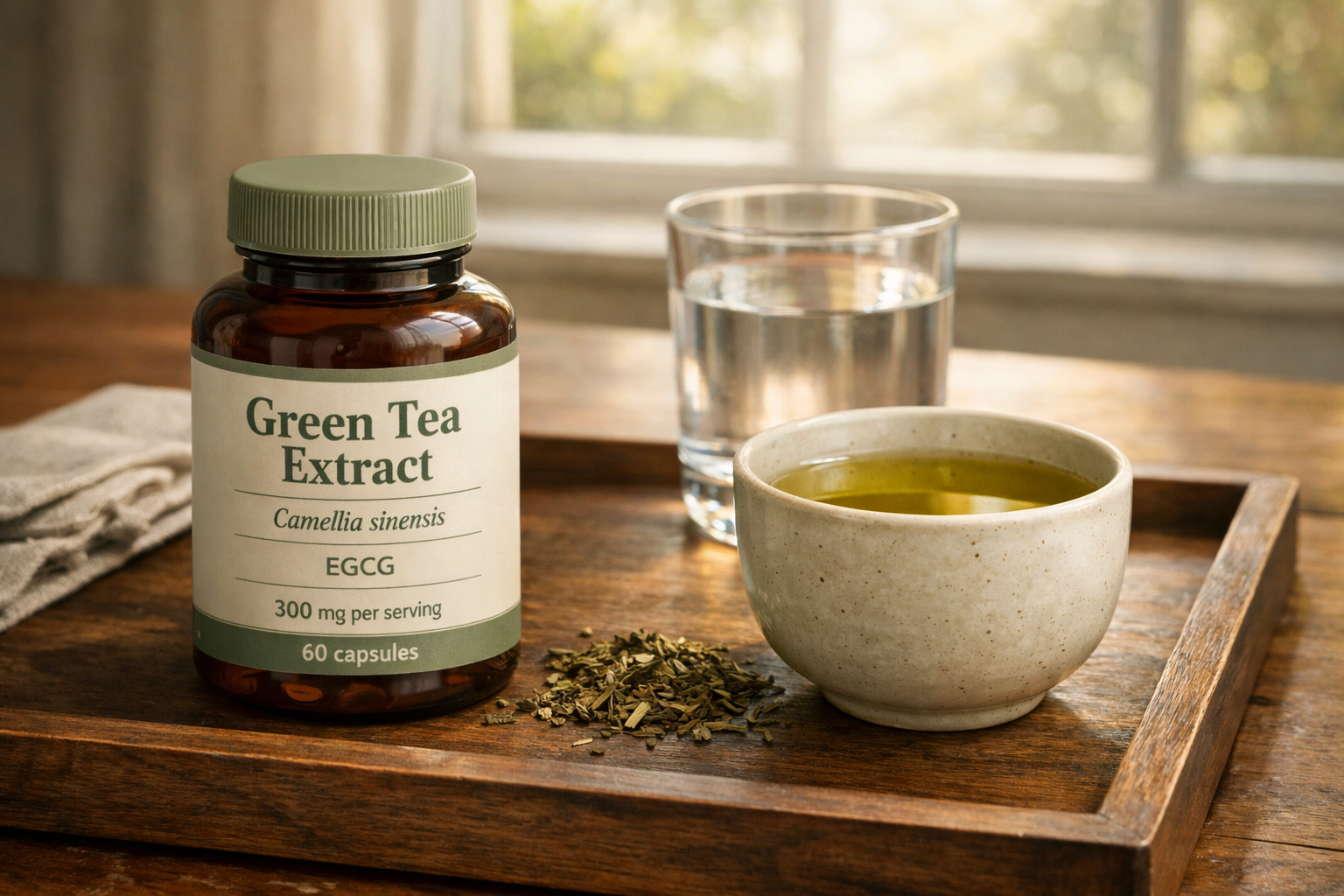
Green tea extract is a concentrated Camellia sinensis supplement valued mainly for catechins, especially EGCG, and many products also contain caffeine. The strongest human evidence supports modest reductions in total and LDL cholesterol, with smaller complementary effects on blood pressure and possibly body composition.
Claims about dramatic fat burning, broad blood-sugar control, or cancer prevention go beyond the current evidence. The main practical concern is safety: concentrated oral extracts are not equivalent to brewed green tea, product EGCG content varies widely, and higher-dose supplements have been linked to rare but real liver injury.
Quick Facts
What is it useful for?
The strongest evidence is for modest lowering of total and LDL cholesterol. Smaller complementary benefits may occur for blood pressure and body composition.
Supplement types
Products include capsules, tablets, powders, liquids, drinks, and standardised catechin or EGCG extracts.
Interactions
It may add caffeine exposure in multi-ingredient stimulant stacks and has been reported to reduce exposure to several medicines, including nadolol, atorvastatin, raloxifene, digoxin, and rosuvastatin.
Side effects
Reported effects include nausea, stomach or abdominal upset, constipation, jitteriness, sleep disturbance, and rare liver injury.
Other possible benefits
Small complementary benefits may occur for blood pressure and body composition. Glucose-control results are mixed and appear more promising in diagnosed type 2 diabetes than in broader at-risk groups.
Regulatory status
The EU limits foods containing green tea extract to below 800 mg EGCG per daily portion with specific warnings. In the US, oral supplements are not FDA-approved for efficacy before sale.
What We Already Know About It
What it is. Green tea extract is a catechin-rich concentrate from Camellia sinensis, not a single isolated compound. EGCG is the best-known catechin, but EGC, ECG, and EC also contribute, and many products include caffeine that may affect alertness, thermogenesis, and tolerability. Modern supplement research therefore focuses on mixed catechin preparations rather than on one perfectly uniform ingredient. NCCIH — Green Tea; EFSA Scientific Opinion on Green Tea Catechins.
What the evidence supports. The most established human findings are modest reductions in total and LDL cholesterol, with smaller average reductions in blood pressure. Evidence for body composition is weaker: some meta-analyses show tiny improvements, while older higher-quality reviews found little meaningful effect on weight loss or weight maintenance. Glucose-control results are mixed and seem more encouraging in people with diagnosed type 2 diabetes than in broader at-risk groups, while cancer-prevention claims remain unproven. Nutrition Journal 2020 — Lipid Meta-analysis; PubMed 2025 — Blood Pressure Meta-analysis; Cochrane Review — Green Tea for Weight Loss; PMC 2024 — Type 2 Diabetes Meta-analysis; Cochrane Review — Green Tea for Cancer Prevention.
Why safety matters. Concentrated oral extracts do not behave like normal brewed tea in safety terms. The key practical concern is uncommon but real liver injury, especially with catechin-rich capsules or tablets, and European regulators now treat EGCG dose as the central safety metric. Because commercial products also vary widely in EGCG and caffeine content, dose, formulation, and interaction screening are essential parts of any evidence-based discussion. EFSA Scientific Opinion on Green Tea Catechins; EUR-Lex Regulation 2022/2340 — Green Tea Extract Rules; LiverTox — Green Tea; USDA ODS DSID — Green Tea Supplements.
Summary of Relevant Scientific Research
Modest cholesterol lowering — Nutrition Journal 2020
In 31 randomised trials with 3,216 participants, green tea lowered total cholesterol by about 7.2 mg/dL and LDL cholesterol by about 2.2 mg/dL, while HDL and triglyceride effects were not clearly significant. This is one of the better-supported human benefits, but the size of effect remains modest. Nutrition Journal 2020 — Lipid Meta-analysis.
Weight-loss effects are small — Cochrane Review
Across weight-loss and weight-maintenance studies in overweight or obese adults, Cochrane found only a very small, statistically non-significant effect and no help with maintaining lost weight. Adverse effects were usually mild to moderate. Cochrane Review — Green Tea for Weight Loss.
Body-composition signal remains limited — British Journal of Nutrition 2024
A dose-response meta-analysis of 46 randomised trials found small reductions in BMI and body-fat percentage, but not significant overall changes in waist circumference or fat mass. The authors described the benefits as clinically small. British Journal of Nutrition 2024 — Body Composition Meta-analysis.
Blood-pressure support is complementary — PubMed 2025
In 36 randomised controlled trials, green tea supplementation was associated with average systolic and diastolic blood-pressure reductions of just over 1 mmHg. The authors concluded it should be viewed as a complementary, not primary, strategy. PubMed 2025 — Blood Pressure Meta-analysis.
Glucose control depends on population — PubMed 2013 and PMC 2024
An older meta-analysis in adults at risk of type 2 diabetes found no significant improvements in fasting glucose, insulin, HbA1c, or insulin resistance. A newer meta-analysis in people with diagnosed type 2 diabetes suggested improvements in fasting glucose, HbA1c, and insulin resistance, making the evidence mixed rather than broadly established. PubMed 2013 — Glycaemic Control Meta-analysis; PMC 2024 — Type 2 Diabetes Meta-analysis.
Safety hinges on extract dose and form — EFSA, LiverTox, and safety reviews
EFSA concluded that intakes at or above 800 mg EGCG per day from supplements can significantly increase serum transaminases, while LiverTox describes green tea extract as a well-established cause of clinically apparent liver injury. Safety reviews also note that this pattern is linked mainly to concentrated capsules and tablets rather than normal tea drinking. EFSA Scientific Opinion on Green Tea Catechins; LiverTox — Green Tea; PubMed 2018 — Systematic Safety Review.
Beliefs, Myths & Unproven Claims
Myth: It is a proven fat burner
The evidence does not support the strong marketing claim that green tea extract is a high-impact fat-burning supplement. Reviews show that any average effect on weight or body fat is usually very small, sometimes statistically uncertain, and often too modest to matter much in real life. Cochrane Review — Green Tea for Weight Loss; British Journal of Nutrition 2024 — Body Composition Meta-analysis.
Myth: If tea is safe, extract must be equally safe
Normal brewed green tea and concentrated oral extract are not interchangeable from a safety perspective. Reviews repeatedly distinguish high-dose catechin-rich capsules and tablets from tea drinking, with liver risk appearing mainly in the concentrated supplement form. PubMed 2018 — Systematic Safety Review; LiverTox — Green Tea.
Myth: More extract milligrams always mean a stronger product
Front-label extract weight is a poor guide to actual exposure. US testing found wide variation in measured EGCG, total catechins, and caffeine, so similar-looking products can deliver very different real doses and stimulant loads. USDA ODS DSID — Green Tea Supplements.
Myth: Green tea extract is proven for cancer prevention
Current clinical evidence does not justify presenting oral green tea extract as a proven anti-cancer supplement. Large reviews found inconsistent observational signals and insufficient trial evidence for reliable preventive conclusions. Cochrane Review — Green Tea for Cancer Prevention; NCCIH — Green Tea.
Detailed Research Observations
What the supplement actually is, and why labels can mislead
Green tea extract is a concentrated preparation from Camellia sinensis, the same plant used for brewed green tea. Its health reputation is driven mainly by catechins, especially EGCG, but real products are mixtures that can also contain other catechins such as EGC, ECG, and EC, plus varying amounts of caffeine. This matters because marketing often presents the ingredient as if it were a single standardised compound with predictable effects, when in practice the supplement category is much less uniform than that. NCCIH — Green Tea; EFSA Scientific Opinion on Green Tea Catechins.
USDA supplement testing makes that variability concrete. In 32 US single-ingredient products, labelled green-tea material ranged from 300 to 6000 mg per day, but measured EGCG ranged from 2 to 630 mg per day, total catechins from 4.2 to 1070 mg per day, and caffeine from 0.25 to 130 mg per day. In practical terms, the extract number on the front of the bottle may not tell consumers much about the actual catechin or stimulant dose they are taking. USDA ODS DSID — Green Tea Supplements.
Absorption, food timing, and why “more absorbed” is not automatically better
One of the more useful nuances in this topic is that taking EGCG with food can substantially reduce oral bioavailability. On paper, that could make empty-stomach dosing look appealing for people chasing maximum absorption. But this is a good example of where pharmacokinetic logic and consumer safety do not point in the same direction. PubMed 2016 — EGCG Bioavailability With Food.
European regulation now requires labels on green tea extract foods to warn against consuming the product on an empty stomach, reflecting concern that larger bolus exposure may contribute to liver stress. That means a consumer cannot simply assume that higher absorption is preferable. For green tea extract, the better question is not only how much EGCG gets absorbed, but whether the formulation and dosing pattern increase risk faster than they improve any likely benefit. EUR-Lex Regulation 2022/2340 — Green Tea Extract Rules; EFSA Scientific Opinion on Green Tea Catechins.
The clearest benefit signal is modest cardiometabolic support
Among the many claims made for green tea extract, cholesterol lowering is one of the cleaner and more reproducible findings in human trials. Meta-analytic evidence shows modest reductions in total cholesterol and LDL cholesterol, while HDL usually changes little and triglycerides do not show a clearly significant fall overall. These are measurable effects, but they remain far smaller than what would normally be expected from prescription lipid-lowering therapy. Nutrition Journal 2020 — Lipid Meta-analysis; NCCIH — Green Tea.
Blood-pressure evidence fits the same general picture. A 2025 meta-analysis found average systolic and diastolic reductions of just over 1 mmHg, which supports the idea of mild complementary cardiometabolic support rather than a primary treatment effect. Put together, the lipid and blood-pressure findings make green tea extract more credible as a modest-support supplement than as a major intervention. PubMed 2025 — Blood Pressure Meta-analysis; Nutrition Journal 2020 — Lipid Meta-analysis.
Weight-loss marketing outruns the data
Green tea extract is often sold as a “fat burner,” but the stronger research base does not support that framing. Cochrane found very small and statistically non-significant effects on weight loss in overweight or obese adults and no meaningful effect on weight-loss maintenance after dieting. That is an important check on advertising language that implies the ingredient has a substantial real-world slimming effect by itself. Cochrane Review — Green Tea for Weight Loss.
Newer dose-response evidence is somewhat more positive, but still limited. The 2024 meta-analysis found small average reductions in BMI and body-fat percentage, while waist circumference and fat mass were not significantly changed overall. The authors themselves described the benefits as clinically small, which is a very different message from dramatic consumer-facing fat-loss claims. British Journal of Nutrition 2024 — Body Composition Meta-analysis.
Glucose control is mixed, and cancer prevention remains unproven
The glucose-control story is more population-specific than broad supplement marketing usually suggests. In adults at risk of type 2 diabetes, an older meta-analysis found no significant improvement in fasting glucose, fasting insulin, HbA1c, or insulin resistance. In contrast, a 2024 meta-analysis in people with diagnosed type 2 diabetes reported improvements in fasting glucose, HbA1c, and insulin resistance. The fairest reading is not that green tea extract “works” or “does not work” for glucose control in general, but that its effects appear mixed and context dependent. PubMed 2013 — Glycaemic Control Meta-analysis; PMC 2024 — Type 2 Diabetes Meta-analysis.
Cancer-prevention claims are weaker still. A large Cochrane review covering 142 studies and more than 1.1 million participants did not establish a reliable preventive benefit, and site-specific signals were inconsistent and low certainty. This is a good reminder that antioxidant reputation and traditional use are not the same as proven modern disease-prevention efficacy. Cochrane Review — Green Tea for Cancer Prevention; NCCIH — Green Tea.
The main practical distinction is safety: extract is not the same as tea
Safety evidence repeatedly separates normal brewed green tea from concentrated oral extracts. A systematic review of 159 human intervention studies linked hepatic adverse events mainly to a limited range of concentrated, catechin-rich preparations taken in large bolus doses, whereas brewed tea and extract-containing beverages and foods did not show the same pattern. LiverTox goes further and describes green tea extract as a well-established cause of clinically apparent liver injury, often with onset within 1 to 6 months and possible recurrence after re-exposure. PubMed 2018 — Systematic Safety Review; LiverTox — Green Tea.
Drug interactions add another layer of caution. A 2024 review reported reduced systemic exposure of several medicines after green tea intake, including atorvastatin, digoxin, fexofenadine, folic acid, lisinopril, nadolol, nintedanib, raloxifene, and rosuvastatin. NCCIH specifically highlights nadolol, atorvastatin, and raloxifene. For medication users, this means green tea extract should not be treated as a harmless background antioxidant that never needs interaction screening. PubMed 2024 — Green Tea Drug Interactions Review; NCCIH — Green Tea.
Dosage evidence is inconsistent, so EGCG is the most useful safety anchor
There is no single evidence-based consumer dose because clinical trials used widely different preparations and reporting standards. In lipid trials, catechin intake ranged from roughly 80 to 2488.7 mg per day, with a median around 630.9 mg per day, while many body-composition studies used several hundred milligrams to about 1000 mg per day of extract. Higher doses did not reliably produce clearly better outcomes, which helps explain why the literature does not yield a simple “best dose” recommendation. Nutrition Journal 2020 — Lipid Meta-analysis; British Journal of Nutrition 2024 — Body Composition Meta-analysis.
For safety, the most practical number is EGCG rather than total extract weight. EFSA identified a liver-enzyme signal at supplemental intakes of 800 mg EGCG per day and above, and EU law now requires products to remain below that threshold and carry warning language. A separate toxicology review proposed a more conservative upper intake of 300 mg EGCG per day, which is not the current legal EU limit but may be useful for cautious readers. EFSA Scientific Opinion on Green Tea Catechins; EUR-Lex Regulation 2022/2340 — Green Tea Extract Rules; PubMed 2017 — EGCG Upper Intake Review.
Regulatory Status (EU and US)
European Union
In the EU, green tea extracts containing EGCG are subject to explicit safety-focused restrictions. Regulation 2022/2340 requires that the daily portion of food contain less than 800 mg EGCG and that labels state the maximum daily portions, warn consumers not to consume 800 mg EGCG or more per day, and advise that the product should not be consumed on an empty stomach. This framework reflects EFSA’s concern about dose-related liver toxicity from concentrated catechin exposure. EUR-Lex Regulation 2022/2340 — Green Tea Extract Rules; EFSA Scientific Opinion on Green Tea Catechins.
United States
In the US, oral green tea extract is generally sold under the dietary supplement framework. Manufacturers are responsible for safety and truthful labelling before marketing, while FDA oversight is largely post-market rather than pre-approval for efficacy. A specific FDA-approved green tea product does exist, but it is a topical prescription medicine for genital and perianal warts, not an oral supplement. Legally available therefore does not mean FDA-approved to work for weight loss, cholesterol, or other common supplement claims. FDA — Dietary Supplements; NCCIH — Green Tea.
Dosage and Standardization
Studies: Catechin intakes ranged from about 80 to 2488.7 mg/day, with a median around 630.9 mg/day; many body-composition trials used several hundred milligrams to about 1000 mg/day.
Safety: EFSA found a liver-enzyme signal at 800 mg EGCG/day and above, and EU rules require products to stay below that threshold and warn against empty-stomach use.
Safety And Interactions
Liver risk: Concentrated catechin-rich capsules and tablets have been linked to uncommon but real liver injury, usually with a hepatocellular pattern. Reported onset is often within 1 to 6 months, and recurrence can happen after re-exposure. Anyone who develops fatigue, nausea, dark urine, itching, jaundice, or right-upper-abdominal pain while using green tea extract should stop use and seek medical advice promptly. LiverTox — Green Tea; PubMed 2018 — Systematic Safety Review.
Common side effects: Trials most often report mild to moderate nausea, abdominal discomfort, constipation, and caffeine-related jitteriness or sleep disturbance, depending on the product’s caffeine content. Taking concentrated extract as a large bolus or on an empty stomach may not be wise from a tolerability or liver-safety perspective. Cochrane Review — Green Tea for Weight Loss; NCCIH — Green Tea; EUR-Lex Regulation 2022/2340 — Green Tea Extract Rules.
Interactions: Green tea intake has been reported to reduce exposure to several medicines, including atorvastatin, digoxin, fexofenadine, folic acid, lisinopril, nadolol, nintedanib, raloxifene, and rosuvastatin. Extra caution is warranted for people with liver disease, those on prescription medicines, and those already using multiple stimulant supplements. PubMed 2024 — Green Tea Drug Interactions Review; NCCIH — Green Tea.
Conclusion
Green tea extract is a plausible but often overstated supplement. Its best-supported human benefits are modest reductions in total and LDL cholesterol, with smaller and less reliable effects on blood pressure, body composition, and glucose control. Claims around dramatic fat burning and cancer prevention are not supported by the current evidence base.
The strongest practical message is about context and caution. Brewed green tea and concentrated extract are not interchangeable, product contents vary widely, and the main oral-supplement risk is rare but real liver injury, particularly with higher-EGCG products. Overall, green tea extract may have a place as a carefully chosen, modest-support supplement, but it is not a shortcut substitute for diet, exercise, or medical care.
Disclaimer
Disclaimer: We attempt to do our best to find relevant, accurate and most up to date information available in both, the public domain and in the clinical and medical research community. We recommend reviewing scientific sources for official information on the subject. This post is not intended as medical advice. Each individual person's health conditions vary and we advise to consult a doctor before taking any supplements.