

 Deutsch
 Español
 Suomi
Suomi Français
 Bahasa Indonesia
 Italiano
 日本語
日本語 Português
 Tagalog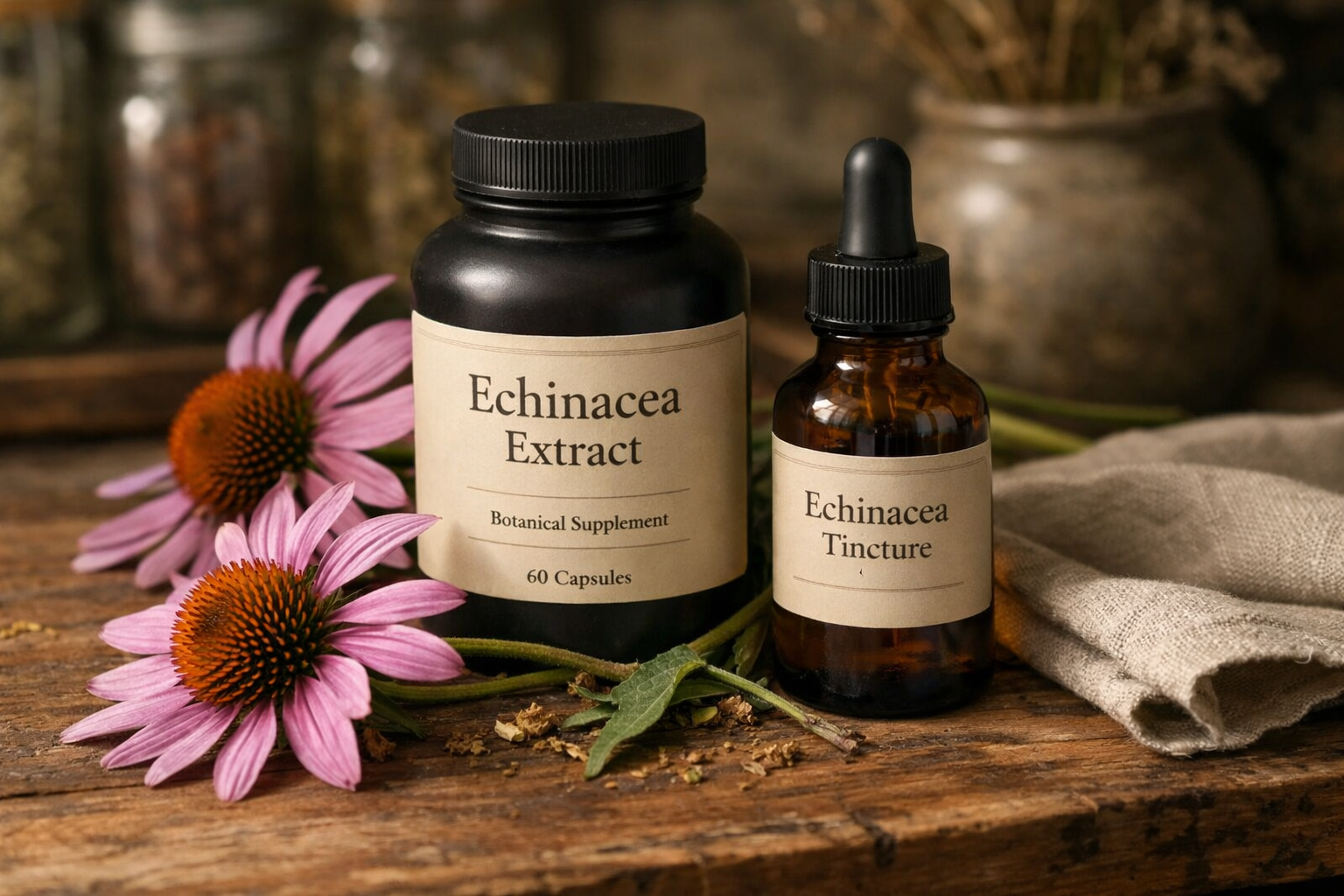
Summary
Echinacea is a group of herbal products made from different species, plant parts, and extraction methods, most often sold for cold and immune support. This matters because echinacea is not one uniform supplement: chemistry, dosing, and clinical evidence can differ substantially from one preparation to another.
The clearest overall finding is modest and product-specific. Some echinacea products may slightly reduce the risk of common colds or upper respiratory infections when used preventively, but evidence that they reliably shorten or improve an established cold is mixed and often negative in better-quality trials. Short-term use is usually tolerated by many adults, yet allergy risk, possible drug interactions, and regulatory differences mean it should not be treated as a simple risk-free remedy.
Quick Facts
What is it useful for?
Mainly for prevention of common colds and other upper respiratory infections, with modest and product-specific evidence of benefit.
Supplement types
Products vary by species, plant part, extract method, and form, including tablets, teas, tinctures, juices, and standardized herbal preparations.
Interactions
Echinacea may interact with immune-active medicines or supplements, and some products may affect drug metabolism. Caution is especially warranted with immunosuppressants.
Side effects
Short-term side effects are usually mild, such as stomach upset, nausea, headache, bad taste, or rash. Rare severe allergic reactions can occur.
Other possible benefits
Broader claims such as general immune boosting, anxiety relief, or benefits for unrelated illnesses remain weakly supported or unproven.
Regulatory status
In the US, echinacea is usually sold as a dietary supplement. In the EU, some specific preparations have herbal medicinal monographs, but this does not amount to blanket approval for all products.
What We Already Know About It
Botanical complexity. Echinacea is better understood as a category of herbal preparations than as one standardized ingredient. Commercial products may use Echinacea purpurea, Echinacea angustifolia, Echinacea pallida, or mixtures, and they can be made from roots, fresh aerial parts, dried juices, teas, tinctures, or extracts. Because species, plant part, solvent, and standardization all influence composition, one positive study cannot automatically be applied to every echinacea product.
What clinical research supports. The most established category-level finding is a small preventive effect in some studies of common colds and upper respiratory infections. When benefit appears, it is modest rather than dramatic. Evidence for treatment after symptoms begin is much less convincing: better-quality trials often fail to show shorter illness duration or meaningful symptom relief, which is why major institutional reviews remain cautious.
Mechanism with limits. Echinacea is often described as immune-modulating, but the article emphasizes that this should not be simplified into broad immune boosting. Proposed active compounds and laboratory mechanisms are still not fully defined, and their clinical relevance appears inconsistent across products. That leaves moderate evidence for some preventive use, but limited or unproven support for broader claims such as general immune enhancement or anxiety relief.
Summary of Relevant Scientific Research
Cautious Institutional Overview — NCCIH and NIH Office of Dietary Supplements
Both institutional reviews describe echinacea as a group of varying herbal products rather than one consistent intervention. Their overall conclusion is cautious: some products may slightly reduce the chance of catching a cold, but evidence that echinacea clearly shortens or improves an established cold remains mixed, and allergy or interaction concerns still matter. NCCIH — Echinacea; NIH ODS — Immune Function Fact Sheet.
Why the Literature Looks Contradictory — JAMA Clinical Evidence Synopsis
The JAMA synopsis of the 2014 Cochrane review covered 24 randomized trials. Individual prevention studies often failed to show clear statistically significant benefit on their own, but pooled exploratory analyses suggested a small reduction in cold incidence. Treatment evidence was weaker, with the better-quality treatment trials not showing shorter colds and product heterogeneity identified as a major limitation. JAMA Clinical Evidence Synopsis on the Cochrane review.
Modest Prevention Signal — 2019 Systematic Review and Meta-analysis
This meta-analysis found that echinacea reduced upper respiratory infection risk compared with placebo, with a risk ratio of 0.78. However, it did not find a significant reduction in average illness duration, reinforcing the idea that prevention evidence is stronger than treatment evidence. PubMed — 2019 meta-analysis on upper respiratory infections.
Negative Trials Still Matter — Rhinovirus and Pediatric Studies
A controlled rhinovirus challenge study of Echinacea angustifolia did not show clinically significant effects on infection or illness, and a pediatric randomized trial found no meaningful reduction in symptom duration or severity after symptoms started, while rashes were more common with echinacea. Newer pediatric prevention data are more encouraging for some specific products, but the evidence remains heterogeneous. PubMed — Experimental rhinovirus study; JAMA — Pediatric echinacea trial; PubMed — 2021 pediatric prevention trial.
Preparation and Interaction Specificity — EMA and Human Interaction Studies
EMA monographs distinguish fresh-herb juice from root extract and assign different regulatory pathways and dosing approaches. Human interaction studies are also mixed: one study suggested altered midazolam exposure, while others found no meaningful pharmacokinetic changes for lopinavir-ritonavir or docetaxel, supporting a product- and drug-specific view of interaction risk. EMA — Echinacea purpurea herba monograph; PubMed — Midazolam interaction study; PMC — Lopinavir-ritonavir interaction study; PubMed — Docetaxel interaction study.
Beliefs, Myths & Unproven Claims
Myth: Echinacea stops a cold as soon as symptoms begin
This claim is stronger than the evidence allows. Better-quality treatment trials and major reviews do not show consistent, clinically meaningful reductions in cold duration or severity once symptoms are established, even though some individual products have shown signals of benefit. JAMA Clinical Evidence Synopsis on the Cochrane review; PubMed — 2019 meta-analysis on upper respiratory infections; PubMed — Experimental rhinovirus study.
Myth: All echinacea products are basically the same
Echinacea products differ by species, plant part, extraction method, and final form, and the evidence behind one preparation cannot simply be transferred to another. European monographs even treat fresh-herb and root products differently, which underlines the lack of interchangeability. NIH ODS — Immune Function Fact Sheet; EMA — Echinacea purpurea herba monograph; EMA — Echinacea purpurea radix monograph.
Myth: Natural means risk-free
Short-term use is often tolerated, but echinacea is not risk-free. Allergy can be serious, rashes have been reported in children, interaction concerns remain plausible, and product quality may vary outside standardized medicinal pathways. NCCIH — Echinacea; JAMA — Pediatric echinacea trial; NCBI Bookshelf — LiverTox on echinacea.
Myth: It is proven for broad immune boosting or anxiety relief
The article does not support these broad claims. EFSA concluded that evidence was insufficient to establish a cause-and-effect relationship for a standardized Echinacea angustifolia extract and reduced subthreshold or mild anxiety, and broader immune-enhancement claims remain weakly supported. EFSA opinion on Echinacea angustifolia and anxiety; NCCIH — Echinacea.
Detailed Research Observations
Traditional use explains popularity, but not modern proof
Echinacea has a long history of use in North America, including traditional use by Indigenous peoples, and this background helps explain why it remains a familiar supplement for colds and general wellness. Historical uses also extended beyond respiratory complaints, including wound-related applications and tooth pain. In the modern market, however, historical popularity does not count as clinical confirmation for specific present-day claims. The article repeatedly separates cultural and historical importance from the narrower question of what randomized trials and evidence reviews actually support today. NCCIH — Echinacea; NIH ODS — Immune Function Fact Sheet.
This distinction matters because consumers often encounter echinacea as though it were a single classic remedy with a stable meaning. In reality, the name covers several species and many kinds of commercial preparations. That makes traditional use a useful starting point for interest, but not a shortcut to assuming that every modern capsule, tincture, tea, or juice has comparable chemistry or comparable evidence behind it. NCCIH — Echinacea; NIH ODS — Immune Function Fact Sheet.
Why echinacea is not one standardized intervention
One of the most important observations in the article is that echinacea is a botanical category, not one single supplement. Products may use Echinacea purpurea, Echinacea angustifolia, Echinacea pallida, or combinations of them. Manufacturers may choose roots, fresh aerial parts, dried juices, alcoholic extracts, tablets, teas, or liquids, and each choice changes the chemical profile that reaches the consumer. Because of this, a positive study on one preparation does not automatically validate another product sold under the same plant name. NCCIH — Echinacea; NIH ODS — Immune Function Fact Sheet.
The article also notes that the proposed active constituents are still not fully defined. Different formulations may emphasize alkamides, caffeic acid derivatives, polysaccharides, or other compounds, and extraction methods can shift the balance between them. This helps explain why the literature often looks inconsistent and why regulatory bodies such as EMA distinguish fresh-herb juice from root preparations rather than treating all echinacea products as interchangeable. NIH ODS — Immune Function Fact Sheet; EMA — Echinacea purpurea herba monograph; EMA — Echinacea purpurea radix monograph.
Prevention evidence is better than treatment evidence
Across adult research, the strongest category-level signal is modest prevention rather than treatment. The 2019 meta-analysis found about a 22 percent relative reduction in upper respiratory infection risk versus placebo, which supports a small preventive effect for some products. Institutional reviews from NCCIH and ODS reach a similar broad conclusion: echinacea may slightly lower the chance of getting a cold or upper respiratory infection, but the benefit is modest and not a guarantee of protection. PubMed — 2019 meta-analysis on upper respiratory infections; NCCIH — Echinacea; NIH ODS — Immune Function Fact Sheet.
When echinacea is tested after symptoms begin, the picture is weaker. The JAMA synopsis of the Cochrane review reported that the better-quality treatment trials did not show shorter colds, and a controlled rhinovirus challenge study of Echinacea angustifolia also failed to show clinically significant benefit. The article also mentions an influenza noninferiority study as an interesting product-specific finding, but it does not support the broader claim that generic echinacea supplements can replace approved antivirals or reliably treat respiratory illness once underway. JAMA Clinical Evidence Synopsis on the Cochrane review; PubMed — Experimental rhinovirus study; PubMed — Echinacea hot drink versus oseltamivir study.
Children and vulnerable groups require extra caution
Pediatric evidence does not support simple yes-or-no messaging. A widely cited randomized trial in children with acute upper respiratory infections found no meaningful symptom benefit compared with placebo and reported more rashes in the echinacea group. More recent work is somewhat more favorable for prevention using specific Echinacea purpurea products, including a 2021 trial with fewer respiratory infections and less antibiotic use, and a newer pediatric meta-analysis suggesting possible benefit. Even so, the article emphasizes that these results remain heterogeneous and product-specific, so routine generalized use in children is not clearly established. JAMA — Pediatric echinacea trial; PubMed — 2021 pediatric prevention trial; PubMed — 2025 pediatric systematic review.
Pregnancy and breastfeeding data are limited and somewhat reassuring, but still sparse. The article notes that MotherToBaby does not suggest a major increase in birth defects or poor pregnancy outcomes from the limited data available, yet product variability and alcohol content in some tinctures complicate casual self-use. EMA monographs add caution for people with autoimmune disease, immunodeficiency, immunosuppression, progressive systemic disorders, and some blood-cell disorders, not because harm is proven in every case, but because uncertainty remains too high for a one-size-fits-all recommendation. MotherToBaby — Echinacea; EMA — Echinacea purpurea herba monograph; EMA — Echinacea purpurea radix monograph.
Safety is usually acceptable, but regulation and standardization still matter
Short-term use appears reasonably well tolerated in many adults, and pooled research has not shown major overall safety signals compared with placebo. The most commonly reported adverse effects are stomach upset, nausea, headache, unpleasant taste, and rash. That said, allergy is a genuine concern: severe hypersensitivity reactions, including anaphylaxis, have been reported, and risk may be higher in people with Asteraceae allergy or a strong atopic background. Rare liver injury reports also exist, even though serious hepatotoxicity appears uncommon. NCCIH — Echinacea; EMA — Echinacea purpurea herba monograph; NCBI Bookshelf — LiverTox on echinacea.
Interaction evidence is plausible but inconsistent. One human study found altered midazolam exposure, suggesting CYP3A-related effects, while other clinical studies did not find meaningful changes for lopinavir-ritonavir or docetaxel. On top of this, EU and US regulation differ in ways that shape product quality expectations: in Europe, some defined preparations have EMA monographs for short-term cold use, whereas in the United States echinacea is typically sold as a dietary supplement without drug-style preapproval. The article's final observation is that poor standardization remains the biggest evidence gap. Until studies use more clearly characterized products, the fairest conclusion stays cautious and formulation-specific. PubMed — Midazolam interaction study; PMC — Lopinavir-ritonavir interaction study; PubMed — Docetaxel interaction study; FDA — Dietary Supplements 101; EMA — Echinacea purpurea herba monograph.
Regulatory Status (EU and US)
European Union
In the EU, echinacea sits in more than one regulatory category. EMA herbal monographs describe certain defined Echinacea purpurea preparations as herbal medicinal products for short-term common-cold use, but the details depend on plant part and extract type. Fresh-herb juice follows a well-established medicinal use pathway, while some root preparations are recognized under traditional herbal medicinal use. This does not validate every echinacea food supplement sold in Europe. EMA — Echinacea purpurea herba monograph; EMA — Echinacea purpurea radix monograph.
United States
In the US, echinacea is generally regulated as a dietary supplement under DSHEA. FDA does not preapprove dietary supplements for safety and effectiveness in the same way it approves drugs. Manufacturers may use structure/function claims, but they cannot legally claim to diagnose, treat, cure, or prevent disease without drug approval. FDA — Dietary Supplements 101; FDA — Structure/Function Claims.
EFSA also illustrates the higher bar for newer health claims: its opinion on a standardized Echinacea angustifolia extract for reducing subthreshold or mild anxiety found the evidence insufficient to establish a cause-and-effect relationship. EFSA opinion on Echinacea angustifolia and anxiety.
Dosage and Standardization
Preparation-specific: there is no single echinacea dose.
EMA examples: 6–9 mL fresh-herb juice daily up to 10 days, or 40 mg root dry extract every second hour up to 360 mg/day.
Trials: some studies used about 2,400 mg/day preventively and up to 4,000 mg/day during colds.
Safety And Interactions
Short-term echinacea use appears generally well tolerated in many adults. Reported side effects include stomach upset, nausea, bad taste, headache, and rash, but severe allergic reactions, including anaphylaxis, have been reported, especially in people with Asteraceae allergy or a strong atopic background. NCCIH — Echinacea; PubMed — 2019 meta-analysis on upper respiratory infections; EMA — Echinacea purpurea herba monograph.
Several sources advise avoidance or careful medical review in autoimmune disease, immunodeficiency, immunosuppression, progressive systemic disorders, and some white blood cell disorders. In children, at least one acute-treatment trial found more rash with echinacea than placebo. EMA — Echinacea purpurea herba monograph; EMA — Echinacea purpurea radix monograph; JAMA — Pediatric echinacea trial.
Interaction evidence is moderate but inconsistent. Some preparations may affect CYP1A2 or CYP3A activity, and ODS warns about possible interaction concerns with immunosuppressants, while other studies did not find meaningful changes with lopinavir-ritonavir or docetaxel. Pregnancy and breastfeeding data are limited, some tinctures may contain alcohol, and rare liver injury reports exist, so people with liver disease, cancer treatment, immune suppression, or complex medication regimens should seek clinical advice. NIH ODS — Immune Function Fact Sheet; PubMed — Midazolam interaction study; PMC — Lopinavir-ritonavir interaction study; PubMed — Docetaxel interaction study; MotherToBaby — Echinacea; NCBI Bookshelf — LiverTox on echinacea.
Conclusion
Echinacea fits best into a cautious middle ground. Some preparations may modestly reduce the risk of common colds or upper respiratory infections, but the category does not support strong claims that it reliably stops or shortens an active cold.
The main reason certainty remains limited is product heterogeneity. Different species, plant parts, extraction methods, and dosages have been tested, so evidence for one product cannot be casually transferred to another.
For many adults, short-term use appears reasonably tolerated, but allergy, product-quality concerns, pregnancy and breastfeeding uncertainty, and possible drug interactions still matter. The most balanced takeaway is realistic expectations: possible preventive help from some formulations, weaker support for treatment, and limited support for broader claims such as generalized immune boosting or anxiety relief.
Disclaimer
Disclaimer: We attempt to do our best to find relevant, accurate and most up to date information available in both, the public domain and in the clinical and medical research community. We recommend reviewing scientific sources for official information on the subject. This post is not intended as medical advice. Each individual person's health conditions vary and we advise to consult a doctor before taking any supplements.