

 Deutsch
 Español
 Suomi
Suomi Français
 Bahasa Indonesia
 Italiano
 日本語
日本語 Português
 Tagalog
Summary
Turmeric is the yellow-orange spice from Curcuma longa, while curcumin is its best-known studied active compound. As a supplement, it is widely used for joint comfort, inflammation support, digestive complaints, and broader wellness goals, but the evidence depends heavily on the exact product because oral curcumin is poorly absorbed and manufacturers use very different formulations to increase bioavailability.
The best-supported use is modest short-term relief of pain and stiffness in knee osteoarthritis. Evidence for adjunctive use in ulcerative colitis, mood symptoms in some chronic disease settings, and selected metabolic or inflammatory biomarkers is promising but less certain. Safety is more complex than many consumers assume: stomach upset can occur, medicine interactions are possible, and rare but clinically important liver injury has been linked especially to concentrated or enhanced-bioavailability products.
Quick Facts
What is it useful for?
The best-supported use is modest short-term relief of osteoarthritis pain and stiffness, especially in knee osteoarthritis. Other uses remain promising but less certain.
Supplement types
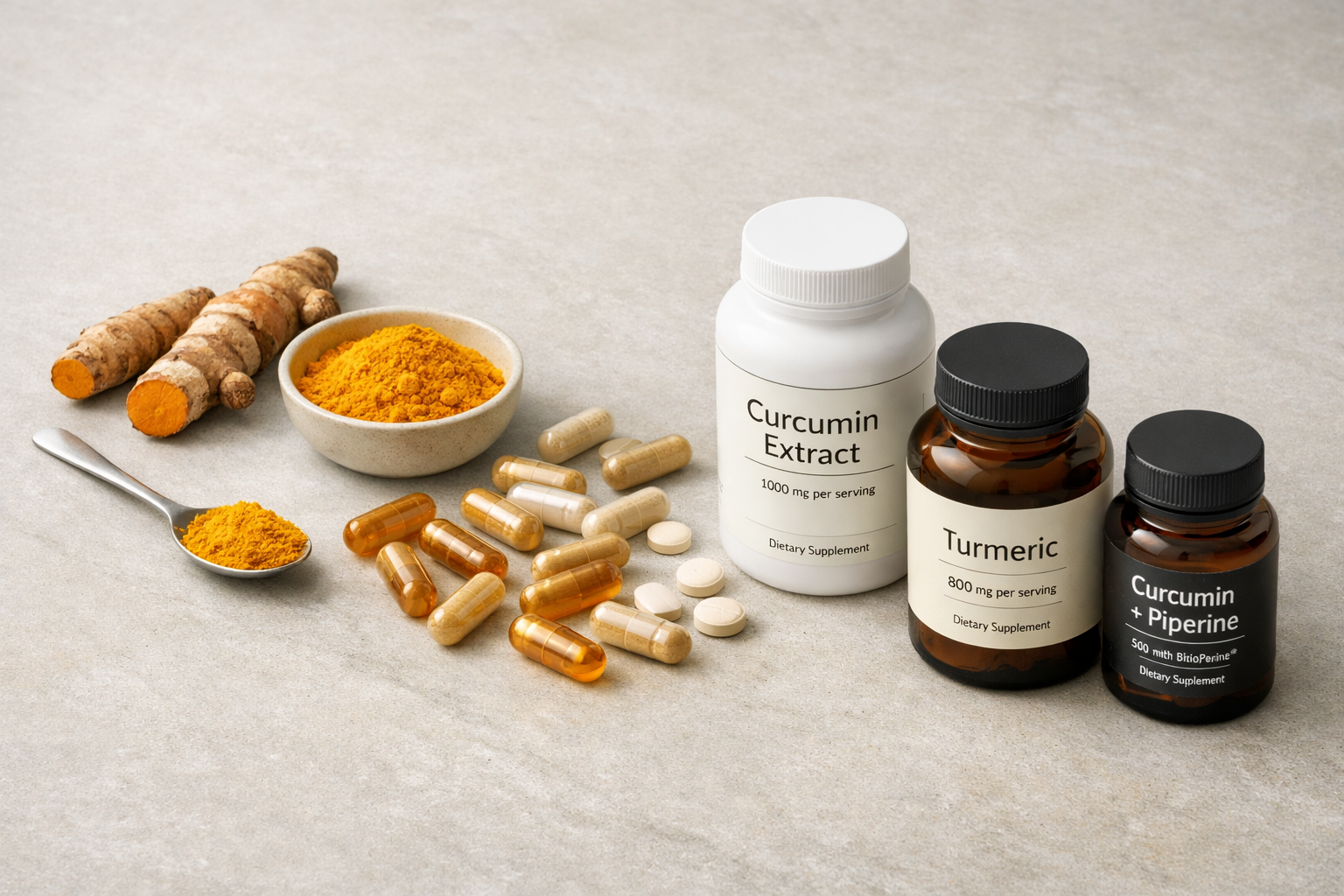
Products range from plain turmeric powder to standardized curcumin extracts and enhanced-bioavailability forms with piperine, phospholipids, or novel carriers.
Interactions
Curcumin may add to the effects of anticoagulant or antiplatelet products and may alter exposure to medicines or supplements that affect drug metabolism. Piperine can further increase interaction concerns.
Side effects
Short-term use is often tolerated, but stomach upset can occur. Rare liver injury has been reported, especially with enhanced formulations.
Other possible benefits
Emerging research suggests possible adjunctive benefits in ulcerative colitis, mood symptoms in some chronic disease settings, and selected metabolic or inflammatory markers.
Regulatory status
In the US it is sold as a dietary supplement without premarket efficacy approval. In the EU no general joint-function health claim is authorized, and EMA traditional use is limited to mild digestive complaints in adults.
What We Already Know About It
Bioavailability is the key issue. The most established scientific point is that curcumin is biologically active but difficult to absorb. Oral curcumin has low systemic bioavailability because it is poorly absorbed and rapidly metabolized, which is why manufacturers use piperine combinations, phospholipid complexes, and other delivery technologies. This also means that two products both labeled as curcumin may behave very differently in the body. (Linus Pauling Institute — Curcumin; PubMed — Bjelakovic et al. 2024 bioavailability methodology study)
Clinical evidence is uneven. The strongest human evidence supports modest short-term symptomatic benefit in osteoarthritis, especially knee osteoarthritis. Multiple meta-analyses report improvements in pain, function, and stiffness, and some analyses suggest results similar to NSAIDs over short study periods. Beyond joints, the literature shows signals for selected metabolic and inflammatory biomarkers and for adjunctive use in ulcerative colitis, but these areas are less mature and appear more dependent on formulation and study design. (PubMed — Zeng et al. 2021 osteoarthritis meta-analysis; PubMed — Bideshki et al. 2024 meta-analysis of meta-analyses; PubMed — Jafari et al. 2024 meta-analysis of 103 trials; PubMed — Sadeghi et al. 2019 ulcerative colitis meta-analysis)
Regulators remain cautious. What looks promising is not the same as what is considered proven. NCCIH states that there is still not enough evidence to definitively conclude benefit for any health purpose, EFSA rejected a general joint-function health claim, and EMA limits herbal medicinal recognition to traditional use for mild digestive complaints in adults rather than modern proof for arthritis or metabolic conditions. Overall, the evidence base is best described as moderate for osteoarthritis symptom relief and preliminary to limited for many other popular claims. (NCCIH — Turmeric: Usefulness and Safety; EFSA — Curcumin and normal joint function claim opinion; EMA — Curcumae longae rhizoma monograph)
Summary of Relevant Scientific Research
Cautious overview of benefits and safety — NCCIH
NCCIH notes that turmeric and curcumin have been studied for osteoarthritis, fatty liver disease, and lipid disorders, but says current evidence is still not strong enough to definitively conclude benefit for any health purpose. It also highlights an important safety concern: highly bioavailable turmeric or curcumin products may harm the liver. (NCCIH — Turmeric: Usefulness and Safety)
Large meta-analysis across 103 trials — Jafari et al. 2024
This synthesis covered 7,216 participants and found statistically significant effects for 23 of 42 outcomes. The more credible signals were for fasting blood glucose, C-reactive protein, HDL cholesterol, and weight, but certainty ranged from higher to very low depending on the endpoint, showing why positive biomarker findings do not automatically translate into clear clinical benefit. (PubMed — Jafari et al. 2024 meta-analysis of 103 trials)
Osteoarthritis has the clearest human signal — Zeng et al. 2021 and later reviews
Among clinical use-cases, osteoarthritis stands out most clearly. Meta-analyses report improvements in pain, function, and stiffness versus placebo, with some short-term outcomes appearing similar to NSAIDs. At the same time, product heterogeneity, short trial duration, and weak review quality mean the findings support modest symptomatic benefit rather than a proven disease-modifying effect. (PubMed — Zeng et al. 2021 osteoarthritis meta-analysis; PubMed — Bideshki et al. 2024 meta-analysis of meta-analyses; PubMed — 2025 critical review of knee osteoarthritis reviews)
Ulcerative colitis as add-on therapy — Sadeghi et al. and Cochrane
Evidence for ulcerative colitis is promising but limited. Reviews suggest that curcumin may improve clinical and endoscopic remission outcomes when used alongside mesalamine or sulfasalazine, and may help maintain remission. The small trial base means it is best viewed as a possible adjunct rather than a replacement treatment. (PubMed — Sadeghi et al. 2019 ulcerative colitis meta-analysis; Cochrane — Curcumin for maintenance of remission in ulcerative colitis)
Liver injury changes the safety discussion — LiverTox, DILIN, and JAMA Network Open
Safety reviews no longer treat turmeric supplements as automatically harmless. LiverTox describes turmeric as a likely cause of clinically apparent liver injury in some users, especially with piperine-containing or otherwise enhanced-bioavailability products. The DILIN case series reported 10 high-confidence US cases, and a national exposure analysis found turmeric was the most commonly used among several potentially hepatotoxic botanicals surveyed. (LiverTox — Turmeric; PubMed — DILIN turmeric-induced liver injury case series; JAMA Network Open — Exposure to potentially hepatotoxic botanicals)
Beliefs, Myths & Unproven Claims
Myth: turmeric is proven for almost every inflammatory condition
The research does not support that sweeping claim. Large syntheses show effects on some biomarkers and symptoms, but the quality and certainty of evidence vary widely by condition, product, and endpoint. Official sources remain cautious, and NCCIH states that evidence is still insufficient to definitively conclude benefit for any health purpose. (NCCIH — Turmeric: Usefulness and Safety; PubMed — Jafari et al. 2024 meta-analysis of 103 trials)
Myth: all curcumin supplements are basically the same
They are not. Poor baseline absorption means that products using piperine, phospholipids, nanoparticles, or other delivery systems may produce very different blood levels, and many reviews do not separate these product types well. Market testing also suggests that label accuracy is not always reliable. (PubMed — Bjelakovic et al. 2024 bioavailability methodology study; ACS Food Science & Technology — Turmeric supplement label accuracy analysis)
Myth: adding piperine only makes curcumin better
Piperine can increase exposure, but higher exposure is not automatically an advantage in every person. It may also increase the chance of drug interactions or contribute to safety concerns, especially when combined with medicines or used long term at high dose. (Linus Pauling Institute — Curcumin; LiverTox — Turmeric; BfR — Curcumin in food supplements opinion)
Myth: natural means risk-free, and food use equals supplement safety
Culinary turmeric and concentrated supplements are not the same exposure. Food use is generally low risk, but most clinical studies use standardized extracts rather than ordinary dietary amounts, and concentrated products can interact with medicines and have been linked to rare but significant liver injury. (FDA — Dietary Supplements 101; PubMed — DILIN turmeric-induced liver injury case series)
Detailed Research Observations
Traditional use is not the same as modern proof
Turmeric has a long history in Indian, Chinese, Islamic, and Thai traditional medicine systems, where it has been used for digestive complaints, skin conditions, common cold symptoms, joint complaints, abdominal discomfort, and liver-related complaints. That traditional background helps explain why it remains so popular in supplement form today, but it should not be treated as equivalent to modern clinical confirmation. Historical use may suggest plausibility, yet it does not establish the magnitude, consistency, or safety profile of concentrated modern extracts. (NCCIH — Turmeric: Usefulness and Safety)
This distinction matters in regulation as well as science. In Europe, the EMA herbal monograph recognizes Curcumae longae rhizoma only on a traditional-use basis for relieving mild digestive complaints in adults. That recognition explicitly separates long-standing use from robust modern efficacy evidence and should not be read as approval for arthritis, depression, liver support, or broad anti-inflammatory claims. (EMA — Curcumae longae rhizoma monograph)
Turmeric, curcumin, and formulation are not interchangeable
Consumers often use the words turmeric and curcumin as though they mean the same thing, but the source article makes clear that they do not. Turmeric is the whole rhizome or its powdered extract, while curcumin is one of the main curcuminoids and the compound most often studied in supplements. Commercial products may contain plain turmeric powder, standardized curcuminoid extracts, curcumin paired with piperine, phospholipid complexes, or other enhanced-delivery systems. Those differences can materially change the expected potency, exposure, and safety profile, even when the front label uses similar wording. (Linus Pauling Institute — Curcumin; LiverTox — Turmeric)
That product diversity is not a minor technical detail; it is central to interpreting the evidence. A consumer may assume that a positive study on one formulation applies to any turmeric capsule on the shelf, but the article repeatedly warns against that shortcut. Because formulations differ so much, the biology, effective dose, and risk profile may differ too. (Linus Pauling Institute — Curcumin)
Bioavailability is the central practical problem
One of the clearest findings in the entire literature is that oral curcumin has poor and variable bioavailability. It is rapidly metabolized and does not easily produce high systemic levels unless the formulation is modified. This is why manufacturers add piperine or use phospholipids, nanoparticles, and other delivery systems. In practical terms, two products that look similar on a label may expose the body to very different amounts of curcumin after swallowing them. (Linus Pauling Institute — Curcumin)
The source article also points out that the research literature has not kept pace with that complexity. A methodological study found that among 171 systematic reviews, only a small minority analyzed results according to bioavailability differences. So even when meta-analyses look large and authoritative, they may still be blending together products that are not genuinely comparable. That helps explain why the field can look both promising and frustratingly hard to apply in real life. (PubMed — Bjelakovic et al. 2024 bioavailability methodology study)
Osteoarthritis has the clearest clinical support
If one condition stands out in the human data, it is osteoarthritis, especially knee osteoarthritis. Multiple meta-analyses report improvements in pain, function, and stiffness compared with placebo, and some analyses suggest short-term effects similar to NSAIDs on several outcomes. This makes curcumin one of the more plausible supplement options for symptom-management discussions when people are specifically looking at osteoarthritis, not generalized inflammation claims. (PubMed — Zeng et al. 2021 osteoarthritis meta-analysis; PubMed — Bideshki et al. 2024 meta-analysis of meta-analyses)
Even here, though, the evidence is not definitive at the highest standard. Trials are commonly short, products differ sharply, and a 2025 critical review argued that many systematic reviews in this area are themselves methodologically weak. The fairest interpretation in the article is not that curcumin is disproven, but that the signal looks real yet modest, product-specific, and still short of the sweeping certainty often implied in marketing. (PubMed — 2025 critical review of knee osteoarthritis reviews)
Other benefits are promising, but more conditional
Beyond osteoarthritis, the article identifies several areas with encouraging but less mature evidence. In ulcerative colitis, curcumin appears most promising as an adjunct to standard therapy rather than a stand-alone treatment. A meta-analysis and a Cochrane review both suggest it may help maintain remission or improve outcomes when added to mesalamine or sulfasalazine, but the total trial base is still small. (PubMed — Sadeghi et al. 2019 ulcerative colitis meta-analysis; Cochrane — Curcumin for maintenance of remission in ulcerative colitis)
Mood-related findings are also described as intriguing rather than settled. A 2025 review found adjunctive benefits for depression and anxiety symptoms in chronic disease contexts, while a 2024 meta-analysis across 103 trials found positive signals for some biomarkers such as fasting glucose, C-reactive protein, HDL, and weight. Together, those findings suggest real physiological activity without proving that curcumin is a broadly reliable solution for every metabolic, psychiatric, or inflammatory problem. (PubMed — 2025 review on depression and anxiety in chronic disease; PubMed — Jafari et al. 2024 meta-analysis of 103 trials)
Product quality and safety complicate real-world use
The article emphasizes that research findings are only as useful as the products people actually buy. An ACS Food Science & Technology analysis of sampled US turmeric supplements found substantial inconsistency between labels and measured curcuminoid content, with only three of ten products matching label expectations. Although that sample was limited, it highlights a practical problem: a consumer may buy something that does not actually match the dose or composition used in trials. (ACS Food Science & Technology — Turmeric supplement label accuracy analysis)
Safety concerns have also become more important in recent years. Short-term use is often tolerated, but official and clinical sources now recognize a real signal for idiosyncratic hepatocellular liver injury, particularly with piperine-containing or otherwise enhanced-bioavailability formulations. LiverTox describes turmeric as a likely cause of clinically apparent liver injury in some cases, and the Drug-Induced Liver Injury Network reported 10 high-confidence US cases. The article’s overall point is not that harm is common, but that widespread use can make a rare adverse event clinically significant. (LiverTox — Turmeric; PubMed — DILIN turmeric-induced liver injury case series; JAMA Network Open — Exposure to potentially hepatotoxic botanicals)
Regulation allows sale, but does not broadly validate claims
The US and EU both allow turmeric or curcumin products on the market, but neither system treats that availability as proof of broad effectiveness. In the United States, these products are generally regulated as dietary supplements, which means they are not approved by the FDA for effectiveness before marketing. Manufacturers carry responsibility for safety and labeling, and disease-treatment claims can trigger drug regulation. (FDA — Dietary Supplements 101)
In Europe, EFSA rejected a proposed claim that curcumin helps maintain normal joint function because a cause-and-effect relationship was not established for the healthy population. EMA supports only traditional herbal medicinal use for mild digestive complaints in adults, while bodies such as BfR and AESAN use EFSA’s acceptable daily intake as a precautionary reference and warn that enhanced-bioavailability products complicate safety assessment. The article’s plain-language takeaway is that legal availability should not be mistaken for strong regulatory endorsement of broad health benefits. (EFSA — Curcumin and normal joint function claim opinion; EMA — Curcumae longae rhizoma monograph; BfR — Curcumin in food supplements opinion; AESAN — Curcumin in food supplements report)
Regulatory Status (EU and US)
United States
Turmeric and curcumin products are generally regulated as dietary supplements. They are not approved by the FDA for safety or effectiveness before reaching the market; manufacturers are responsible for product safety, quality control, and labeling, while the FDA mainly acts after marketing when products are adulterated, misbranded, or make illegal disease-treatment claims. (FDA — Dietary Supplements 101)
European Union
EFSA concluded that a cause-and-effect relationship had not been established for a general joint-function health claim, so no such claim is authorized. EMA recognizes turmeric only for traditional herbal medicinal use in relieving mild digestive complaints in adults, which is not the same as modern proof for arthritis or broader claims. EFSA’s acceptable daily intake of 3 mg/kg/day for curcumin as food additive E100 is used by bodies such as BfR and AESAN as a precautionary reference, with added concern that enhanced-bioavailability products complicate safety assessment. (EFSA — Curcumin and normal joint function claim opinion; EMA — Curcumae longae rhizoma monograph; EFSA — Curcumin acceptable daily intake opinion; BfR — Curcumin in food supplements opinion; AESAN — Curcumin in food supplements report)
Dosage and Standardization
Studied ranges: Labels and trials span roughly 100 mg to over 1,000 mg/day depending on formulation. Osteoarthritis trials often use about 500 mg twice daily to 1,500–2,000 mg/day; ulcerative colitis adjunctive studies often use about 2 g/day.
Safety And Interactions
Major concern: Short-term curcumin supplementation is often tolerated, but the best-documented modern safety issue is rare hepatocellular liver injury, typically appearing after roughly 1 to 4 months and noted especially with piperine-containing or other enhanced-bioavailability products.
Interactions: Curcumin may affect anticoagulants and antiplatelet drugs and may interact with sulfasalazine, CYP3A4 substrates, transporter-mediated drugs, and possibly some chemotherapy regimens. Piperine can further alter drug exposure.
Other cautions: Gastrointestinal upset can occur. Extra caution is advised in pregnancy, breastfeeding, children and adolescents, people with liver disease, people taking multiple medicines, and anyone using anticoagulant or antiplatelet therapy. If jaundice, dark urine, unusual fatigue, or abdominal pain appear after starting a turmeric supplement, the product should be stopped and medical advice sought promptly.
Conclusion
Turmeric and curcumin supplements have real biological activity, but their practical value is highly product-specific. The best-supported use is modest short-term symptom relief in osteoarthritis, especially knee osteoarthritis, while evidence for adjunctive use in ulcerative colitis, mood symptoms, and some metabolic or inflammatory markers remains promising but less definitive.
Poor oral bioavailability, major formulation differences, inconsistent supplement quality, and rare but clinically important liver injury make broad marketing claims unreliable. These products are legally available in the US and Europe, but that should not be confused with strong approval of wide-ranging health benefits. At present, curcumin is best viewed as a potentially useful but not universally proven supplement whose benefits and risks depend heavily on the exact product and the person taking it.
Disclaimer
Disclaimer: We attempt to do our best to find relevant, accurate and most up to date information available in both, the public domain and in the clinical and medical research community. We recommend reviewing scientific sources for official information on the subject. This post is not intended as medical advice. Each individual person's health conditions vary and we advise to consult a doctor before taking any supplements.