

 Deutsch
 Español
 Suomi
Suomi Français
 Bahasa Indonesia
 Italiano
 日本語
日本語 Português
 Tagalog
Summary
Choline is an essential nutrient used to build membrane phospholipids, make the neurotransmitter acetylcholine, support methylation, and help move fat out of the liver. The strongest evidence for choline is not as a broad performance supplement, but as a basic nutrition need that helps prevent deficiency-related liver and muscle problems.
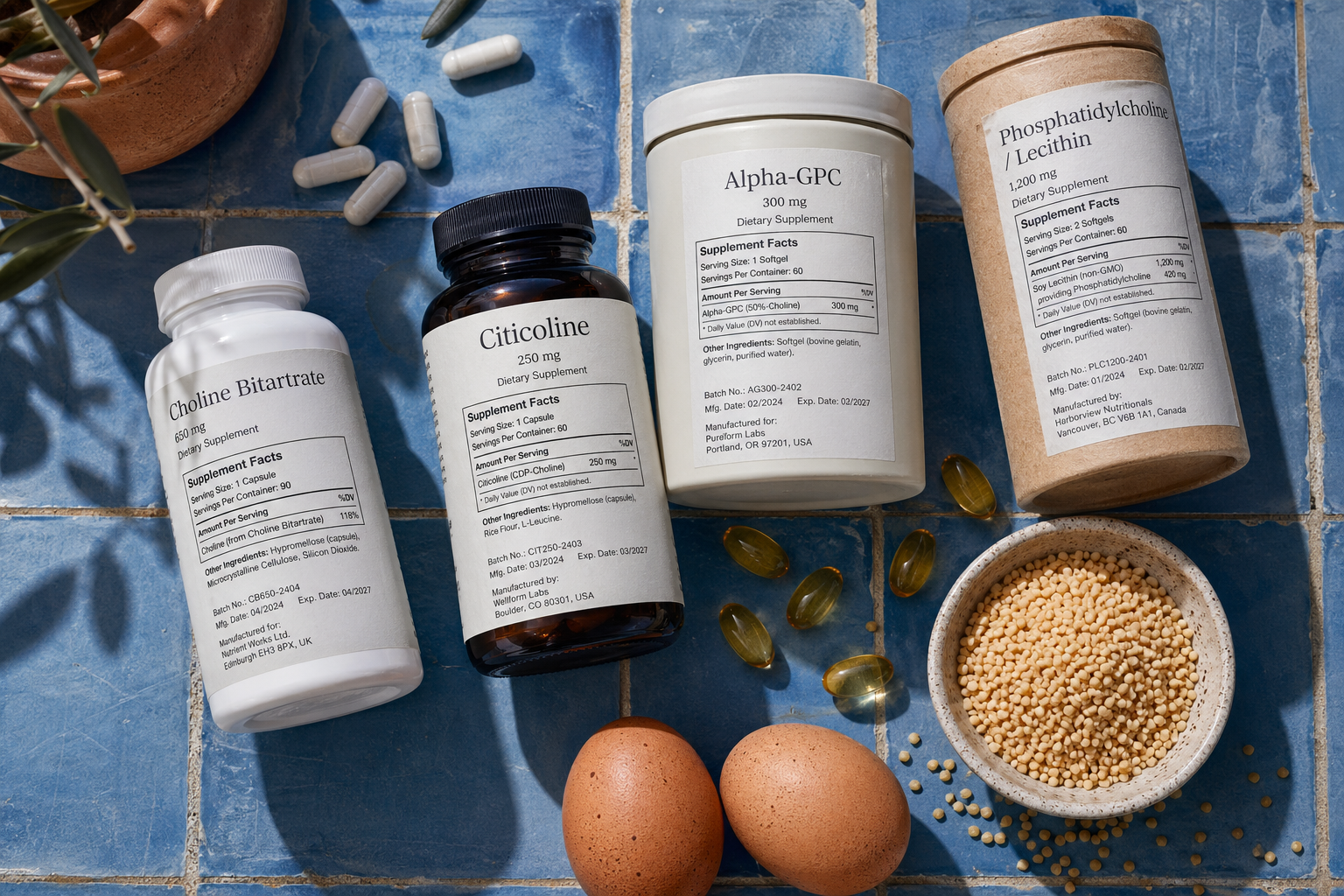
Supplement forms differ meaningfully. Choline bitartrate and choline chloride mainly serve as nutrient-delivery forms, while phosphatidylcholine and lecithin fit membrane and adequacy uses. Citicoline has the clearest cognition-specific human evidence among common forms reviewed here, and alpha-GPC appears promising but remains less established and more complicated from a regulatory perspective. Food-first adequacy remains the most defensible practical approach.
Quick Facts
What is it useful for?
Choline is essential for liver function, acetylcholine production, cell-membrane structure, and normal methylation.
Supplement types
Common forms include choline bitartrate, phosphatidylcholine, lecithin, citicoline, alpha-GPC, and choline chloride.
Interactions
No major clinically relevant medication interactions are established for choline itself, but very high combined intakes can raise side-effect risk.
Side effects
Excessive intake can cause fishy body odor, sweating, salivation, vomiting, low blood pressure, and possible liver-related problems.
Other possible benefits
Some forms may improve biomarkers such as plasma choline, betaine, or homocysteine, and citicoline or alpha-GPC may help some cognitive outcomes.
Regulatory status
Choline is allowed in US supplements and has specific authorized EU health claims, but disease-treatment claims are not permitted and alpha-GPC has EU novel-food complexity.
What We Already Know About It
Core biology. Choline is reasonably established as essential for normal human physiology. The body uses it to make phosphatidylcholine and sphingomyelin, two major membrane phospholipids, to synthesize acetylcholine for nerve signaling, and to donate methyl groups through betaine metabolism. Choline also supports lipid transport out of the liver, which helps explain why deficiency can contribute to liver dysfunction and, in depletion settings, liver and muscle damage. This foundational nutritional role is much better established than many narrower marketing claims. NIH ODS — Choline Fact Sheet; NCBI Bookshelf — Choline
Evidence hierarchy. The evidence becomes more mixed when the goal shifts from adequacy to performance or therapeutic benefits. For general nutrition, the strongest case is getting enough choline from diet or supplements when intake is low. For cognition, the evidence is form-specific rather than interchangeable: citicoline has some credible human trial data, alpha-GPC has emerging but still limited evidence, and simpler forms such as choline bitartrate are mainly supported as nutrient-delivery forms that raise blood choline. Pregnancy is also important because low intake appears common, but intervention studies do not justify sweeping claims that supplementation reliably improves child cognitive outcomes in all groups. PubMed — Nakazaki et al. citicoline memory trial; PubMed — Kim et al. alpha-GPC trial; PubMed — Nguyen et al. pregnancy intake review; PubMed — Cheatham et al. pregnancy trial
Summary of Relevant Scientific Research
Essentiality and intake benchmarks — NIH ODS and EFSA
Official US and EU reviews agree that choline is an essential nutrient and use Adequate Intakes rather than stronger requirement estimates, showing both established biological importance and remaining uncertainty about exact requirements. NIH ODS — Choline Fact Sheet; EFSA — Dietary Reference Values for Choline
Genetic differences change choline needs — da Costa et al.
Controlled feeding research found that common genetic polymorphisms in choline metabolism influenced vulnerability to organ dysfunction during low-choline intake, helping explain why some people appear more susceptible to inadequacy than others. PubMed — da Costa et al. choline requirement genetics
Food form can change bioavailability — Smolders et al.
In a randomized crossover trial, egg-yolk phospholipids produced a substantially larger plasma choline response than the same nominal dose from choline bitartrate, suggesting that source and chemical form affect short-term bioavailability markers. PubMed — Smolders et al. egg-yolk phospholipids vs bitartrate
Pregnancy evidence supports adequacy, not hype — Nguyen et al. and Cheatham et al.
Recent review data suggest many pregnant women do not meet recommended choline intake, but one randomized trial of phosphatidylcholine supplementation during pregnancy and postpartum did not improve measured infant cognition in women whose diets already supplied moderate choline. PubMed — Nguyen et al. pregnancy intake review; PubMed — Cheatham et al. pregnancy trial
Cognition-focused forms show mixed but more targeted signals — Citicoline and alpha-GPC studies
Citicoline improved some memory measures in older adults with age-associated memory impairment, and alpha-GPC has encouraging newer data in amnestic mild cognitive impairment. However, pooled stroke evidence does not justify broad disease-treatment claims, and benefits remain indication-specific rather than universal. PubMed — Nakazaki et al. citicoline memory trial; PubMed — Grieb et al. citicoline systematic review; PubMed — Sagaro and Amenta stroke meta-analysis; PubMed — Kim et al. alpha-GPC trial
Beliefs, Myths & Unproven Claims
Myth: “Choline acid” is a separate standard nutrient
Authoritative references use choline as the standard nutrient name. In consumer use, “choline acid” usually reflects confusion about choline itself or about a specific compound such as choline bitartrate, phosphatidylcholine, citicoline, alpha-GPC, or choline chloride. NIH ODS — Choline Fact Sheet; NCBI Bookshelf — Choline Compounds
Myth: All choline supplements work the same for the brain
The reviewed evidence does not support treating all forms as interchangeable. Choline bitartrate can raise circulating choline, but that is not the same as proving cognitive improvement, while citicoline and alpha-GPC have more targeted human cognition data. PubMed — choline bitartrate biomarker trial; PubMed — Nakazaki et al. citicoline memory trial; PubMed — Kim et al. alpha-GPC trial
Myth: More choline is always better
Official guidance includes an adult upper intake level because excessive intake can cause fishy body odor, low blood pressure, vomiting, sweating, increased salivation, and possible liver-related problems. Regulatory language is also limited: supplements cannot legally make disease-treatment claims, and EU claims are restricted to specific authorized functions. NCBI Bookshelf — Choline; NIH ODS — Choline Fact Sheet; FDA — Structure/Function Claims; EUR-Lex — EU Authorized Choline Claims
Detailed Research Observations
Essentiality and deficiency risk are the strongest part of the evidence base
Choline is best understood first as an essential nutrient, not as a niche performance ingredient. The body cannot reliably make enough to cover needs, so intake from food or supplements matters. Its established functions include membrane phospholipid synthesis, acetylcholine production, methyl-group metabolism, and liver fat handling. That helps explain why low intake is linked less to vague “wellness” issues and more to measurable problems such as liver dysfunction and muscle damage in depletion settings. Official guidance was built in part from depletion-repletion data, which is why the prevention of deficiency-related problems remains the most defensible reason to care about choline status. NIH ODS — Choline Fact Sheet; NCBI Bookshelf — Choline
Need is also not identical for everyone. Controlled feeding work showed that common genetic polymorphisms in choline metabolism can alter vulnerability to organ dysfunction during low-choline intake. This is an important practical observation because it helps explain why some people may show signs of inadequacy even when average population intake data do not look alarming. Pregnancy, long-term parenteral nutrition, and certain genetically susceptible individuals are repeatedly highlighted as situations where adequacy deserves extra attention. PubMed — da Costa et al. choline requirement genetics; NIH ODS — Choline Fact Sheet
Food sources and supplement labels should not be treated as physiologically identical
Foods provide choline in a mixed dietary matrix rather than as an isolated ingredient. Eggs and other animal foods are commonly emphasized in practice, often supplying phosphatidylcholine and related phospholipids alongside protein, fats, vitamins, and minerals. Supplements, by contrast, deliver a labeled dose of a defined chemical form. That makes them useful when intake is low or when a consumer is intentionally selecting a form such as citicoline for its specific evidence base, but it also means that equal-looking label amounts do not necessarily imply equal biological behavior. NIH ODS — Choline Fact Sheet
A practical example comes from a randomized crossover study comparing egg-yolk phospholipids with choline bitartrate. At the same nominal choline dose, the phospholipid-rich egg source produced a much larger plasma choline response. That does not prove better long-term health outcomes from egg-based sources, but it strongly suggests that chemical form and food matrix can influence short-term bioavailability. It also supports the article’s broader point that food sources, phosphatidylcholine-rich products, and simple salts should not automatically be discussed as if they were interchangeable. PubMed — Smolders et al. egg-yolk phospholipids vs bitartrate
Simple salts mainly serve as nutrient-delivery forms
Choline bitartrate and choline chloride are the most straightforward forms from a nutrition standpoint. Their main value is delivering choline efficiently and often economically when intake is low or when a product is designed to raise choline status. In a randomized trial in healthy postmenopausal women, 1 g/day of choline as choline bitartrate increased plasma choline and betaine over 6 and 12 weeks. That finding supports a practical role for bitartrate in improving biomarker status and helping close an intake gap. PubMed — choline bitartrate biomarker trial
What these data do not show is just as important. Raising plasma choline is not the same as proving improved memory, better everyday cognition, or disease modification. The reviewed material repeatedly treats simple salts as nutrient-delivery tools rather than broadly proven nootropics. Choline chloride is also a legitimate choline source used in fortification and some products, but the consumer-facing outcome evidence around cognition is much thinner than it is for citicoline or alpha-GPC. NCBI Bookshelf — Choline Compounds; NIH ODS — Choline Fact Sheet
Phosphatidylcholine and lecithin fit nutrient and membrane-focused uses better than big brain claims
Phosphatidylcholine is both a natural dietary form and a supplement ingredient, while lecithin products are usually mixtures rich in phospholipids rather than a precise dose of free choline. That difference matters because consumers often read “lecithin” as if it were equivalent to a defined amount of choline or to a targeted nootropic compound. The reviewed evidence supports a more careful interpretation: these forms fit membrane biology, liver-related roles, and nutrient adequacy better than sweeping cognitive promises. NCBI Bookshelf — Choline Compounds; NIH ODS — Choline Fact Sheet
Human research also suggests that phosphatidylcholine can influence methylation-related biomarkers. In a crossover study, roughly 2.6 g choline per day as phosphatidylcholine lowered fasting and post-methionine-load homocysteine in healthy men. That result fits choline’s role in methylation and homocysteine metabolism, but it does not prove reduced cardiovascular events or justify extrapolating to unrelated outcomes. For readers, the defensible message is that phosphatidylcholine may affect relevant biomarkers, yet the clinical meaning remains narrower than common supplement marketing often implies. PubMed — phosphatidylcholine and homocysteine study; EUR-Lex — EU Authorized Choline Claims
Citicoline and alpha-GPC have the most targeted cognition evidence, but it is still form-specific
Citicoline stands out because its evidence base is more cognition-oriented than that of generic choline salts. In a 12-week randomized placebo-controlled trial, 500 mg/day improved composite memory and episodic memory in older adults with age-associated memory impairment. A broader systematic review concluded that citicoline has been studied across several neurological indications, but its benefits are clearer in some areas than others and remain uncertain in settings such as brain trauma. The clean interpretation is not that citicoline is a universally proven brain supplement, but that it has a more credible form-specific evidence base than bitartrate or choline chloride for certain cognitive questions. PubMed — Nakazaki et al. citicoline memory trial; PubMed — Grieb et al. citicoline systematic review
Alpha-GPC, also called choline alphoscerate, occupies a similar but still emerging space. A newer placebo-controlled trial reported cognitive improvement in participants with amnestic mild cognitive impairment, and a stroke-related meta-analysis found some encouraging signals for alpha-GPC compared with the more clearly disappointing pooled citicoline results for acute stroke outcomes. Even so, the evidence base is not large or consistent enough to justify broad nootropic claims for healthy adults. The article’s broader point holds: benefits must be tied to the exact form and population actually studied. PubMed — Kim et al. alpha-GPC trial; PubMed — Sagaro and Amenta stroke meta-analysis
Pregnancy and regulation both demand a careful, non-exaggerated interpretation
Pregnancy is one of the clearest stages where choline deserves attention. Official guidance raises intake targets in pregnancy and lactation, and a recent systematic review found that only a minority of pregnant women met recommended intake levels. That supports prioritizing dietary assessment and, when needed, thoughtful supplementation. But it does not mean that every pregnancy supplement claim is justified. In one randomized trial, phosphatidylcholine supplementation from mid-pregnancy into postpartum did not improve measured infant cognition in women whose diets already supplied moderate choline. Adequacy matters; guaranteed developmental enhancement is not established. EFSA — Dietary Reference Values for Choline; NIH ODS — Choline Fact Sheet; PubMed — Nguyen et al. pregnancy intake review; PubMed — Cheatham et al. pregnancy trial
Regulatory treatment also varies by form. In the US, choline is a lawful dietary ingredient and may appear in structure-function statements, but supplements cannot legally claim to diagnose, treat, cure, or prevent disease. In the EU, specific choline claims are authorized for lipid metabolism, homocysteine metabolism, and maintenance of normal liver function, while a proposed infant brain-development claim was rejected. Citicoline has a clearer novel-food footing in the EU, whereas alpha-GPC now faces added complexity because a 2024 consultation treated foods or supplements consisting of L-alpha-GPC as novel foods. FDA — Structure/Function Claims; EUR-Lex — EU Authorized Choline Claims; EUR-Lex — 2015 Brain Development Claim Decision; European Commission — Alpha-GPC Novel Food Consultation
Regulatory Status (EU and US)
United States
Choline is a lawful dietary ingredient and can also appear on food labels. Under FDA structure-function claim rules, products may describe support for normal structure or function if the wording is truthful and not misleading, but they cannot legally claim to diagnose, treat, cure, or prevent disease. FDA also permits nutrient-content claims such as “good source of choline” or “high in choline” when products meet the criteria, and the current Daily Value on labels is 550 mg for adults and children aged 4 years and older. FDA — Structure/Function Claims; FDA — Choline Nutrient Content Claims; FDA — Daily Value on Labels
European Union
The EU allows a narrower set of specific choline claims: contribution to normal lipid metabolism, contribution to normal homocysteine metabolism, and maintenance of normal liver function, provided conditions of use are met. A proposed claim linking choline to brain development in infants and young children was not authorized. Form-specific status also matters: citicoline has a clearer novel-food footing, while a 2024 consultation concluded that foods or supplements consisting of L-alpha-GPC are considered novel foods. EUR-Lex — EU Authorized Choline Claims; EUR-Lex — 2015 Brain Development Claim Decision; European Commission — Novel Food Authorisations; European Commission — Citicoline Application Summary; European Commission — Alpha-GPC Novel Food Consultation
Dosage and Standardization
Adults: US AI 550 mg/day for men and 425 mg/day for women; EFSA AI 400 mg/day for adults.
Pregnancy/lactation: US 450/550 mg and EU 480/520 mg daily.
Upper limit: 3,500 mg/day for adults. Study doses varied by form, including 1 g/day choline bitartrate and 500 mg/day citicoline.
Safety And Interactions
Choline is essential, but excessive intake can cause adverse effects. The best-established concerns are fishy body odor, vomiting, sweating, increased salivation, low blood pressure, and possible liver toxicity at high intakes. The adult upper intake level used in US guidance is 3,500 mg/day, and the article also notes that higher choline intake can increase trimethylamine N-oxide, so cardiovascular discussions around high-dose use are not uniformly positive. NIH ODS — Choline Fact Sheet; NCBI Bookshelf — Choline
For interactions, the NIH Office of Dietary Supplements reports that no clinically relevant medication interactions are known for choline itself. That is reassuring, but it does not make every high-dose combination risk-free, especially when multiple products all contribute choline. Extra caution is reasonable for pregnant or breastfeeding users, people with significant liver concerns, patients on long-term parenteral nutrition, and anyone using choline supplements as a substitute for medical care for cognitive or neurological symptoms. NIH ODS — Choline Fact Sheet; NCBI Bookshelf — Choline Compounds
Conclusion
Choline is best understood first as an essential nutrient and only second as a supplement category. The strongest evidence supports its roles in cell membranes, acetylcholine synthesis, methylation, liver function, and the prevention of deficiency-related problems. That basic case is solid.
The evidence becomes more selective when specific supplement forms are discussed. Choline bitartrate and similar salts are useful mainly for delivering choline and improving status. Phosphatidylcholine and lecithin fit nutrient and membrane-focused uses better than sweeping nootropic promises. Citicoline has the most credible cognition-specific human evidence among the commonly marketed forms reviewed here, while alpha-GPC is promising but still more emerging and regionally more complicated from a regulatory standpoint.
For general readers, the most balanced takeaway is to prioritize food-first adequacy, pay extra attention during pregnancy and other higher-risk situations, and not assume all choline products are interchangeable. More research is still needed on long-term clinical outcomes, head-to-head form comparisons, and who benefits most from supplementation beyond correcting low intake. Until then, the evidence supports careful, form-specific, non-exaggerated use.
Disclaimer
Disclaimer: We attempt to do our best to find relevant, accurate and most up to date information available in both, the public domain and in the clinical and medical research community. We recommend reviewing scientific sources for official information on the subject. This post is not intended as medical advice. Each individual person's health conditions vary and we advise to consult a doctor before taking any supplements.