

 Deutsch
 Español
 Suomi
Suomi Français
 Bahasa Indonesia
 Italiano
 日本語
日本語 Português
 Tagalog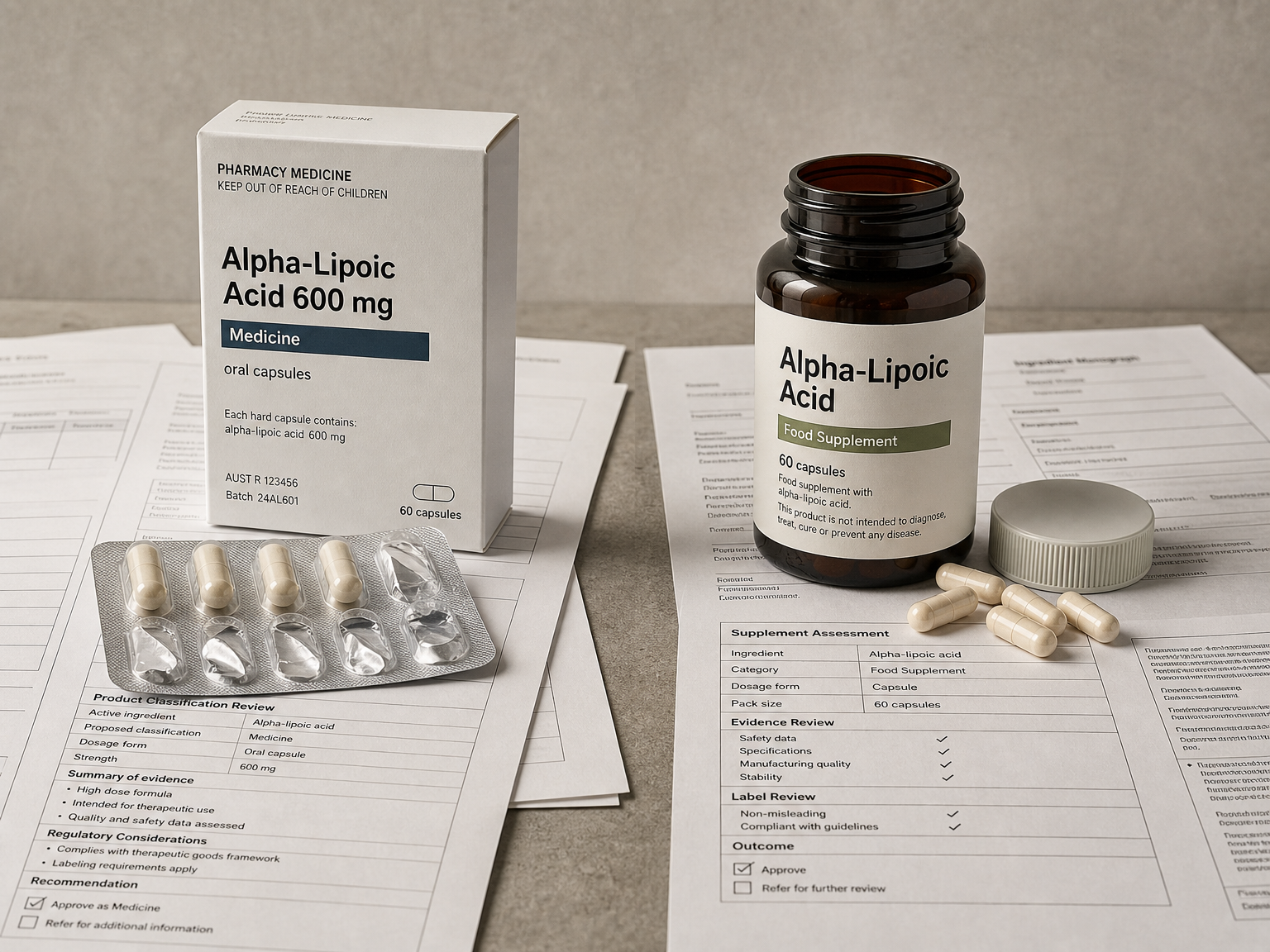

1. What is alpha-lipoic acid?
Alpha-lipoic acid is a sulfur-containing compound that the body makes in small amounts and uses in energy metabolism. It is also found in foods at low levels and sold as an alpha-lipoic acid supplement ingredient in tablets, capsules and medicinal products.
You may see the same molecule called alpha-lipoic acid, lipoic acid or thioctic acid. Some products contain a racemic mixture, meaning both R-ALA and S-ALA forms are present. Others specifically market R-ALA. That is not just chemistry trivia: different forms and formulations can behave differently in the body.
This is where the regulatory puzzle begins. A molecule can have real pharmacological effects and still be sold as a supplement in one country. It can also be authorized as a medicine for one narrow use without being approved for every claim a supplement brand might like to make.

2. How Germany treats ALA as a medicine
Germany is the clearest example of ALA’s medicinal status. Authorized German products include oral 600 mg tablets and 600 mg infusion products used for sensory disturbances in diabetic polyneuropathy. In plain English, that means nerve-related symptoms, such as abnormal sensations, linked to diabetic nerve damage.
The German Alpha-Lipogamma 600 mg tablet label gives a narrow indication: dysesthesia, or sensory disturbance, in diabetic polyneuropathy. The adult dose is 600 mg once daily, taken about 30 minutes before the first meal. The label also notes that severe symptoms may begin with infusion therapy first, and that long-term treatment may be needed.
Infusion products are more clearly medicalized. One German infusion label describes a 600 mg daily intravenous dose for 2 to 4 weeks during the initial treatment phase, followed by 300 to 600 mg per day orally afterwards. These are defined medicinal formulations, including specific salts and excipients, not generic wellness capsules.
There is another nuance: German medicinal status does not always mean prescription-only. Thiogamma 600 oral is described by its manufacturer as non-prescription but pharmacy-only. By contrast, an ALA infusion listing in the Rote Liste is restricted to healthcare professionals and is treated as prescription medicine.
The reimbursement story is also more complicated than the usual supplement-market shorthand suggests. Older discussions often describe ALA as reimbursed in Germany for diabetic neuropathy. German rules now generally exclude non-prescription medicines from statutory reimbursement unless they are listed as exceptions for serious diseases. A Brandenburg court decision noted that alpha-lipoic acid was not included on that OTC exception list in that case. So the safer statement is this: Germany has a long medicinal tradition for ALA in diabetic polyneuropathy, but routine reimbursement for oral OTC ALA should not be assumed.
3. What the clinical evidence actually says
ALA’s German medicinal history grew out of clinical trials in diabetic polyneuropathy, especially studies using intravenous 600 mg daily treatment over about three weeks. A German clinical review from the late 1990s concluded that short-term IV treatment appeared to reduce major neuropathic symptoms, while the oral evidence was more mixed.
A later meta-analysis of randomized, double-masked, placebo-controlled trials found clinically meaningful improvement in positive neuropathic symptoms and deficits with 600 mg per day IV ALA for three weeks. That remains the strongest part of the traditional case.
The picture becomes less straightforward when we move to long-term oral use. The ALADIN III trial used 600 mg per day IV for three weeks, followed in one group by 600 mg orally three times daily for six months. That oral maintenance dose, 1,800 mg per day, is much higher than the common 600 mg once-daily German tablet regimen and higher than many supplement products.
More recently, a 2023 Cochrane review concluded that ALA probably has little or no effect on neuropathy symptoms after six months, and little or no effect on impairment after 24 months in the longer-duration trials it assessed. This does not erase the short-term IV findings, but it does limit how far the prescription heritage can be stretched.
Evidence for broad claims such as antioxidant protection, glucose control, fat burning or healthy aging is much weaker in the regulatory record.
 Narrowest support: Diabetic peripheral neuropathy, especially short-term symptom relief with defined medical regimens.
 Route matters: A positive IV medicine result does not automatically transfer to an ordinary oral supplement.
 Broad claims: Antioxidant, glucose, fat-burning and aging claims are much less settled.
4. Why EFSA rejected ALA health claims
In the EU, health claims on foods and supplements are handled through a separate system. EFSA does not approve supplements as medicines. It evaluates whether a proposed food health claim is supported by evidence and worded in a way that food law allows.
In 2010, EFSA assessed proposed ALA claims related to protection of body lipids from oxidative damage, maintenance of normal blood cholesterol, increased beta-oxidation of fatty acids, maintenance of normal blood glucose and effects on gene transcription or NF-kappa B. EFSA reached unfavorable conclusions.
In 2011, EFSA looked at claims for protection of the nervous system and increased insulin sensitivity. The nervous-system claim leaned on evidence about treating diabetic polyneuropathy. EFSA judged that this was disease-treatment evidence, which is not an Article 13 general food health claim. The insulin-sensitivity claim was considered a potentially beneficial physiological effect in principle, but EFSA said the submitted evidence did not establish cause and effect.
That distinction is important. An EFSA rejection does not mean ALA has no biological effect. It means the specific proposed claim cannot be used on foods or supplements in the EU because the submitted evidence did not meet the relevant food-claim standard, the claim was framed too much like disease treatment, or both.
The EU Register of Health Claims records ALA-related claims as non-authorized. For consumers, the practical result is simple: EU supplement brands should not legally market ALA with those rejected health claims. That is a labeling decision, not a full clinical verdict on every possible medical use.
5. Why the United States treats ALA differently
In the United States, ALA is widely sold as a dietary supplement ingredient. FDA-linked database records connect ALA with many supplement labels in commerce.
That does not mean the FDA has approved ALA supplements as effective. Under the U.S. dietary supplement framework, the FDA generally does not approve supplements for safety or effectiveness before they are sold. Companies are responsible for lawful labeling and product safety, while FDA oversight is largely post-market.
So U.S. supplement status answers a different question again. It means ALA can appear in the supplement marketplace if legal requirements are met. It does not mean ALA has passed a drug-style benefit-risk review for neuropathy, glucose control or any other condition.
This is one reason the same evidence base can lead to different outcomes. German drug regulation evaluated defined medicinal products for a disease indication. EU health-claim law evaluated claims proposed for foods. U.S. supplement law allows marketing without premarket proof of effectiveness, provided the product and claims stay within the supplement rules.
6. EU member states are not uniform
Even inside the EU, ALA is not handled in exactly the same way everywhere. The European food supplement framework allows national rules and notification systems, especially for substances other than vitamins and minerals. That leaves room for different national risk judgments.
Belgium has taken a notably cautious view. Its Superior Health Council recommended considering ALA a medicine rather than a food supplement for the general population. Belgium’s medicines agency has also treated ALA as an active borderline-products issue, with recommendations being developed for ministerial guidance.
Spain’s scientific committee discussed lipoic acid in the context of food supplements and judged, from a safety perspective, that about 0.6 mg per kg body weight per day would be acceptable. For a 70 kg adult, that is roughly 42 mg per day — far below the 300 to 600 mg doses commonly seen in supplements and German medicinal products.
Italy appears to allow ALA as an other substance in supplements, with a warning advising medical advice and noting that rare cases of hypoglycemia can occur. This shows a different policy choice: allow supplement use, but attach cautionary language.
These differences do not mean one country has discovered the final truth and another has missed it. They show that borderline ingredients sit at the intersection of evidence, legal definitions, national risk tolerance and historical medical use.
7. Safety: the insulin autoimmune syndrome signal
ALA is often presented as familiar and well tolerated, but regulators have become more cautious because of insulin autoimmune syndrome, or IAS. IAS is a rare condition in which the immune system produces antibodies to insulin, which can cause episodes of low blood sugar.
In 2021, EFSA concluded that ALA added to foods, including supplements, is likely to increase IAS risk in people with certain HLA genetic variants. EFSA could not define a safe intake level below which IAS would not be expected. Reported cases involved roughly 200 to 800 mg per day.
That is a difficult finding for regulators to manage. The risk may be concentrated in genetically susceptible people, but consumers generally do not know their HLA type. EFSA also noted that both medicinal and supplement products had been implicated, which makes impurities or degradation products an unlikely sole explanation.
German medicine labels include IAS warnings. Some labels also warn about hypersensitivity reactions, including serious reactions with infusion products, and note limited experience in children. Anyone with diabetes, hypoglycemia episodes, medication use, pregnancy, or planned surgery should treat ALA as a medically relevant substance rather than a casual wellness add-on. This is why supplement safety guidance for ALA is more than a formality.
8. Is a supplement equivalent to the German medicine?
Not necessarily. This is the central practical point.
A supplement may contain the same named ingredient but differ in dose, formulation, salt form, stereochemistry, stability, release profile, excipients, manufacturing standards and monitoring. Pharmacokinetic research shows that oral alpha-lipoic acid bioavailability can vary by dosage form. The NIH Office of Dietary Supplements notes that only about 20% to 40% of an oral 50/50 R/S mixture may be absorbed.
The studied German products are specific medicinal formulations used under defined conditions. A bottle of imported or domestic supplement capsules is not automatically the same clinical product.
Germany’s medicinal history does strengthen the case that ALA is pharmacologically active and worth taking seriously. It does not prove that an ordinary supplement delivers the same benefit-risk profile, especially for long-term use or for people without diabetic neuropathy.