

 Deutsch
 Español
 Suomi
Suomi Français
 Bahasa Indonesia
 Italiano
 日本語
日本語 Português
 Tagalog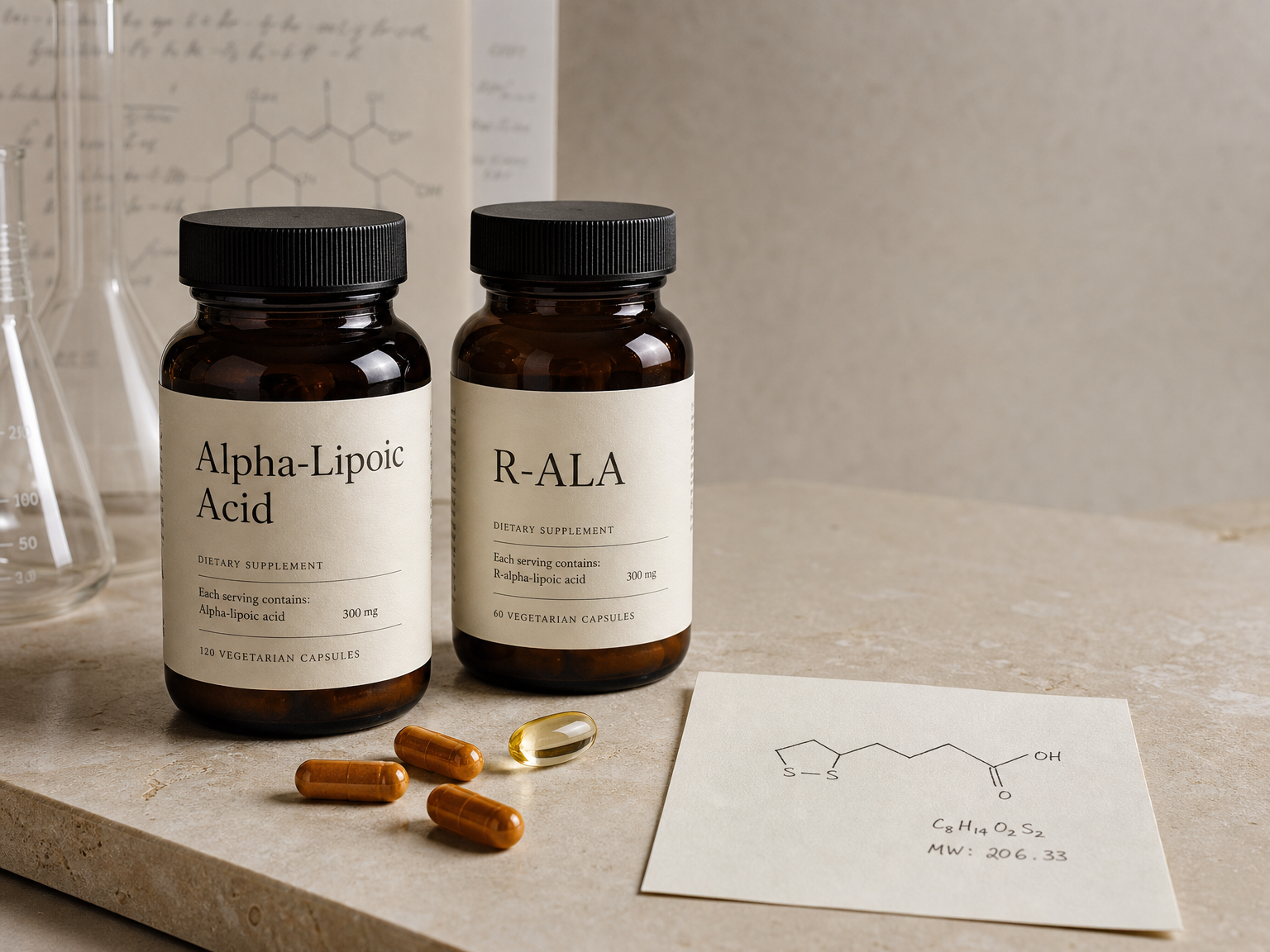

1. What is alpha-lipoic acid?
Alpha-lipoic acid is a sulfur-containing compound involved in mitochondrial energy metabolism. Mitochondria are the parts of cells that help turn food into usable energy.
In the body, lipoic acid is usually attached to proteins as part of enzyme complexes. Supplemental alpha-lipoic acid is different: it is free lipoic acid, taken in much higher amounts than you would get from food. In that setting, it behaves more like a drug-like compound than a simple nutrient top-up.
Alpha-lipoic acid comes in two mirror-image forms, known as enantiomers. These are called R-ALA and S-ALA. R-ALA is the form made in living systems. S-ALA is produced during chemical manufacturing. Conventional ALA supplements, also called thioctic acid, usually contain both forms in equal amounts.
That difference is real. The harder question is whether it changes what a supplement does for a person.

2. How the supplement forms differ
R-ALA is often marketed as the “active” or “natural form”. There is a reason for that language: it is the form used in natural mitochondrial enzyme systems. Some lab studies also suggest that S-ALA may interact differently with enzyme machinery, and in some settings could theoretically compete with R-ALA.
Still, the story is not as simple as “R good, S useless.” One enzyme study found that lipoamide dehydrogenase strongly preferred R-lipoic acid, while glutathione reductase reduced S-lipoic acid somewhat faster. Biology can be selective without being one-dimensional.
Formulation adds another layer. Free R-ALA can be chemically unstable and prone to polymerization, meaning its molecules can link together in ways that reduce usability. To get around this, some products use stabilized forms such as sodium R-lipoate. Others use complexes such as R-ALA with gamma-cyclodextrin, designed to improve solubility and absorption.
Controlled-release ALA is another category. Rather than focusing on the R-only question, these products aim to smooth the blood-level curve over time.
3. Absorption and metabolism: what human studies show
Human pharmacokinetic studies — studies that track how a compound appears in the blood, moves through the body and is cleared — show meaningful differences between forms.
In an early study in healthy volunteers, racemic ALA produced higher plasma exposure to R-ALA than to S-ALA. S-ALA was cleared faster. Later research also found roughly twofold higher bioavailability of the R form compared with the S form after racemic ALA, and showed that oral solutions produced higher exposure than tablets.
Oral ALA is absorbed quickly, but it does not stay in the bloodstream for long. One metabolism study found that absolute bioavailability was about 30%, largely because the liver extracts and metabolizes much of it before it reaches the wider circulation. Main metabolic routes included beta-oxidation and S-methylation.
Stabilized R-ALA can change the blood-level picture. Sodium R-lipoate has been reported to produce higher peak levels and total exposure than older free R-ALA comparisons. A small study of an R-ALA/gamma-cyclodextrin complex found about 2.5 times higher plasma exposure than free R-ALA at the same stated dose.
One comparison is especially useful for consumers. In a study of healthy Korean men, 300 mg R-ALA as a tromethamine salt produced R-ALA exposure similar to 600 mg racemic thioctic acid, which contains 300 mg R-ALA plus 300 mg S-ALA. A 200 mg R-ALA dose did not match it. The study also found no measurable S-ALA after R-only dosing, suggesting there was no meaningful conversion from R to S in that setting.
So yes: form can change exposure. R-only products may deliver similar R-ALA exposure at a lower labeled total dose than racemic products. Stabilized products may improve solubility and absorption. These are real differences.
4. What the evidence says about health outcomes
The human outcome evidence is much less convincing than the absorption evidence.
Most long-term human trials have used conventional racemic ALA, or have not clearly specified a pure R-only form. Direct R-ALA versus racemic ALA trials looking at long-term symptom improvement, nerve function, mobility, metabolic health or disease progression are essentially absent.
A few important findings help set realistic expectations:
 Neuropathy: Oral ALA probably has little or no effect on symptoms at 6 months.
 Long-term trials: NATHAN 1 missed its primary endpoint, with modest secondary signals.
 R-ALA trials: Signals exist, but direct long-term form comparisons are missing.
In diabetic peripheral neuropathy, a 2024 Cochrane review found that oral ALA probably has little or no effect on neuropathy symptoms at six months, and may have little or no effect on impairment.
In the four-year NATHAN 1 trial, 600 mg oral ALA daily did not significantly improve the prespecified primary composite endpoint, although some secondary nerve-impairment measures improved modestly.
In progressive multiple sclerosis, a 24-month trial of oral lipoic acid did not improve walking speed, mobility or patient-reported outcomes versus placebo, although imaging markers suggested less brain volume loss.
There are some signals worth noting. A 24-week trial of 600 mg/day R-ALA in overweight or obese adults found a modest reduction in BMI versus placebo, but no triglyceride reduction. Because that trial did not include a racemic ALA comparison group, it cannot tell us whether R-ALA is better than standard ALA.
A randomized crossover study in people with progressive multiple sclerosis compared 600 mg R-lipoic acid with 1200 mg racemic lipoic acid. It found similar absorption of the R component and fewer gastrointestinal side-effect reports with R-lipoic acid. That is useful, but it was mainly an absorption and tolerability study over days, not a long-term efficacy trial.
The fair conclusion is that R-ALA has pharmacokinetic advantages, but clinical superiority remains unproven.
5. How to compare products
If you are comparing ALA supplement products, start with what the label actually says.
“Alpha-lipoic acid” or “thioctic acid” usually means racemic ALA, unless the label clearly states R-ALA. A 600 mg racemic ALA capsule typically contains about 300 mg R-ALA and 300 mg S-ALA.
“R-alpha-lipoic acid” should mean the R form only, but quality and stability still depend on manufacturing. “Sodium R-lipoate” or “NaRLA” is a stabilized salt form. “R-ALA/gamma-cyclodextrin” is a complex intended to improve absorption.
For consumers, the most evidence-based reasons to choose one form over another are:
- transparency about the exact form and dose
- third-party testing or strong quality controls
- tolerability, especially stomach comfort
- cost per amount of R-ALA delivered
- whether the formulation matches the goal, such as fewer capsules or steadier release
It is not evidence-based to assume that the most expensive R-ALA product will produce better health outcomes than a well-made racemic ALA product.
6. Safety
ALA is generally well tolerated in clinical trials. Common side effects can include nausea, stomach upset, reflux, headache or skin reactions. Gastrointestinal effects may be more likely at higher total doses.
A rarer but more serious concern is insulin autoimmune syndrome, a condition that can cause episodes of low blood sugar. EFSA reviewed case reports linked to ALA from supplements or medicines and concluded that the risk is real, especially in genetically susceptible people. The available evidence did not allow a reassuring safe threshold to be set.
People with diabetes, a history of unexplained low blood sugar, autoimmune disease, thyroid disease, kidney disease, liver disease, or those taking glucose-lowering medication should speak with a healthcare professional before using ALA. The same applies during pregnancy or breastfeeding.