

 Deutsch
 Español
 Suomi
Suomi Français
 Bahasa Indonesia
 Italiano
 日本語
日本語 Português
 Tagalog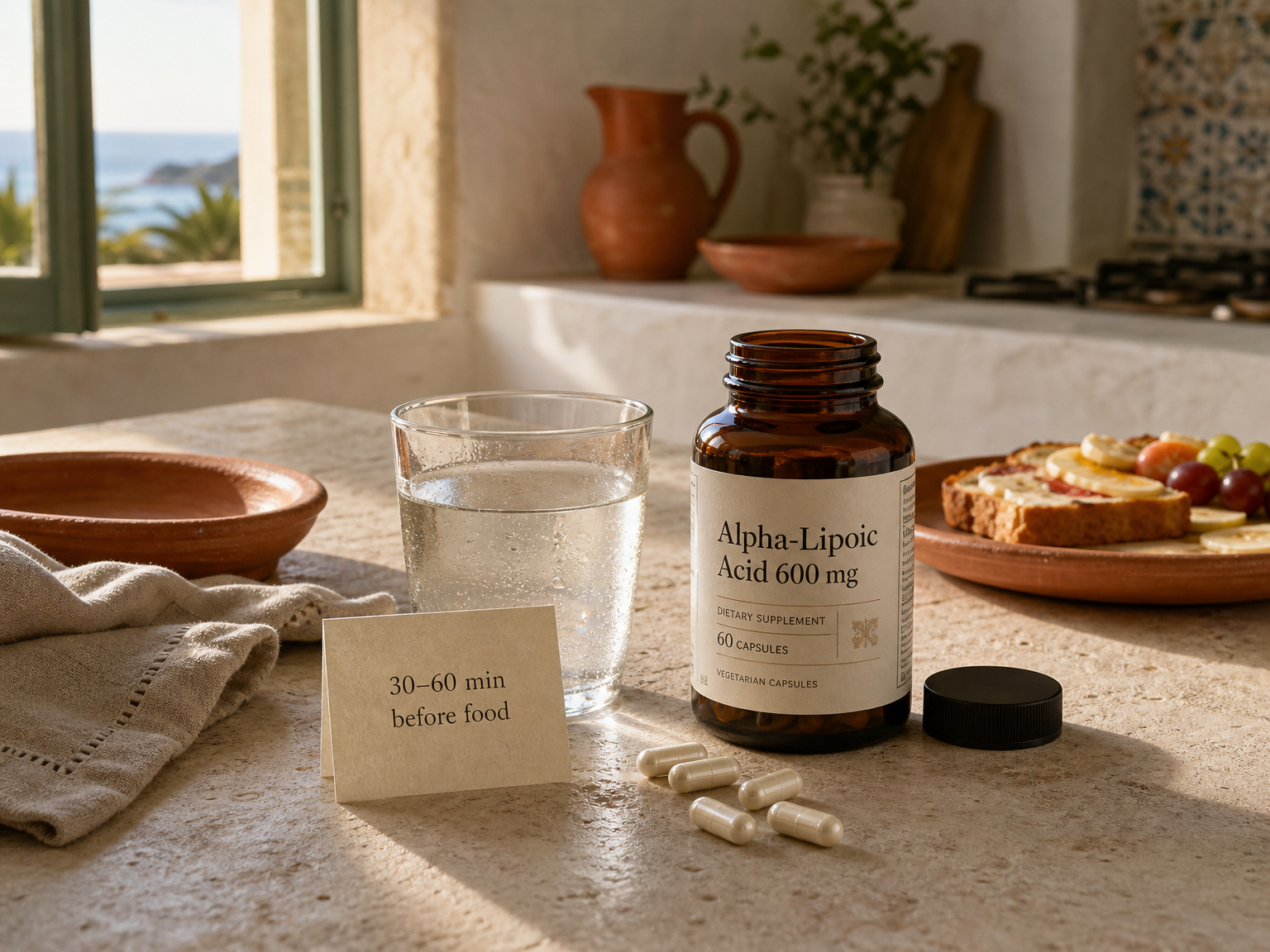

1. What is alpha-lipoic acid?
Alpha-lipoic acid is a sulfur-containing compound that the body makes in small amounts and that is also sold as a supplement. It plays a role in energy metabolism inside cells and has antioxidant properties, which means it can help neutralize reactive molecules in certain conditions.
People most often take an ALA supplement for nerve symptoms related to diabetes, blood sugar metabolism, or general antioxidant support. The most useful research on how to take it comes from pharmacokinetic studies — studies that track how much of a compound gets into the blood, how quickly it peaks, and how long it stays there.
Most ALA supplements are sold as racemic alpha-lipoic acid, a mixture of two mirror-image forms called R-lipoic acid and S-lipoic acid. Some products contain only R-lipoic acid. Human studies show that the R form can reach higher blood levels than the S form, but that does not automatically mean every R-only supplement leads to better real-world results.
2. Food and absorption: empty stomach is the clearest rule
The clearest practical finding is that food lowers oral ALA exposure. In the foundational human food-effect study, a single 600 mg oral dose was absorbed less well when it was taken with food. The Linus Pauling Institute summarizes the effect as roughly a 30% lower peak blood level and about 20% lower total blood exposure compared with taking it while fasting.
That does not mean ALA taken with food is useless. It means that, on average, less reaches the bloodstream. If you want to follow the conditions used in most absorption studies, take it away from meals.
A simple routine is:
- Take ALA first thing in the morning with water, then wait 30–60 minutes before breakfast.
- Or take it mid-afternoon, at least 2 hours after lunch and before an evening meal.
- If it upsets your stomach, taking it with a small snack may be reasonable, but absorption may be lower.
3. Does time of day matter?
There is no convincing human evidence that morning, afternoon, or evening is inherently better. ALA is absorbed quickly. In one fasted-state pharmacokinetic study, oral 600 mg ALA reached peak blood levels in roughly 20–30 minutes, depending on the formulation.
So the main timing question is not the clock. It is what else is in your stomach and what other medicines or supplements you are taking around the same time.
Morning often works well because it is easier to take ALA before breakfast than to find a fasting window later in the day. Evening can work too, as long as it is separated from dinner and from medicines with sensitive timing. If ALA gives you nausea, reflux, or light-headedness, avoid taking it right before bed.
4. Once daily or divided dosing?
The most established oral dose in clinical neuropathy research is 600 mg once daily. In the SYDNEY 2 trial, people with diabetic nerve symptoms took 600 mg, 1200 mg, or 1800 mg once daily for 5 weeks. Later appraisals generally see 600 mg once daily as the best balance of possible benefit and tolerability.
Divided dosing has also been studied. In a pilot trial in type 2 diabetes, participants used 600 mg once daily, twice daily, or three times daily for 4 weeks. The researchers did not find a clear dose effect, so the active groups were combined in the analysis. In the ALADIN II trial, oral 600 mg once daily and 600 mg twice daily were studied over 2 years after a short intravenous lead-in phase.
In practical terms:
- 600 mg once daily is the simplest and best-established oral schedule.
- Higher daily totals, such as 1200–1800 mg, have not shown a consistent clear advantage and may be harder to tolerate.
- Dividing the dose may help some people with stomach side effects, but it is not clearly proven to work better.
- Controlled-release ALA can delay the peak level, but clinical superiority over standard forms has not been established.
 Food matters: Meals lower peak and total ALA exposure.
 Dose evidence: 600 mg once daily is the best-studied oral schedule.
 Caution: Interaction and long-term safety evidence is more mixed.
5. Interactions with medicines, minerals, vitamins, and supplements
ALA may affect how the body handles blood sugar, so the most practical interaction concern is with diabetes medicines or other glucose-lowering agents. One controlled study found no clinically relevant acute interaction between thioctic acid and glibenclamide or acarbose in healthy volunteers, which is reassuring. Still, that does not fully answer what happens in people with diabetes who take several medicines over months. If you use insulin, sulfonylureas, GLP-1 medicines, SGLT2 inhibitors, or several glucose-lowering supplements, such as berberine, monitor carefully and involve your clinician.
Pregabalin is commonly used for neuropathic pain. A crossover study in healthy volunteers found no clinically significant pharmacokinetic interaction between pregabalin and thioctic acid, and the combination was well tolerated in that setting.
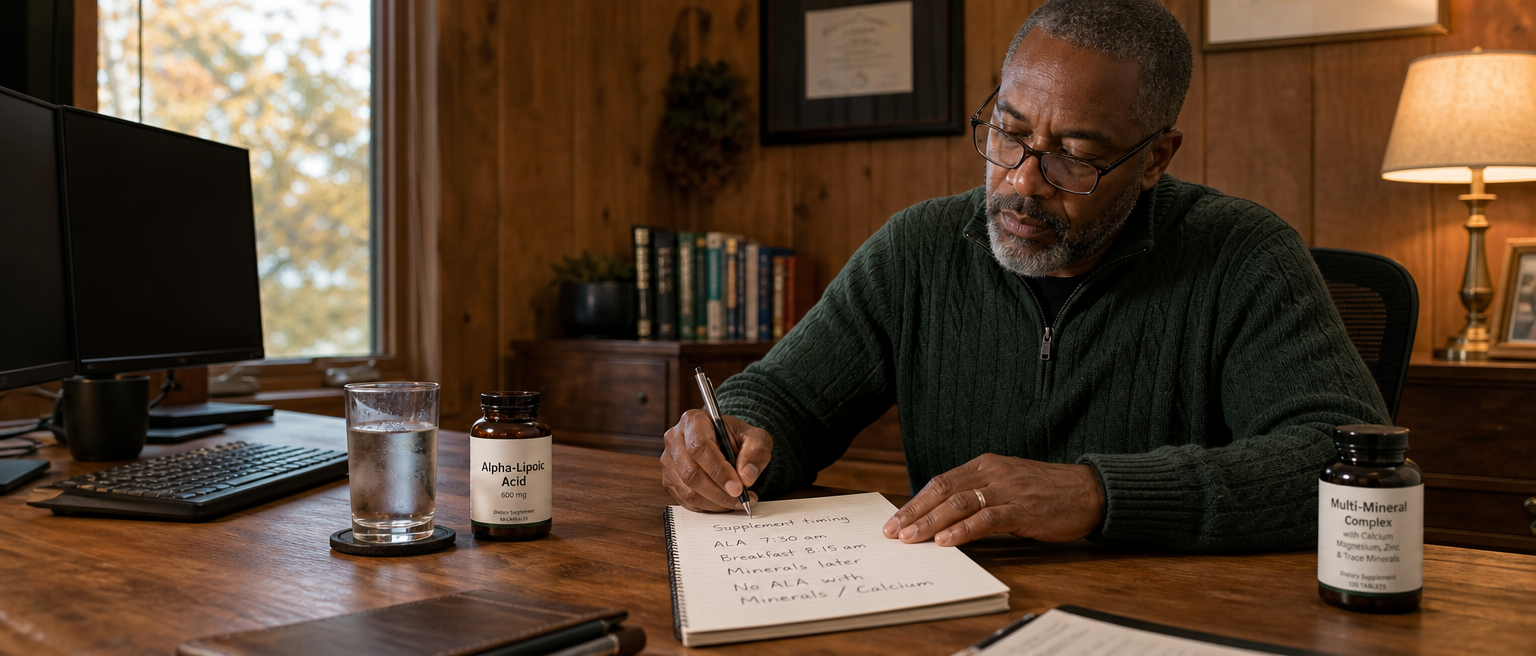
For minerals such as iron, calcium, magnesium, zinc, and antacids, direct human interaction data are limited. Because ALA has chemical properties that can interact with metals, and because minerals can interfere with the absorption of some compounds, spacing them out is a sensible precaution. A practical approach is to separate ALA from mineral supplements or mineral-containing antacids by at least 2 hours.
Vitamin interactions are less certain. Laboratory work suggests ALA can interact with the sodium-dependent multivitamin transporter and inhibit cellular transport of biotin and pantothenic acid, also called vitamin B5. That gives researchers a plausible mechanism, but there is not strong clinical evidence that typical ALA use causes biotin or B5 deficiency. If you use high-dose ALA long term, it is reasonable to avoid taking it at exactly the same time as a multivitamin.
Levothyroxine deserves special care. Evidence for a strong ALA-thyroid interaction in humans is weak, but thyroid medication is highly timing-sensitive. If you take levothyroxine, keep taking it exactly as prescribed and separate ALA by several hours so changes in thyroid blood tests are easier to interpret.
6. Duration of use and safety
Human studies have used ALA for weeks, months, and in some cases years. A controlled-release study used 900 mg daily for 6 weeks followed by 1200 mg daily for another 6 weeks in people with type 2 diabetes and found no severe side effects or major liver, kidney, or blood toxicity. The ALADIN II neuropathy trial followed oral schedules for 2 years.
Across 71 randomized placebo-controlled studies, a safety meta-analysis found that ALA was not linked to a statistically significant increase in overall treatment-emergent adverse events compared with placebo. Common side effects, when they occur, are usually mild and may include nausea, vomiting, stomach discomfort, headache, dizziness, skin reactions, or symptoms that feel like low blood sugar.
The rare but important safety issue is insulin autoimmune syndrome. EFSA reviewed 49 case reports where insulin autoimmune syndrome developed after ALA consumption and concluded that ALA in foods or supplements is likely to increase risk in genetically susceptible people. This can cause episodes of unexplained low blood sugar and may take weeks to months to resolve after stopping ALA.
Extra caution is also needed with heavy alcohol use or possible thiamine, also called vitamin B1, deficiency. Clinical references flag this as a situation where self-prescribing high-dose ALA is not wise.