

 Deutsch
 Español
 Suomi
Suomi Français
 Bahasa Indonesia
 Italiano
 日本語
日本語 Português
 Tagalog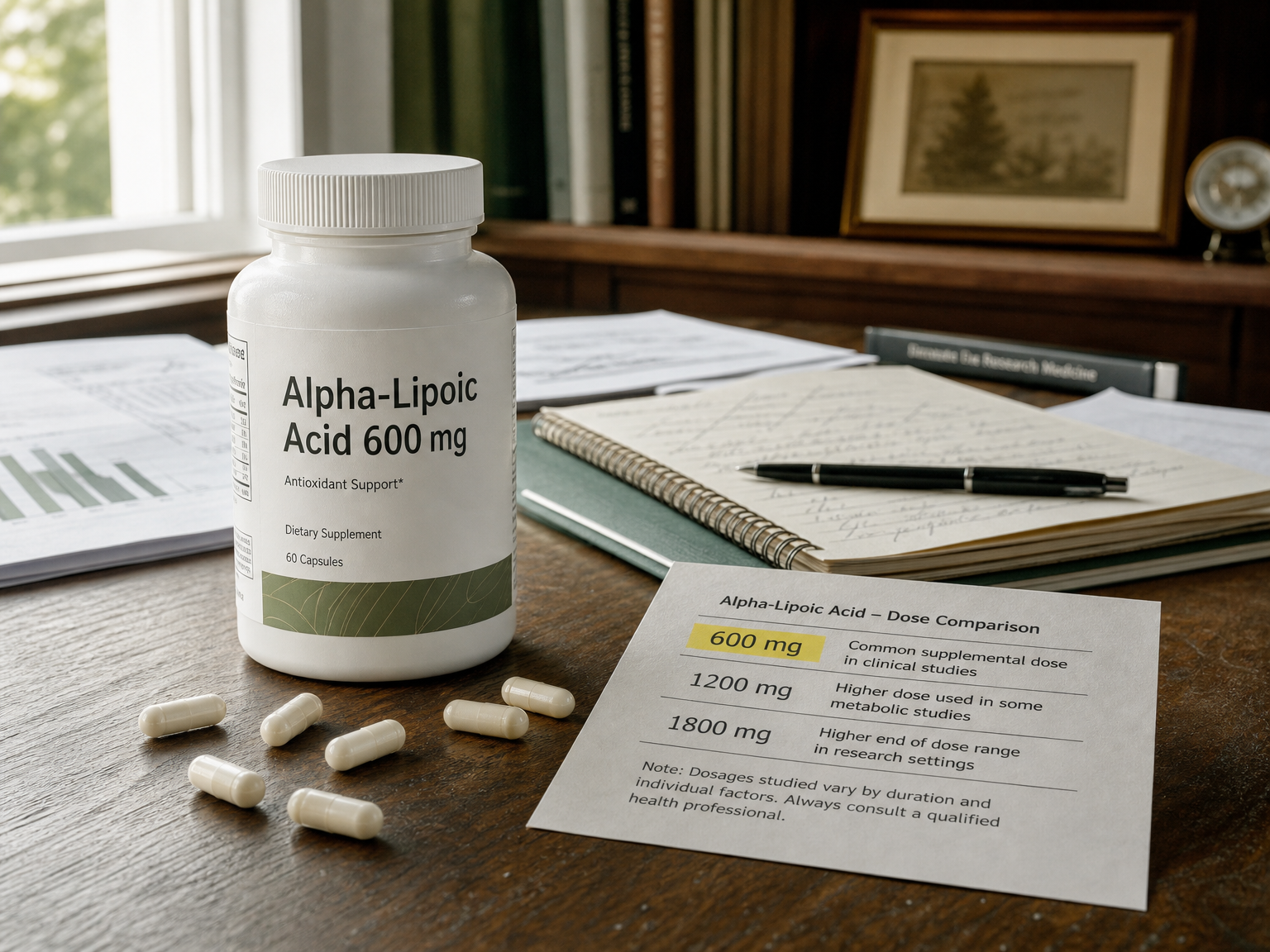

1. What is alpha-lipoic acid?
Alpha-lipoic acid is a sulfur-containing compound that the body makes in small amounts. It helps enzymes involved in energy metabolism, and researchers have studied supplemental ALA partly because it can act as an antioxidant in laboratory settings.
That does not mean every antioxidant claim on a supplement label has been proven in people. ALA is not approved by the U.S. Food and Drug Administration to treat any disease, and dietary supplements are not reviewed for effectiveness before marketing in the same way prescription medicines are.
Most older clinical studies used racemic ALA, which means a 50:50 mix of two mirror-image forms: R-alpha-lipoic acid and S-alpha-lipoic acid. Some newer products use only R-ALA, but results from racemic 600 mg studies should not automatically be applied to every R-ALA product.
2. Why does 600 mg appear so often?
The short answer is history, plus the momentum of clinical trials.
Official supplement references describe typical ALA supplement amounts as ranging from about 50 mg to 600 mg. LiverTox notes that conventional products commonly run up to 600 mg, and published dose suggestions have ranged from 100 to 600 mg once or twice daily.
But 600 mg did not become common simply because it is a perfect biological threshold. It became common because early neuropathy trials and pharmaceutical-style ALA products often used 600 mg tablets or 600 mg intravenous ampoules. A pharmacokinetic study in healthy adults noted that major clinical outcome data had been generated with 600 mg products, which helped support development of 200 mg, 300 mg, and 600 mg formulations.
Put simply, supplement labels likely followed a familiar research benchmark. That is not the same as proving 600 mg is the right dose for every person or every goal.

3. How oral 600 mg behaves in the body
ALA is absorbed quickly. In healthy adults taking a single 600 mg fasted dose, blood levels usually peaked in about 20 to 30 minutes. The form also matters: in one human study, an oral solution produced higher exposure than tablets, and R-ALA exposure was higher than S-ALA exposure.
Still, oral bioavailability is limited. One study estimated absolute bioavailability at about 30%, largely because the liver extracts much of the dose before it reaches the wider circulation. Another found no accumulation after 600 mg once daily for four days.
This explains an important difference between routes: 600 mg by mouth is not the same as 600 mg by intravenous infusion. Intravenous ALA bypasses the gut and first-pass liver extraction, so it can create a different exposure pattern. That is one reason the strongest neuropathy evidence for IV 600 mg cannot be casually extended to over-the-counter oral capsules.
4. What has actually been studied at 600 mg?
The condition studied most often is diabetic peripheral neuropathy, a type of nerve damage that can cause burning, tingling, numbness, or pain in the feet and legs. Readers comparing nerve-support nutrients may also see discussions of thiamine and vitamin B12, but those are separate topics with different evidence.
- In the ALADIN trial, intravenous ALA at 600 mg/day and 1200 mg/day for three weeks improved neuropathy symptoms more than placebo. The 100 mg dose did not. Importantly, 600 mg had symptom improvement comparable to 1200 mg but fewer adverse events.
- A meta-analysis of four placebo-controlled trials found that IV 600 mg/day for three weeks improved positive neuropathic symptoms and neuropathic deficits in people with diabetes.
- In the SYDNEY 2 oral trial, 600 mg, 1200 mg, and 1800 mg once daily for five weeks all improved symptom scores compared with placebo, but higher doses caused more side effects. The researchers concluded that 600 mg once daily had the best risk-to-benefit balance.
 Short-term IV: 600 mg/day for about 3 weeks improved neuropathy symptoms in several trials.
 Short-term oral: 600 mg/day improved symptoms with fewer side effects than higher doses.
 Long-term oral: Evidence is weaker, with less persuasive findings over months or years.
Longer-term oral evidence is less encouraging. In the four-year NATHAN 1 trial, oral 600 mg/day did not improve the main combined neuropathy endpoint, although some secondary nerve-impairment measures improved. A 2024 Cochrane review focusing on studies lasting at least six months concluded that ALA at 600 to 1800 mg/day probably has little or no effect on diabetic neuropathy symptoms and may have little or no effect on impairment.
ALA has also been studied for metabolic outcomes. A pilot trial in type 2 diabetes found that 600 mg, 1200 mg, and 1800 mg/day improved insulin-stimulated glucose disposal over four weeks, with no clear dose effect among active groups. A 2022 dose-response meta-analysis found statistically significant changes in several cardiometabolic markers, but the improvements were generally below thresholds considered clinically important. Fasting glucose and LDL cholesterol appeared to improve up to around 600 mg/day, with little reason to assume higher doses produce meaningfully larger benefits.
Other 600 mg uses have mixed or early evidence. A two-year trial found 600 mg/day did not prevent clinically significant diabetic macular edema. Official summaries also report no clear kidney benefit in diabetic nephropathy. A 12-week metabolic syndrome trial reported improvements in triglycerides and total cholesterol at 600 mg/day. A 24-week trial of 600 mg/day pure R-ALA found modest weight and BMI reductions in overweight or obese adults, but this was a different formulation than the racemic ALA used in much of the neuropathy literature. For comparison, weight loss supplement claims often depend heavily on the exact ingredient, dose, and outcome studied. Trials in burning mouth syndrome and migraine often use total daily doses around 600 to 800 mg, but these are condition-specific and do not prove a universal target dose.
5. Do higher doses work better?
Usually, the evidence says “not clearly.”
In neuropathy trials, 1200 mg and 1800 mg oral doses often did not outperform 600 mg in a meaningful way, while side effects increased. In the IV ALADIN study, 1200 mg worked about as well as 600 mg but caused more adverse events: 32.6% versus 18.2%.
A similar pattern appears in metabolic studies. Higher doses may raise blood exposure, but that does not reliably lead to better real-world outcomes. In several studies, 600 mg captured much of the measurable effect, while larger doses mainly added pill burden and tolerability problems.
Lower doses are less well supported for clinical outcomes. In ALADIN, 100 mg IV did not beat placebo for neuropathy symptoms. Pharmacokinetic studies show that 200 mg is absorbed, but absorption is not the same as clinical effectiveness. A lower dose may still be reasonable in some supplement contexts, but it should not be presented as proven equivalent to researched 600 mg regimens unless a study directly shows that.
6. Practical considerations and safety
Many oral ALA studies used fasted dosing because food can affect absorption. Products also vary: tablets, capsules, oral solutions, racemic ALA, and R-ALA may not produce the same blood levels.
Common side effects include nausea, heartburn, headache, vomiting, abdominal discomfort, diarrhea or constipation, and dizziness. These are more likely at higher doses.
ALA may also affect blood sugar. People with diabetes, people using insulin or glucose-lowering medication, and anyone prone to low blood sugar should speak with a clinician before using it. A rare condition called insulin autoimmune syndrome has been reported after ALA exposure in susceptible individuals. European safety reviewers concluded that the risk appears real but that available data are too limited to identify a clearly safe lower dose.
Very large overdoses are dangerous. LiverTox reports that severe ALA overdoses have caused seizures, lactic acidosis, rhabdomyolysis, coma, multiorgan failure, and death. Routine use has not been linked to clinically apparent liver injury, but “not usually liver-toxic” is not the same as risk-free.