

 Deutsch
 Español
 Suomi
Suomi Français
 Bahasa Indonesia
 Italiano
 日本語
日本語 Português
 Tagalog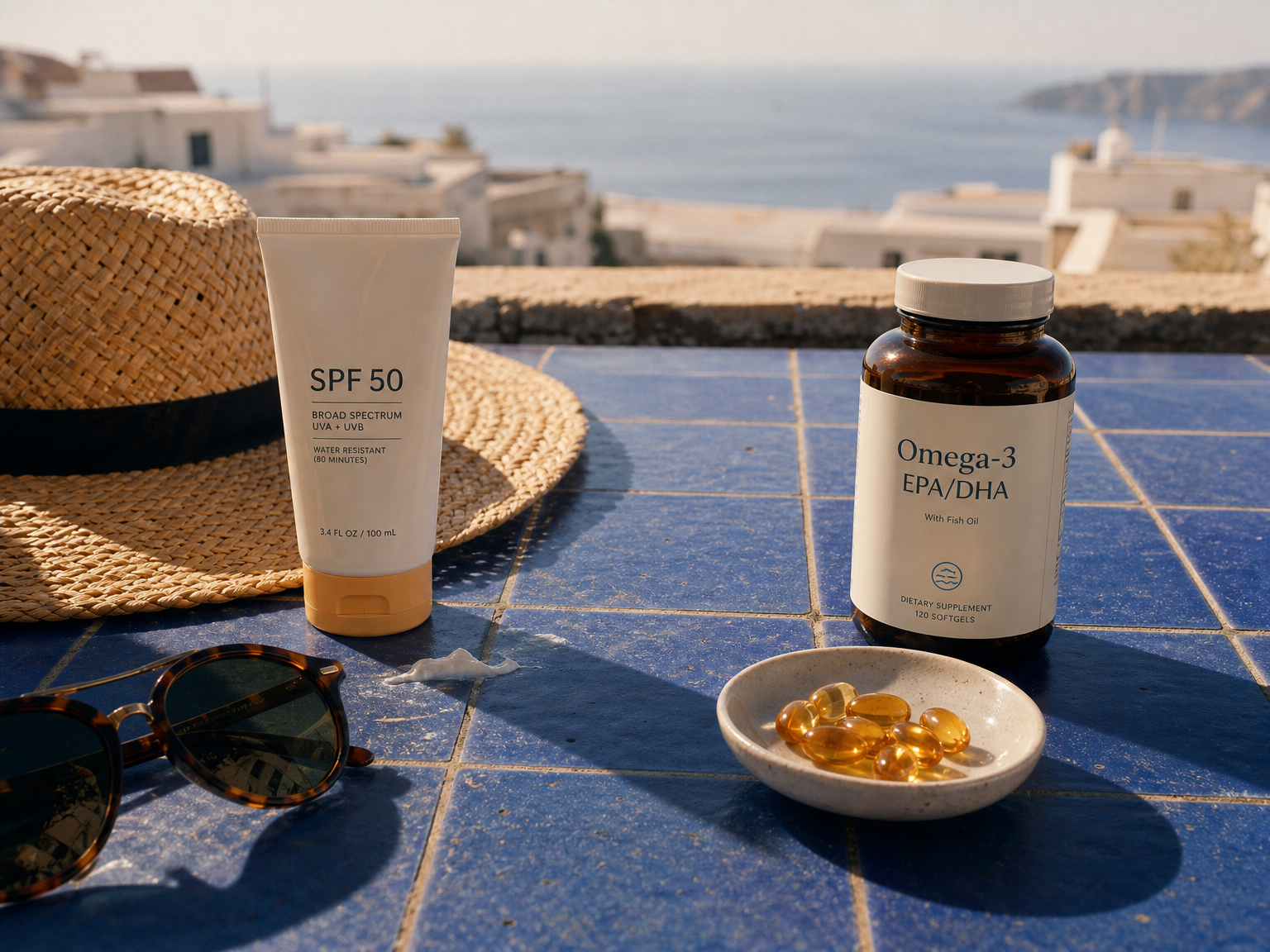

1. What are omega-3 fatty acids?
Omega-3 fatty acids are fats we get from food or supplements. The main types are ALA, EPA and DHA. ALA is found in plant foods such as flax, chia, and walnuts. EPA and DHA are the long-chain omega-3s found mainly in oily fish, fish oil, krill oil, and algae-based supplements.
When it comes to omega-3 skin health, most of the research attention on sun exposure and sun damage has been on EPA, or on EPA-rich marine omega-3 products. EPA can become part of cell membranes and may shift the mix of inflammatory compounds made in the skin.
One practical detail is easy to overlook: a “1,000 mg fish oil” capsule does not usually contain 1,000 mg of EPA plus DHA. The active EPA and DHA amount may be much lower, so it is worth reading the label closely.

2. How omega-3s might change the skin’s response to UV
UV exposure affects skin in several overlapping ways. It can trigger redness, inflammation, oxidative stress, DNA damage signals, immune changes in the skin, and, over time, photoaging and higher skin cancer risk.
Omega-3s do not sit on the surface of the skin and block UV rays, and they are not a sunscreen substitute. Their possible effect is slower and more indirect. With regular intake, EPA and DHA can be incorporated into skin-cell membranes. EPA then competes with arachidonic acid, an omega-6 fat the body uses to make several inflammatory messengers.
One group of these messengers is called eicosanoids. Two UV-related examples are PGE2 and 12-HETE. Put simply, EPA seems to nudge the skin’s inflammatory chemistry away from some arachidonic-acid-derived signals and toward a less inflammatory pattern. That may help explain why some studies find less UV-triggered redness, lower inflammatory markers, or partial protection against UV-related immune suppression.
3. What the evidence says
The evidence on omega-3 photoprotection is encouraging, but it is not strong enough to make omega-3s a stand-alone sun-protection strategy.
- In an early trial of 20 healthy adults, four weeks of fish oil produced a small but statistically significant rise in minimal erythema dose. That means participants needed a slightly higher UV dose before visible sunburn redness appeared.
- Another human fish-oil study found reduced UVB-related redness sensitivity, but also reported more epidermal lipid peroxidation. That is an important caveat: omega-3 fats may calm some inflammatory signals while also being vulnerable to oxidation in the skin.
- A double-blind study using 4 g per day of purified EPA for three months found a higher UV redness threshold and improvements in early markers of UV-related genetic stress, including reduced p53 expression in skin. These were useful biological signals, not proof of long-term skin-cancer prevention.
 Redness threshold: Small trials found a higher UV dose was needed before redness.
 Skin mediators: EPA shifted inflammatory lipid signals after controlled UV.
 Visible effects: Redness and fading are less consistent across studies.
Other studies add to the picture. In women given EPA-rich omega-3s for 12 weeks, researchers found partial protection against UV-related suppression of contact hypersensitivity, a measure of immune response in the skin. A related mechanistic study showed that EPA changed the skin fatty-acid profile and lowered the balance of arachidonic-acid-derived inflammatory mediators compared with EPA-derived mediators.
A later skin lipid study offers a useful reality check. After 10 weeks of EPA or DHA supplementation, researchers saw clear changes in skin mediator biology after UV exposure. EPA more strongly reduced several arachidonic-acid-derived inflammatory lipids, while DHA appeared to affect other pathways. But neither EPA nor DHA changed sunburn redness, the UV threshold for redness, or how quickly visible redness faded over 72 hours.
The most balanced reading is this: omega-3s can change how human skin responds to UV exposure at a biochemical level, and EPA-rich products may modestly reduce sun-related inflammation or damage-related markers. Visible UV-related benefits are less consistent.
4. Can omega-3s help recovery after sun exposure?
This is where the evidence is thinner. Some animal research suggests omega-3-enriched fish oil may reduce inflammatory gene activity and speed healing after UVB sunburn. That is interesting, but mouse skin studies cannot tell us what will happen in people.
In humans, the best evidence points more toward “preparation over time” than “recovery after the fact.” Omega-3s need time to alter cell membranes and skin lipid mediators. They are unlikely to do much if taken only after a day in the sun.
If you are already sunburned, standard care is still the priority: get out of the sun, cool the skin, hydrate, avoid further UV exposure, and seek medical help for blistering, fever, severe pain, dehydration, or sunburn in a baby or young child.
5. Practical considerations
If someone is considering omega-3s for skin resilience, the research pattern points to EPA-rich marine omega-3s taken consistently for several weeks or months. Many studies used gram-level doses, such as 3–5 g per day of marine omega-3 preparations or 4 g per day purified EPA. Those doses are higher than many everyday supplement routines and should not be started casually, especially if you take medication or have heart-rhythm concerns.
Food is a sensible place to start. Health agencies often note that the evidence for seafood as part of a healthy diet is stronger than the evidence for omega-3 supplements for many outcomes. Oily fish such as salmon, sardines, trout, and mackerel provide EPA and DHA along with protein and other nutrients. Algal oil is the main vegan source of DHA and sometimes EPA.
Cod liver oil needs extra caution because it also contains vitamins A and D. Taking it alongside other multivitamins or high-dose vitamin D products can increase the risk of getting too much.
6. Safety
Omega-3 supplements are usually well tolerated at common doses. The most common side effects are mild digestive symptoms, fishy burps, nausea, or loose stools.
Higher doses call for more care. EPA and DHA can have antiplatelet effects, meaning they may influence blood clotting. Large safety reviews from EFSA and FDA-related guidance commonly place up to about 5 g per day of combined EPA plus DHA as a level that does not raise safety concerns for adults, but that is not a personal target dose. Some long-term cardiovascular trials using around 4 g per day have also reported a small signal for increased atrial fibrillation in some higher-risk adults.
People who use anticoagulant or antiplatelet medicines, have a bleeding disorder, are scheduled for surgery, have atrial fibrillation or high risk for it, are pregnant or breastfeeding, or have fish or shellfish allergy should check with a clinician before using omega-3 supplements. Supplement quality also varies, and dietary supplements are not approved by the FDA for safety and effectiveness before they are sold.