

 Deutsch
 Español
 Suomi
Suomi Français
 Bahasa Indonesia
 Italiano
 日本語
日本語 Português
 Tagalog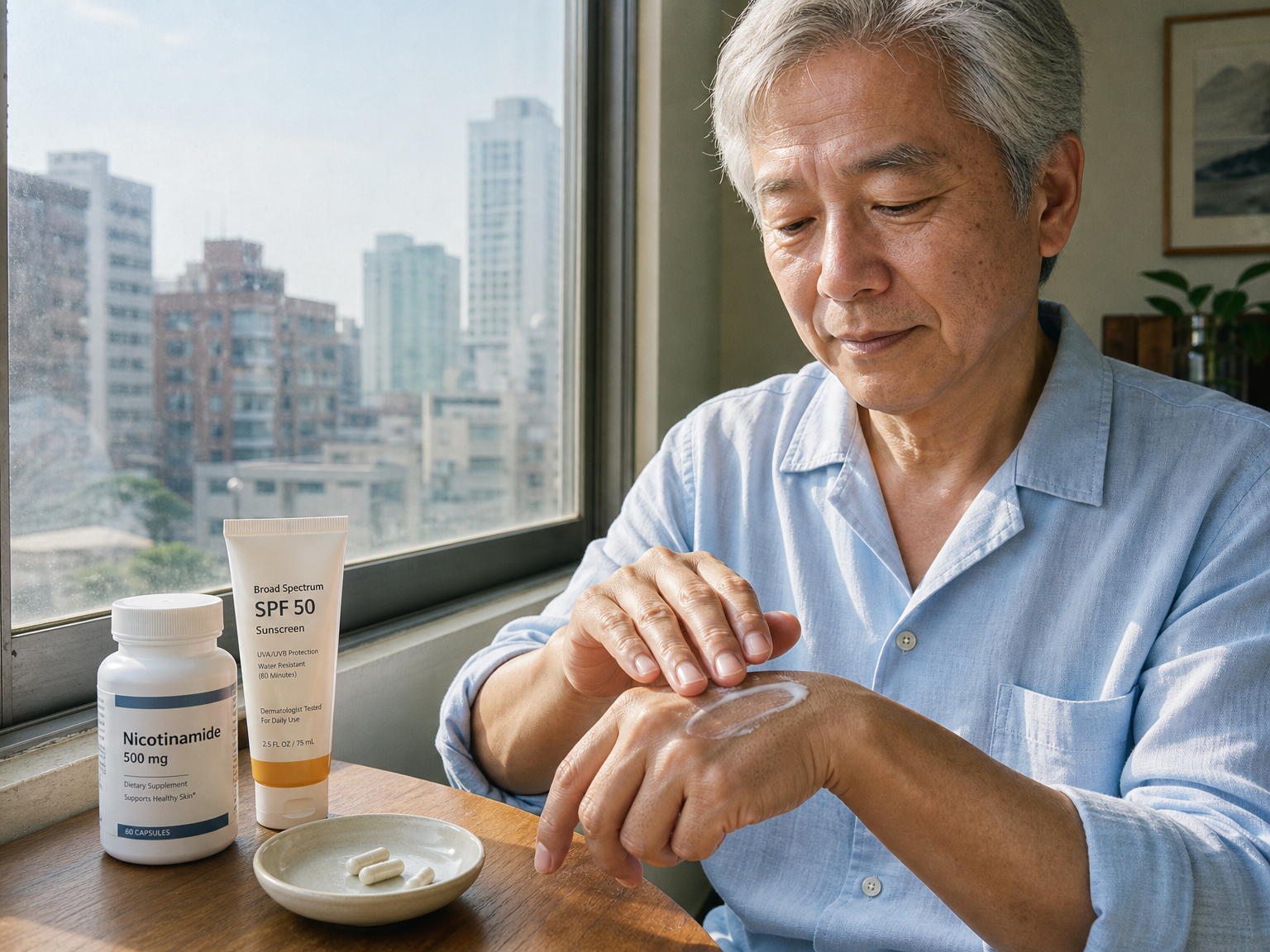

1. What is nicotinamide?
Nicotinamide is the amide form of vitamin B3. You may also see it called niacinamide. It is related to niacin, but it behaves differently in the body. One practical difference is that nicotinamide does not cause the warm flushing reaction commonly linked with nicotinic acid, another form of niacin.
In skin care, niacinamide is usually found in creams and serums. In dermatology research, nicotinamide has also been studied as an oral supplement, often at 500 mg twice daily. That dose is much higher than someone would normally get from food, so it is best thought of as a therapeutic-style dose rather than a casual multivitamin amount.
Researchers are interested in nicotinamide for sun-exposed skin because of its connection with NAD+, a molecule cells use to produce and manage energy. UV radiation stresses skin cells, damages DNA, and can weaken local immune surveillance. Nicotinamide appears to help replenish the NAD+ pool, which may give cells more capacity to carry out repair work after UV stress.
2. How it may work in UV-stressed skin
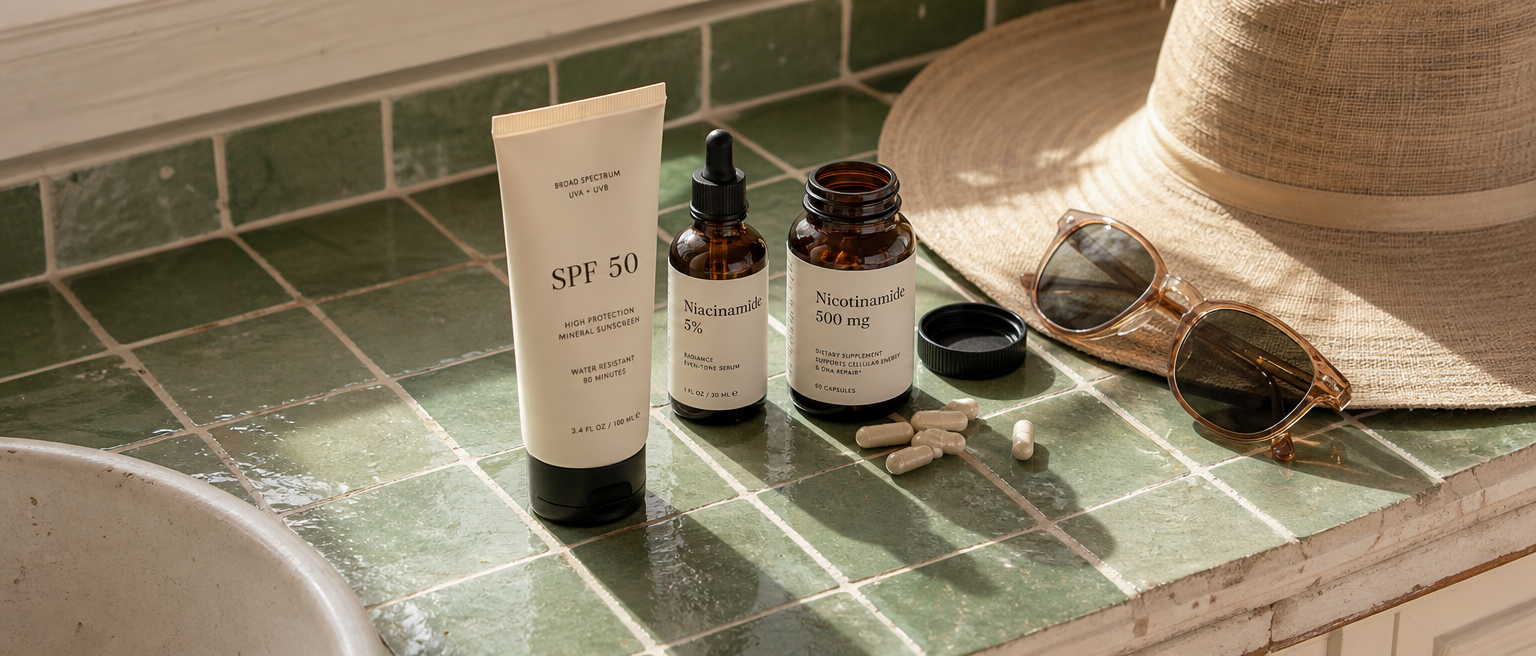
Nicotinamide is not a sunscreen. It does not sit on top of the skin and filter UV rays. Laboratory and human skin studies suggest a different role: helping skin cells cope after UV exposure has already caused stress.
In mechanistic studies, nicotinamide helped preserve cellular energy after UV exposure and improved repair of UV-related DNA changes, including cyclobutane pyrimidine dimers and oxidative DNA damage markers. These are types of molecular injury that can happen when skin is exposed to ultraviolet light.
It may also affect UV-induced immunosuppression. After UV exposure, the skin can temporarily become less effective at certain immune responses. Older human studies found that oral and topical nicotinamide reduced this UV-related suppression in experimental models. That is relevant because immune surveillance is one way the body detects abnormal cells.
Still, most of this evidence comes from mechanisms and surrogate markers. It helps explain why nicotinamide might be useful, but it does not prove that a healthy person can take it before a sunny holiday and meaningfully prevent sunburn, DNA damage, photoaging, or cancer.
3. What the evidence says
The most convincing human trial is the 2015 ONTRAC study published in the New England Journal of Medicine. It included 386 adults who were immunocompetent and had at least two previous non-melanoma skin cancers in the past five years. Participants took nicotinamide 500 mg twice daily or placebo for 12 months.
The result was meaningful: the nicotinamide group had 23% fewer new non-melanoma skin cancers during the treatment period. Actinic keratoses, which are rough sun-damage spots that can sometimes progress to squamous cell carcinoma, were also lower at several time points. The important catch is that the benefit was not maintained after people stopped taking nicotinamide.
A later systematic review and meta-analysis found a reduction in skin cancers across several trials, but the authors rated the recommendation as weak. The evidence base is still fairly small, and much of it involves people who already have substantial sun damage or previous skin cancers.
 High-risk adults: 500 mg twice daily reduced new non-melanoma skin cancers during treatment.
 Healthy skin: UV-protection findings are mixed and not sunscreen-like.
 Topical use: 4% to 5% niacinamide may improve visible photoaging over about 12 weeks.
A large 2024 JAMA Dermatology veteran cohort added real-world support. Nicotinamide use at 500 mg twice daily was associated with a modest lower risk of later skin cancer, especially cutaneous squamous cell carcinoma, with the largest apparent benefit when started after a first skin cancer. But this was observational research, not a randomized trial, and the cohort was mostly older White men.
The limits of the evidence are just as important as the positive findings. In a 2023 trial of solid-organ transplant recipients, nicotinamide did not reduce keratinocyte cancers or actinic keratoses. That suggests the benefit seen in immunocompetent high-risk adults should not be automatically extended to heavily immunosuppressed people.
For healthy people trying to prepare for UV exposure, the findings are mixed. Older studies showed less UV-induced immunosuppression after oral or topical nicotinamide. But a 2025 healthy-volunteer study using oral nicotinamide 2,000 mg daily for 30 days did not increase the UVB sunburn threshold and did not measurably reduce UVB-induced DNA damage. A 2026 UVA study found a 26% increase in the UVA redness threshold, but it still did not show reduced measurable DNA damage. Less redness is not the same as less molecular injury.
For topical niacinamide, the evidence is more about appearance and skin recovery. Trials using 5% niacinamide found improvements in fine lines, wrinkles, hyperpigmented spots, red blotchiness, yellowing, and skin texture over about 12 weeks. That fits well with use for visible photoaging. It does not prove prevention of deeper UV injury or skin cancer.
4. Practical considerations
For people with a history of non-melanoma skin cancer or heavy actinic damage, oral nicotinamide is worth discussing with a dermatologist. The studied dose is usually 500 mg twice daily, and the strongest benefit appears to depend on ongoing use. It should be used alongside regular skin checks, sunscreen, protective clothing, shade, and prompt assessment of changing lesions.
For general skin appearance, topical niacinamide is the more everyday option. Products around 4% to 5% are commonly used in research and cosmetic practice. It can usually be applied once or twice daily, depending on the product and how well your skin tolerates it.
Nicotinamide should not be treated as internal sunscreen. The American Academy of Dermatology continues to recommend broad-spectrum, water-resistant sunscreen with SPF 30 or higher, plus shade and sun-protective clothing. Those basics remain the foundation for reducing sunburn, photoaging, and skin-cancer risk.
5. Safety
Nicotinamide is generally better tolerated than nicotinic acid because it does not cause flushing. In the ONTRAC trial, oral nicotinamide 500 mg twice daily did not show noteworthy adverse-event differences compared with placebo.
Even so, dose and personal context count. The NIH Office of Dietary Supplements lists a U.S. adult supplemental upper limit of 35 mg per day for niacin, based on flushing but applied to both nicotinic acid and nicotinamide. EFSA lists an adult upper limit of 900 mg per day for nicotinamide in its summary tables. That means the common dermatology trial dose of 1,000 mg per day sits above one regulatory benchmark and far above another.
Higher intakes can cause problems. The NIH notes nausea, vomiting, and signs of liver toxicity around 3,000 mg per day, and dialysis studies using 500 to 1,500 mg per day reported diarrhea and low platelet counts. People with liver disease, kidney disease, pregnancy, breastfeeding, cancer treatment, immune suppression, or complex medication routines should not self-prescribe high-dose nicotinamide without medical guidance.