 Deutsch
 Español
 Suomi
Suomi Français
 Bahasa Indonesia
 Italiano
 日本語
日本語 Português
 Tagalog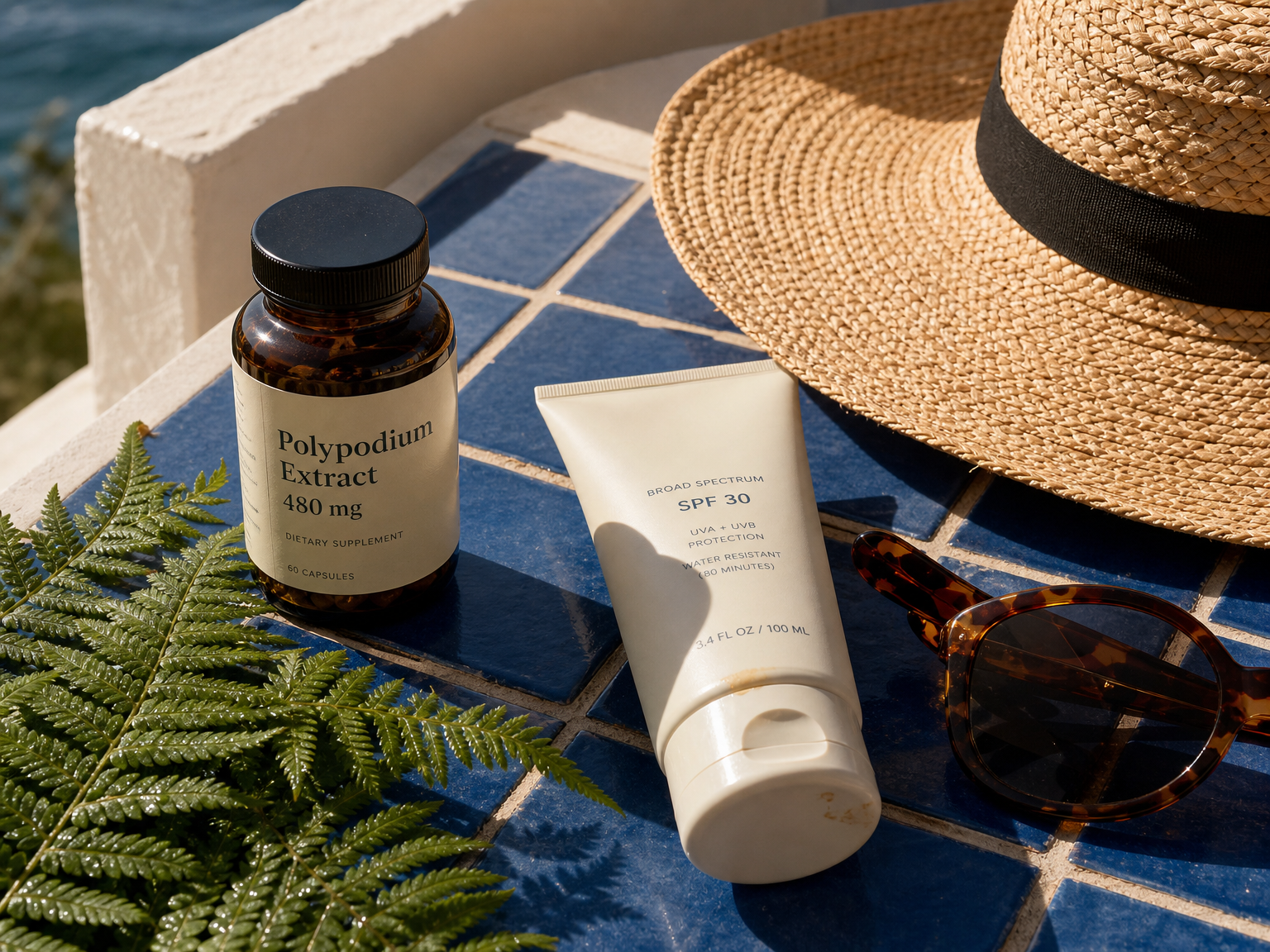

1. What is Polypodium leucotomos?
Polypodium leucotomos is a fern native to Central and South America. Extracts from the plant have been studied in dermatology for their antioxidant and anti-inflammatory effects.
Most modern human studies use an oral extract, often at 480 mg per day, and many involve a branded preparation known as Fernblock. That distinction is important. A 2018 systematic review stressed that evidence for one standardized extract should not automatically be applied to every capsule on the shelf, because different extraction methods can change the final mix of plant compounds.
Put simply, Polypodium leucotomos extract, or PLE, is a supplement studied for helping skin tolerate UV exposure. It is not a licensed sunscreen, and it does not form a physical or chemical barrier on the skin.
2. How it might work before, during and after sun exposure
Researchers usually explain PLE through three linked effects.
First, it appears to reduce oxidative stress. UV radiation can create reactive molecules in the skin, which may irritate cells and contribute to redness and inflammation. Laboratory and mechanistic studies suggest PLE can dampen some of that activity.
Second, it may turn down inflammatory signals after UV exposure. That fits with a repeated finding in studies: people taking PLE often need a higher UV dose before their skin becomes visibly red. This threshold is called the minimal erythema dose, or MED.
Third, researchers have explored whether it affects DNA repair and recovery after sun exposure. Some preclinical work suggests Fernblock may influence pathways linked with oxidative stress and delayed DNA lesions after UVA exposure. In people, though, the recovery picture is still unclear. Newer trials measuring thymidine dimers, a type of UV-related DNA damage marker, did not show clear reductions despite improved redness thresholds.
So PLE may help prepare the skin by making redness less likely at a given UV dose. It may also reduce some visible and inflammatory responses during exposure. Whether it meaningfully improves repair afterward in people remains uncertain.

3. What the evidence says
The clearest and most consistent signal is less redness after controlled UV exposure.
In a human clinical study of 22 adults with lighter skin types, participants took 480 mg total PLE before UVB irradiation. After supplementation, 17 of 22 showed reduced UVB-induced skin changes by clinical assessment and colorimetry. Skin samples also showed lower levels of several damage and inflammation markers, including sunburn cells and cyclobutane pyrimidine dimers.
A separate randomized, double-blind, placebo-controlled trial followed 40 healthy adults taking 240 mg twice daily for 60 days. The PLE group was more likely than the placebo group to show increased MED and reduced UV-induced erythema intensity. They were also less likely to report sunburn episodes, although the study was still small.
The broader 2018 systematic review found that most of 18 human studies reported beneficial photoprotective effects, commonly through increased MED, with no serious adverse effects reported.
 Redness: Studies most consistently show higher MED and less visible UV redness.
 DNA markers: Newer UVB and UVA trials did not clearly reduce thymidine dimers.
 Real-world proof: Skin-cancer prevention and true sunscreen-like protection remain unproven.
Newer evidence makes the picture more nuanced:
- In a 2025 human trial, 480 mg per day of PLE increased UVB MED by 29%, but did not significantly reduce thymidine dimer levels in skin biopsies or urine.
- In a 2026 UVA trial, 480 mg per day increased UVA MED by 26%, but again did not reduce measured thymidine dimers.
- In a study of 57 people with idiopathic photodermatoses, mostly polymorphic light eruption, about 74% reported improvement in reactions and symptoms while using 480 mg per day during sunlight exposure.
Taken together, this pattern is helpful. PLE has better support for reducing redness and sensitivity than for proving deeper molecular protection. It may be especially interesting for people with certain photosensitivity conditions, under clinician guidance, but the evidence is weaker for broad claims about everyday sun protection in healthy people.
4. Practical considerations
Most human studies used around 480 mg per day, either as 240 mg twice daily or as a total dose taken shortly before controlled UV exposure. Some studies tested acute use 1 to 2 hours before irradiation. Others used daily supplementation for 30 to 60 days.
That does not mean everyone needs that dose, or that higher doses work better. It simply means 480 mg per day is the most common research pattern in the studies covered here.
Formulation is a major limitation. The evidence is strongest for standardized extracts, especially Fernblock. A product labelled Polypodium leucotomos may not match the composition, dose or quality of the extract used in trials.
PLE should come after the basics: broad-spectrum sunscreen, protective clothing, hats, sunglasses, shade and avoiding long exposure when the sun is strongest. The FDA treats sunscreen as a regulated nonprescription drug and gives clear guidance on proven sun-protection behaviours. An oral supplement does not replace those measures.
5. Safety
Short-term safety looks generally reassuring in adult studies. In the 60-day randomized trial, 480 mg per day did not change measured safety assessments. The systematic review also reported no serious adverse effects across the included human studies.
Still, no serious events in small trials is not the same as long-term certainty. Most studies included limited numbers of adults, often with lighter Fitzpatrick skin types, and followed people for weeks rather than years.
Children, pregnancy and breastfeeding are important gaps. DermNet notes that there is no supporting clinical data for these groups. Drug-interaction data are also limited, so people taking regular medication or managing a medical condition should check with a clinician.
Marketing claims deserve caution. The FDA has previously objected to claims that an oral supplement containing Polypodium leucotomos could prevent DNA damage or provide certified protection from sun rays. That regulatory warning lines up with the science: PLE may reduce some UV responses, but it has not been proven to prevent skin cancer or work as a true sunscreen substitute.