

 Deutsch
 Español
 Suomi
Suomi Français
 Bahasa Indonesia
 Italiano
 日本語
日本語 Português
 Tagalog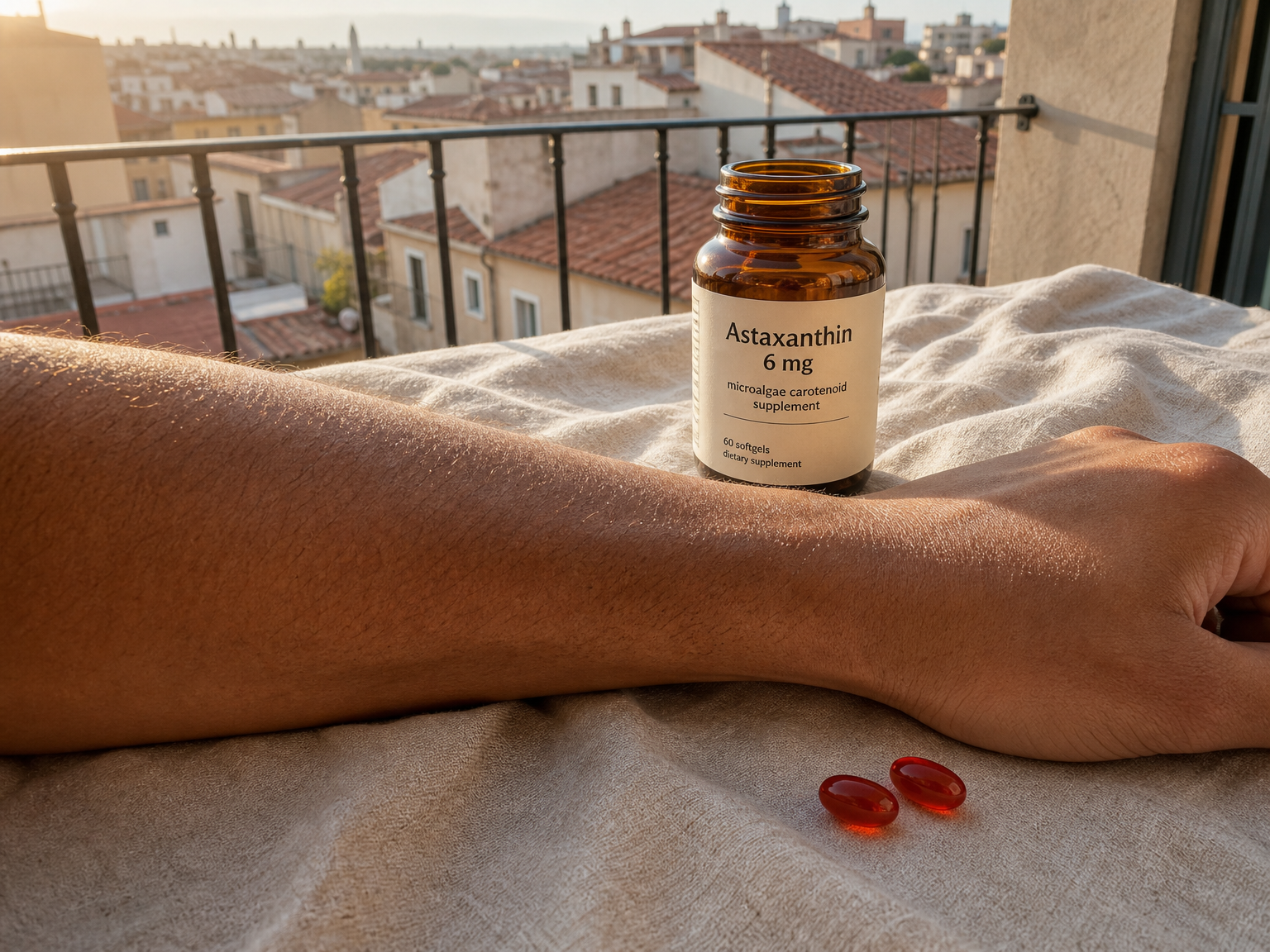

1. What is astaxanthin?
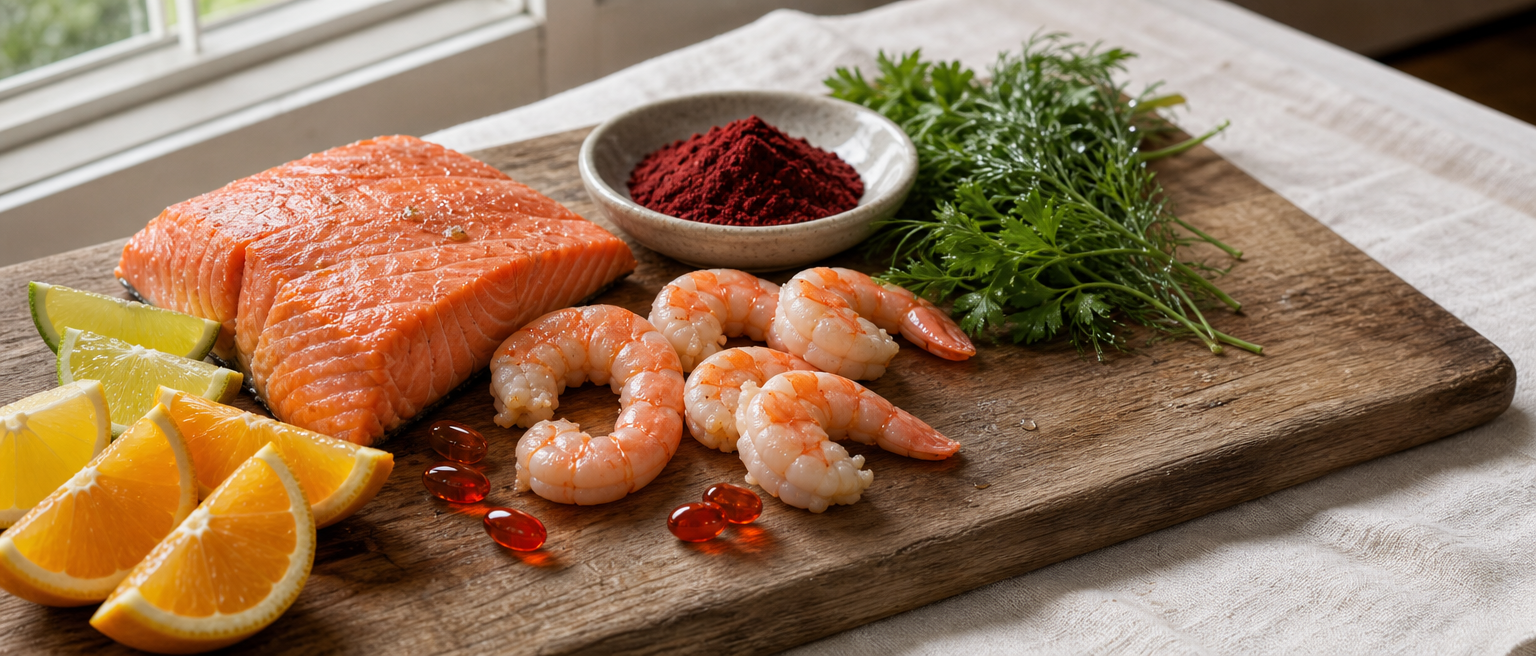
Astaxanthin is a red-orange carotenoid, part of the same broad pigment family that gives carrots, tomatoes, salmon, krill, and some algae their colour. More specifically, it is a lipophilic xanthophyll carotenoid. In plain English, that means it dissolves in fat and can settle into fatty tissues and cell membranes.
Most supplement forms come from the microalgae Haematococcus pluvialis. This algae produces astaxanthin when it is under environmental stress, which is one reason researchers are interested in whether the compound might help human tissues cope with stress too.
For skin, the idea is fairly straightforward: UV radiation increases reactive oxygen species, unstable molecules that can irritate cells, damage proteins and lipids, and switch on inflammatory signals. In lab and animal studies, astaxanthin appears to reduce some of these signals. The key question is whether that translates into visible, useful protection in people.
2. How it may work in sun-exposed skin
Sunlight affects skin in more than one way. UVB is strongly linked with sunburn. UVA reaches deeper into the skin and is closely tied to photoaging, including collagen breakdown and pigmentation changes. Both can increase oxidative stress.
Astaxanthin may help through three overlapping routes.
First, it acts as an antioxidant in fat-rich areas, including cell membranes. This may help reduce UV-triggered oxidative stress before it builds into a larger inflammatory response.
Second, lab studies suggest astaxanthin can quiet inflammatory signals from keratinocytes, the main cells in the outer layer of skin. In one human keratinocyte study, astaxanthin reduced UVB-induced reactive oxygen species and signs of apoptosis, which is programmed cell death.
Third, it may affect collagen-related pathways. UV exposure can increase enzymes called matrix metalloproteinases, or MMPs, which break down collagen and other structural proteins. Preclinical work and small human-related studies suggest astaxanthin may reduce some of this enzyme activity, although that does not prove it rebuilds sun-damaged skin in people.
3. What the human evidence says
The most relevant human evidence comes from UV-challenge trials. In these studies, researchers expose a small patch of skin to controlled UV light, then measure the redness that follows.
In a 2018 randomized, double-blind, placebo-controlled trial, healthy Japanese adults took either 4 mg/day astaxanthin or placebo for 9 weeks. Compared with placebo, the astaxanthin group had an increased minimal erythema dose, or MED. MED is the amount of UV exposure needed to cause visible redness. The astaxanthin group also had less UV-related loss of skin moisture seven days after irradiation and better self-rated roughness and texture. The trial was small, with 22 people analyzed, so it is best viewed as promising proof-of-concept.
A newer 2026 randomized, double-blind trial tested 6 mg/day Haematococcus-derived astaxanthin for 8 weeks in Japanese adults. The abstract reports a significant MED increase and reduced UV-related redness. That supports the idea that astaxanthin may help skin prepare for UV exposure, but the full results tables were not available in the supplied evidence, so the finding should be weighed cautiously.
Broader skin studies point in a similar, but gentler, direction. A 2021 systematic review and meta-analysis found that oral astaxanthin improved skin moisture and elasticity across small trials, but did not significantly reduce wrinkle depth versus placebo. A 2020 clinical review also concluded that astaxanthin often improved skin texture, appearance, and moisture, with 3 to 6 mg/day being common in skin studies.
 UV tolerance: Direct trials suggest a modest rise in MED before redness appears.
 Skin comfort: Hydration, barrier comfort, and elasticity are the steadier signals.
 Sun damage: Wrinkle reversal and true repair are not well proven.
4. Can astaxanthin help skin recover after sun exposure?
This is where the evidence gets thinner.
Some older and indirect studies suggest astaxanthin may reduce post-UV darkening or collagen-degrading signals. A large 2023 review summarized an older Japanese study in which 3 mg/day astaxanthin, taken before and after UV exposure, appeared to reduce post-UV melanin and improve skin-colour measures compared with placebo. The same review also described a combination study using astaxanthin plus collagen hydrolysate, where UV-exposed skin biopsies showed lower MMP1 and MMP12 expression and higher procollagen type I expression.
Those findings are interesting, but they do not prove astaxanthin repairs sun-damaged skin on its own. One study is difficult to verify in full, and the combination product makes it impossible to know how much of the effect came from astaxanthin.
Animal studies add biological plausibility. In hairless mice, dietary astaxanthin reduced UVA-related photoaging changes. In a separate mouse wound-healing model, topical astaxanthin helped full-thickness wounds heal faster. These studies help explain possible mechanisms, but they are not evidence that an oral astaxanthin capsule heals sunburn or reverses photoaging in humans.
5. Practical use: dose, timing, and expectations
Most human skin trials used oral astaxanthin capsules in the 3 to 6 mg/day range. Some used 12 mg/day. The direct UV-challenge trials used 4 mg/day for 9 weeks and 6 mg/day for 8 weeks.
Because astaxanthin is fat-soluble, it is usually taken with a meal that contains some fat. That may improve absorption, although the skin trials mainly measured outcomes rather than comparing different timing strategies.
If someone chooses to try astaxanthin for sun-exposed skin, the most evidence-aligned expectation is gradual support for skin resilience over several weeks. It is not a same-day sunburn remedy. It is not a substitute for SPF. It does not give permission to stay longer in strong sun.
A sensible way to frame it is this: as one of several possible skin supplements, astaxanthin may be one small internal layer of skin care, alongside sunscreen, protective clothing, shade, sleep, and a varied diet rich in colourful plants.
6. Safety notes
The safety picture for adults is generally reassuring at typical supplement doses. EFSA concluded that 8 mg/day astaxanthin from food supplements is safe for adults, even when combined with high dietary exposure. A 2019 safety review found no safety concerns across many human studies of natural astaxanthin, including studies using at least 12 mg/day.
There are still important caveats. Many skin trials excluded pregnant or breastfeeding people, people with skin disease, and people using medicines that affect light sensitivity. If any of those apply, it is worth checking with a clinician before using astaxanthin.
Natural astaxanthin and synthetic astaxanthin are not identical forms, and safety findings for one should not automatically be applied to the other. Most skin supplement research focuses on natural, algae-derived astaxanthin.