

 Deutsch
 Español
 Suomi
Suomi Français
 Bahasa Indonesia
 Italiano
 日本語
日本語 Português
 Tagalog
Summary
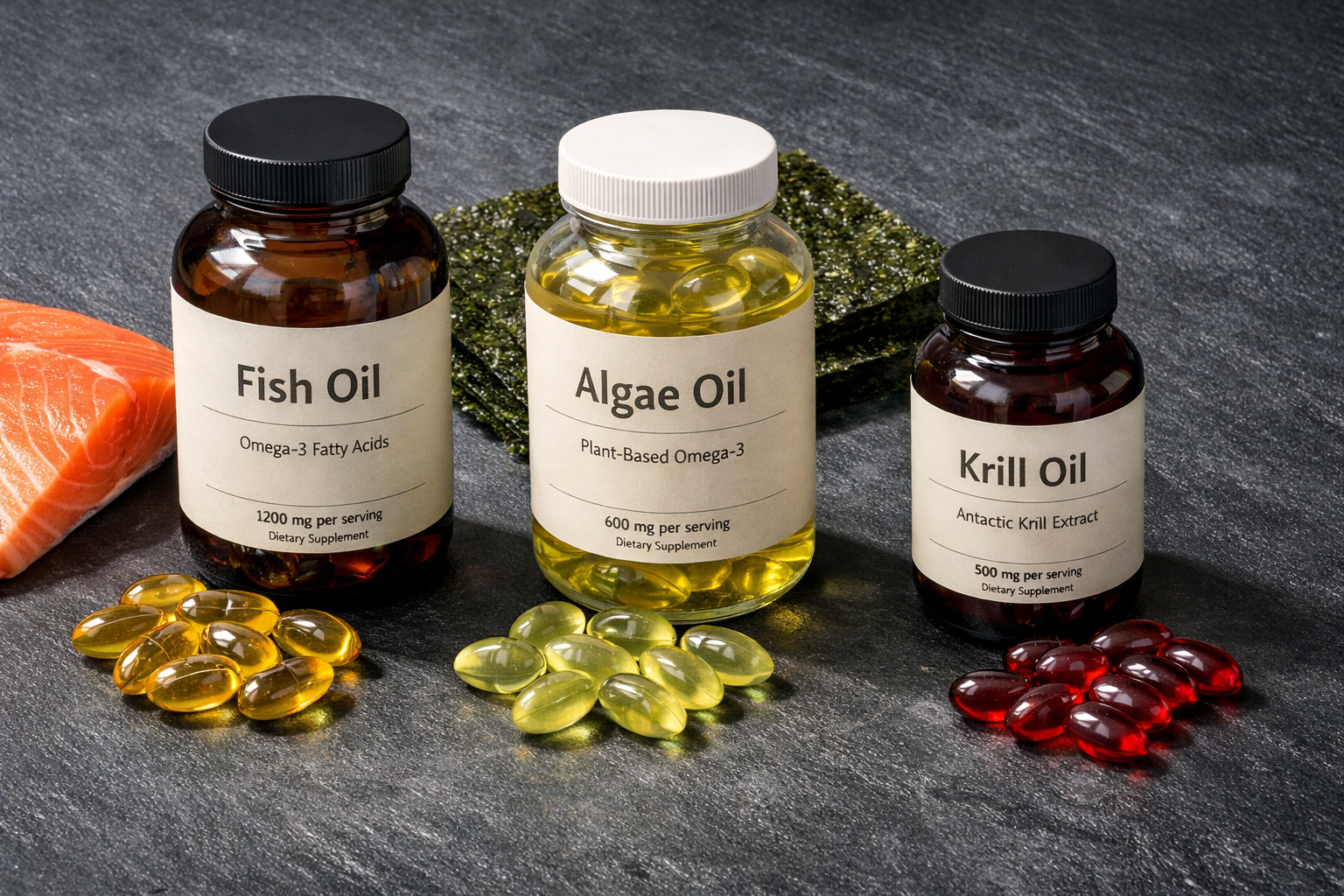
EPA and DHA are the main long-chain marine omega-3 fats found in oily fish and in supplements such as fish oil, krill oil, cod liver oil, and algae oil. The clearest evidence-based use is lowering high triglycerides, particularly with prescription-strength products rather than standard over-the-counter capsules.
Outside that main use, evidence is more mixed. Pregnancy intake guidance is relatively well supported, while routine claims for heart protection, mood, cognition, and dementia prevention remain inconsistent or modest. Across products, actual EPA plus DHA content, freshness, testing, and source quality usually matter more than premium marketing language.
Quick Facts
What is it useful for?
Best supported for raising EPA and DHA intake and lowering high triglycerides. Evidence for broader heart, mood, and brain outcomes is mixed.
Supplement types
Common forms include fish oil, krill oil, algal oil, cod liver oil, fortified foods, and prescription omega-3 medicines.
Interactions
High-dose use may add to the effects of medicines or supplements that influence clotting, so caution is sensible.
Side effects
Fishy aftertaste, nausea, heartburn, loose stools, and general gastrointestinal discomfort are the most commonly reported effects.
Other possible benefits
Pregnancy support is one of the more practical secondary uses. Mood and cognition benefits appear inconsistent or modest.
Regulatory status
Supplements are allowed in the EU and US, but health claims are limited. Prescription omega-3 products are regulated separately for triglyceride-lowering uses.
What We Already Know About It
Core nutrients. EPA and DHA are the main direct marine long-chain omega-3 fats in human nutrition. Microalgae produce them first, then fish and krill concentrate them through the marine food chain. Fatty fish therefore remains the most reliable food source, while fish oil, krill oil, cod liver oil, and algae oil are the main supplemental routes when diet does not provide enough direct intake. NIH — Omega-3 Fatty Acids Fact Sheet
Established clinical role. The strongest consistent clinical use is lowering elevated triglycerides, especially at gram-level doses used in prescription products rather than ordinary wellness capsules. Broader cardiovascular protection is less certain: routine low-dose mixed EPA plus DHA supplementation has not consistently prevented major cardiovascular events in the general population, and outcomes depend heavily on dose, formulation, and patient group. FDA — Lovaza Prescribing Information; PMC — Cardiovascular Trial Synthesis
Absorption and form. Omega-3 products can present EPA and DHA as triglycerides, re-esterified triglycerides, phospholipids, free fatty acids, or ethyl esters. Ethyl esters are often somewhat less efficiently absorbed than triglyceride-like forms under some conditions, but all major forms can still raise blood omega-3 status over time. In practice, the actual labeled milligrams of EPA plus DHA usually matter more than premium label language alone. NIH — Omega-3 Fatty Acids Fact Sheet; PubMed — Ghasemifard Bioavailability Review
Summary of Relevant Scientific Research
Triglyceride Lowering Is the Strongest Use — FDA / EFSA
Prescription omega-3 products are used as adjuncts to diet for adults with severe hypertriglyceridemia, and EFSA also ties higher EPA plus DHA intakes to triglyceride-related claim conditions. The FDA label does not say these products are proven to reduce pancreatitis or cardiovascular events. FDA — Lovaza Prescribing Information; EFSA — EPA and DHA Claims and Safety
Pregnancy Guidance Is More Coherent Than Many Other Uses — NIH / FDA-EPA
NIH summarizes guidance for at least 250 mg per day of DHA plus EPA, with an extra 100 to 200 mg per day of DHA during pregnancy. US seafood advice frames fish intake as a benefit-risk balance and recommends lower-mercury choices rather than blanket avoidance. NIH — Pregnancy Fact Sheet; FDA/EPA — Advice About Eating Fish During Pregnancy
Form Matters Somewhat, but Dose Still Leads — Ghasemifard / Yurko-Mauro / Bailey-Hall
Bioavailability work suggests ethyl esters are often somewhat less absorbable than triglyceride-like forms under some conditions, yet all major forms can improve omega-3 status. Direct studies also challenge claims that krill oil is clearly superior and support algae oil as a comparable direct source when doses are matched. PubMed — Ghasemifard Bioavailability Review; PubMed — Yurko-Mauro Krill vs Fish Oil Trial; PubMed — Bailey-Hall Algal Oil Comparison
Heart Disease Prevention Claims Remain Limited — FDA / EMA / Trial Meta-analysis
The FDA allows only qualified health claims for EPA and DHA related to hypertension and coronary heart disease risk, calling the evidence inconsistent and inconclusive. EMA also removed secondary prevention after myocardial infarction as an indication for combination EPA plus DHA ethyl ester medicines. FDA — Qualified Health Claims for EPA and DHA; EMA — Omega-3 Ethyl Esters Referral; PMC — Cardiovascular Trial Synthesis
Mood, Cognition, and High-Dose Safety Stay Uncertain — Mocking / Cammalleri / Albert
Meta-analytic evidence suggests any average depression benefit is modest and inconsistent, while cognitive decline and dementia-prevention findings are also mixed. At the same time, randomized-trial synthesis supports a small but real increase in atrial fibrillation risk with omega-3 treatment, especially with long-term high-dose use in cardiovascular populations. PubMed — Mocking Depression Meta-analysis; PMC — Cammalleri Cognition Review; PMC — Albert Atrial Fibrillation Meta-analysis
Beliefs, Myths & Unproven Claims
A 1,000 mg fish-oil softgel gives 1,000 mg of EPA plus DHA
This is one of the most common misunderstandings. Many standard fish-oil softgels contain only about 300 mg combined EPA plus DHA, with the rest made up of other fats or capsule contents, so total oil weight should not be confused with active omega-3 dose. NIH — Omega-3 Fatty Acids Fact Sheet
Premium forms are automatically better absorbed and more effective
The evidence is more nuanced. Form can matter somewhat, especially when comparing ethyl esters with triglyceride-like forms, but the practical difference is often smaller than the difference in actual EPA plus DHA dose between products. PubMed — Ghasemifard Bioavailability Review; NIH — Omega-3 Fatty Acids Fact Sheet
Krill oil is clearly superior and algae oil is only a weak plant omega-3
Direct human evidence does not prove clear clinical superiority of krill oil over matched-dose fish oil. Algae oil should not be confused with ALA-rich foods such as flax or chia, because it can provide direct DHA and sometimes EPA, with dose-matched studies showing comparable bioavailability to fish oil. PubMed — Yurko-Mauro Krill vs Fish Oil Trial; PubMed — Bailey-Hall Algal Oil Comparison
Ordinary fish-oil supplements reliably prevent heart disease in everyone
Regulators do not support that level of certainty. The FDA describes cardiovascular evidence as inconsistent and inconclusive, and EMA removed post-heart-attack secondary-prevention use for combination EPA plus DHA ethyl ester medicines, showing that broad prevention claims are overstated. FDA — Qualified Health Claims for EPA and DHA; EMA — Omega-3 Ethyl Esters Referral
Mercury-free means risk-free, and more is always better
Purified supplements are generally very low in methylmercury, but that does not settle all quality questions. Oxidation, PCB and dioxin burdens, inaccurate payload, cod-liver vitamin A exposure, and a small atrial fibrillation risk signal with higher long-term doses all remain relevant. PubMed — Supplement Contaminant Survey; PubMed — Persistent Pollutant Review; PMC — Albert Atrial Fibrillation Meta-analysis
Detailed Research Observations
Marine Origin and Why Food Sources Still Matter
EPA and DHA are best understood as marine long-chain omega-3 fats rather than nutrients that begin in fish alone. Microalgae synthesize them first, and fish and krill accumulate them through the marine food chain. This matters because it explains why fatty fish, krill oil, and algal oil can all serve as direct sources of EPA and DHA. It also helps explain why algae oil is not equivalent to relying on ALA-rich plant foods such as flax or chia, which are different omega-3 sources. The food-first perspective still has a strong practical basis in the evidence, because oily fish provides EPA and DHA together with protein and other nutrients, while supplements are mainly a way to fill intake gaps or meet a more specific goal. NIH — Omega-3 Fatty Acids Fact Sheet
Why Label Reading Matters More Than Capsule Size
One of the most important consumer observations in the literature is that total oil weight does not equal active EPA plus DHA content. A fish-oil softgel labeled as 1,000 mg may still deliver only about 300 mg combined EPA and DHA, which means people can easily overestimate what they are actually taking. This becomes especially important when comparing fish oil, krill oil, algae oil, cod liver oil, or fortified foods, because the most relevant comparison is the labeled milligrams of EPA and DHA per serving, not the size of the capsule, the price tier, or the brand’s premium language. The source material repeatedly points readers back to active payload as the key metric for both value and likely physiological effect. NIH — Omega-3 Fatty Acids Fact Sheet
Chemical Form and Bioavailability: Real but Often Overstated Differences
Marine oils can present EPA and DHA as natural triglycerides, re-esterified triglycerides, ethyl esters, free fatty acids, or phospholipids. The human literature summarized in the article supports a nuanced conclusion: triglyceride, re-esterified triglyceride, and free-fatty-acid forms are often somewhat better absorbed than ethyl esters under some conditions, but all major forms can still improve blood omega-3 status over time. That means form does influence efficiency, yet the size of that advantage is often exaggerated in marketing. A product with clearly stated EPA plus DHA content may be more useful in practice than one relying heavily on re-esterification or phospholipid branding. The article’s main interpretive point is that dose and product transparency usually outrank format hype in real-world decision making. PubMed — Ghasemifard Bioavailability Review; NIH — Omega-3 Fatty Acids Fact Sheet
Krill Oil and Algae Oil in Context
Krill oil is often promoted as clearly superior because its omega-3s are carried partly in phospholipids, but matched-dose human trials did not show clearly superior plasma EPA and DHA outcomes compared with fish-oil triglyceride or ethyl-ester products. The article therefore treats krill oil as a legitimate option, but not one with established superiority. Algae oil is presented differently: it is not simply a weak plant precursor source. It can supply direct DHA and, in some products, EPA as well. Dose-matched human comparison studies showed that algal oil can provide bioavailability comparable to fish oil, which is why the article highlights it as the main direct vegan option and a useful source when seafood intake is low or dietary preferences exclude fish. PubMed — Yurko-Mauro Krill vs Fish Oil Trial; PubMed — Bailey-Hall Algal Oil Comparison
Where the Evidence Is Strongest: Triglycerides, Not Universal Heart Protection
The clearest evidence-based use for EPA and DHA is triglyceride lowering. This is the part of the omega-3 story that enters formal medical practice, because prescription products are used as adjuncts to diet in adults with severe hypertriglyceridemia. The article also stresses that ordinary over-the-counter fish-oil products should not be treated as interchangeable with prescription medicines, since dosing, formulation, and regulation differ. By contrast, broader cardiovascular protection is more complicated. Low-dose mixed EPA plus DHA supplementation has not consistently prevented major cardiovascular events in the general population, while more favorable findings are seen mainly in selected high-risk settings and prescription-style strategies. That is why the article advises against simple yes-or-no statements about “omega-3s for the heart.” FDA — Lovaza Prescribing Information; PMC — Cardiovascular Trial Synthesis; EMA — Omega-3 Ethyl Esters Referral
Pregnancy, Source Choice, and Quality Control
Pregnancy is one of the areas where guidance is relatively coherent. The article cites expert recommendations for at least 250 mg per day of DHA plus EPA, plus an additional 100 to 200 mg per day of DHA during pregnancy, with low-mercury seafood often presented as a practical first option. Supplements can fill gaps when seafood intake is low, and algae oil is especially relevant for vegetarian or vegan adults. At the same time, the article warns that cod liver oil needs extra caution because it also contributes vitamins A and D, and preformed vitamin A intake matters in pregnancy planning. On the quality side, purified omega-3 supplements are generally very low in methylmercury, but that does not mean all products are equal: PCB and dioxin burdens can vary, and oxidation or rancidity can differ substantially across brands. NIH — Pregnancy Fact Sheet; FDA/EPA — Advice About Eating Fish During Pregnancy; PubMed — Supplement Contaminant Survey; PubMed — Oxidation Survey; PubMed — New Zealand Quality Survey
Regulatory Status (EU and US)
European Union
EFSA allows a relatively narrow set of claim conditions for EPA and DHA. Examples include 250 mg per day of EPA plus DHA for maintenance of normal cardiac function and higher intake ranges, around 2 to 4 g per day, in relation to maintenance of normal triglyceride and blood pressure levels under defined conditions. EMA also reviewed omega-3 acid ethyl ester medicines and removed secondary prevention after myocardial infarction as an indication for combination EPA plus DHA products, while retaining triglyceride-lowering use. EFSA — EPA and DHA Claims and Safety; EMA — Omega-3 Ethyl Esters Referral
United States
In the US, the FDA permits only qualified health claims for EPA and DHA in relation to hypertension and coronary heart disease risk, and it describes the evidence as inconsistent and inconclusive. Over-the-counter fish-oil products are sold as dietary supplements, while products such as Lovaza are prescription drugs with specific indications and labeling, so the two categories are not interchangeable. FDA — Qualified Health Claims for EPA and DHA; FDA — Lovaza Prescribing Information
Dosage and Standardization
General adult intake: EFSA uses 250 mg per day of EPA plus DHA as a baseline intake level for maintenance of normal cardiac function.
Pregnancy: NIH summarizes guidance for at least 250 mg per day of DHA plus EPA, plus an extra 100 to 200 mg per day of DHA.
Therapeutic use: Severe hypertriglyceridemia is treated in the prescription lane, where gram-level dosing is used and ordinary OTC capsules should not be assumed equivalent.
Upper intake context: EFSA found no general safety concern up to 5 g per day in adults, but that should not be interpreted as meaning more is always better.
Safety And Interactions
Common effects: Fishy aftertaste, nausea, heartburn, abdominal discomfort, and loose stools are the most common problems, and tolerability can vary with dose and product freshness. NIH — Omega-3 Fatty Acids Fact Sheet; PubMed — Oxidation Survey
Interactions and bleeding: Clinically significant bleeding problems have generally not been demonstrated at usual supplemental intakes, but caution is sensible for people taking warfarin or similar medicines, using multiple clotting-active supplements, or preparing for surgery. NIH — Omega-3 Fatty Acids Fact Sheet; EFSA — EPA and DHA Claims and Safety
Higher-dose and source concerns: Long-term gram-level use may raise atrial fibrillation risk in susceptible adults. Purified supplements are generally very low in methylmercury, but PCB and dioxin burdens can still vary by brand, and cod liver oil adds vitamins A and D, which is especially relevant in pregnancy. PMC — Albert Atrial Fibrillation Meta-analysis; PubMed — Supplement Contaminant Survey; PubMed — Persistent Pollutant Review
Conclusion
EPA and DHA have a large evidence base, but the strongest findings are narrower than many labels imply. The clearest use is triglyceride lowering, especially in prescription contexts, while fatty fish remains the most practical food source for many adults and algae oil stands out as the best direct vegan option.
For everyday buying decisions, the most useful questions are how much EPA plus DHA a serving actually provides, whether the product is well tested, and whether freshness and source quality are clear. Broader claims around routine heart protection, mood, and cognition should be treated more cautiously.
Disclaimer
Disclaimer: We attempt to do our best to find relevant, accurate and most up to date information available in both, the public domain and in the clinical and medical research community. We recommend reviewing scientific sources for official information on the subject. This post is not intended as medical advice. Each individual person's health conditions vary and we advise to consult a doctor before taking any supplements.