

 Deutsch
 Español
 Suomi
Suomi Français
 Bahasa Indonesia
 Italiano
 日本語
日本語 Português
 Tagalog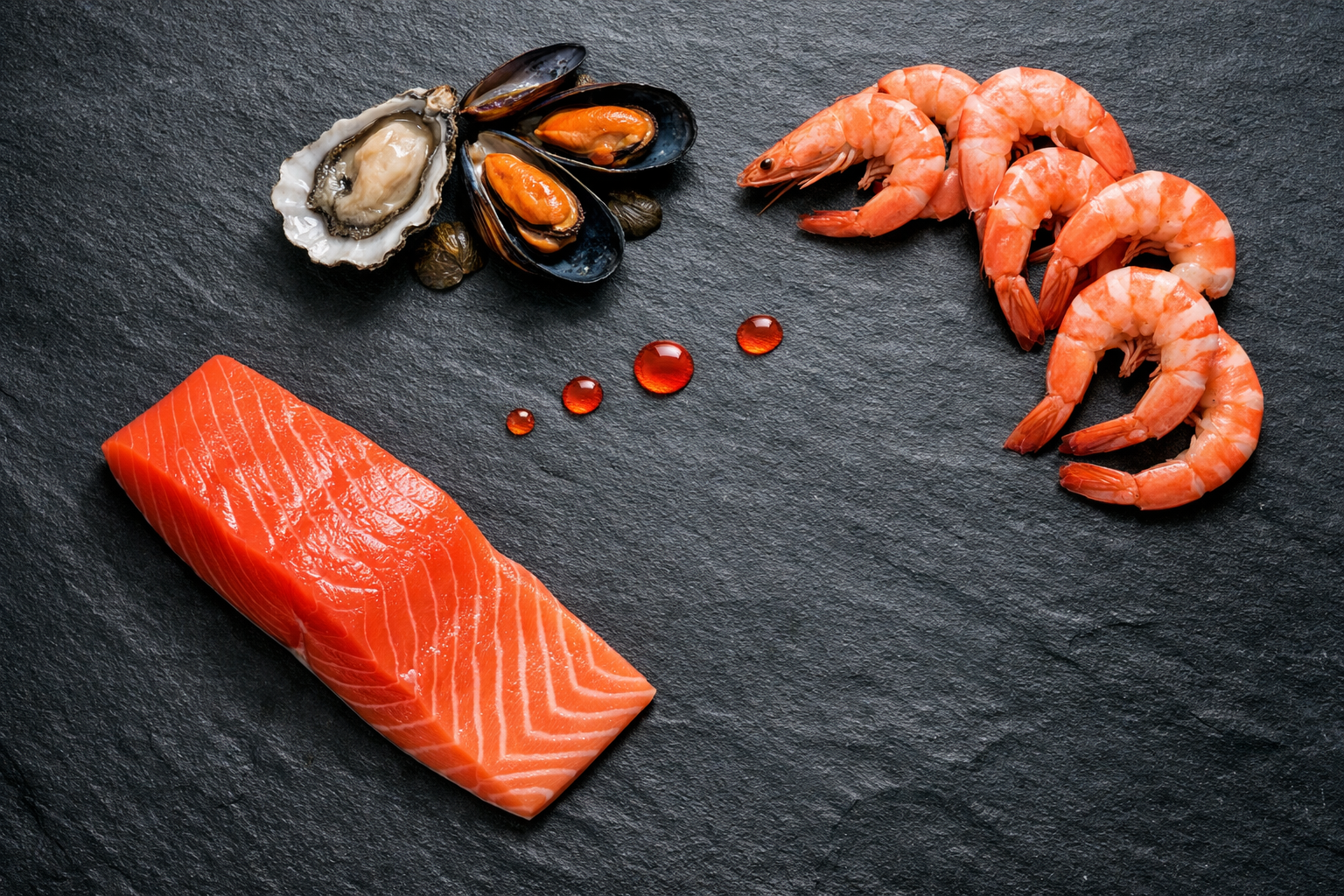
Summary
Astaxanthin is a red-orange xanthophyll carotenoid found in microalgae and, through the food chain, in seafood such as salmon and shellfish. As a supplement, it is mainly used for antioxidant support, skin health, eye comfort, exercise recovery, and broader wellness goals, with most human products made from oil-based Haematococcus pluvialis extract.
The evidence is promising but selective. Human trials and meta-analyses suggest mild effects on oxidative-stress and inflammation markers, with some of the clearest practical results in skin moisture, elasticity, and support during UV exposure. Evidence for cholesterol, glucose, blood pressure, weight, cognition, and sports performance is more mixed, so astaxanthin is better viewed as a developing wellness supplement than a proven cure-all.
Quick Facts
What is it useful for?
Current best evidence supports modest help with oxidative-stress and inflammation markers and some skin hydration, elasticity, and UV-support outcomes.
Supplement types
Most products use oil-based Haematococcus pluvialis extract. Some products use bacterial or yeast sources that differ in chemistry and companion carotenoids.
Interactions
Direct interaction trials are sparse, so caution is sensible with products or medicines that affect blood pressure, glucose, clotting, or immunity.
Side effects
Short-term studies usually report good tolerability, with occasional mild digestive upset or pigment-related changes. Safety depends on dose, source, and age group.
Other possible benefits
Visual fatigue, exercise adaptation, and selected metabolic markers may improve in some groups, but the evidence is mixed and not definitive.
Regulatory status
EU and US markets allow certain uses, but EFSA has not approved common astaxanthin benefit claims and dose limits can be source-specific.
What We Already Know About It
Marine carotenoid profile. Astaxanthin is reasonably well characterized as a marine-type carotenoid supplement rather than an essential nutrient. Mainstream human supplements are usually based on the microalga Haematococcus pluvialis, with astaxanthin often present in esterified form and delivered in oil. Source and formulation matter because stereochemistry, esterification, extraction method, and lipid delivery can influence stability and absorption. It is also important that astaxanthin is not a provitamin A carotenoid, so its nutritional role is different from beta-carotene. Review — Stereoisomer composition and extraction method; PubMed — Astaxanthin facts and safety overview; NIH — Vitamin A and Carotenoids Fact Sheet; Human bioavailability study — lipid-based formulations
Human evidence pattern. The best-supported human evidence is moderate rather than dramatic. Pooled randomized trials suggest mild reductions in oxidative-stress and inflammation markers, and skin outcomes such as moisture and elasticity appear more promising than many other marketed uses. There is also some supportive evidence for resilience during UV exposure. By contrast, evidence for cholesterol, blood pressure, glucose control, weight loss, cognition, and broad athletic performance claims is mixed or inconsistent. Overall, the evidence base is strongest for biological activity and selected wellness outcomes, but weaker for hard clinical endpoints and disease-related claims. PubMed — Meta-analysis of oxidative stress and inflammation trials; Nutrients — Meta-analysis on skin ageing outcomes; Randomized trial — UV-induced skin deterioration; PubMed — Meta-analysis of obesity, blood pressure, CRP, glucose, and lipids; PubMed — Earlier meta-analysis of lipid and glucose changes; RSC review — Astaxanthin in cardiovascular health
Summary of Relevant Scientific Research
EU Safety Benchmark for Adult Supplements — EFSA Journal 2020
EFSA concluded that astaxanthin from Haematococcus pluvialis used in food supplements at up to 8 mg per day was safe for adults when dietary exposure from other sources was considered. This provides a formal EU safety benchmark for a major natural supplement ingredient, but it is a safety opinion rather than proof of benefit or approval of marketing claims. EFSA Journal 2020 — Safety of astaxanthin as a novel food
Mild Biomarker Improvements in Randomized Trials — Systematic Review and Meta-analysis
A meta-analysis of randomized controlled trials found mild overall reductions in oxidative-stress and inflammation biomarkers, with some stronger signals in people with type 2 diabetes. The evidence supports genuine biological activity, but most benefits were seen in biomarkers rather than major clinical outcomes such as disease prevention or long-term functional improvement. PubMed — Astaxanthin and oxidative stress/inflammation meta-analysis
Skin Moisture, Elasticity, and UV Support — Nutrients Meta-analysis and Randomized Trial
Human skin evidence is among the more encouraging areas. The meta-analysis reported improvements in skin moisture and elasticity, while wrinkle-depth changes were not clearly significant in pooled data. A separate randomized controlled trial suggested oral astaxanthin may help maintain skin condition under UV exposure, supporting modest cosmetic and photoprotective benefits without replacing standard sun protection. Nutrients — Meta-analysis on skin ageing; Randomized trial — UV-induced skin deterioration
Cardiometabolic Claims Remain Inconsistent — Two Meta-analyses
Pooled analyses found no robust overall effect on obesity, blood pressure, or lipid profile, with only limited signals for CRP reduction or slight glucose lowering in some subgroups. These findings argue against broad claims that astaxanthin reliably improves cardiometabolic health in the general population, even though specific higher-risk groups may respond differently in some studies. PubMed — Meta-analysis of obesity, blood pressure, CRP, glucose, and lipids; PubMed — Meta-analysis of lipid and glucose outcomes
Context-Dependent Effects on Fatigue, Vision, and Exercise — Meta-analysis and Visual Function Trial
In healthy participants, astaxanthin showed a positive trend for fatigue relief, marginal effects on cognitive accuracy, no clear effect on reaction time, and better fat oxidation and physical performance when combined with regular training. Another trial found improved visual-function measures after visual-display stress, suggesting possible benefits for eye strain and exercise adaptation rather than strong evidence for nootropic or eye-disease claims. SAGE Journals — Meta-analysis on fatigue, motor function, and cognition; Randomized visual-function study — visual-display stress
Formulation Changes Absorption — Human Pharmacokinetic Study
In a single-dose human pharmacokinetic study, lipid-based formulations increased astaxanthin absorption by roughly 1.7-fold to 3.7-fold compared with a reference product. This does not prove superior long-term health outcomes, but it strongly supports the practical importance of oil-based products or taking astaxanthin with fat-containing meals. Human bioavailability study — lipid-based formulations
Beliefs, Myths & Unproven Claims
Myth: Astaxanthin is basically vitamin A
That is misleading. Astaxanthin is a carotenoid, but it is not listed among the main provitamin A carotenoids by the NIH, and human pharmacokinetic literature also states that it does not have vitamin A activity. It should not be treated as a substitute for vitamin A nutrition. NIH — Vitamin A and Carotenoids Fact Sheet; Human bioavailability study — lipid-based formulations
Myth: All astaxanthin products are interchangeable
Different astaxanthin products can vary by source, stereochemistry, esterification, extraction method, and accompanying carotenoids. Natural algal, bacterial, yeast-derived, and synthetic forms are not chemically identical, so results from one product type cannot automatically be applied to another. Review — Stereoisomer composition and extraction method
Myth: Strong antioxidant activity guarantees broad health benefits
The human evidence does not support that leap. Meta-analyses suggest mild improvements in oxidative and inflammatory biomarkers, but far less consistent effects on weight, lipids, blood pressure, or glucose. EU regulators also did not substantiate several proposed claims, so legal sale should not be confused with validated benefit claims. PubMed — Astaxanthin and oxidative stress/inflammation meta-analysis; PubMed — Cardiometabolic meta-analysis; PubMed — Lipid and glucose meta-analysis; EFSA Journal 2010 — Astaxanthin related claims

Detailed Research Observations
Source Differences Are More Than a Label Detail
Astaxanthin is a xanthophyll carotenoid found in marine and freshwater food chains, but the supplement market is dominated by microalgal production rather than seafood extraction. Most human supplements use Haematococcus pluvialis, which is treated as the richest commercially important natural source and the most established nutraceutical raw material. This matters because astaxanthin products are not all chemically identical. Natural H. pluvialis astaxanthin is usually esterified and enriched in a specific stereoisomer pattern, whereas synthetic astaxanthin is generally non-esterified and sold as a mixed stereoisomer product. Yeast and bacterial sources can differ again and may include other carotenoids that complicate interpretation of study results. PubMed — Astaxanthin facts and safety overview; Review — Stereoisomer composition and extraction method; Review — Safety and source differences
The practical implication is that the word “astaxanthin” on a front label does not guarantee interchangeable bioactivity or evidence. Trials using one source cannot always be assumed to predict the performance of another, especially when companion compounds and formulation differ. The chemistry differences are well documented, but direct head-to-head human trials proving clinical superiority of one source remain limited. That is why the best-supported human evidence tends to cluster around oil-based algal products rather than the category as a whole. Review — Stereoisomer composition and extraction method; Review — Safety and source differences
Bioavailability Depends Strongly on Formulation
Astaxanthin is fat-soluble, so delivery format has a direct effect on how much reaches circulation. One of the most useful human pharmacokinetic studies showed that lipid-based formulations increased absorption by about 1.7-fold to 3.7-fold compared with a reference product after a single oral 40 mg dose. This does not prove that all oil-based products are clinically superior in every setting, but it does show that formulation can materially affect exposure. That helps explain why many mainstream products are sold as oil-based softgels rather than as dry powders or simple capsules. Human bioavailability study — lipid-based formulations
From a practical perspective, this supports two consistent points in the literature: oil-based systems are more plausible for efficient delivery, and taking astaxanthin with a fat-containing meal is sensible. The broader science section reinforces this by linking stereochemistry, esterification, extraction method, and lipid delivery with differences in stability and absorption. In other words, dose alone is not the whole story. A lower-dose product with better delivery may not behave the same way as a higher-dose product with poor formulation. Human bioavailability study — lipid-based formulations; Review — Stereoisomer composition and extraction method
Biological Activity Is Real, but Clinical Meaning Is Often Modest
The most consistent broad human evidence is not dramatic symptom relief but modest changes in oxidative-stress and inflammation markers. A systematic review and meta-analysis of randomized controlled trials found mild overall reductions in these biomarkers, with some signals appearing stronger in people with type 2 diabetes. A smaller controlled trial in healthy young women also reported reductions in a DNA oxidative-damage marker and CRP alongside shifts in selected immune markers. Together, these studies support the idea that astaxanthin has measurable biological activity in humans rather than only in cell or animal models. PubMed — Astaxanthin and oxidative stress/inflammation meta-analysis; Controlled trial — immune function and oxidative stress
However, the current evidence also shows the limit of that finding. Biomarker improvement is not the same thing as established clinical benefit in disease prevention, functional performance, or long-term symptom relief. Reviews focused on cardiovascular science make this gap explicit, noting that mechanistic plausibility and preclinical findings are stronger than the human outcome literature. This makes astaxanthin more credible as a selective adjunct for oxidative-stress management than as proof of broad disease-modifying power. PubMed — Astaxanthin and oxidative stress/inflammation meta-analysis; RSC review — Astaxanthin in cardiovascular health
Skin Outcomes Are the Strongest Practical Use Case
Among marketed uses, skin is one of the most credible. A systematic review and meta-analysis of randomized trials found that oral astaxanthin improved skin moisture and elasticity compared with placebo, while wrinkle-depth changes were less clearly significant in pooled data. A separate randomized trial suggested that oral astaxanthin may help maintain skin condition under UV exposure. These findings support a moderate, practical use case centered on hydration, elasticity, and some support against UV-related deterioration. Nutrients — Meta-analysis on skin ageing; Randomized trial — UV-induced skin deterioration
The important limitation is that this is still supportive evidence, not proof of a miracle anti-ageing effect. The pooled data did not clearly show large wrinkle-depth reductions, and the authors do not justify treating astaxanthin as a replacement for sunscreen, protective clothing, or sun-avoidance measures. The most balanced reading is that skin benefits appear more consistent than cardiometabolic or cognitive claims, but the magnitude is modest and best interpreted as supportive rather than transformative. Nutrients — Meta-analysis on skin ageing; Randomized trial — UV-induced skin deterioration
Vision, Fatigue, and Exercise Benefits Appear Context-Dependent
Eye comfort and visual fatigue are plausible but still specialized evidence areas. In a randomized trial, healthy adults taking astaxanthin for six weeks showed improvements in some visual-function measures after visual-display stress. That makes astaxanthin more interesting for screen-heavy lifestyles than for claims about preventing major eye diseases, which the reviewed evidence does not support. Cognitive findings are also restrained: a recent meta-analysis reported only marginal effects on cognitive accuracy and no clear effect on reaction time. Randomized visual-function study — visual-display stress; SAGE Journals — Meta-analysis on fatigue, motor function, and cognition
Exercise data follow a similar pattern. The 2024 meta-analysis in healthy participants found a positive trend for fatigue relief and some benefits for fat oxidation and physical performance when astaxanthin was combined with regular training. That qualifier matters. The signal appears stronger when supplementation supports an existing exercise program rather than acting as a passive ergogenic shortcut. Since not every measured outcome improved, the fairest interpretation is that astaxanthin may help in specific performance contexts without qualifying as a universal sports supplement. SAGE Journals — Meta-analysis on fatigue, motor function, and cognition
Cardiometabolic Claims and Dosing Need Caution
Claims for cholesterol, glucose control, blood pressure, and weight management are among the most overstated. Two meta-analyses found no robust overall improvements in obesity measures, blood pressure, or lipid profile, with only limited signals for CRP reduction or small glucose changes. A newer trial in people with prediabetes and dyslipidemia reported improvements in total cholesterol and LDL, which suggests certain higher-risk groups may respond differently. Even so, the broader literature does not support a reliable cardiometabolic effect across general users. PubMed — Meta-analysis of obesity, blood pressure, CRP, glucose, and lipids; PubMed — Meta-analysis of lipid and glucose outcomes; Clinical trial — Prediabetes and dyslipidemia
Dose context also matters. Human studies commonly use roughly 2 to 12 mg daily for several weeks, with many skin and general-wellness trials clustered around 4 to 6 mg daily. Some exercise or special-population studies have used 12 to 20 mg daily, and absorption work used a single 40 mg dose, but that should not be read as a standard long-term recommendation. The literature also notes that higher dosing does not always produce stronger outcomes, reinforcing the idea that formulation, context, and appropriate dose matter more than simply choosing the highest number on the label. Controlled trial — immune function and oxidative stress; Human bioavailability study — lipid-based formulations
Regulatory Status (EU and US)
European Union
In the EU, astaxanthin-rich oleoresin from Haematococcus pluvialis is regulated as a novel food ingredient. The 2023 implementing regulation sets age-specific maximum daily intakes for supplements and requires labeling to avoid use by unintended age groups. EFSA also concluded that 8 mg per day was safe for adults for this source when broader dietary exposure was considered. EUR-Lex — Commission Implementing Regulation (EU) 2023/1581; EFSA Journal 2020 — Safety of astaxanthin as a novel food
United States
In the US, the FDA had no questions regarding a GRAS conclusion for H. pluvialis extract containing astaxanthin esters for specified food uses, and astaxanthin also has a regulatory history as a color additive in salmonid fish feed. These actions support lawful use under stated conditions, but they are not the same as FDA approval that astaxanthin supplements treat disease or deliver all marketed benefits. FDA — GRAS notice for H. pluvialis astaxanthin extract; FDA — Final rule on astaxanthin as a color additive in fish feed
A separate EU issue is claims law: EFSA did not substantiate commonly proposed claims for visual acuity, cholesterol, CRP, connective tissue, joints, or protection from oxidative damage. That means legal market access and approved health claims are not the same thing. EFSA Journal 2010 — Astaxanthin related claims
Dosage and Standardization
Typical studied range: 2–12 mg daily for 4–12 weeks.
Common use: 4–6 mg daily in skin and wellness studies.
Higher-study doses: Some exercise-related or special-population trials used 12–20 mg daily, while a single 40 mg dose was used only in absorption research.
EU limits for H. pluvialis oleoresin: up to 2.3 mg daily for children aged 3 to under 10 years, up to 5.6 mg daily for adolescents aged 10 to under 14 years, and up to 8 mg daily for older adolescents and adults.
Practical note: Because astaxanthin is fat-soluble, oil-based softgels or use with a fat-containing meal are likely to improve absorption.
Safety And Interactions
Tolerability. Short-term human studies generally report good tolerability at commonly marketed adult doses, and EFSA supported up to 8 mg daily for adults for astaxanthin from Haematococcus pluvialis when total dietary exposure is considered. Reported side effects are usually mild when they occur, such as digestive discomfort or other minor symptoms, but the strongest safety data are source-specific and centered on the better-studied natural algal ingredient rather than every astaxanthin product on the market. EFSA Journal 2020 — Safety of astaxanthin as a novel food; Review — Safety and source differences
Interactions and special populations. Robust human interaction trials were not identified in the reviewed sources. Caution around combining astaxanthin with blood-pressure-lowering, glucose-lowering, anticoagulant, or immunomodulating therapies is therefore preliminary or theoretical rather than strongly proven. Pregnancy and breastfeeding data were not well established, and EU age-specific permitted levels should not be confused with a general recommendation that children need supplementation. Product source, formulation, and labeling remain important safety details. RSC review — Astaxanthin in cardiovascular health; Healthline — Astaxanthin health claims overview; EUR-Lex — Commission Implementing Regulation (EU) 2023/1581
Conclusion
Astaxanthin is best understood as a non-essential dietary carotenoid supplement with selective, moderate-strength evidence rather than as a proven all-purpose health solution. The most convincing human findings support mild improvements in oxidative-stress and inflammation markers and modest benefits for skin hydration, elasticity, and resilience under UV exposure. There is also some promising but less settled evidence for visual fatigue, exercise-related outcomes, and fatigue relief.
At the same time, cardiometabolic claims remain mixed, many marketed benefits lack strong clinical confirmation, and not all astaxanthin products are chemically or practically equivalent. Natural Haematococcus pluvialis oil-based products are the best-studied form in humans, and regulatory status in the EU and US is narrower than marketing often suggests. More long-term, source-comparison, and clinically meaningful outcome research is still needed.
Disclaimer
Disclaimer: We attempt to do our best to find relevant, accurate and most up to date information available in both, the public domain and in the clinical and medical research community. We recommend reviewing scientific sources for official information on the subject. This post is not intended as medical advice. Each individual person's health conditions vary and we advise to consult a doctor before taking any supplements.