

 Deutsch
 Español
 Suomi
Suomi Français
 Bahasa Indonesia
 Italiano
 日本語
日本語 Português
 Tagalog
Summary
Hyaluronic acid is a water-binding compound your body already makes in skin, joints, and connective tissue. As an oral supplement, it is mainly marketed for skin hydration, wrinkle support, and joint comfort, but it is not a classical essential nutrient and has no established dietary reference intake.
Current oral evidence is strongest for modest skin benefits, especially hydration and some wrinkle-related outcomes, with the clearest support at about 60 to 120 mg daily over 6 to 12 weeks. Evidence for joint symptom relief is more mixed and weaker. Oral supplements should also be kept separate from topical products and injectable fillers or joint treatments, which have different mechanisms, evidence standards, and regulatory categories.
Quick Facts
What is it useful for?
The best-supported oral use is modest improvement in skin hydration and some wrinkle measures. Joint symptom support has weaker evidence.
Supplement types
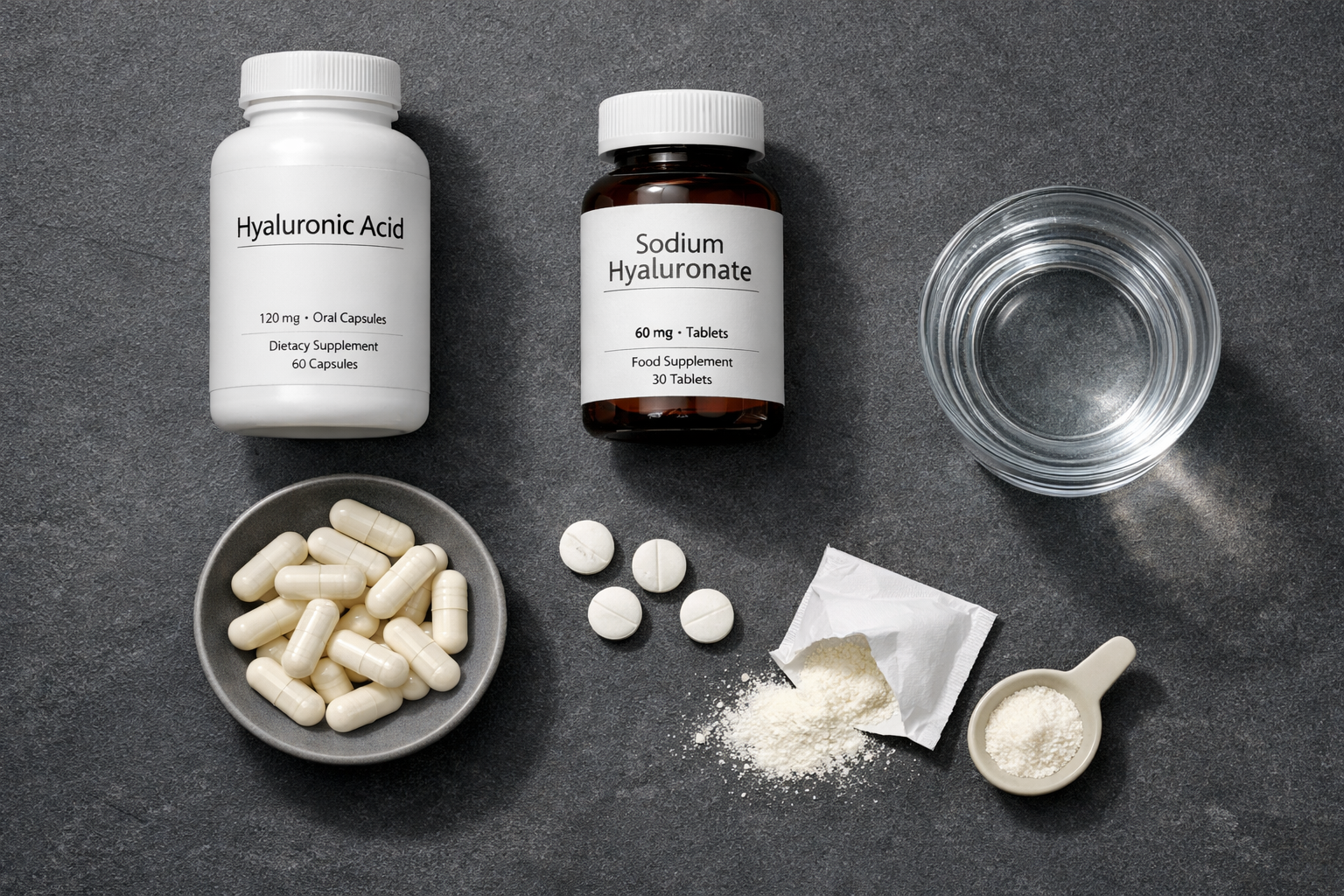
Supplements commonly use hyaluronic acid or sodium hyaluronate in capsules, tablets, powders, gummies, or liquids, from fermentation or animal sources.
Interactions
Clear interaction data are limited. Combination joint products may overlap with other mobility or pain ingredients and make effects harder to attribute.
Side effects
Oral hyaluronic acid appears generally well tolerated in adult trials, with occasional mild digestive complaints.
Other possible benefits
Joint comfort is the main additional oral claim under study, but evidence for reflux, bladder, eye, or bone benefits remains limited or indirect.
Regulatory status
In the US, oral products are sold as dietary supplements and are not FDA-approved for efficacy. In the EU, general skin and joint claims are not authorized.
What We Already Know About It
Body-made structural compound. Hyaluronic acid is a naturally occurring glycosaminoglycan found in skin, synovial fluid, cartilage, and connective tissue, where it helps tissues retain water and maintain structure. From a nutrition perspective, it is better described as an endogenous compound and supplement ingredient than as an essential nutrient, because no recommended intake has been established for it. (PubChem — Hyaluronic Acid; FDA — Dietary Supplements Q&A)
Why oral use is plausible. Oral hyaluronan does not necessarily need to be absorbed intact as one very large molecule. Mechanistic work suggests it can be degraded by intestinal bacteria into smaller fragments and metabolites that may then be absorbed, distributed to tissues, or influence signaling pathways indirectly. This supports biological plausibility, but mechanistic plausibility is not the same as proven clinical benefit in people. (PubMed — Intestinal absorption study on oral hyaluronan; PubMed — Carbohydrate Polymers review on oral hyaluronan and microbiota)
Where evidence is strongest. Human oral research is most consistent for skin outcomes, with randomized trials and a recent meta-analysis showing modest improvements in hydration and some support for elasticity and wrinkle-depth measures. Joint-symptom studies exist, but they are smaller, more heterogeneous, and often involve combination formulas, so confidence is lower. Topical cosmetics and injectable fillers or osteoarthritis injections are separate categories and should not be treated as proof that oral supplements work equally well. (PubMed — 2025 meta-analysis on oral hyaluronic acid and skin; Scientific Reports — 150-adult sodium hyaluronate trial; PMC — Mediterranean Journal of Rheumatology systematic review; FDA — Approved dermal fillers)
Summary of Relevant Scientific Research
Meta-analysis of oral skin outcomes — Journal of Drugs in Dermatology
A 2025 meta-analysis of seven randomized controlled trials found statistically significant improvements in skin hydration, elasticity, and wrinkle depth with oral hyaluronic acid. Firmness, wrinkle volume, and transepidermal water loss did not reach significance, so the overall signal is encouraging but still modest rather than dramatic. (PubMed — 2025 meta-analysis on oral hyaluronic acid and skin)
12-week dose trial in healthy adults — Scientific Reports
In 150 healthy adults, high-molecular-weight sodium hyaluronate at 60 mg/day and 120 mg/day improved several skin-related measures over 12 weeks. The 120 mg dose showed clearer effects on hydration, elasticity, transepidermal water loss, wrinkle depth, epidermal thickness, dermal density, and natural moisturizing factor markers. (Scientific Reports — 150-adult sodium hyaluronate trial)
Molecular-weight studies do not show one universal winner — Journal of Clinical Biochemistry and Nutrition; Clinical Interventions in Aging
In a dry-skin trial, 120 mg/day of 800 kDa or 300 kDa hyaluronan improved skin moisture versus placebo over six weeks. In a separate wrinkle study, 120 mg/day of 2 kDa or 300 kDa hyaluronan improved wrinkle outcomes over 12 weeks, with especially clear benefits in the 300 kDa group. (PubMed — Dry-skin hyaluronan trial; PubMed — Wrinkle trial by molecular weight)
Benefits may appear within weeks — Skin Research and Technology
A randomized trial in 129 women reported improved skin hydration within roughly two to eight weeks, better skin tone by four to eight weeks, and increased epidermal thickness by 12 weeks. The study broadened the skin evidence, but it was still a relatively short cosmetic-endpoint trial. (PMC — Skin Research and Technology oral hyaluronic acid trial)
Joint studies suggest possible benefit, but evidence is mixed — Mediterranean Journal of Rheumatology and supporting trials
The oral joint literature is more heterogeneous than the skin literature. A systematic review found that most studies reported at least one benefit in osteoarthritis or low back pain, and small placebo-controlled trials using about 200 mg/day reported symptom improvements and, in one case, reduced NSAID or analgesic use. The studies were still too small and mixed to establish a robust standard of care. (PMC — Mediterranean Journal of Rheumatology systematic review; PMC — 56-day knee osteoarthritis study; PMC — 12-month oral hyaluronic acid plus exercise study)
Beliefs, Myths & Unproven Claims
Myth: Hyaluronic acid is an essential nutrient like a vitamin or mineral
The reviewed material does not support that framing. Hyaluronic acid is a body-made structural molecule and supplement ingredient, but no US or EU intake reference value was identified, and the regulatory material cited does not present it as an essential nutrient. (FDA — Dietary Supplements Q&A; PubChem — Hyaluronic Acid)
Myth: One molecular weight or one source is clearly superior for everyone
Human oral trials do not justify that certainty. Benefits have been reported with low-, medium-, and high-molecular-weight preparations, and the reviewed material did not show convincing clinical evidence that animal-derived material outperforms fermentation-derived material. Fermented sodium hyaluronate has practical manufacturing advantages, but that is not the same as proven superiority in outcomes. (PubMed — Dry-skin hyaluronan trial; PubMed — Wrinkle trial by molecular weight; Scientific Reports — 150-adult sodium hyaluronate trial; PubMed — Review of hyaluronic acid production and applications)
Myth: Oral supplements should work as strongly as fillers or joint injections
That does not follow from the evidence. Oral findings are modest and route-specific, with the strongest support for skin hydration and some wrinkle measures. Many other consumer-facing claims, including strong benefits for reflux, bladder pain, bone health, or eye disorders, remain preliminary, indirect, or based on other product types and routes rather than solid oral supplement trials. (PubMed — 2025 meta-analysis on oral hyaluronic acid and skin; PMC — Mediterranean Journal of Rheumatology systematic review; ACR/Arthritis Foundation — osteoarthritis guideline)
Detailed Research Observations
What it is and why it is not a classic nutrient
Hyaluronic acid, also called hyaluronan, is a large polysaccharide in the glycosaminoglycan family. It is made naturally in the body and helps bind water, support extracellular structure, cushion joints, and contribute to skin texture and hydration. That biology explains why it became commercially interesting for both beauty and joint products. Unlike vitamins or minerals with established deficiency concepts, hyaluronic acid is better understood as an endogenous structural compound that can also be sold as a supplement ingredient. (PubChem — Hyaluronic Acid; PubMed — Review of hyaluronic acid production and applications)
The reviewed materials did not identify a recommended dietary allowance, adequate intake, or tolerable upper intake level for hyaluronic acid. In the US, it fits more naturally under the broad dietary-supplement framework than under the category of a recognized essential nutrient. That distinction matters because being marketed as a supplement does not mean the substance is nutritionally essential. (FDA — Dietary Supplements Q&A; PubChem — Hyaluronic Acid)
Supplement forms, sources, and why labels matter
Most oral products use either hyaluronic acid or sodium hyaluronate, the sodium salt form often favored for stability and formulation. Products are sold as capsules, tablets, powders, gummies, and liquids, sometimes as stand-alone ingredients and sometimes combined with collagen, vitamin C, biotin, MSM, or glucosamine. Molecular weight is heavily marketed, but the best-supported oral forms in the human literature are simply hyaluronan and sodium hyaluronate used at meaningful study doses. (Scientific Reports — 150-adult sodium hyaluronate trial; PMC — 56-day knee osteoarthritis study)
Source and manufacturing mainly affect vegan suitability, impurity concerns, scalability, and supply consistency. Historically, hyaluronic acid was extracted from animal tissues such as rooster combs, while modern production also uses microbial fermentation followed by purification. The evidence reviewed did not prove that animal-derived oral hyaluronic acid works better than fermentation-derived material in humans. It also highlighted a practical market issue: some labels contain far less than study-like doses, including an NIH Dietary Supplement Label Database example listing just 5 mg sodium hyaluronate per serving. (PubMed — Review of hyaluronic acid production and applications; EU Commission — Consultation on fermentation-derived sodium hyaluronate; NIH DSLD — Sodium hyaluronate label example)
Bioavailability questions and the strongest skin evidence
A common objection is that hyaluronic acid is too large to do much when swallowed. Mechanistic work suggests the situation is more complex. Oral hyaluronan may be broken down by intestinal bacteria into smaller oligosaccharides and metabolites, which may then be absorbed and distributed or may influence immune and tissue signaling indirectly. In other words, clinical activity would not require the whole giant molecule to pass unchanged into the bloodstream. Still, this is only a plausibility argument; human trials remain the deciding evidence. (PubChem — Hyaluronic Acid; PubMed — Intestinal absorption study on oral hyaluronan; PubMed — Carbohydrate Polymers review on oral hyaluronan and microbiota)
Across randomized skin trials, oral hyaluronic acid has repeatedly improved skin hydration, and some trials also report gains in elasticity, wrinkle depth, epidermal thickness, skin tone, or barrier-related measures. The strongest recent trial used high-molecular-weight sodium hyaluronate at 60 mg/day and 120 mg/day for 12 weeks in 150 healthy adults, with clearer overall effects at 120 mg/day. A 2025 meta-analysis supports a real signal for hydration, elasticity, and wrinkle depth, while also showing that not every cosmetic endpoint improves significantly. Taken together, the evidence supports modest rather than dramatic oral skin benefits. (Scientific Reports — 150-adult sodium hyaluronate trial; PubMed — 2025 meta-analysis on oral hyaluronic acid and skin; PMC — Skin Research and Technology oral hyaluronic acid trial)
Molecular weight claims and the weaker joint literature
The supplement market often implies that one molecular-weight band is the only effective option. Human evidence does not justify that level of certainty. Benefits have been reported with 2 kDa, 300 kDa, 800 kDa, high-molecular-weight sodium hyaluronate, and broader formulations. One dry-skin trial found improved moisture with both 800 kDa and 300 kDa hyaluronan, while a wrinkle study found benefit with both 2 kDa and 300 kDa forms. The practical conclusion is that molecular weight may influence behavior, but there is no definitive winner across all oral outcomes. (PubMed — Dry-skin hyaluronan trial; PubMed — Wrinkle trial by molecular weight; Scientific Reports — 150-adult sodium hyaluronate trial)
Joint-support evidence is less clean than the skin literature. A recent systematic review found that many studies reported at least one benefit in osteoarthritis or low back pain, but the studies varied widely in design, comparators, and whether hyaluronic acid was used alone or in combinations. Small trials around 200 mg/day suggest possible symptom relief and, in one case, lower use of NSAIDs or analgesics. A longer study suggested benefit might be more apparent in certain subgroups and alongside exercise. That makes oral hyaluronic acid more plausible as an adjunct than as a strongly proven standalone joint therapy. (PMC — Mediterranean Journal of Rheumatology systematic review; PMC — 56-day knee osteoarthritis study; PMC — 12-month oral hyaluronic acid plus exercise study)
Why route, regulation, and product quality change the interpretation
One of the most important practical distinctions is that oral supplements, dermal fillers, and osteoarthritis injections are not the same category. Dermal fillers are local medical devices used for specific cosmetic indications, while knee injections are medical treatments with their own guideline debates. Even in injected osteoarthritis care, evidence is not uniformly positive: the AAOS does not recommend routine use of intra-articular hyaluronic acid for symptomatic knee osteoarthritis, and the ACR/Arthritis Foundation guideline conditionally recommends against it in several settings. Those medical-route debates should not be used as shortcut evidence that oral supplements are strongly validated. (FDA — Approved dermal fillers; AAOS — Knee osteoarthritis guideline; ACR/Arthritis Foundation — osteoarthritis guideline; Mayo Clinic — Hyaluronic acid injection overview)
Regulatory findings also explain why promising supplement research does not automatically translate into approved claims. EFSA concluded that the submitted evidence did not establish cause and effect for protecting the skin against dehydration and did not substantiate a general-population claim for maintenance of normal joints. In the US, supplements are not pre-approved by FDA for efficacy, and FDA has also warned about some hyaluronic-acid-labeled pain products containing undeclared drug ingredients. From a practical standpoint, the best fit with current evidence is a reputable product using hyaluronan or sodium hyaluronate at study-like doses rather than tiny label amounts. (EFSA — Opinion on skin dehydration claim; EFSA — Opinion on joint maintenance claim; FDA — Dietary Supplements Q&A; FDA — Warning on undeclared ingredients in hyaluronic acid pain products)
Regulatory Status (EU and US)
United States
Oral hyaluronic acid products are generally sold within the dietary-supplement framework. Under that system, supplements are not FDA-approved for efficacy before marketing, so oral hyaluronic acid should not be described as an approved treatment. Injectable dermal fillers and osteoarthritis injections are separate FDA-regulated medical categories and should not be grouped together with food supplements. (FDA — Dietary Supplements Q&A; FDA — Approved dermal fillers; Mayo Clinic — Hyaluronic acid injection overview)
European Union
In the EU, the key issue is health-claim authorization. EFSA concluded that the submitted evidence did not establish a cause-and-effect relationship for protecting skin against dehydration and did not substantiate a general-population claim for maintenance of normal joints. EU law requires health claims to be authorized within the Union framework, so plausible mechanisms and small trials do not automatically become permitted label claims. (EFSA — Opinion on skin dehydration claim; EFSA — Opinion on joint maintenance claim; EU Commission — Nutrition and health claims framework)
A practical EU point is that fermentation-derived sodium hyaluronate from the cited process was considered not novel for use in food supplements. That supports its legitimacy as a supplement ingredient, but it does not prove superior clinical efficacy. (EU Commission — Consultation on fermentation-derived sodium hyaluronate)
Dosage and Standardization
Skin: 60–120 mg/day for 6–12 weeks, with 120 mg/day most consistently supported.Joints: About 200 mg/day in studies, but evidence is less consistent and not a formal standard.
Safety And Interactions
In the reviewed adult oral trials, hyaluronic acid was generally well tolerated. Skin studies reported no major hyaluronic-acid-related adverse events, and the osteoarthritis systematic review described adverse effects as mostly mild or absent, with occasional gastrointestinal complaints. That gives oral hyaluronic acid a fairly reassuring short-term safety profile in generally healthy adults, although the evidence base is still much smaller than for common vitamins or minerals. (PubMed — Dry-skin hyaluronan trial; PMC — Mediterranean Journal of Rheumatology systematic review)
High-quality evidence on drug-supplement interactions for pure oral hyaluronic acid was limited in the reviewed sources. A practical caution is combination products, especially joint formulas that include multiple active ingredients and make side effects or interactions harder to attribute. Product quality also matters, because FDA has warned about certain products marketed as hyaluronic acid for pain relief that contained undeclared drug ingredients. (FDA — Warning on undeclared ingredients in hyaluronic acid pain products; FDA — Dietary Supplements Q&A)
Special-population data remain limited. Most oral trials were conducted in healthy adults or adults with osteoarthritis, so pregnancy, breastfeeding, and pediatric use are under-studied rather than clearly established as safe. Oral supplements also have a different safety profile from knee injections and dermal fillers, which carry route-specific local or procedural risks. (PMC — 56-day knee osteoarthritis study; FDA — Approved dermal fillers; Mayo Clinic — Hyaluronic acid injection overview)
Conclusion
Hyaluronic acid is a real, biologically important body compound, but as a supplement it should not be oversold. It is not a classical essential nutrient, and the evidence differs sharply by route and use case. The strongest oral-human support is for skin outcomes, especially hydration, with some additional support for elasticity and wrinkle-depth measures.
The best-supported oral forms are hyaluronan or sodium hyaluronate at study-like doses, often around 60 to 120 mg/day for skin, while joint-symptom studies more often use around 200 mg/day. Overall, evidence for oral skin benefits is moderate, evidence for oral joint benefits is preliminary to limited, and many other popular claims remain weak or route-confused. Product choice should focus on realistic claims, reputable manufacturing, and doses that resemble actual studies.
Disclaimer
Disclaimer: We attempt to do our best to find relevant, accurate and most up to date information available in both, the public domain and in the clinical and medical research community. We recommend reviewing scientific sources for official information on the subject. This post is not intended as medical advice. Each individual person's health conditions vary and we advise to consult a doctor before taking any supplements.