

 Deutsch
 Español
 Suomi
Suomi Français
 Bahasa Indonesia
 Italiano
 日本語
日本語 Português
 Tagalog
If you are taking creatine for running because you want a higher VO₂ max, you will probably be disappointed. The current evidence does not support that goal, especially if your main event is steady distance running.
That does not make creatine useless for runners. It makes it specific. It is more likely to help the short, hard parts of training and racing: hill surges, 400 m repeats, sprint finishes, middle-distance races, and strength work that supports your running.
If you run anything from 5K to marathon distance, the real question is not whether creatine monohydrate is a good supplement in general. It is whether its likely benefits match the places where you actually lose time, and whether a small increase in water weight is worth it for your event.
Why creatine does not act like a VO₂ max booster
Creatine mainly works by increasing creatine and phosphocreatine stored in muscle. That helps your muscles remake ATP quickly during brief, intense efforts. In plain English, it is better suited to a hard surge than to improving aerobic fitness.
That matters because runners often hear creatine talked about as if it lifts every performance marker at once. It does not. VO₂ max is tied to oxygen uptake and use during hard exercise. Creatine is not an oxygen-delivery supplement, so a large direct boost would be surprising.
Myth
Creatine raises your aerobic engine and should improve VO₂ max.
Fact
The strongest pooled evidence says creatine does not improve VO₂ max and should not be sold to runners on that promise.
A systematic review and meta-analysis of 19 randomized controlled trials found no VO₂ max advantage. Across those studies, VO₂ max tended to improve less with creatine than with placebo, and post-supplement VO₂ max was also slightly lower in the creatine groups.
What the endurance evidence shows
When you move from VO₂ max to real endurance performance, the picture is still underwhelming. A meta-analysis in trained athletes found no significant improvement in endurance performance after creatine, with a pooled effect that was trivially negative overall.
That does not mean creatine always makes endurance worse. It means the average effect is so small that runners should not expect a meaningful endurance advantage from it.
This is especially important for trained runners. Small changes matter in a half marathon or marathon. If a supplement cannot reliably improve performance in trained endurance athletes, it is probably not the right tool for shaving minutes off a race just by adding powder to a bottle.
Creatine can be a useful supplement for a runner without being a useful supplement for steady endurance pace.
Where runners might still notice something
Creatine becomes more interesting when running stops being steady. Because it supports fast energy turnover inside muscle, it makes the most sense when pace repeatedly spikes or when a race ends with a short, hard effort.

The best-fit running scenarios
Think of the moments when your legs need a sharp burst: uphill attacks, repeated hill efforts, hard intervals, cross-country surges, and the final kick. These are the situations where creatine is more plausible.
That does not prove faster race times. It simply matches creatine's known role better than a long, even pace does.
Middle-distance races
Events with fast starts, tactical surges, and hard finishes are a better fit than long steady races.
Interval-heavy blocks
Creatine may be more useful when training includes repeated hard reps, sprint work, or hill sessions.
Strength-supported running
Runners who lift seriously may care more about creatine's gym benefits than its direct endurance effects.
There is some direct support for that narrower view. A small older running study found better performance in an all-out uphill treadmill effort lasting about a minute after short-term creatine loading. That is much closer to a steep hill surge than to holding pace for 10K, a half marathon, or a marathon.
Mechanistic work also points in this direction. During hard endurance-style exercise, creatine can improve muscle energy status even when the whole-event performance result does not clearly change. The biology makes sense, but the jump from that biology to faster distance race times is inconsistent.
The water-weight trade-off matters in running
One reason creatine is harder to judge in runners than in lifters is body mass. Creatine commonly increases body water, especially during a loading phase. That is not fake weight, but it is also not the same as instantly gaining new muscle tissue.
For runners, this matters because running is weight-bearing. You carry every extra kilogram with every step. In cycling, rowing, or some gym-based sports, a small increase in body mass may matter less. In distance running, it can affect comfort, economy, and how light you feel at pace.
Why the scale can change
Early weight gain on creatine is usually mostly water. For some runners, that is an acceptable trade-off if the supplement helps gym work, sprint work, or repeated surges.
For others, especially longer-distance runners who feel every extra kilogram, the trade-off may not be worth it.

Creatine can make more sense for a 1500 m runner than for a marathoner. The shorter and more surge-heavy the event, the easier it is to justify a small water-weight increase.
Recovery and training quality are possible, not guaranteed
Creatine may also have a role in recovery between hard sessions. A systematic review and meta-analysis of randomized trials found lower creatine kinase after muscle-damaging exercise, especially around 48 to 96 hours, with possible benefits for muscle function.
That sounds useful, but the recovery evidence is mixed. Studies use different exercise models, different participant groups, and different methods. It is hard to turn those findings into a confident promise for runners.
What you might notice first
If creatine helps your running, the first signs may appear in training quality rather than on a VO₂ max printout: better late-rep pop, less drop-off across intervals, or sharper strength sessions during a heavy mileage block.
Who should consider creatine?
Creatine is most defensible for runners who do not need it to be an aerobic miracle. It is a better fit when your training or racing includes short, hard muscular efforts on top of an aerobic base.
More likely to suit
- Middle-distance runners
- Runners doing lots of intervals, sprints, or hills
- Runners who also lift seriously
- Athletes in races with repeated surges or hard finishes
- Vegetarian or low-meat athletes, who may start with lower baseline muscle creatine stores
Lower priority
- Runners chasing a higher VO₂ max specifically
- Steady half-marathon and marathon runners who are sensitive to body-mass changes
- Runners expecting a clear endurance boost without changing training
- Anyone who dislikes the idea of a small water-weight increase
A marathoner can still choose to use creatine. The point is that the burden of proof is higher. If the likely downside matters to your event and the likely upside sits mostly in strength work or short surges, the decision has to fit your own training.
How to use it if you decide to try it
If you do experiment with creatine, the evidence-based choice is plain creatine monohydrate. It is the form with the strongest performance and safety record, and most runners do not need to pay more for fancier versions.
| Approach | Typical use | Runner-friendly note |
|---|---|---|
| Loading | About 0.3 g per kilogram of body weight per day for 5 to 7 days, then 3 to 5 g per day. | Works faster, but may cause a more obvious jump in water weight. |
| No loading | About 3 to 5 g per day consistently, reaching near-full saturation more gradually over roughly 4 weeks. | Often the more comfortable choice for runners who want a slower change. |
Consistency matters more than perfect timing
For most runners, taking creatine every day is more important than taking it at a perfect minute. A slower 3 to 5 g daily approach may also reduce stomach upset and make scale changes easier to track.
Do not start a new supplement in race week. Test it during normal training, when a small change in weight or digestion will not ruin a key event.
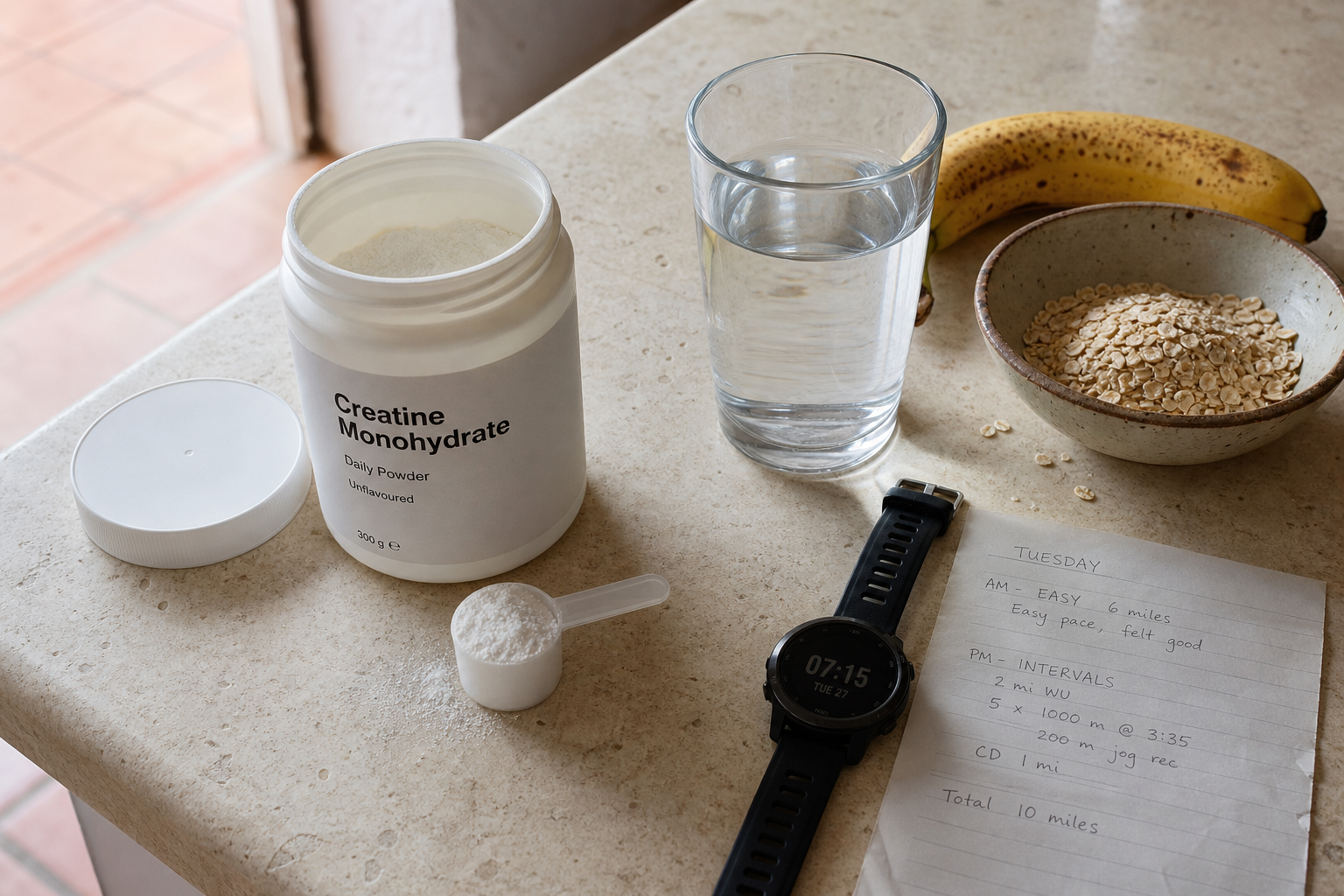
It is also sensible to buy a product that has been third-party tested. The NIH Office of Dietary Supplements points consumers toward programmes such as NSF Certified for Sport, Informed-Choice, and BSCG because supplement quality can vary.
Most evidence supports creatine monohydrate as safe for healthy adults when used at recommended doses. The common annoyances are usually practical: water retention, occasional gastrointestinal discomfort, and sometimes feeling a bit heavier. If you have a medical condition or take medication, check with a clinician before starting.
Myth
Every runner should load creatine and time it perfectly around workouts.
Fact
Many runners can simply take 3 to 5 g daily. Consistency usually matters more than exact timing.
A few runner myths to drop
Creatine directly improves aerobic fitness
It does not look like a VO₂ max booster, and runners should not buy it for that reason.
All weight gained is muscle
Early scale gain is usually mostly water, which matters more in weight-bearing sports.
Loading is mandatory
A daily low-dose approach is valid and may suit runners better than a fast loading phase.
No endurance boost means no use
Creatine may still help runners whose training depends on sprints, hills, intervals, or gym work.
What to take away
Creatine is not a VO₂ max supplement, and runners should not be sold it as one. Across trained athletes, direct endurance outcomes are usually unchanged, and any average benefit looks very small at best.
Where creatine still earns a place is at the sharp end of running: surges, sprints, hill attacks, interval sessions, middle-distance events, and strength-supported performance. Add the water-weight trade-off, and the practical answer is clearer: most steady distance runners should not expect faster race times from creatine alone, but some runners can use it sensibly for the high-intensity parts of training and racing.
References
- Gras et al. Creatine supplementation and VO₂max: a systematic review and meta-analysis
- Todorovic et al. Effects of creatine monohydrate on endurance performance in a trained population
- Ergolytic/ergogenic effects of creatine on aerobic power
- International Society of Sports Nutrition position stand on creatine supplementation
- NIH Office of Dietary Supplements: Exercise and Athletic Performance fact sheet