Creatine for Women: What the Research Says About Strength, Brain Health, and Healthy Aging
Creatine monohydrate is one of the best-studied supplements women can use. The strongest evidence supports strength and training adaptation, especially when paired with resistance exercise, while brain-health and healthy-aging benefits look promising but less definitive.
Strongest for strength
Women-focused guide
Evidence review
Quick Summary: Creatine monohydrate is one of the better-supported supplements women can consider. Its clearest benefit is improved strength and training adaptation, especially with resistance training and especially in older women; cognitive and healthy-aging benefits are plausible, but the evidence there is more conditional.
How Creatine Works
Creatine is a naturally occurring compound stored mostly in muscle, but it also plays an energy-buffering role in the brain. Its main job is to help the body rapidly regenerate ATP, the immediate energy currency used during short bursts of demanding activity such as heavy lifting, sprinting, jumping, or repeated high-intensity efforts.
Supplementing with creatine increases muscle creatine and phosphocreatine stores. In practical terms, that can help support better performance during repeated hard efforts, improve training quality, and over time contribute to better strength gains when training is consistent. This is why creatine monohydrate has remained one of the most reliable sports-nutrition supplements in high-intensity exercise settings.
For women, the key point is that creatine is not just a bodybuilding product. Research increasingly frames it as relevant across the female lifespan, from younger active women to postmenopausal and older women whose main goals may be preserving strength, mobility, and independence rather than adding visible muscle size.
Place images/inline-image-1.jpg in the draft image folder
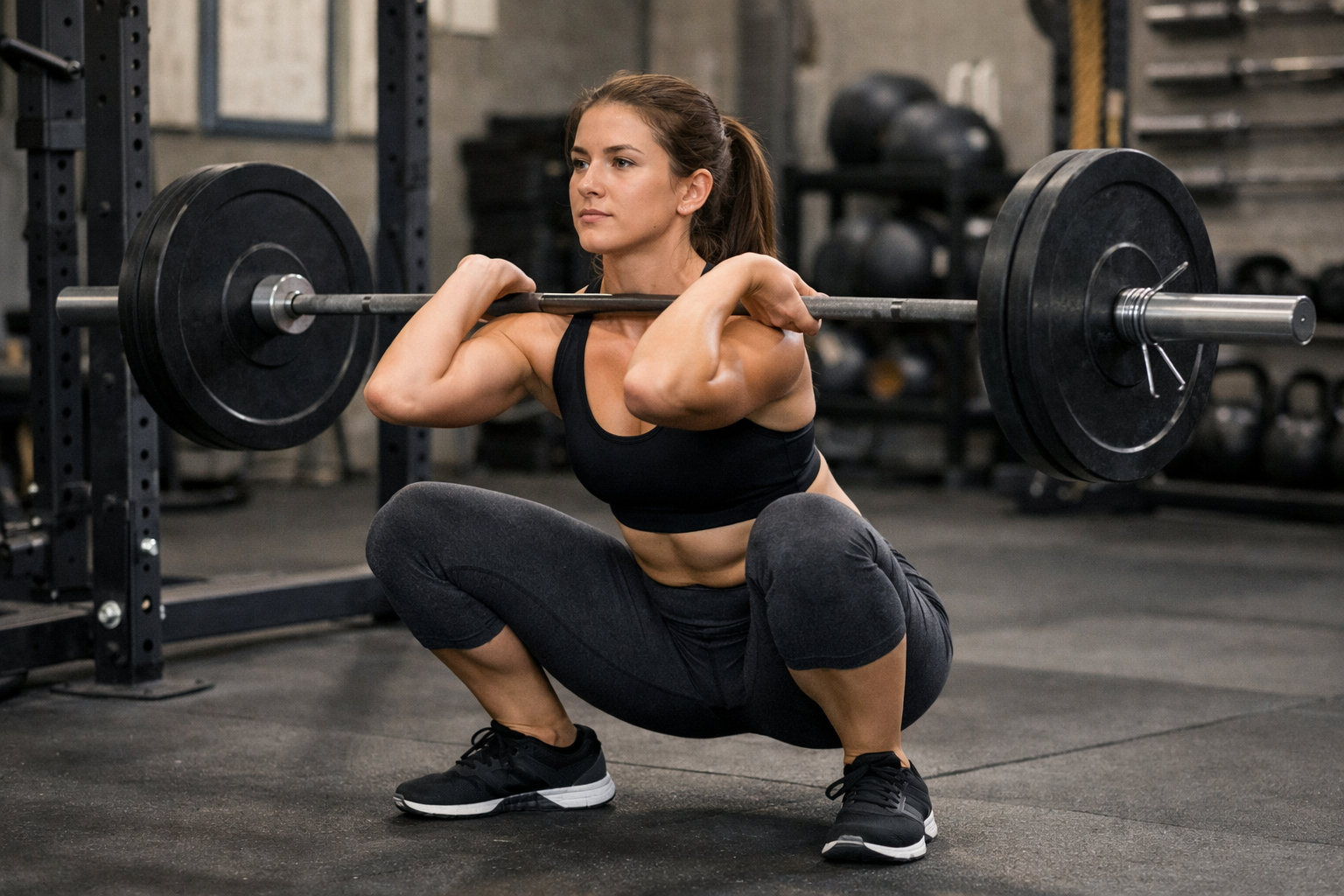
Resistance training is where creatine has the clearest evidence base for women, especially for improving strength and supporting healthy aging over time.
Research-Backed Benefits
Strength and training adaptation
The strongest case for creatine in women is exercise performance related to high-intensity work and resistance training. In older females, systematic reviews and meta-analyses show that creatine combined with resistance training can improve strength, with especially encouraging results in longer studies. Importantly, these benefits often show up more clearly in function and lifting performance than in dramatic changes in muscle size.
Healthy aging and physical function
This is where creatine may matter most for many women. In postmenopausal and older women, better strength can translate into better mobility, more confidence with daily activity, and improved long-term independence. The evidence does not support selling creatine as a miracle muscle-builder or a proven bone-density supplement, but it does support viewing it as a practical tool that may help maintain physical function when paired with regular resistance exercise.
Younger active women: promising, but less predictable
The overall creatine literature is very positive, but female-specific research in younger active women is smaller and more mixed. Some studies report benefits for strength, power, or anaerobic performance, while others do not. That does not mean creatine fails in younger women; it more likely reflects a thinner evidence base, small sample sizes, and inconsistent handling of factors such as menstrual cycle timing and hormonal contraceptive use. The practical takeaway is to keep expectations realistic rather than assuming a guaranteed performance boost in every case.
Brain health and cognition
Creatine is also scientifically interesting for brain health because the brain has high energy demands. Reviews suggest memory benefits are plausible, with the clearest signal appearing in older adults and perhaps in situations of sleep loss, stress, or low baseline creatine intake. However, the evidence is not strong enough to present creatine as a universal nootropic for all healthy women. Mood-related findings in clinical populations are intriguing, but they should not be generalized into broad wellness claims.
Most likely to help
Women doing regular resistance training, especially older and postmenopausal women who want to preserve strength, function, and training quality.
What not to expect
Not a shortcut to getting “bulky,” not a guaranteed win for every younger athlete, and not proven as a universal brain or mood enhancer.
The clearest case for creatine in women is not “bulking up” — it is better support for high-intensity work, strength, and healthy aging.
One of the most misunderstood issues is body-weight change. Early increases on the scale or on lean-mass measurements can reflect water being drawn into muscle cells, not sudden fat gain or instant new muscle tissue. Over time, creatine may still support lean mass and training adaptation, but short-term changes are often more about hydration inside muscle than visible hypertrophy.
Dosage & Practical Use
Best-studied form
Creatine monohydrate is the form backed by the overwhelming majority of research on efficacy, safety, and dosing. Powders and capsules are both reasonable. Other forms exist, but they do not currently have better evidence than plain monohydrate.
Typical daily dose
For most adult women, the simplest evidence-based approach is 3 to 5 grams of creatine monohydrate per day. This aligns with common research protocols and guidance from major sports-nutrition and health authorities. An optional loading phase of about 0.3 g/kg/day for 5 to 7 days can saturate stores faster, after which 3 to 5 g/day is used for maintenance.
Loading is optional, not mandatory. If larger doses cause stomach discomfort, skipping the loading phase and taking a steady daily dose is a sensible alternative. Consistency matters more than using a complicated strategy.
How to think about results
Creatine works best when it supports better training over time. Women who lift weights or perform repeated high-intensity exercise are the most likely to notice a practical payoff. Endurance-only benefits are less impressive, and it should not be treated as a substitute for training, protein intake, sleep, or overall diet quality.
In Europe, EFSA allows specific creatine claims tied to short-term high-intensity exercise at 3 g/day and to improved muscle strength in adults over 55 when daily creatine is combined with regular resistance training. In the United States, creatine is sold as a dietary supplement rather than an FDA-approved drug, so product quality and labeling still matter. Choosing a reputable brand is the most practical shopping advice.
Safety & Considerations
The overall safety picture for healthy women is reassuring. Female-focused reviews report no deaths or serious adverse outcomes in the available literature, and pooled analyses have not found significant increases in total adverse events, gastrointestinal events, or overall weight gain compared with control groups.
The most consistent side effect is a mild, water-related increase in body weight, not fat gain. Some women also experience stomach upset, especially during loading phases or with larger doses. Common fears that creatine inevitably harms the kidneys, causes dehydration or cramping, requires cycling, or reliably causes hair loss are not supported by the weight of evidence in healthy users taking standard doses.
One important nuance is lab testing: creatine can raise serum creatinine, but that is not the same thing as kidney injury. Women with known kidney disease, those being evaluated for kidney function, or those taking medications that can stress the kidneys should only use creatine with medical supervision. It is also wise to mention creatine use before lab work.
Pregnancy, breastfeeding, and certain medical conditions deserve extra caution because direct trial evidence is still limited. In those settings, it is better to speak with a clinician than to self-prescribe based on general fitness advice. For healthy adults using standard doses, though, creatine monohydrate remains one of the more evidence-supported and generally well-tolerated supplement options.
This article is for educational purposes only and is not medical advice. Individual health needs vary, and anyone with a medical condition or medication concerns should consult a qualified clinician before starting supplements.


 Deutsch
 Español
 Suomi
Suomi Français
 Bahasa Indonesia
 Italiano
 日本語
日本語 Português
 Tagalog