
 Deutsch
 Español
 Suomi
Suomi Français
 Bahasa Indonesia
 Italiano
 日本語
日本語 Português
 Tagalog

1. What is selenium, and is it required by the body?
Yes. Your body needs selenium, but only in very small amounts. That is why it is called a trace mineral.
According to the NIH Office of Dietary Supplements selenium fact sheet, selenium is built into at least 25 human selenoproteins. These are proteins that rely on selenium to do their job. Some help protect cells from oxidative damage. Others help support thyroid hormone metabolism, support reproduction, assist DNA synthesis, and contribute to normal immune responses.
A helpful way to think about selenium is that it is not a fuel like carbohydrate or fat, and it is not a structural nutrient like protein. It is more like a small but important part in several biochemical tools your body uses every day.
For adults, the U.S. Recommended Dietary Allowance is 55 micrograms per day. During pregnancy, it rises to 60 micrograms per day, and during breastfeeding to 70 micrograms per day, according to the same NIH guidance.
2. How selenium works in the body
Selenium does most of its work through selenoproteins. Three examples help explain why it shows up in conversations about thyroid health, immunity, and antioxidant defense.
First, glutathione peroxidases help neutralize peroxides, which are reactive compounds produced during normal metabolism and inflammation. This is one reason selenium is often described as part of the body’s antioxidant defense system.
Second, thioredoxin reductases help maintain the cell’s redox balance. In plain English, they help cells handle chemical stress.
Third, iodothyronine deiodinases help activate and deactivate thyroid hormones. This is why selenium and thyroid health are often discussed together. It does not mean selenium is a thyroid cure, but severe deficiency can make thyroid problems worse, especially when iodine intake is also low.
The European Food Safety Authority used plasma selenoprotein P as a marker of adequate selenium supply to tissues. Its dietary reference values opinion also makes an important point: once selenium intake is enough to meet selenoprotein needs, more selenium has not been shown to add extra health benefits.
3. What the evidence says about benefits
Selenium has real biological roles. The more practical question is whether selenium supplements add anything once you are already getting enough from food.
 Deficiency correction is the strongest case for supplementation.
 Routine disease prevention is not well supported by randomized trials.
 Skin evidence is biologically plausible, but still limited.
Deficiency correction is the strongest case. If someone has low selenium intake or a diagnosed deficiency, restoring adequate selenium can help normal selenoprotein function. The NIH notes that selenium supplementation generally does not further increase key selenium-dependent markers unless someone is deficient.
Routine disease prevention is not well supported. A Cochrane review on selenium and cancer prevention found that randomized trial evidence does not support selenium supplements for preventing cancer in the general population. A separate Cochrane review on cardiovascular disease prevention found no meaningful benefit for major cardiovascular outcomes.
The skin evidence is biologically plausible but limited. Selenium is involved in antioxidant systems in the skin. A mouse study in PLOS ONE on selenoproteins and skin development found that disrupting selenoprotein synthesis in skin cells impaired skin and hair follicle development. That supports a mechanism, but it does not prove that selenium pills improve skin in healthy adults.
Low selenium status has been associated with some inflammatory skin conditions. A systematic review and meta-analysis on selenium levels and skin diseases found lower selenium levels in acne vulgaris cases than controls, but this does not prove that low selenium causes acne.
There is also limited intervention evidence. An older open trial of selenium plus vitamin E in acne vulgaris reported improvement, especially in pustular acne, but it had no placebo control and used a combination treatment. A trial in women with PCOS found that 200 micrograms per day of selenium improved acne-related outcomes alongside oxidative-stress and inflammation markers, but that result applies to a specific hormonal condition and should not be generalized to all acne. A recent systematic review of oral nutraceuticals for acne concluded that evidence is still small and mixed.
In short: selenium may help skin if low selenium status is part of the problem, but it is not an established acne treatment.
Sources: NIH Office of Dietary Supplements, EFSA dietary reference values, Cochrane cancer review, Cochrane cardiovascular review, PLOS ONE skin selenoprotein study.
4. Deficiency: what can happen if selenium is low?
True selenium deficiency is uncommon in the United States, but it can happen. Risk is higher in low-selenium regions, in people receiving long-term parenteral nutrition without enough selenium, some people on dialysis, and people with certain digestive or clinical conditions that affect absorption or losses.
Clinical deficiency can be serious. The StatPearls clinical review on selenium deficiency links low selenium status with cardiomyopathy, thyroid dysfunction, impaired immunity, reproductive problems, cognitive issues, and musculoskeletal problems. Severe deficiency is classically associated with Keshan disease, a type of cardiomyopathy, and Kashin-Beck disease, an osteoarthropathy seen in some low-selenium regions.
Milder low intake can be harder to recognize. Possible signs can include fatigue, muscle weakness, hair and nail changes, reduced immune resilience, or worsened thyroid hormone handling. These symptoms are not specific to selenium, so they should not be used to self-diagnose deficiency.
5. Food sources, Brazil nuts, and the soil effect
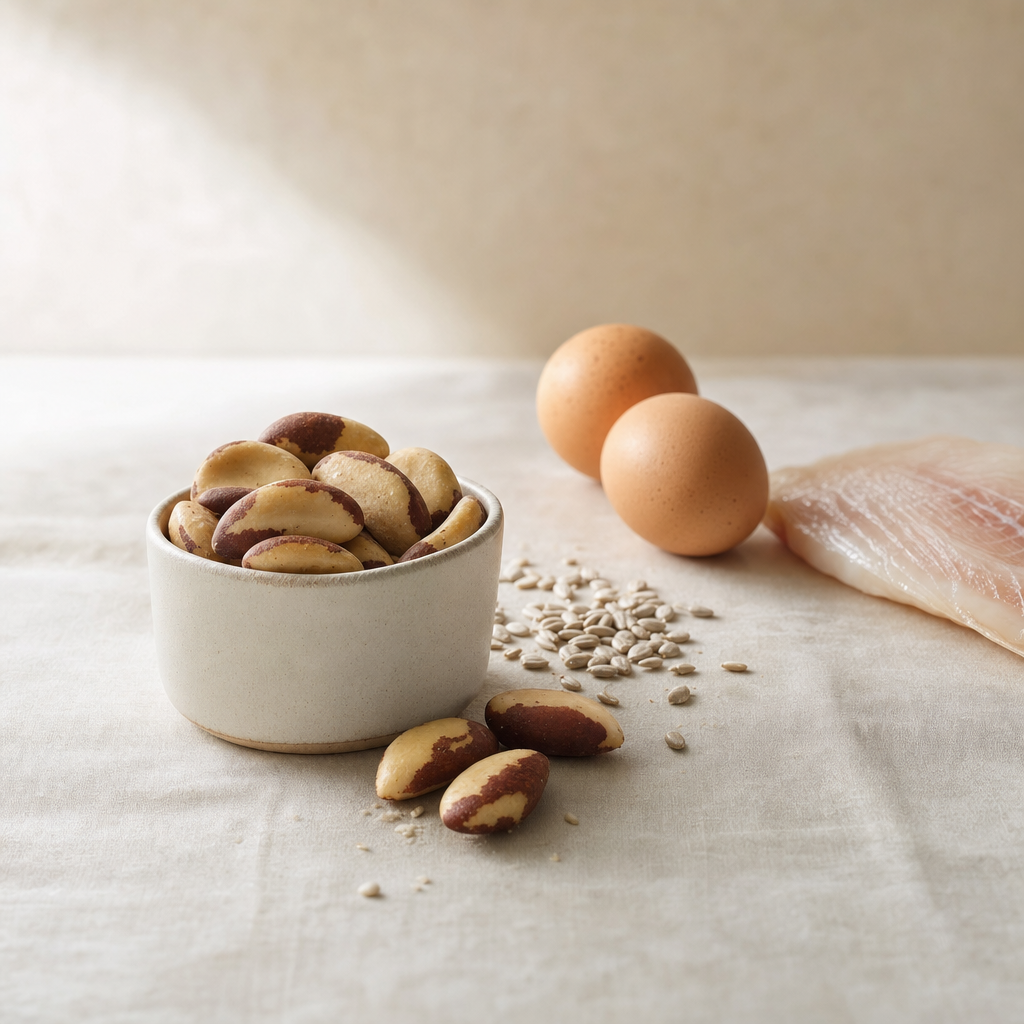
Food is usually the best place to start. Common selenium-rich foods include Brazil nuts, seafood, meat, poultry, eggs, and grains. Fish, shellfish, organ meats, and animal foods tend to be more consistent sources than plant foods.
The tricky part is that selenium in plant foods depends heavily on soil. The NIH fact sheet explains that soil selenium amount, chemical form, pH, and organic matter affect how much selenium crops take up. This means the same food can contain very different selenium levels depending on where it was grown.
Brazil nuts are the best-known example. They can contain very high amounts of selenium, but the amount varies widely. For some people, one Brazil nut may be enough to contribute meaningfully to daily intake; for others, frequent handfuls could push intake too high.
This soil effect also helps explain why selenium status varies between regions. Someone living in a low-selenium area may have a lower daily intake even if their diet looks healthy on paper.
6. Practical considerations and safety
Selenium supplements come in several forms, including selenomethionine, selenium-enriched yeast, sodium selenite, and sodium selenate. Many multivitamins contain about 55 micrograms, roughly the adult daily requirement in the U.S. Selenium-only products may contain 100 to 400 micrograms, which is much closer to safety limits.
This is where the dose needs attention. Selenium has a narrow therapeutic-to-toxic range. In the U.S., the adult tolerable upper intake level is 400 micrograms per day. EFSA is more conservative: its 2023 opinion on the tolerable upper intake level for selenium set an adult upper limit of 255 micrograms per day, including during pregnancy and lactation.
Chronic excess can cause selenosis. Possible symptoms include hair loss, brittle nails or nail loss, garlic-smelling breath, a metallic taste, rash, nausea, diarrhea, fatigue, irritability, and neurological symptoms.
The people most likely to overdo selenium are regular users of high-dose selenium supplements and people who eat Brazil nuts frequently in large amounts. If you already take a multivitamin, check the label before adding a separate selenium product.