

 Deutsch
 Español
 Suomi
Suomi Français
 Bahasa Indonesia
 Italiano
 日本語
日本語 Português
 Tagalog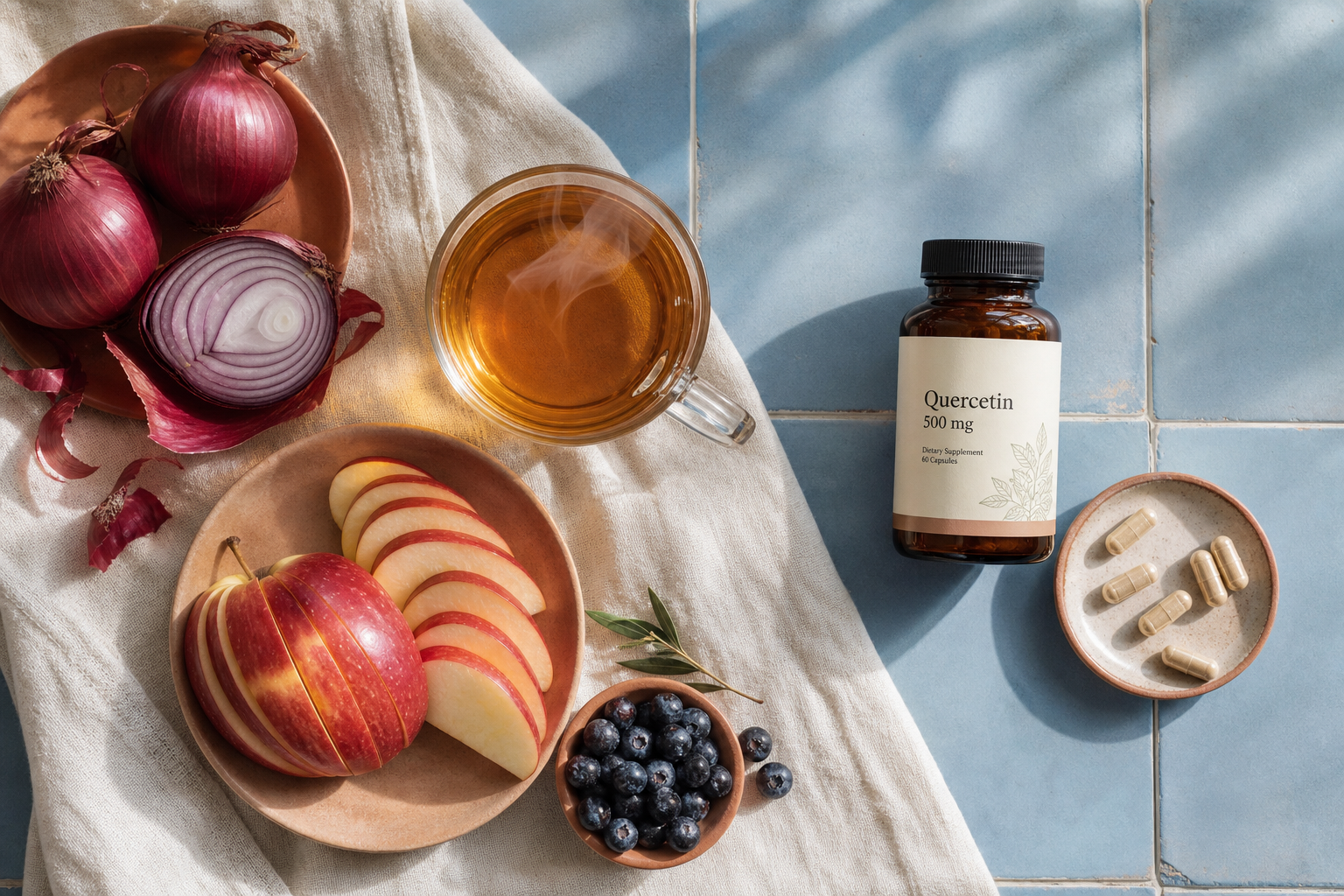
Summary
Quercetin is a flavonol found in foods such as onions, apples, tea, berries, and some vegetables, and it is also sold as a supplement. It is best described as a non-essential dietary bioactive compound rather than an essential nutrient, because there is no recognized deficiency disease or recommended intake level.
Human evidence is strongest for a modest reduction in blood pressure. By contrast, evidence for lipid improvement, glucose control, allergy relief, immune support, and exercise performance is weaker, mixed, or still emerging. A practical takeaway is that food quercetin and supplemental quercetin are not interchangeable, because dose, chemical form, food matrix, and absorption can differ substantially.
Quick Facts
What is it useful for?
Quercetin has the best human evidence for modest blood-pressure support. Most other proposed uses remain mixed or preliminary.
Supplement types
Common forms include plain quercetin aglycone, quercetin dihydrate, glycosylated forms such as isoquercitrin, and enhanced-delivery forms such as phytosomes.
Interactions
Quercetin may interact with anticoagulants and with drugs handled by certain transporters or enzymes. Caution is especially relevant with warfarin and some other narrow-therapeutic-index medicines.
Side effects
Short-term studies generally report good tolerability. Long-term safety is still not well defined.
Other possible benefits
It may have small effects on fasting glucose and possible niche allergy benefits, but the evidence is not strong enough for broad claims.
Regulatory status
In the US, it is sold as a dietary supplement. In the EU, reviewed health claims were not substantiated by EFSA, and some source-specific novel-food issues may apply.
What We Already Know About It
Bioactive, not essential. Quercetin is reasonably well established as a non-essential dietary bioactive flavonol found in plant foods and sold in supplements. It is not treated like an essential nutrient with a deficiency syndrome, recommended intake, or dietary reference value. That framing matters because much of the public discussion treats quercetin as though it were vitamin-like, when official sources place it more accurately among bioactive food components (NIH ODS — Bioactive Food Components Initiatives; Nutrients review on quercetin in foods and supplements).
Plausible mechanisms. Researchers are interested in quercetin because it affects oxidative stress pathways, inflammatory signaling, endothelial function, nitric oxide biology, and possibly glucose-handling pathways. These mechanisms are biologically plausible and active in laboratory settings, but they do not automatically predict large real-world effects in humans (NIH ODS — Bioactive Food Components Initiatives; Nutrients review on quercetin in foods and supplements).
Human evidence is narrower. The strongest clinical signal is a modest blood-pressure-lowering effect, with pooled trial data suggesting average reductions of roughly 2 to 3 mmHg. Evidence for lipids and glucose is much less impressive overall, and formulation clearly matters because poor solubility and extensive metabolism make food glycosides, aglycone capsules, phytosomes, and micellar forms behave differently in the body. Better absorption is demonstrated for some forms, but better clinical outcomes are less certain (Nutrition Reviews meta-analysis on quercetin and blood pressure; Dose-response meta-analysis on quercetin and cardiometabolic markers; Pharmacokinetic trial of quercetin phytosome; Micellar quercetin pilot study).
Summary of Relevant Scientific Research
Bioactive compound, not essential nutrient — NIH ODS and Nutrients review
These sources support the basic framing for quercetin: it is a dietary bioactive constituent found in foods and supplements, not an essential nutrient with an RDA or deficiency syndrome. They also show that normal dietary exposure is only a few milligrams per day, far below the hundreds of milligrams commonly used in supplement trials (NIH ODS — Bioactive Food Components Initiatives; NIH ODS — DSHEA wording; Nutrients review on quercetin in foods and supplements).
Food matrix changes absorption — Lee, Hollman, and Egert human studies
Human bioavailability work shows that source and food matrix matter. Onion-derived quercetin glucosides were absorbed faster and more efficiently than apple sources, and enriched cereal bars increased plasma quercetin more than matched powder-filled capsules. More quercetin on the label does not always mean more quercetin in circulation (Journal of Agricultural and Food Chemistry — apple versus onion quercetin absorption; Journal of Nutrition — ileostomy study of onion quercetin glucosides; British Journal of Nutrition — cereal bars versus capsules).
Blood pressure is the clearest clinical signal — Meta-analyses of randomized trials
Across randomized trials, quercetin supplementation significantly reduced systolic and diastolic blood pressure overall, with average reductions in the modest range of about 2 to 3 mmHg. Earlier pooled work also suggested stronger signals at doses above 500 mg per day and in longer-duration studies (Nutrition Reviews meta-analysis on quercetin and blood pressure; Serban et al. meta-analysis on quercetin and blood pressure).
Broader metabolic claims are weaker — Newer cardiometabolic meta-analyses
The broader cardiometabolic picture is less convincing. A 2024 dose-response meta-analysis found a very small reduction in fasting glucose and a modest fall in systolic blood pressure, but no significant overall effect on triglycerides, HDL-C, waist circumference, or diastolic pressure. A lipid-focused meta-analysis in overweight or obese adults found no meaningful overall improvements in standard lipid markers (Dose-response meta-analysis on quercetin and cardiometabolic markers; Lipid meta-analysis in overweight or obese adults).
Advanced formulations raise blood exposure — Pharmacokinetic trials and reviews
Phytosome, micellar, and some glycosylated forms can substantially increase plasma exposure compared with plain quercetin. What remains uncertain is whether these pharmacokinetic advantages consistently translate into better clinical outcomes for blood pressure, allergy symptoms, or other endpoints (Pharmacokinetic trial of quercetin phytosome; Micellar quercetin pilot study; Review of quercetin glycosides and supplement forms).
Beliefs, Myths & Unproven Claims
Myth: Quercetin is a required nutrient
Quercetin is not treated as a vitamin-like nutrient that everyone needs in set amounts. Official framing describes it as a non-essential bioactive food component, with no recognized deficiency syndrome, recommended daily allowance, or accepted daily requirement (NIH ODS — Bioactive Food Components Initiatives).
Myth: It is a proven natural antihistamine, immune booster, or antiviral
These claims are mechanistically understandable, but the human evidence is much thinner than marketing suggests. Allergy trials are heterogeneous, and positive findings are limited to small or form-specific studies such as modified isoquercitrin in pollinosis, which is not the same as proving broad benefit for standard quercetin capsules (Systematic review of flavonoids in allergies; Japanese cedar pollinosis trial of enzymatically modified isoquercitrin).
Myth: Quercetin is a reliable sports-performance supplement
Official NIH guidance states there is little scientific evidence to support quercetin for exercise or athletic performance. A recent sports review similarly found no clear consensus for aerobic performance, anaerobic performance, muscle damage, or recovery outcomes (NIH ODS — Exercise and Athletic Performance fact sheet; 2024 sports review of quercetin supplementation).
Myth: All quercetin products work the same way
Onion glucosides, plain aglycone capsules, quercetin dihydrate, phytosomes, and micellar products can produce very different blood levels. Better absorption has been demonstrated for some forms, but that is not yet the same as proving superior health outcomes across clinical uses (Pharmacokinetic trial of quercetin phytosome; Review of quercetin glycosides and supplement forms).
Myth: Quercetin has broad approved EU health claims
EFSA reviewed claims related to oxidative damage, cardiovascular function, mental performance, and liver or kidney health and did not substantiate them. Legal sale of quercetin-containing products should not be confused with formal EU approval of those health benefits (EFSA opinion on quercetin health claims).

Detailed Research Observations
A food compound, not a required nutrient
Quercetin is a flavonol within the wider flavonoid and polyphenol family. In practical nutrition terms, it fits better under non-essential dietary bioactive compounds than under essential nutrients. That distinction matters because people often assume that if a substance is found in foods and sold in capsules, it must serve a defined nutritional requirement. For quercetin, official framing does not support that interpretation. There is no known deficiency disease, no dietary reference intake, and no accepted daily requirement. Instead, it is one of many plant compounds that may influence physiology without being required for basic survival (NIH ODS — Bioactive Food Components Initiatives; Nutrients review on quercetin in foods and supplements).
This distinction also helps explain why food exposure and supplement use should not be treated as equivalent. Review data suggest average intake from the usual diet is only a few milligrams per day in US adults, while even a nutritious diet may provide only about 13 mg daily. Most clinical trials, by contrast, use hundreds of milligrams per day. That means supplemental quercetin is better understood as a separate intervention with a different dose range and a different risk-benefit profile than ordinary food intake (Nutrients review on quercetin in foods and supplements; NIH ODS — Exercise and Athletic Performance fact sheet).
Food source and matrix can change absorption
Quercetin in foods often appears as glycosides rather than as free aglycone. Onion quercetin is particularly rich in glucoside forms such as quercetin-4'-glucoside and quercetin-3,4'-diglucoside, while apples contain a more mixed profile including rutinoside, galactoside, rhamnoside, and glucoside forms. These are not minor chemistry details. Human studies show that onion-based quercetin sources can be absorbed faster and more efficiently than apple-based sources, indicating that high-quercetin foods are not automatically interchangeable in biological effect (Journal of Agricultural and Food Chemistry — apple versus onion quercetin absorption; Nutrients review on quercetin in foods and supplements).
An especially important practical observation is that food-derived quercetin is not always inferior to simple supplements. Ileostomy work suggests major onion glucosides are efficiently hydrolyzed and largely absorbed in the small intestine, and a crossover trial found enriched cereal bars raised plasma quercetin more than matched powder-filled capsules. In other words, the food matrix can sometimes improve real-world delivery. This is one reason consumers should be careful about assuming that a plain high-dose capsule is automatically the most effective route (Journal of Nutrition — ileostomy study of onion quercetin glucosides; British Journal of Nutrition — cereal bars versus capsules).
Formulation matters, but outcome data lag behind
The most common basic supplement form is quercetin aglycone, often used in capsules and older trials. Quercetin dihydrate is another common raw material used in products and research, while glycosylated derivatives such as isoquercetin or isoquercitrin and enzymatically modified isoquercitrin aim to improve solubility and uptake. Newer formats include phospholipid complexes such as quercetin phytosome and lipid-based micellar systems. The reason these forms matter is straightforward: quercetin has poor water solubility and undergoes extensive metabolism, so blood exposure depends heavily on the formulation used (Review of quercetin glycosides and supplement forms; Pharmacokinetic trial of quercetin phytosome).
This is one of the clearer science-backed differences within the quercetin market. In healthy volunteers, quercetin phytosome produced much higher plasma exposure than unformulated quercetin at the same dose, and a small pilot study also reported improved absorption from a lipid-based micellar product, although responses varied considerably between individuals. Even so, the evidence is strongest for pharmacokinetics, not for clinical superiority. Better Cmax or AUC does not automatically prove better blood-pressure control, allergy relief, or other outcomes in randomized trials (Pharmacokinetic trial of quercetin phytosome; Micellar quercetin pilot study; Review of quercetin glycosides and supplement forms).
Blood pressure is the clearest use case, but the effect is modest
Among the major proposed uses, blood-pressure support has the strongest human evidence. Meta-analyses of randomized controlled trials found significant reductions in systolic and diastolic blood pressure, generally in the modest range of about 2 to 3 mmHg. That size of effect is not dramatic, but it is enough to distinguish quercetin from pure hype. Some subgroup findings suggest stronger signals at higher doses, especially above 500 mg per day, with longer study durations and possibly in people who already have elevated cardiometabolic risk (Nutrition Reviews meta-analysis on quercetin and blood pressure; Serban et al. meta-analysis on quercetin and blood pressure).
The wider metabolic picture is less convincing. In overweight or obese adults, a lipid meta-analysis found no significant overall changes in LDL-C, HDL-C, triglycerides, or total cholesterol, although some subgroup signals appeared at higher doses. A newer dose-response meta-analysis found a statistically significant but very small reduction in fasting glucose and a modest reduction in systolic blood pressure, but no significant overall effect on several other metabolic markers. In plain language, quercetin is more plausible as a modest cardiometabolic adjunct than as a broad-spectrum metabolic supplement (Lipid meta-analysis in overweight or obese adults; Dose-response meta-analysis on quercetin and cardiometabolic markers).
Exercise and allergy claims remain much less certain
Quercetin is often marketed for endurance, recovery, and general athletic performance, largely because of its antioxidant profile and early enthusiasm about mechanistic pathways. However, official NIH consumer guidance says there is little scientific evidence to support quercetin for exercise or athletic performance. A recent sports review reached a similar conclusion, noting that the literature is heterogeneous and that there is still no clear consensus for aerobic capacity, anaerobic performance, muscle damage, or recovery outcomes. This is a clear example of a supplement with plausible mechanisms but underwhelming outcome data (NIH ODS — Exercise and Athletic Performance fact sheet; 2024 sports review of quercetin supplementation).
Allergy and antihistamine claims follow a similar pattern. Mechanistic rationale exists, especially around inflammatory and mast-cell-related pathways, but the human evidence base is still thin. A systematic review of flavonoids in allergies found heterogeneous trials with only limited direct evidence using quercetin-type interventions. One small placebo-controlled study of enzymatically modified isoquercitrin reported improvement in some ocular symptoms of Japanese cedar pollinosis at 100 mg daily, but that is a narrow and form-specific result rather than broad proof that standard quercetin works for seasonal allergies in general (Systematic review of flavonoids in allergies; Japanese cedar pollinosis trial of enzymatically modified isoquercitrin).
Safety, interactions, and regulation shape practical use
Short-term safety looks reasonably reassuring, but the evidence base is not complete. Controlled trials summarized by LiverTox found quercetin at 100 to 1000 mg daily for 2 to 12 weeks was generally well tolerated, and no convincing liver-toxicity signal stands out. Reviews in sports settings also note that single doses up to 4 g and repeated short-term use around 500 mg twice daily have not shown major safety concerns. Even so, institutional sources emphasize that long-term human safety data remain limited, so short-term tolerability is better established than long-term routine use (LiverTox — Quercetin; 2024 sports review of quercetin supplementation).
Interaction risk deserves more attention than many supplement labels imply. Memorial Sloan Kettering reports a case of elevated INR in a person using warfarin with quercetin and notes preclinical evidence that quercetin may alter tamoxifen bioavailability. Because quercetin may affect drug-metabolizing enzymes or transport pathways, added caution is sensible with anticoagulants, transplant medicines, chemotherapy, and other narrow-therapeutic-index drugs. Regulatory context reflects those limits: in the US, quercetin is sold as a dietary supplement rather than an approved drug, while in the EU, EFSA did not substantiate reviewed health claims and some source-specific novel-food issues can apply (Memorial Sloan Kettering — Quercetin; NIH ODS — DSHEA wording; FDA 101: Dietary Supplements; EFSA opinion on quercetin health claims; European Commission — novel food consultation on quercetin from Dimorphandra mollis).
Regulatory Status (EU and US)
United States
In the US, quercetin is sold under the dietary supplement framework rather than as an approved drug. That means products can be marketed without the kind of premarket efficacy proof required for medicines, although they are still restricted from making unauthorized disease-treatment claims (NIH ODS — DSHEA wording; FDA 101: Dietary Supplements).
European Union
In the EU, EFSA did not substantiate reviewed quercetin health claims relating to oxidative protection, cardiovascular support, mental performance, or liver and kidney effects. There is also a source-specific caveat: quercetin derived from Dimorphandra mollis is considered novel when used as or in foods, so regulatory status can depend partly on source and manufacture (EFSA opinion on quercetin health claims; European Commission — novel food consultation on quercetin from Dimorphandra mollis).
Dosage and Standardization
Diet vs supplements: Foods usually provide only a few milligrams daily; a nutritious diet may reach about 13 mg.
Studied doses: Most trials use roughly 150–1,000 mg/day for 2–12 weeks, with stronger blood-pressure signals above 500 mg/day and longer durations.
Safety And Interactions
Short-term safety appears reasonably reassuring. Controlled studies summarized by LiverTox found quercetin at 100 to 1000 mg per day for 2 to 12 weeks was generally well tolerated, and no convincing hepatotoxicity signal stands out. However, long-term human safety information remains limited (LiverTox — Quercetin).
The best-documented interaction concern is with anticoagulation: Memorial Sloan Kettering reports a case of elevated INR associated with warfarin plus quercetin. It also notes preclinical evidence that quercetin may alter tamoxifen bioavailability. Extra caution is sensible with warfarin and other anticoagulants, tamoxifen, transplant medicines, chemotherapy, and other narrow-therapeutic-index drugs. Because pregnancy, breastfeeding, and pediatric data are thin, routine use in those groups is not well supported (Memorial Sloan Kettering — Quercetin; LiverTox — Quercetin).
Conclusion
Quercetin is best understood as a non-essential dietary bioactive flavonol rather than a classical nutrient. The strongest human evidence supports a modest reduction in blood pressure, while evidence for lipid lowering, glucose control, exercise performance, immune support, and allergy relief is smaller, mixed, or still preliminary. Source and formulation matter because absorption can vary substantially, and supplement doses are usually far higher than food exposure. Short-term safety appears fairly good, but long-term data and interaction risks still warrant caution.
Disclaimer
Disclaimer: We attempt to do our best to find relevant, accurate and most up to date information available in both, the public domain and in the clinical and medical research community. We recommend reviewing scientific sources for official information on the subject. This post is not intended as medical advice. Each individual person's health conditions vary and we advise to consult a doctor before taking any supplements.