

 Deutsch
 Español
 Suomi
Suomi Français
 Bahasa Indonesia
 Italiano
 日本語
日本語 Português
 Tagalog
Summary
Coenzyme Q10, or CoQ10, is a vitamin-like compound involved in mitochondrial energy production and antioxidant defence. As a supplement, it is most plausibly useful as an adjunct in heart failure, with more moderate evidence for migraine prevention and some male infertility outcomes.
The broader evidence is mixed. Small supportive effects may exist for systolic blood pressure, glycemic control, and statin-related muscle symptoms, but the data do not justify broad claims about anti-aging, general energy enhancement, Parkinson disease, or athletic performance. In practice, formulation, absorption, dose, and interaction risk are as important as the advertised benefit.
Quick Facts
What is it useful for?
Most plausibly as an adjunct in heart failure; it may also help migraine prevention and some male fertility markers.
Supplement types
Main forms are ubiquinone and ubiquinol. Ubiquinol is often marketed as more bioavailable than standard ubiquinone.
Interactions
Use caution with warfarin or other coumarin anticoagulants, blood-pressure medicines, insulin, and other diabetes treatments. It may also be unsuitable with some cancer treatments.
Side effects
Usually well tolerated, but mild stomach upset, nausea, diarrhea, heartburn, headache, dizziness, insomnia, fatigue, irritability, or rash can occur.
Other possible benefits
Small adjunctive benefits have been reported for systolic blood pressure, glycemic control, and statin-related muscle symptoms.
Regulatory status
In the US it is sold as a dietary supplement. In the EU it may be sold, but EFSA did not substantiate key health claims for the healthy general population.
What We Already Know About It
Core biology. CoQ10 is a naturally occurring compound that helps transfer electrons in mitochondria, supporting ATP production, and it also contributes to antioxidant defence. This role is especially relevant in high-energy tissues such as the heart, which is why CoQ10 has long attracted interest in cardiology, neurology, exercise science, and aging research. Oral absorption is a practical limitation because CoQ10 is fat-soluble and relatively poorly bioavailable, so formulation choice and taking it with food matter in real-world use. (Sources: NIH ODS — Primary Mitochondrial Disorders Fact Sheet; Linus Pauling Institute — Coenzyme Q10)
Clinically established uses. The best-supported human evidence is narrower than marketing often implies. Heart failure is the leading mainstream indication, where systematic reviews suggest probable reductions in mortality and heart-failure hospitalisation when CoQ10 is used as an adjunct. Migraine prevention and some male infertility measures are promising but still better described as moderate-evidence uses. Small effects on systolic blood pressure and glycemic markers may exist, yet they appear supportive rather than transformative. (Sources: PubMed — Cochrane Review on CoQ10 for Heart Failure; PubMed — 2024 Meta-analysis on CoQ10 in Heart Failure; PubMed — Meta-analysis on CoQ10 for Migraine; PubMed — Meta-analysis on CoQ10 in Idiopathic Male Infertility; PubMed — Meta-analysis on CoQ10, Blood Pressure and Heart Rate; PubMed — Meta-analysis on CoQ10 and Glycemic Control)
Limits of the evidence. Several popular claims remain weak or disproven. A major high-dose trial found no benefit in early Parkinson disease, exercise benefits in healthy adults are limited and inconsistent, and evidence for statin-related muscle symptoms is mixed rather than settled. Overall, CoQ10 has moderate support in a few targeted areas, preliminary support in several others, and insufficient evidence for broad claims about energy, anti-aging, or disease prevention in healthy people. (Sources: PubMed — High-Dose CoQ10 in Early Parkinson Disease; PubMed — Review of CoQ10 and Exercise Performance; Cambridge Core — CoQ10 and Statin Myopathy Review)
Summary of Relevant Scientific Research
Adjunct in Heart Failure — Cochrane Review
Across 11 studies with 1,573 participants, CoQ10 probably reduced all-cause mortality and heart-failure hospitalisation. The review still rated evidence for several secondary outcomes as low or very low certainty, so routine use was not considered fully settled. (Source: PubMed — Cochrane Review on CoQ10 for Heart Failure)
Updated Heart Failure Signal — BMC Cardiovascular Disorders meta-analysis
A 2024 synthesis of 33 studies reported lower all-cause mortality, fewer heart-failure hospitalisations, improved New York Heart Association class, and lower BNP levels with CoQ10. GRADE quality was moderate for mortality and hospitalisation but lower for several secondary outcomes. (Source: PubMed — 2024 Meta-analysis on CoQ10 in Heart Failure)
Migraine Prevention — Systematic review and dose-response meta-analysis
In four randomised trials involving 221 participants, CoQ10 reduced migraine attack frequency by about 1.87 attacks per month. It did not significantly improve attack severity or duration, which supports prevention more than acute symptom relief. (Source: PubMed — Meta-analysis on CoQ10 for Migraine)
Idiopathic Male Infertility — Meta-analysis
Nine studies with 781 men found improvements in sperm concentration, semen volume, total motility, and seminal CoQ10, with higher odds of clinical pregnancy. Benefits appeared stronger when supplementation lasted longer than three months. (Source: PubMed — Meta-analysis on CoQ10 in Idiopathic Male Infertility)
Negative and Mixed Findings — Parkinson disease, exercise, and statin symptoms
A major NIH-funded trial found no benefit from high-dose CoQ10 in early Parkinson disease. Reviews also report limited, inconsistent exercise effects in healthy adults, while statin-related muscle symptom data suggest only small, mixed benefits rather than a reliably proven effect. (Sources: PubMed — High-Dose CoQ10 in Early Parkinson Disease; PubMed — Review of CoQ10 and Exercise Performance; Cambridge Core — CoQ10 and Statin Myopathy Review)
Beliefs, Myths & Unproven Claims
Everyone needs CoQ10 with age
Official sources do not support the idea that the general population has a meaningful CoQ10 deficit or that healthy adults routinely need supplementation. BfR states there is no evidence of a CoQ10 deficiency in the general population and that routine use is not necessary for healthy people. (Source: BfR — Coenzyme Q10 Health Risk FAQ)
CoQ10 is a proven natural energy booster
The mechanism sounds persuasive because CoQ10 is involved in mitochondrial energy production, but clinical support for broad energy or endurance claims in healthy adults is weak. EFSA did not substantiate energy, endurance, or performance claims for the healthy population, and recent exercise reviews remain inconsistent. (Sources: EFSA — Scientific Opinion on Coenzyme Q10 Claims; PubMed — Review of CoQ10 and Exercise Performance)
Natural means interaction-free
Because the body makes CoQ10, some people assume it cannot meaningfully interact with medicines. That is incorrect: authoritative sources repeatedly warn about warfarin or related coumarin anticoagulants, and they also advise caution with blood-pressure medicines, diabetes therapies, and some cancer-treatment settings. (Sources: NCCIH — Coenzyme Q10; Mayo Clinic — Coenzyme Q10; BfR — Coenzyme Q10 Health Risk FAQ)
It reliably fixes statin pain or protects the brain
Evidence for statin-related muscle symptoms is mixed, with some trials positive and others neutral, so any benefit appears modest and patient-specific. Parkinson disease is even less supportive: a major randomised trial found no benefit from high-dose CoQ10 despite strong mechanistic interest. (Sources: NCCIH — Coenzyme Q10; Cambridge Core — CoQ10 and Statin Myopathy Review; PubMed — High-Dose CoQ10 in Early Parkinson Disease)
Detailed Research Observations
What CoQ10 is and why absorption matters
CoQ10 is an endogenous, vitamin-like compound involved in mitochondrial electron transport and antioxidant activity rather than a traditional herbal remedy. That helps explain both its appeal and its limits: it has a clear biochemical role, but that role does not automatically make supplementation broadly necessary. The reviewed sources also note that average dietary intake is relatively low, around 3 to 6 mg per day, whereas supplements commonly start around 30 to 100 mg daily and can go much higher in clinical settings. This gap makes supplementation look more like pharmacological support than simple nutritional replacement. (Sources: NCCIH — Coenzyme Q10; NIH ODS — Primary Mitochondrial Disorders Fact Sheet; Linus Pauling Institute — Coenzyme Q10)
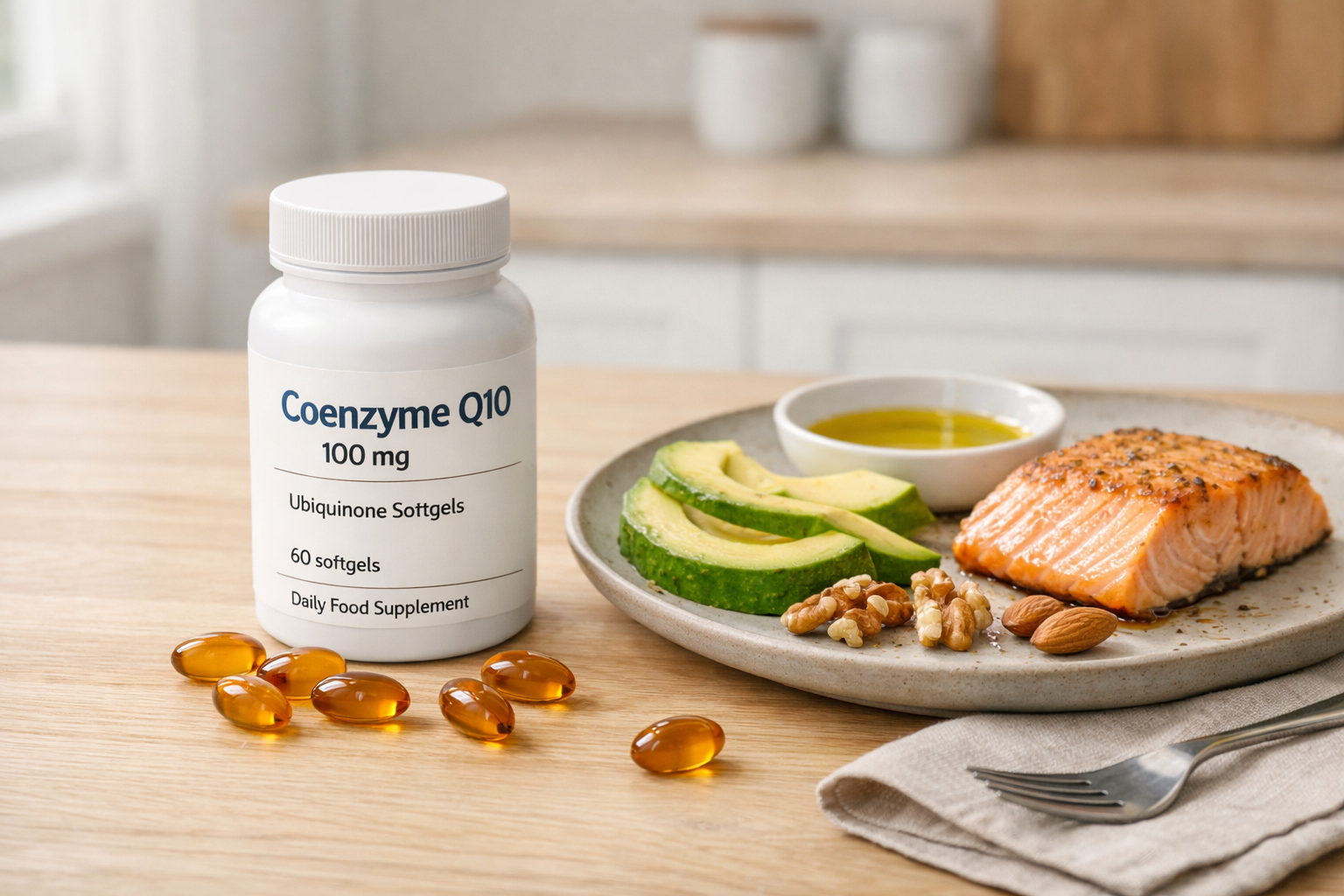
Absorption is the main practical complication. CoQ10 is fat-soluble, powder forms absorb poorly, and only a small fraction of an oral dose is thought to reach circulation. Ubiquinol is often described as three to five times more bioavailable than ubiquinone, and taking CoQ10 with a meal or dietary fat improves absorption. Even so, the sources emphasise that better bioavailability does not automatically prove better clinical outcomes for every use case, so label form alone should not be confused with proven superiority in patient-important outcomes. (Sources: NIH ODS — Primary Mitochondrial Disorders Fact Sheet; Linus Pauling Institute — Coenzyme Q10)
Heart failure is the leading evidence-based indication
Among common mainstream uses, heart failure has the most convincing support. A Cochrane review pooling 11 studies with 1,573 participants found that CoQ10 probably reduces all-cause mortality and heart-failure hospitalisation. A newer 2024 meta-analysis of 33 studies reported similarly favourable findings, including lower mortality, fewer hospitalisations, improvement in New York Heart Association class, and lower BNP levels. These are clinically relevant signals and make heart failure the strongest evidence-based use discussed in the article. (Sources: PubMed — Cochrane Review on CoQ10 for Heart Failure; PubMed — 2024 Meta-analysis on CoQ10 in Heart Failure)
The important limitation is certainty. Several secondary outcomes remain low or very low certainty because trials vary in quality, duration, formulation, and background therapy. The evidence therefore supports CoQ10 best as an adjunct rather than a stand-alone treatment or universal standard of care. In practical terms, the article’s most defensible conclusion is not that every patient with heart failure should automatically take CoQ10, but that it is the most plausible mainstream indication when used alongside established medical treatment. (Sources: PubMed — Cochrane Review on CoQ10 for Heart Failure; PubMed — 2024 Meta-analysis on CoQ10 in Heart Failure)
Migraine prevention and male infertility show targeted promise
The migraine literature is smaller than the heart-failure literature but more encouraging than many consumers may realise. A systematic review and dose-response meta-analysis found that CoQ10 reduced migraine frequency by about 1.87 attacks per month on average. The same analysis did not show significant improvement in attack severity or duration, which matters because it frames CoQ10 more as a preventive option than an acute symptom reliever. The article also notes that benefit may take weeks to months to judge, which fits how preventive strategies are typically assessed in practice. (Source: PubMed — Meta-analysis on CoQ10 for Migraine)
Idiopathic male infertility is another area with promising but not definitive evidence. A meta-analysis of nine studies with 781 men found improvements in sperm concentration, semen volume, total motility, seminal CoQ10 levels, and higher odds of clinical pregnancy. Benefits appeared stronger when supplementation lasted longer than three months, which is biologically plausible given the time course of sperm development. Still, the article draws a useful distinction between better semen markers and reliably improved final fertility outcomes, so CoQ10 is better described as potentially supportive in selected men rather than as a guaranteed fertility treatment. (Source: PubMed — Meta-analysis on CoQ10 in Idiopathic Male Infertility)
Cardiometabolic and statin-symptom effects appear modest
CoQ10 is often marketed for broad cardiometabolic support, but the better reading of the evidence is more restrained. A meta-analysis of 45 randomised controlled trials found a statistically significant reduction in systolic blood pressure of roughly 3.44 mmHg, but no significant effect on diastolic pressure or heart rate. A separate large meta-analysis on glycemic control found modest reductions in fasting glucose, HbA1c, and fasting insulin, while also rating the certainty of evidence as very low. These patterns are consistent with small adjunctive effects, not a substitute for standard treatment of hypertension or diabetes. (Sources: PubMed — Meta-analysis on CoQ10, Blood Pressure and Heart Rate; PubMed — Meta-analysis on CoQ10 and Glycemic Control)
Statin-related muscle symptoms sit in a similarly uncertain category. Older official summaries were sceptical, while a newer systematic review and meta-analysis found a small but statistically significant symptom reduction across seven randomised trials. The article interprets this as mixed evidence shaped by heterogeneous patients, varying doses, and short study durations. That makes CoQ10 a possible option for selected patients, but not a reliably proven fix for everyone who develops muscle symptoms during statin use. (Sources: NCCIH — Coenzyme Q10; Cambridge Core — CoQ10 and Statin Myopathy Review)
Neurology, exercise, and cancer-related claims remain weak
Some of the most popular retail narratives around CoQ10 are not among its best-supported uses. A major NIH-funded randomised trial in early Parkinson disease found no benefit from high-dose CoQ10, which is an important negative finding because Parkinson disease had strong mechanistic appeal in mitochondrial medicine. Likewise, a recent review of exercise performance reported that supplementation clearly raises blood CoQ10 levels, yet the performance effects in healthy adults were limited and inconsistent. Together these findings illustrate a recurring theme in CoQ10 research: plausible mechanisms and altered biomarkers do not automatically translate into measurable clinical benefit. (Sources: PubMed — High-Dose CoQ10 in Early Parkinson Disease; PubMed — Review of CoQ10 and Exercise Performance)
The article also treats cancer-related marketing very cautiously. The National Cancer Institute notes ongoing interest in specialised contexts such as anthracycline cardiotoxicity, but it does not support CoQ10 as an evidence-based cancer treatment. A placebo-controlled trial in breast-cancer patients using CoQ10 plus vitamin E did not prevent worsening fatigue or improve quality of life. This is a good example of why mechanistic appeal should not be confused with clinically demonstrated benefit in oncology. (Source: National Cancer Institute — Coenzyme Q10 PDQ)
Regulatory realities and evidence gaps still matter
Regulatory status does not equal proof of effectiveness. In the United States, CoQ10 is sold as a dietary supplement under a food-style framework, which means it is not pre-approved by FDA for efficacy before marketing. In the European Union, the product may also be sold, but EFSA did not substantiate the major health claims proposed for healthy people, including claims related to energy metabolism, blood pressure, cognition, cholesterol, and endurance. Germany’s BfR adds that there is no evidence-based need for routine use in healthy people and highlights extra caution above 100 mg daily in some medication users. (Sources: FDA — Dietary Supplements; FDA — Label Claims for Dietary Supplements; EFSA — Scientific Opinion on Coenzyme Q10 Claims; BfR — Coenzyme Q10 Health Risk FAQ)
The evidence base also has persistent technical weaknesses: many trials are small, formulations differ, doses vary widely, follow-up is often short, and reporting of diet or background medication use is inconsistent. There is also a gap between showing better absorption of ubiquinol and proving that ubiquinol consistently delivers better clinical outcomes than ubiquinone. For consumers, that means product form may matter, but claims that one form is universally superior remain ahead of the evidence. (Sources: NIH ODS — Primary Mitochondrial Disorders Fact Sheet; Linus Pauling Institute — Coenzyme Q10)
Regulatory Status (EU and US)
United States
In the US, CoQ10 is typically marketed as a dietary supplement under the Dietary Supplement Health and Education Act framework. That means it is regulated as a food rather than as a drug, and consumers should not assume that a widely sold product has been pre-approved by FDA for effectiveness before marketing. Structure/function claims such as support for normal cellular energy may be used if properly substantiated, but disease-treatment claims are not lawful on ordinary supplement labels.
European Union
In the EU, CoQ10 may be sold, but EFSA did not substantiate proposed claims for energy-yielding metabolism, blood pressure, oxidative damage protection, cognitive function, cholesterol, or endurance in the healthy general population. Germany’s BfR further states that there is no evidence-based need for routine supplementation in healthy people, notes that there is no EU-wide maximum amount, and points to a German general ruling permitting up to 100 mg daily in food supplements.
Dosage and Standardization
Typical use: Retail doses are often 30–100 mg daily, while many studies use about 100–300 mg daily.
Practical use: Take with a fat-containing meal; doses above about 100 mg daily are often split. Heart-failure trials often used 100 mg three times daily or 120 mg twice daily, and migraine studies about 100–400 mg daily.
Safety And Interactions
CoQ10 is generally well tolerated, and reported adverse effects are usually mild. These include stomach upset, nausea, diarrhea, reduced appetite, heartburn, headache, dizziness, insomnia, fatigue, irritability, and rash. Short-term high-dose studies in healthy adults have reported good tolerability, but very long-term high-dose use in typical consumers is less well characterised.
The most important documented interaction concern is warfarin or related coumarin anticoagulants, because CoQ10 may reduce anticoagulant effectiveness. Extra caution is also reasonable with blood-pressure medicines, insulin, and other diabetes therapies because CoQ10 may have small effects of its own. NCCIH also notes possible incompatibility with some cancer treatments. Pregnancy, breastfeeding, childhood use, and complex medical conditions are areas where routine self-prescribing is not well supported without clinician input.
Conclusion
CoQ10 is a biologically plausible and widely used supplement with a respectable but uneven evidence base. The strongest support is for adjunctive use in heart failure, while migraine prevention and some male infertility outcomes are promising but less definitive.
At the same time, several popular claims are over-marketed. Evidence is negative for Parkinson disease, inconsistent for exercise performance in healthy adults, and mixed for statin-related muscle symptoms. Overall, CoQ10 appears generally safe and potentially useful in selected contexts, but it is not a universal energy, anti-aging, or disease-prevention supplement.
Disclaimer
Disclaimer: We attempt to do our best to find relevant, accurate and most up to date information available in both, the public domain and in the clinical and medical research community. We recommend reviewing scientific sources for official information on the subject. This post is not intended as medical advice. Each individual person's health conditions vary and we advise to consult a doctor before taking any supplements.