

 Deutsch
 Español
 Suomi
Suomi Français
 Bahasa Indonesia
 Italiano
 日本語
日本語 Português
 Tagalog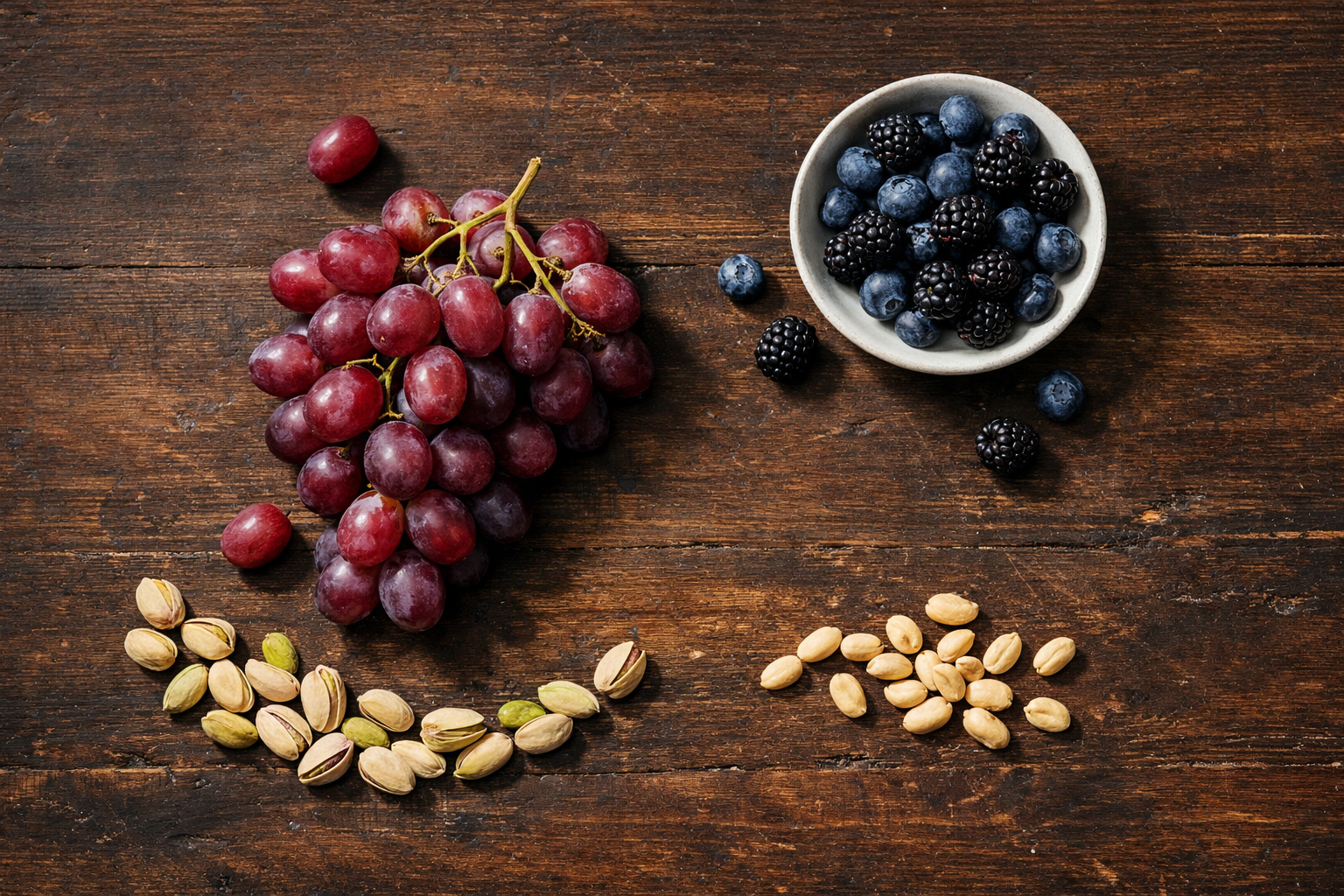
Summary
Resveratrol is a nonessential plant polyphenol found in foods such as grapes, red wine, peanuts, pistachios, and some berries. Supplements usually provide oral trans-resveratrol, which delivers much larger amounts than normal food intake.
Laboratory research suggests effects on inflammation, blood vessel function, oxidative stress, and cellular energy signaling, but human evidence is mixed. The clearest pattern is modest improvement in some cardiometabolic markers in selected groups, not proven anti-aging, weight-loss, or disease-treatment effects. A major limitation is low oral bioavailability, because resveratrol is rapidly metabolized after absorption.
Quick Facts
What is it useful for?
Human studies suggest resveratrol may modestly improve some cardiometabolic markers in selected groups, but evidence is mixed and not definitive.
Supplement types
Most supplements use oral trans-resveratrol. Foods contain variable amounts of cis- and trans-resveratrol depending on source and processing.
Interactions
It may interact with anticoagulant, antiplatelet, and some CYP-metabolized products, so caution is needed with medications and similar supplements.
Side effects
Higher supplemental doses are most often linked to gastrointestinal effects such as nausea, gas, abdominal pain, diarrhea, and loose stools.
Other possible benefits
Research is exploring vascular, inflammatory, liver, cognitive, and glucose-related effects, but many findings remain preliminary or population-specific.
Regulatory status
In the EU, trans-resveratrol has a novel food intake limit of 150 mg/day for adults. In the US, supplements are marketed under food-style rules, not drug approval.
What We Already Know About It
Established identity. Resveratrol is a plant-derived stilbene polyphenol rather than a required nutrient, and laboratory work shows that it can influence oxidative stress, inflammation, endothelial function, and cellular energy signaling. Researchers still consider its biology active and plausible, but simplified explanations such as direct activation of SIRT1 no longer capture the full picture of how it may work in cells. NCBI MeSH — Resveratrol; NIH Intramural Research Program — Mechanism of Resveratrol Activity
Bioavailability limits translation. After oral intake, resveratrol is absorbed but rapidly converted into glucuronide and sulfate metabolites, so blood levels of unchanged resveratrol remain low. This helps explain why strong cell-culture results often fail to produce equally large human effects, and why food intake, supplement dose, formulation, and timing do not translate neatly into predictable outcomes. Linus Pauling Institute — Resveratrol
Human evidence is narrower. In people, the most credible evidence supports modest, population-specific cardiometabolic effects rather than broad anti-aging, weight-loss, or disease-treatment claims. Review-level evidence points to small improvements in markers such as blood pressure in type 2 diabetes and some effects on waist circumference or cholesterol in selected groups, while broader benefit claims remain limited or inconsistent. Nutrition Journal — Umbrella Review of Resveratrol Trials; Cochrane — Resveratrol for Adults with Type 2 Diabetes Mellitus; PubMed — Meta-analysis on Weight and BMI
Summary of Relevant Scientific Research
Food Sources and Classification — NCBI MeSH / Journal of Agricultural and Food Chemistry
Reference sources classify resveratrol as a plant stilbene polyphenol rather than an essential nutrient. Food-source analyses show variable amounts in grapes, wine, peanuts, peanut butter, and some berries, with dietary exposure usually far below supplement doses used in trials. NCBI MeSH — Resveratrol; Journal of Agricultural and Food Chemistry — Plant Foods and Herbal Sources of Resveratrol
Low Bioavailability in Humans — Linus Pauling Institute
The Linus Pauling Institute highlights a central limitation: oral resveratrol is rapidly converted into glucuronide and sulfate metabolites, leaving low levels of unchanged resveratrol in circulation. The review also notes that repeated intakes above about 1 g/day are more likely to cause gastrointestinal side effects. Linus Pauling Institute — Resveratrol
Mechanism Is More Complex Than SIRT1 Marketing — NIH Intramural Research Program
NIH summarized work suggesting resveratrol does not simply act by directly switching on SIRT1. A proposed mechanism involves phosphodiesterase inhibition and changes in cellular energy signaling, which makes the biology interesting but less settled than common anti-aging claims suggest. NIH Intramural Research Program — Probable Mechanism Underlying Resveratrol Activity
Best Evidence Points to Modest Cardiometabolic Effects — Nutrition Journal
An umbrella review of 45 systematic reviews found high-certainty evidence for small reductions in waist circumference, total cholesterol in overweight adults, and blood pressure in people with type 2 diabetes. Moderate-certainty evidence suggested possible benefits for glucose metabolism, endothelial function, liver fat, inflammation, kidney-related markers, and working memory. Nutrition Journal — Umbrella Review of Systematic Reviews and Meta-analyses
Not Proven for Diabetes or Weight Loss — Cochrane / NCCIH / Clinical Nutrition / JCEM
Cochrane found the randomized trial evidence in type 2 diabetes too limited and short-term to judge efficacy or safety, while NCCIH describes only low-certainty signals for glycemic control. Separately, a meta-analysis found no meaningful effect on body weight or BMI, and a placebo-controlled metabolic syndrome trial showed no broad benefit at 150 mg/day or 1000 mg/day. Cochrane — Resveratrol for Adults with Type 2 Diabetes Mellitus; NCCIH — Type 2 Diabetes and Dietary Supplements: Science; Clinical Nutrition / PubMed — Weight and BMI Meta-analysis; Journal of Clinical Endocrinology and Metabolism — Metabolic Syndrome Trial
Beliefs, Myths & Unproven Claims
Myth: Resveratrol is a proven anti-aging supplement
Early yeast and animal findings created a strong longevity narrative, but human trials have not shown that resveratrol reliably slows aging, extends lifespan, or broadly prevents age-related disease. Even the mechanism is more complex than the popular idea that it simply switches on a longevity gene. NIH Intramural Research Program — Mechanism of Resveratrol Activity; MSKCC — Resveratrol
Myth: It is a weight-loss supplement
Current evidence does not support marketing resveratrol as a meaningful slimming aid. A systematic review and meta-analysis found no significant benefit for body weight or BMI, with only a small effect on waist circumference. PubMed — Meta-analysis on Weight and BMI
Myth: It can replace evidence-based diabetes care
Some studies suggest possible glycemic benefits, especially at higher doses, but the direct randomized evidence in type 2 diabetes is still too limited and short-term to support treatment claims. Resveratrol should not be presented as a substitute for standard diabetes management. Cochrane — Resveratrol for Adults with Type 2 Diabetes Mellitus; NCCIH — Type 2 Diabetes and Dietary Supplements: Science
Myth: More red wine is a practical health strategy
Red wine contains resveratrol, but the amounts are far lower and more variable than doses used in supplement trials, and alcohol brings its own risks. If someone wants a diet-first approach, grape products, peanuts, pistachios, and berries are more sensible food sources than treating wine as an intervention. Journal of Agricultural and Food Chemistry — Plant Foods and Herbal Sources of Resveratrol; MSKCC — Resveratrol
Detailed Research Observations
A Bioactive Phytochemical, Not a Required Nutrient
Resveratrol is most accurately described as a non-flavonoid polyphenol in the stilbene family that plants make as part of their own defense response. That matters because it places resveratrol in the category of optional bioactive compounds rather than essential nutrients such as vitamin C, calcium, or iron. No recognized human deficiency syndrome exists for low resveratrol intake, and EFSA has explicitly stated that it does not have a nutritionally relevant role in the human diet. For consumers, that changes the framing: interest in resveratrol is about possible added effects, not about meeting a basic nutritional requirement. NCBI MeSH — Resveratrol; EFSA Journal — Safety of Synthetic Trans-Resveratrol
Food Sources, Supplement Forms, and Why Intake Varies
The main dietary sources repeatedly cited include grapes and grape skins, red wine, peanuts, peanut butter, pistachios, mulberries, blueberries, cranberries, and some botanical materials such as Japanese knotweed. The amount in foods varies widely because plant stress, variety, growing conditions, storage, fermentation, and processing all affect content. That variability is important when consumers try to compare a grape-based diet with a capsule label: ordinary eating usually delivers smaller and less predictable amounts than the doses tested in clinical trials. Most supplements instead use oral trans-resveratrol, sometimes from botanical sources and sometimes synthetic, while foods may contain both cis- and trans-resveratrol. Journal of Agricultural and Food Chemistry — Plant Foods and Herbal Sources of Resveratrol; EFSA Journal — Safety of Synthetic Trans-Resveratrol; MSKCC — Resveratrol
Mechanisms Are Interesting, but Bioavailability Is the Central Practical Problem
Resveratrol attracted attention because laboratory and animal studies suggested effects on oxidative stress, inflammation, endothelial function, phosphodiesterases, and cellular energy signaling. Those mechanisms make it biologically plausible as a vascular or cardiometabolic support compound, but they do not prove strong clinical outcomes in humans. One reason is that oral resveratrol is rapidly metabolized into glucuronide and sulfate conjugates, so circulating levels of unchanged resveratrol stay low after ingestion. This mismatch between promising mechanisms and limited exposure helps explain why dramatic cell-culture findings do not translate neatly into real-world benefits and why higher doses do not automatically solve the problem. The current scientific position is better described as promising mechanisms with mixed human translation than as a settled, proven mechanism leading to broad benefits. NIH Intramural Research Program — Probable Mechanism Underlying Resveratrol Activity; Linus Pauling Institute — Resveratrol
Best-Supported Benefits Are Modest and Population-Specific
The strongest synthesis of human research does not show dramatic whole-body transformation. Instead, it points to small, selective cardiometabolic effects in some groups. An umbrella review of systematic reviews and meta-analyses reported high-certainty evidence for small reductions in waist circumference, total cholesterol in overweight adults, and systolic and diastolic blood pressure in people with type 2 diabetes. Moderate-certainty evidence suggested possible benefits for glucose metabolism, endothelial function, hepatic steatosis, kidney-related markers, inflammatory markers, and working memory. These findings are meaningful research signals, but they are still modest, context-dependent, and not universal across all populations or outcomes. That is a much narrower picture than common marketing suggests, but it is also more credible because it matches the pattern seen across multiple reviews. Nutrition Journal — Umbrella Review of Systematic Reviews and Meta-analyses
Several High-Profile Uses Remain Weak, Neutral, or Early
Some of the most heavily marketed claims are not the best supported. A placebo-controlled trial in men with metabolic syndrome found that neither 150 mg/day nor 1000 mg/day improved inflammation, glucose homeostasis, blood pressure, or liver lipid content, and the higher dose was linked to some less favorable biomarker changes. A separate meta-analysis found no meaningful effect on body weight or BMI, which argues against presenting resveratrol as a weight-loss supplement. For diabetes, Cochrane concluded that the available randomized evidence was too limited and short-term to judge efficacy or safety, while NCCIH notes only low-certainty evidence for possible glycemic benefit. Cognitive research is also early: a 26-week trial in mild cognitive impairment found encouraging biomarker-type changes, but clear learning and memory improvements were not demonstrated. Journal of Clinical Endocrinology and Metabolism — Metabolic Syndrome Trial; PubMed — Meta-analysis on Weight and BMI; Cochrane — Resveratrol for Adults with Type 2 Diabetes Mellitus; NCCIH — Type 2 Diabetes and Dietary Supplements: Science; PMC — Resveratrol Trial in Mild Cognitive Impairment
Food Versus Supplements, Regulation, and the Remaining Evidence Gaps
Food and supplements create very different exposure patterns. Foods provide lower, variable amounts alongside other nutrients and polyphenols, whereas supplements deliver much larger doses intended to create a more pharmacologic exposure. In Europe, synthetic trans-resveratrol has been assessed as a novel food with a maximum adult intake of 150 mg/day, which creates a clearer use context. In the United States, resveratrol is generally sold under dietary supplement rules rather than drug approval, so consumers may encounter broader dosing ranges and stronger marketing despite limited clinical proof. Across the research base, important gaps remain: many trials are short, doses vary widely, formulations differ, and many findings rely on surrogate markers instead of hard clinical outcomes. Long-term safety in pregnancy, breastfeeding, children, and people taking multiple medications is also not well characterized. EUR-Lex — EU Implementing Regulation on Trans-Resveratrol; FDA — Dietary Supplements Consumer Update; Linus Pauling Institute — Resveratrol; LactMed — Resveratrol
Regulatory Status (EU and US)
European Union
In the EU, synthetic trans-resveratrol has a defined regulatory context as a novel food ingredient. EFSA concluded that resveratrol does not have a nutritionally relevant role in the human diet and found no safety concern for synthetic trans-resveratrol at 150 mg/day for adults under the assessed conditions of use. EU implementing regulation then set a maximum intake of 150 mg/day for the adult population. EFSA Journal — Safety of Synthetic Trans-Resveratrol; EUR-Lex — EU Implementing Regulation on Trans-Resveratrol
United States
In the US, resveratrol supplements are sold under the dietary supplement framework rather than drug approval. FDA states that supplements are regulated as foods, not as drugs, and labels may use structure/function language if truthful and not misleading, but they cannot legally claim to diagnose, treat, cure, or prevent disease. Legal sale does not mean resveratrol is an FDA-approved treatment for aging, diabetes, heart disease, or other conditions. FDA — Dietary Supplements Consumer Update; FDA — Structure/Function and Related Claims for Dietary Supplement Labeling
Dosage and Standardization
Studied range: Most trials used oral trans-resveratrol at about 75-1000 mg/day; some pharmacokinetic studies tested single doses of 0.5-5 g.
EU adult benchmark: 150 mg/day maximum for synthetic trans-resveratrol; intakes above about 1 g/day more often cause gastrointestinal effects.
Safety And Interactions
Side effects. At commonly marketed doses, resveratrol appears reasonably well tolerated for many adults, but safety depends on dose and population. The most consistent side effects are gastrointestinal—diarrhea, nausea, gas, abdominal pain, and loose stools—and these are reported more often around or above 1 g/day. EFSA Journal — Safety of Synthetic Trans-Resveratrol; Linus Pauling Institute — Resveratrol; MSKCC — Resveratrol
Interactions. Interaction concerns include anticoagulant and antiplatelet drugs or supplements, with possible bleeding-risk implications, as well as possible effects on CYP2C9 and other CYP-metabolized medicines. People using blood thinners, preparing for surgery, or taking multiple medications should review use with a clinician or pharmacist first. NCCIH — Type 2 Diabetes and Dietary Supplements: Science; EFSA Journal — Safety of Synthetic Trans-Resveratrol; MSKCC — Resveratrol
Higher-caution groups. Breastfeeding safety data are lacking, MSKCC advises caution in hormone-sensitive cancers because resveratrol may have estrogen-like activity, and evidence for pregnancy, children, and long-term use in medically complex populations remains limited. LactMed — Resveratrol; MSKCC — Resveratrol
Conclusion
Resveratrol is best understood as a nonessential plant polyphenol with interesting biology, real food sources, and a supplement market that often promises more than the human evidence can currently support. Its benefits appear modest, selective, and context-dependent rather than dramatic or universal.
For most people, resveratrol-containing foods can fit into a healthy diet, while supplementation is optional and better approached as a targeted experiment than a nutritional necessity. Realistic expectations, attention to dose, and awareness of interactions matter more than broad marketing claims.
Disclaimer
Disclaimer: We attempt to do our best to find relevant, accurate and most up to date information available in both, the public domain and in the clinical and medical research community. We recommend reviewing scientific sources for official information on the subject. This post is not intended as medical advice. Each individual person's health conditions vary and we advise to consult a doctor before taking any supplements.