

 Deutsch
 Español
 Suomi
Suomi Français
 Bahasa Indonesia
 Italiano
 日本語
日本語 Português
 Tagalog
Summary
Phosphatidylserine, or PS, is a membrane phospholipid found throughout the body and especially concentrated in the brain. As a supplement, it is mainly used for memory support, cognitive aging, and sometimes stress-response or attention-related concerns because of its role in membrane function, cell signaling, and neurotransmission.
The best-supported human use is modest memory support in older adults with memory complaints or age-related cognitive decline, most often at about 300 mg per day for 12 to 15 weeks. Earlier positive studies often used bovine-cortex PS, while current products are more commonly soy-, sunflower-, or marine-derived. Evidence is not strong enough to consider PS a proven treatment for dementia, ADHD, or broad cognitive enhancement in healthy people.
Quick Facts
What is it useful for?
The best-supported use is modest memory support in older adults with memory complaints or age-related cognitive decline, rather than general cognitive enhancement for all adults.
Supplement types
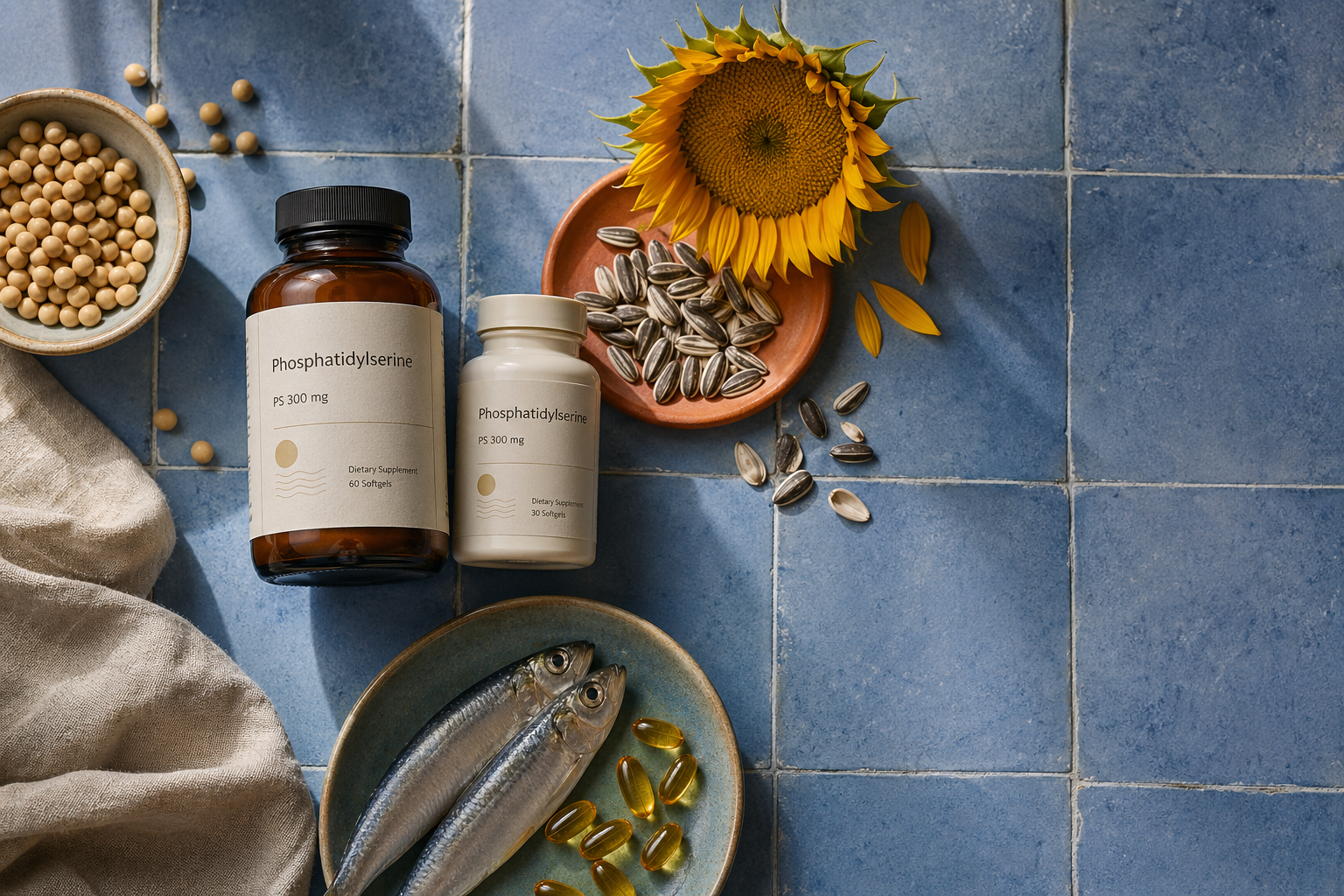
Main forms include historical bovine-cortex PS, soy-derived PS, sunflower-derived PS, and marine or DHA-enriched PS products.
Interactions
Robust clinical interaction studies with medicines or other supplements are limited. PS is often paired with omega-3s, but proven interaction effects are not clearly established.
Side effects
Short-term adult use appears generally well tolerated. Mild gastrointestinal discomfort has been reported occasionally in some studies.
Other possible benefits
Smaller studies suggest possible effects on exercise stress responses or some behavior-related outcomes, but the evidence is limited.
Regulatory status
In the US, PS is sold as a dietary supplement with only qualified claims. In the EU, official review pathways are more restrictive and do not support broad freely usable cognitive claims.
What We Already Know About It
Core biology. Phosphatidylserine is a real membrane phospholipid, not a marketing invention. It is especially concentrated in neural tissue and is involved in membrane fluidity, cell signaling, neurotransmission, synaptic activity, apoptosis-related signaling, coagulation, and neuroinflammatory processes. That makes PS biologically relevant to brain structure and function, but this mechanistic rationale does not by itself prove that supplementation creates meaningful clinical benefits. PubMed — Comprehensive overview of synthesis, metabolism, and nutrition
Why source may matter. Researchers have also focused on source differences because brain PS is naturally enriched with DHA. This helps explain interest in marine or omega-3-linked PS forms, while soy and sunflower PS dominate the modern market and older trials often used bovine-cortex PS. These differences can affect fatty-acid composition, allergen relevance, and how closely modern products match classic research materials. PubMed — DHA and brain phosphatidylserine; PubMed — Marine phospholipids overview; PubMed — PS sources and production
Clinical pattern. The most established human evidence points to modest, domain-specific memory benefits in older adults with memory complaints or age-related decline rather than dramatic global cognitive improvement. Evidence for dementia treatment, ADHD, healthy-person cognitive enhancement, or broad anti-stress effects remains mixed, limited, or low certainty. Overall, the science supports a specific use case more than the broad claims often attached to PS products. PubMed — Age-associated memory impairment trial; PubMed — Omega-3-containing PS memory study; KoreaScience — Meta-analysis on cognitive function in the elderly
Summary of Relevant Scientific Research
Classic memory benefit in age-associated impairment — PubMed 2027477
In a multicenter placebo-controlled trial of 149 people with age-associated memory impairment, bovine-cortex PS at 100 mg three times daily for 12 weeks improved some learning and memory tasks, with stronger effects in lower-performing participants. The study remains historically important, but the tested source is less representative of most current products. PubMed — Effects of phosphatidylserine in age-associated memory impairment
Modern PS-DHA trial in older adults with memory complaints — PubMed 20523044 and PMC3136416
Among 157 non-demented older adults with memory complaints, omega-3-enriched PS showed memory-related improvements after 15 weeks, while a related safety study found 300 mg daily generally well tolerated without major lab or vital-sign changes. This is among the more relevant non-bovine evidence for current supplement users. PubMed — PS containing omega-3 fatty acids may improve memory abilities; PMC — Safety of phosphatidylserine containing omega-3 fatty acids
Soy PS and combination-product studies are supportive, not definitive — PubMed 23723695 and 25414047
An open-label soy-derived PS pilot reported improvements in several cognitive measures at 300 mg daily for 12 weeks, but its design was vulnerable to expectancy and practice effects. A dementia study using PS plus phosphatidic acid cannot establish that PS alone caused the reported changes. PubMed — Soy-derived PS pilot study; PubMed — PS plus phosphatidic acid in Alzheimer and dementia
Evidence synthesis supports only modest cognitive claims — KoreaScience meta-analysis
A meta-analysis concluded that PS had a positive effect on memory in older adults with cognitive decline, which supports the idea that the clinical literature contains a real signal. Still, the underlying trials were small, heterogeneous, and often older, so the overall conclusion remains encouraging rather than definitive. KoreaScience — Effect of phosphatidylserine on cognitive function in the elderly
ADHD and stress findings remain low certainty — PMC and JISSN sources
Pediatric evidence is mixed, with low-certainty signals for inattention in some ADHD studies, often where PS was combined with omega-3s, while newer studies show no consistent improvement in core symptoms. Stress and exercise studies suggest possible endocrine or EEG effects, but they are small and short term. PMC — Pediatric ADHD meta-analysis; PMC — Newer ADHD study; JISSN — Exercise stress-response study
Beliefs, Myths & Unproven Claims
Myth: PS is proven to prevent dementia or treat Alzheimer disease
Older studies showed some positive signals, especially with bovine-cortex PS, but the evidence is mixed, sample sizes were modest, and the formulations do not fully match most current products. US regulatory materials place PS under qualified health claims rather than full approval, which is not consistent with a proven therapy standard. PubMed — Early dementia crossover trial; FDA — Qualified health claims and enforcement discretion
Myth: All phosphatidylserine sources work the same way
Bovine PS generated much of the classic cognitive literature, but modern products are more often soy-, sunflower-, or marine-derived. These forms differ in allergen relevance, fatty-acid composition, and how closely they resemble older research materials, and direct head-to-head evidence showing clear equivalence or superiority is lacking. PMC — Safety study of PS with omega-3 fatty acids; PubMed — Soy-derived PS pilot; PMC — Sunflower PS trial in healthy children; PubMed — DHA and brain phosphatidylserine
Myth: PS is a proven ADHD treatment or universal brain booster
The current evidence does not support PS as an established ADHD treatment or a reliable cognitive enhancer for healthy children and young adults. At most, there are low-certainty signals for inattention or some behavior-related outcomes, while newer and more directly relevant studies do not show consistent benefits in core ADHD symptoms or broad cognition. PMC — ADHD meta-analysis; PMC — Randomized open-label ADHD study; PMC — Sunflower-derived PS in healthy children
Detailed Research Observations
Biological role gives PS credibility, but not automatic clinical proof
Phosphatidylserine is a phospholipid that forms part of cell membranes and is especially concentrated in the nervous system. Its scientific interest comes from roles in membrane structure, cell signaling, neurotransmission, synaptic function, apoptosis-related signaling, and neuroinflammatory processes. This gives PS a strong mechanistic basis as a brain-related nutrient compound and helps explain why it attracts research attention in cognition and stress-related topics. PubMed — Comprehensive overview of synthesis, metabolism, and nutrition; PubMed — DHA and brain phosphatidylserine; PubMed — PS sources and production
At the same time, the article repeatedly separates biological plausibility from proven benefit. A nutrient can be physiologically important without producing large or reliable improvements when taken as a supplement. That distinction is central to PS: the mechanistic case is real, but the human outcome data remain more modest and selective than supplement marketing often suggests. PubMed — Comprehensive overview of synthesis, metabolism, and nutrition
Why source evolution matters for interpreting the evidence
Much of the early positive literature used bovine-cortex PS, which helped build the ingredient’s reputation for memory support. Commercial sourcing later shifted away from bovine brain because of bovine spongiform encephalopathy and prion-related concerns. That means the strongest historic trials are not always testing the same source categories that consumers usually buy today. PubMed — Age-associated memory impairment trial; PMC — Safety study of PS with omega-3 fatty acids
Modern source categories include soy-derived PS, sunflower-derived PS, and marine or DHA-enriched PS. These differ in manufacturing route, allergen relevance, and fatty-acid profile. The reviewed literature does not prove that one current source is universally best, but it does show that sources are not interchangeable by assumption. This is especially important when people try to generalize bovine-era findings directly to current soy, sunflower, or marine products. PubMed — PS sources and production; PubMed — Marine phospholipids overview; PMC — Sunflower PS study in healthy children
The clearest use case is cognitive aging support in selected older adults
The article’s most consistent message is that PS is not best supported as a universal brain enhancer. Instead, the strongest human signal is for modest memory support in older adults with memory complaints or age-related cognitive decline. Classic bovine PS trials reported gains in learning and memory tasks, and later work with omega-3-enriched PS found memory-related benefits in non-demented older adults with memory complaints. PubMed — Effects of phosphatidylserine in age-associated memory impairment; PubMed — PS containing omega-3 fatty acids may improve memory abilities
A meta-analysis also concluded that PS had a positive effect on memory in older adults with cognitive decline, which strengthens the idea that the literature is showing more than random noise. Even so, the likely effect size appears modest, and the benefit is better framed as domain-specific memory support than as broad cognitive restoration or dramatic improvement. KoreaScience — Effect of phosphatidylserine on cognitive function in the elderly
Dementia and Alzheimer-related claims remain suggestive, not established
Some older studies explored PS in early dementia or Alzheimer-type conditions and found signals that may look encouraging at first glance. One small crossover trial suggested greater overall clinical improvement than placebo during one phase of treatment, and a separate study using PS with phosphatidic acid reported favorable changes in mood, daily function, and general condition. PubMed — Early dementia of the Alzheimer type trial; PubMed — PS plus phosphatidic acid study
However, these findings do not establish PS as a treatment for dementia. The early trial was small and had mixed psychometric outcomes, while the combination-product study cannot isolate PS as the active driver. The article’s conclusion is that dementia-related marketing often goes beyond what the evidence can support, especially when older bovine evidence and combination-product data are presented as proof for modern stand-alone PS supplements. PubMed — Early dementia of the Alzheimer type trial; FDA — Qualified health claims and enforcement discretion
Soy, sunflower, and DHA-enriched products have different strengths and limits
Soy-derived PS has some supportive human evidence, including an open-label pilot study reporting improvements in several memory and executive measures at 300 mg per day for 12 weeks. But the study design was open-label, so placebo effects and practice effects remain important concerns. Sunflower-derived PS is increasingly relevant because it avoids soy and animal-sourcing issues, yet direct efficacy evidence remains sparse, and a modern randomized trial in healthy children found largely null overall cognitive effects. PubMed — Soy-derived PS pilot study; PMC — Sunflower-derived PS in healthy children
DHA-enriched or marine-related PS has a strong mechanistic rationale because brain PS is naturally rich in DHA and phospholipid-bound omega-3s may have distinctive delivery characteristics. Still, the reviewed human trials do not clearly show that DHA-enriched PS outperforms standard plant-derived PS on real-world memory outcomes. The practical takeaway is that source choice matters, but no modern form has clearly won the evidence race. PubMed — DHA and brain phosphatidylserine; PubMed — Marine phospholipids overview
Stress and exercise claims are narrower than marketing suggests
PS is sometimes promoted as a cortisol-lowering, anti-stress, or performance-support supplement. The article describes that evidence as interesting but limited. One small crossover study in healthy men found that 600 mg per day of soy-derived PS for 10 days blunted the cortisol response to moderate-intensity exercise and improved the testosterone-to-cortisol ratio. A sports medicine review summarized similar early findings, and another small study reported EEG changes after induced stress. JISSN — Exercise stress-response study; PubMed — Sports medicine review; PubMed — EEG and stress study
These findings support only a preliminary signal in specific stress models. They do not show that PS broadly reduces everyday psychological stress or reliably improves athletic performance for general users. The article treats this area as promising but far from settled. JISSN — Exercise stress-response study
Pediatric and ADHD evidence is mixed and low certainty
Some supplement marketing positions PS as a well-established aid for attention problems in children, but the article does not support that claim. A systematic review and meta-analysis suggested only preliminary, low-certainty evidence for improvements in inattention symptoms, often in studies where PS was combined with omega-3s rather than tested alone. PMC — Pediatric ADHD meta-analysis
More recent evidence remains inconsistent. A randomized open-label controlled study found no significant improvement in core ADHD symptoms, though some behavior-related outcomes such as aggression improved. Meanwhile, a modern randomized trial of sunflower-derived PS in healthy children found largely null cognitive effects overall. Taken together, the pediatric evidence is mixed, low certainty, and not enough to support routine use or strong cognitive-enhancement claims in youth. PMC — Newer ADHD study; PMC — Sunflower-derived PS in healthy children
Safety looks acceptable short term, but modern evidence gaps remain
Across the reviewed adult studies, PS appears generally well tolerated at typical study doses, especially around 300 mg per day for 12 to 15 weeks in older adults. The best direct safety trial found no major adverse changes in routine laboratory measures or vital signs with PS containing omega-3 fatty acids, and mild gastrointestinal discomfort was the most practical side effect to watch for. PMC — Safety of phosphatidylserine containing omega-3 fatty acids
The larger uncertainty is not obvious short-term toxicity but the lack of long-term, high-dose, and special-population data, especially for the same soy, sunflower, and DHA-enriched products sold today. Trial registries show newer confirmatory studies have been attempted or planned, but some have no posted results and at least one was terminated because of recruitment problems. That leaves PS better studied than many supplements, but still not fully settled. ClinicalTrials.gov — Mild cognitive impairment trial; ClinicalTrials.gov — Elderly cognition study; ClinicalTrials.gov — Newer cognition study
Regulatory Status (EU and US)
United States
In the US, phosphatidylserine is regulated as a dietary supplement ingredient rather than an approved drug treatment for memory disorders, dementia, or ADHD. FDA materials discuss PS in supplement and qualified health claim contexts, which means any claims must remain limited and caveated. GRAS notices relate to specified food uses and should not be confused with proof that PS improves memory or treats disease. FDA — Dietary Supplement Ingredient Directory; FDA — Qualified health claims and enforcement discretion; FDA — GRAS notice for phosphatidylserine
European Union
In Europe, health claims are handled through EFSA scientific opinions and the European Commission register. The reviewed materials do not indicate a broad freely usable EU-authorized cognitive claim for PS, even though the ingredient itself may appear in products. In practical terms, the EU framework is more restrictive on claim language than common supplement marketing suggests. EFSA — Scientific opinion on phosphatidylserine; European Commission — EU Register of nutrition and health claims
Across both systems, PS is not treated as a proven medicine for cognitive disease, which broadly matches the current evidence base.
Dosage and Standardization
Cognition studies: 300 mg/day, usually 100 mg three times daily, for 12–15 weeks.
Other contexts: 600–800 mg/day short term in exercise or stress research.
Safety And Interactions
Short-term tolerability: Modern adult studies suggest PS is generally well tolerated, especially around 300 mg per day over 12 to 15 weeks. A placebo-controlled safety study of PS containing omega-3 fatty acids found no major adverse changes in routine laboratory tests or vital signs. Mild gastrointestinal discomfort is the main practical side effect mentioned in the reviewed literature. PMC — Safety of phosphatidylserine containing omega-3 fatty acids
Source and allergy considerations: Historical bovine-cortex PS is important in the literature, but commercial use shifted toward soy, sunflower, and marine forms because of bovine-source safety concerns. Soy-derived PS may be unsuitable for people with soy allergy, while sunflower PS may be preferable when soy avoidance matters. PMC — Sunflower-derived PS study; PubMed — Marine phospholipids overview
Interactions and special populations: Robust clinical interaction studies with prescription medicines were not identified, and there is no strong database of established PS-specific supplement-drug interactions. Evidence is also limited in children, pregnancy, breastfeeding, and long-term high-dose use, so people with complex medical conditions or medication use should be cautious. FDA — Dietary Supplement Ingredient Directory; PMC — Pediatric ADHD meta-analysis
Conclusion
Phosphatidylserine is one of the more biologically plausible brain-related supplements, and it has a more meaningful human research base than many trendy cognition products. The strongest evidence points to modest, fairly specific memory support in older adults with memory complaints or age-related cognitive decline, most often at about 300 mg per day for 12 to 15 weeks.
At the same time, the evidence remains narrower than broad supplement marketing often implies. Dementia treatment, ADHD treatment, general cognitive enhancement in healthy people, and broad anti-stress claims are still mixed, preliminary, or low certainty. Modern soy, sunflower, and DHA-enriched products are relevant commercially, but better direct comparative trials are still needed.
Disclaimer
Disclaimer: We attempt to do our best to find relevant, accurate and most up to date information available in both, the public domain and in the clinical and medical research community. We recommend reviewing scientific sources for official information on the subject. This post is not intended as medical advice. Each individual person's health conditions vary and we advise to consult a doctor before taking any supplements.