 Deutsch
 Español
 Suomi
Suomi Français
 Bahasa Indonesia
 Italiano
 日本語
日本語 Português
 Tagalog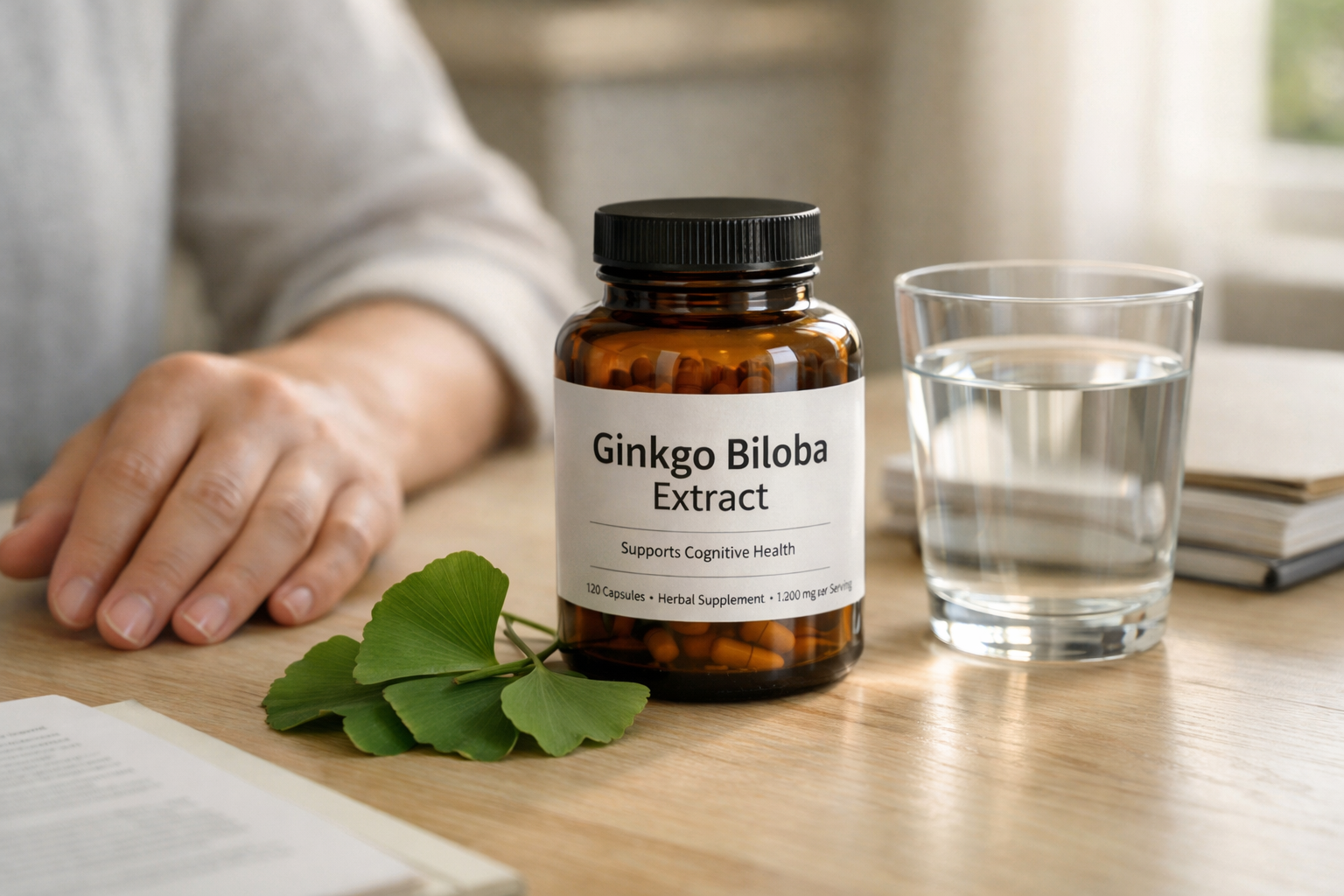
Summary
Ginkgo biloba is widely marketed for memory, circulation, tinnitus, and general brain health, but the research base is much narrower than the marketing. The strongest evidence does not support ginkgo for preventing dementia or reliably improving cognition in healthy adults, and studies do not support it for tinnitus or altitude sickness.
Some standardized leaf extracts may provide modest symptom support in certain adults with mild dementia, but results are mixed. Early findings in anxiety or depression are promising but still preliminary. Safety is an important part of the picture because ginkgo can affect bleeding risk, is contraindicated in pregnancy, and product quality varies across the market.
Quick Facts
What is it useful for?
Standardized ginkgo extract may offer modest symptom support in some adults with mild dementia, but it is not proven to prevent dementia.
Supplement types
Standardized leaf extracts are the main research form. Leaf powders, teas, and seed products are not equivalent in safety or quality.
Interactions
Ginkgo may increase bleeding risk with anticoagulants, antiplatelet drugs, NSAIDs, fish oil, garlic, vitamin E, or other products that affect clotting.
Side effects
Common side effects include headache, dizziness, stomach upset, and possible allergic reactions. Seeds or crude plant parts can be toxic.
Other possible benefits
Early studies suggest possible anxiety or depression symptom benefits, but the evidence remains preliminary and uneven.
Regulatory status
In the US, ginkgo is sold as a supplement without premarket FDA approval. In Europe, some herbal medicines are recognised, but supplement claims are restricted.
What We Already Know About It
Active compounds matter. Ginkgo leaf extracts contain flavonoid glycosides and terpene lactones, compounds thought to influence blood flow, oxidative-stress pathways, platelet activity, and cell-signalling systems. Standardized extracts such as EGb 761 are designed to control these constituents and keep potentially problematic ginkgolic acids very low, which is important because both activity and safety depend on preparation quality. (Scientific Reports — Ginkgo extract composition; EMA monograph — Ginkgo biloba leaf)
Evidence is narrow. The best-supported use is not dementia prevention or general memory enhancement, but the possibility of limited symptom benefit in some mild dementia settings when defined leaf extracts are used at researched doses. Even there, the picture is mixed: higher-level reviews report little or no effect on some major outcomes, while other pooled measures suggest small symptomatic improvements. That places the evidence at moderate at best for selected symptom relief and weaker for broader claims. (Cochrane Review — Cognitive impairment and dementia; PubMed — Ginkgo Evaluation of Memory trial)
Many popular uses are unsupported. In healthy adults, research does not support reliable cognitive enhancement. For tinnitus and altitude sickness, results are negative. Anxiety and depression signals are more encouraging, but they remain preliminary and need stronger replication before they can be treated as established uses. Overall, ginkgo has a long research history, yet that history supports cautious and limited conclusions rather than broad endorsement. (PubMed — Meta-analysis in healthy individuals; Cochrane Review — Ginkgo for tinnitus; JAMA Internal Medicine — Altitude-sickness trial; PubMed — Anxiety trial with EGb 761; Frontiers in Pharmacology — Depression meta-analysis)
Summary of Relevant Scientific Research
No Dementia Prevention — JAMA Ginkgo Evaluation of Memory trial
In a large randomized trial of more than 3,000 adults aged 75 years or older, 240 mg/day of ginkgo did not reduce all-cause dementia or Alzheimer disease versus placebo. This directly tested one of ginkgo’s most common marketing claims and produced a negative result. (PubMed — GEM trial results)
Mixed Symptom Results in Dementia — Cochrane review
The Cochrane review found that after about six months, ginkgo probably has little or no effect on some major measures of global clinical status, cognition, and instrumental activities of daily living. Some lower-certainty pooled findings suggested small symptomatic improvements on other scales, so the overall picture is limited and inconsistent rather than clearly positive. (Cochrane Review — Ginkgo in cognitive impairment and dementia)
No Reliable Brain Boost in Healthy People — Meta-analysis
Research focused on healthy individuals did not support dependable cognitive enhancement. This matters because many consumers take ginkgo as a nootropic, yet the pooled evidence does not justify broad claims about better memory, concentration, or productivity in healthy users. (PubMed — Cognitive enhancement meta-analysis)
Tinnitus and Altitude Claims Fall Short — Cochrane and JAMA Internal Medicine
Cochrane found no evidence that ginkgo is effective when tinnitus is the primary complaint. A placebo-controlled altitude-sickness trial also found that ginkgo did not prevent acute mountain sickness, while acetazolamide performed better. (Cochrane Review — Tinnitus; JAMA Internal Medicine — Acute mountain sickness trial)
Mental Health Signals Are Emerging — Anxiety trial and 2024 meta-analysis
A randomized trial reported dose-dependent improvement in anxiety symptoms with EGb 761 at 240 mg/day and 480 mg/day over four weeks. A 2024 systematic review and meta-analysis also suggested improved depression-related outcomes, but the studies were heterogeneous and often adjunctive, so these findings remain preliminary. (PubMed — Anxiety trial; Frontiers in Pharmacology — Depression outcomes review)
Formulation and Quality Matter — EMA, PubMed, and NIST
European regulators tie evidence and dosing to defined leaf preparations rather than all products labeled “ginkgo biloba.” Laboratory work has also found adulteration and quality problems in selected ginkgo supplements, and NIST has created reference material to support authenticity testing. (EMA — Ginkgo folium overview; PubMed — Supplement quality research; NIST — Ginkgo reference material)
Beliefs, Myths & Unproven Claims
Myth: Ginkgo prevents dementia
This is not supported by the best modern evidence. The large GEM trial did not show prevention of dementia or Alzheimer disease, and NCCIH also states that ginkgo has not been shown to prevent or slow dementia. At most, some standardized extracts may offer modest symptom support in certain mild dementia populations, which is a much narrower claim. (PubMed — GEM trial; NCCIH — Ginkgo)
Myth: It is a proven nootropic for healthy people
That claim is overstated. Meta-analytic evidence in healthy individuals did not support reliable cognitive enhancement, so claims about sharper focus, better exam performance, or broad memory improvement remain weak or unsupported. (PubMed — Healthy-individuals meta-analysis)
Myth: Ginkgo works for tinnitus and altitude sickness
These uses are often repeated in consumer content, but higher-level evidence does not back them. Cochrane found no evidence of effectiveness for tinnitus as the primary complaint, and a randomized altitude trial found ginkgo did not prevent acute mountain sickness. (Cochrane Review — Tinnitus; JAMA Internal Medicine — Altitude-sickness trial)
Myth: Traditional use proves modern supplement benefits
Traditional use explains why ginkgo remains popular, but it is not the same as modern clinical proof. European regulators still separate traditional powdered-leaf use from better-studied dry extracts, and that distinction shows why historical use should not be treated as evidence that all modern ginkgo products work for today’s marketed claims. (NCCIH — Ginkgo overview; EMA — Ginkgo folium)
Detailed Research Observations
Why Ginkgo Became Popular
Ginkgo biloba comes from one of the oldest surviving tree species, and leaf extracts have long been used in both traditional and modern herbal practice. Its popularity rose in part because it seemed biologically plausible that a plant influencing blood flow, oxidative stress, and platelet-related pathways might help cognition or circulation. That plausibility encouraged decades of research and helped build a large commercial market around “brain health” and memory support. (NCCIH — Ginkgo background; EMA — Ginkgo folium overview)
The practical lesson from the modern evidence is that biological plausibility did not translate into broad, dependable clinical benefit. Ginkgo remains scientifically interesting, but its current evidence profile is much narrower than its reputation. That difference between plausible mechanism and proven outcome is one of the most important themes in the literature. (NCCIH — Ginkgo)
Prevention Claims Are Not Supported
If a consumer buys ginkgo mainly to avoid dementia later in life, the best evidence does not support that use. The landmark Ginkgo Evaluation of Memory trial tested 240 mg/day in older adults and found no reduction in all-cause dementia or Alzheimer disease. This is especially important because dementia prevention is one of ginkgo’s most persistent public claims and one of the clearest examples where marketing runs ahead of evidence. (PubMed — Ginkgo Evaluation of Memory trial)
NCCIH reaches the same practical conclusion in its consumer guidance, stating that ginkgo has not been shown to prevent or slow dementia. Taken together, these sources make prevention the weakest major selling point in the ginkgo literature. In evidence-based terms, ginkgo is not a preventive dementia supplement. (NCCIH — Ginkgo consumer guidance)
Symptom Relief in Mild Dementia Is Narrower Than Marketing
The more nuanced part of the evidence concerns treatment of existing cognitive impairment or mild dementia symptoms. Here, the literature is not uniformly negative. The Cochrane review found moderate-certainty evidence of little or no effect on some major outcomes after about six months, but some lower-certainty pooled findings suggested small symptomatic improvements on other scales. This means certain standardized extracts may help some patients a little, but the overall effect is modest and inconsistent rather than robust. (Cochrane Review — Cognitive impairment and dementia)
This distinction matters because it is easy to turn a limited symptomatic signal into an exaggerated consumer message. A careful reading of the literature supports a much narrower statement: defined leaf extracts may offer modest symptom support in some mild dementia settings, but that is very different from preventing decline or broadly restoring memory. (Cochrane Review — Ginkgo in dementia)
Healthy Users, Tinnitus, and Altitude Claims Hold Up Poorly
Ginkgo is heavily marketed to healthy adults who want sharper thinking, better recall, or improved productivity, yet the evidence does not support reliable cognitive enhancement in that population. A meta-analysis focused on healthy individuals did not show dependable benefit, which is a practical warning against assuming that findings in people with cognitive problems can be transferred to healthy users. For healthy people seeking a “brain booster,” the research remains unconvincing. (PubMed — Meta-analysis in healthy individuals)
Other popular uses perform similarly poorly under closer study. Cochrane concluded there is no evidence that ginkgo is effective when tinnitus is the primary complaint, and a randomized trial found it did not prevent acute mountain sickness, while acetazolamide performed better. These negative findings reinforce a broader pattern: the more rigorously headline claims are tested, the more often effects appear absent or smaller than expected. (Cochrane Review — Tinnitus; JAMA Internal Medicine — Acute mountain sickness trial)
Mental Health Findings Are Interesting but Still Early
Not all newer research is negative. A placebo-controlled trial reported dose-dependent improvement in anxiety symptoms with standardized extract EGb 761 at 240 mg/day and 480 mg/day over four weeks. A 2024 systematic review and meta-analysis also suggested improved depression-related outcomes across more than 2,000 patients, without a clear increase in adverse events. These results are clinically interesting because they point to uses beyond cognition that may deserve further investigation. (PubMed — Anxiety trial with EGb 761; Frontiers in Pharmacology — Depression meta-analysis)
Even so, this area should still be treated as emerging evidence rather than settled guidance. The studies were heterogeneous, often short-term, and in many cases involved adjunctive use or specific regional practice patterns. That makes the signal worth watching, but not strong enough to place anxiety or depression among established, evidence-backed ginkgo uses. (Frontiers in Pharmacology — Systematic review)
Formulation, Timing, and Quality Control Change the Real-World Picture
One of the most important practical distinctions in the ginkgo literature is that standardized extracts are not the same as generic products labeled simply “ginkgo biloba.” EGb 761, one of the best-known research extracts, is adjusted to contain about 22% to 27% flavonoid glycosides, 5% to 7% terpene lactones, and very low ginkgolic acids. EMA dosing guidance is also written for defined herbal preparations rather than for any product with the plant name on the bottle. This means the evidence is attached to specific formulations, not to a plant name alone. (Scientific Reports — Extract standardization; EMA monograph — Defined preparations and dosing)
Timing also matters. The EMA notes human bioavailability data for terpene lactones after oral dosing and advises at least eight weeks of treatment before assessing effect in the recognised medicinal context. That does not fit the quick-acting “brain booster” image often used in supplement marketing. Adding to this, a European study found adulteration and quality issues in selected ginkgo supplements, while NIST developed reference material to support authenticity testing. Quality control is therefore a central limitation in everyday consumer use. (EMA monograph — Treatment duration; PubMed — Adulteration and quality study; NIST — Authenticity testing reference material)
Safety, Regulation, and the Main Evidence Gaps
Ginkgo is often treated as a gentle herbal product, but the safety picture is not trivial. Bleeding concerns, perioperative cautions, pregnancy contraindication, seizure warnings, toxicity of seeds or crude plant material, and uncertain breastfeeding safety all complicate routine use. Long-term uncertainty also remains, and IARC lists Ginkgo biloba extract as Group 2B, possibly carcinogenic to humans. This should not be read as proof that standard supplement dosing causes cancer, but it is a real caution within the broader toxicology picture. (EMA monograph — Safety warnings; NCCIH — Safety overview; LactMed — Ginkgo and breastfeeding; IARC — Carcinogenic classifications)
Regulatory context also shapes expectations. In Europe, the EMA separates certain herbal medicinal products from general food supplements and recognises specific defined preparations; in the United States, ginkgo is typically sold as a dietary supplement without premarket FDA approval. Research still leaves open which subgroups respond best, whether some standardized extracts outperform others, how mental-health signals hold up in larger trials, and how much product variability changes real-world outcomes. Until those questions are better answered, the most evidence-based position remains restrained. (EMA — Ginkgo folium; FDA — Dietary supplements Q&A; Frontiers in Pharmacology — Depression review; PubMed — Supplement quality research)
Regulatory Status (EU and US)
United States
In the United States, ginkgo products sold as dietary supplements are generally not approved by the FDA before marketing. Manufacturers are responsible for safety and lawful labeling, and supplements cannot legally claim to diagnose, treat, cure, or prevent disease. Federal consumer guidance also points readers to NCCIH for the current evidence summary. (FDA — Dietary supplements Q&A; NIH ODS — Botanicals list; NCCIH — Ginkgo)
European Union
In the European Union, the situation is more layered. Health claims on foods and supplements must be authorised under EU rules, while the EMA separately evaluates certain herbal medicinal products. For ginkgo, the EMA recognises defined leaf-extract herbal medicines for improving age-related cognitive impairment and quality of life in adults with mild dementia, and it also describes a traditional-use route for powdered leaf in minor circulatory complaints. No standalone broadly authorised EU food-supplement health claim for ginkgo was verified in this review. (European Commission — Nutrition and health claims; EMA — Ginkgo folium; EFSA — Botanicals)
Dosage and Standardization
Standardized leaf extract at 240 mg/day is the best-known research dose. One anxiety study used 240 mg/day and 480 mg/day for 4 weeks, and EMA advises at least 8 weeks before assessing effect; non-standardized powders, teas, seeds, and vague blends are not equivalent to studied extracts.
Safety And Interactions
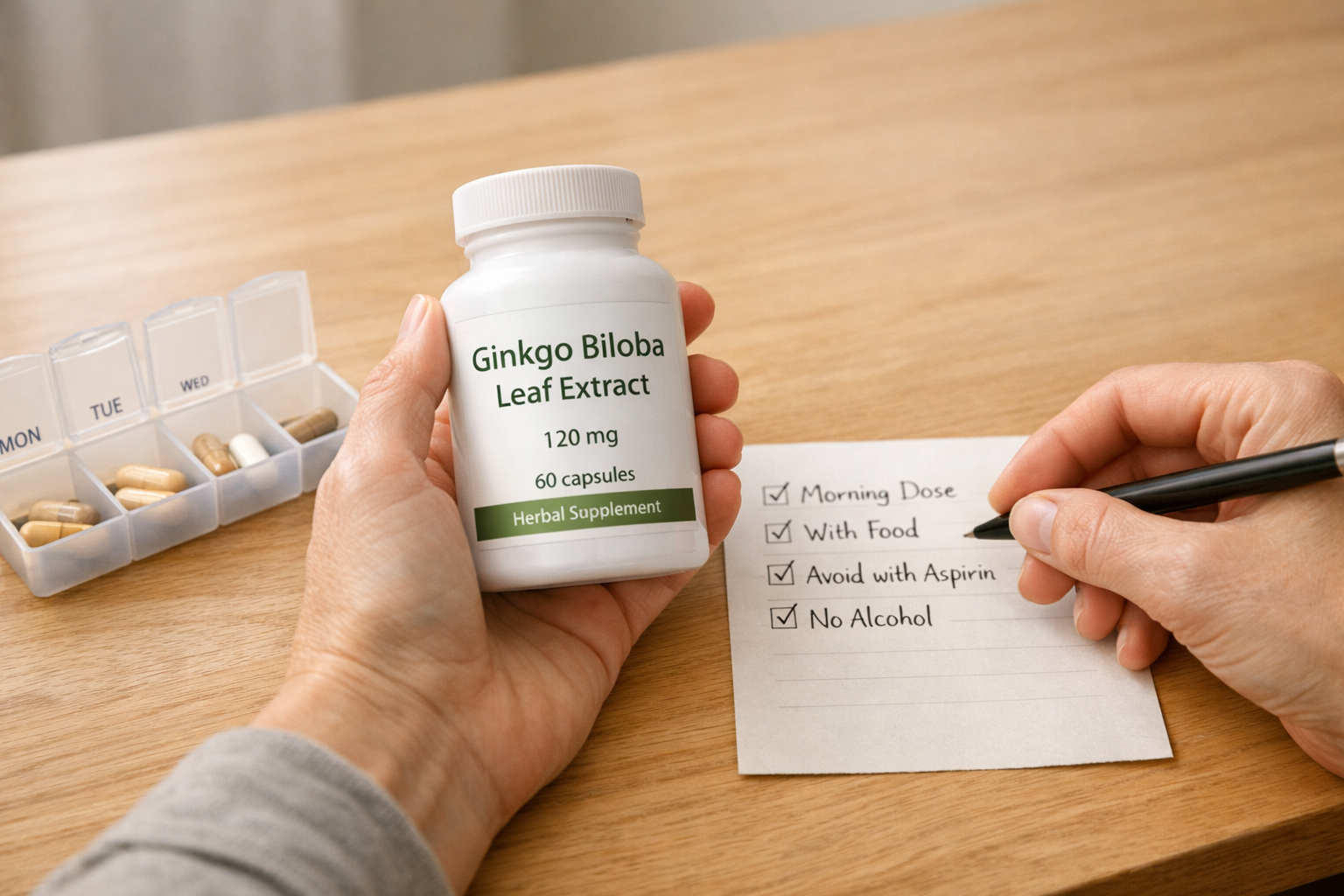
The main established concern is bleeding risk. Ginkgo may interact with anticoagulants, antiplatelet drugs, NSAIDs, and other products that influence clotting, and the EMA advises caution in people with a bleeding tendency and stopping use 3 to 4 days before surgery. (EMA monograph — Safety and interactions; Proceedings (Baylor) — Herb-drug interaction review; Mayo Clinic — Ginkgo overview)
Common side effects include headache, dizziness, gastrointestinal upset, and possible allergic reactions. Fresh or roasted ginkgo seeds can be toxic, and EMA also advises caution in people with epilepsy because of seizure concerns. (NCCIH — Ginkgo safety; EMA monograph — Contraindications and warnings)
Pregnancy is contraindicated in the EMA monograph, and breastfeeding safety data are insufficient. Long-term safety is less settled than many consumer summaries imply, and IARC classifies Ginkgo biloba extract as Group 2B, possibly carcinogenic to humans, which is a caution rather than proof of harm at standard consumer use. (LactMed — Ginkgo; IARC — List of classifications)
Conclusion
Ginkgo biloba remains one of the most recognisable herbal supplements, but its scientific profile is much narrower than its reputation. The strongest evidence does not support it for preventing dementia, reliably improving cognition in healthy adults, treating tinnitus, or preventing altitude sickness.
The most defensible use is limited: certain standardized leaf extracts, typically around 240 mg/day, may provide modest symptom support in some mild dementia contexts, though even that evidence is mixed. Mental-health findings are still emerging, and safety, interaction risks, pregnancy and breastfeeding concerns, seizure cautions, and variable product quality all argue for realistic expectations and careful product selection.
Disclaimer
Disclaimer: We attempt to do our best to find relevant, accurate and most up to date information available in both, the public domain and in the clinical and medical research community. We recommend reviewing scientific sources for official information on the subject. This post is not intended as medical advice. Each individual person's health conditions vary and we advise to consult a doctor before taking any supplements.