
 Deutsch
 Español
 Suomi
Suomi Français
 Bahasa Indonesia
 Italiano
 日本語
日本語 Português
 Tagalog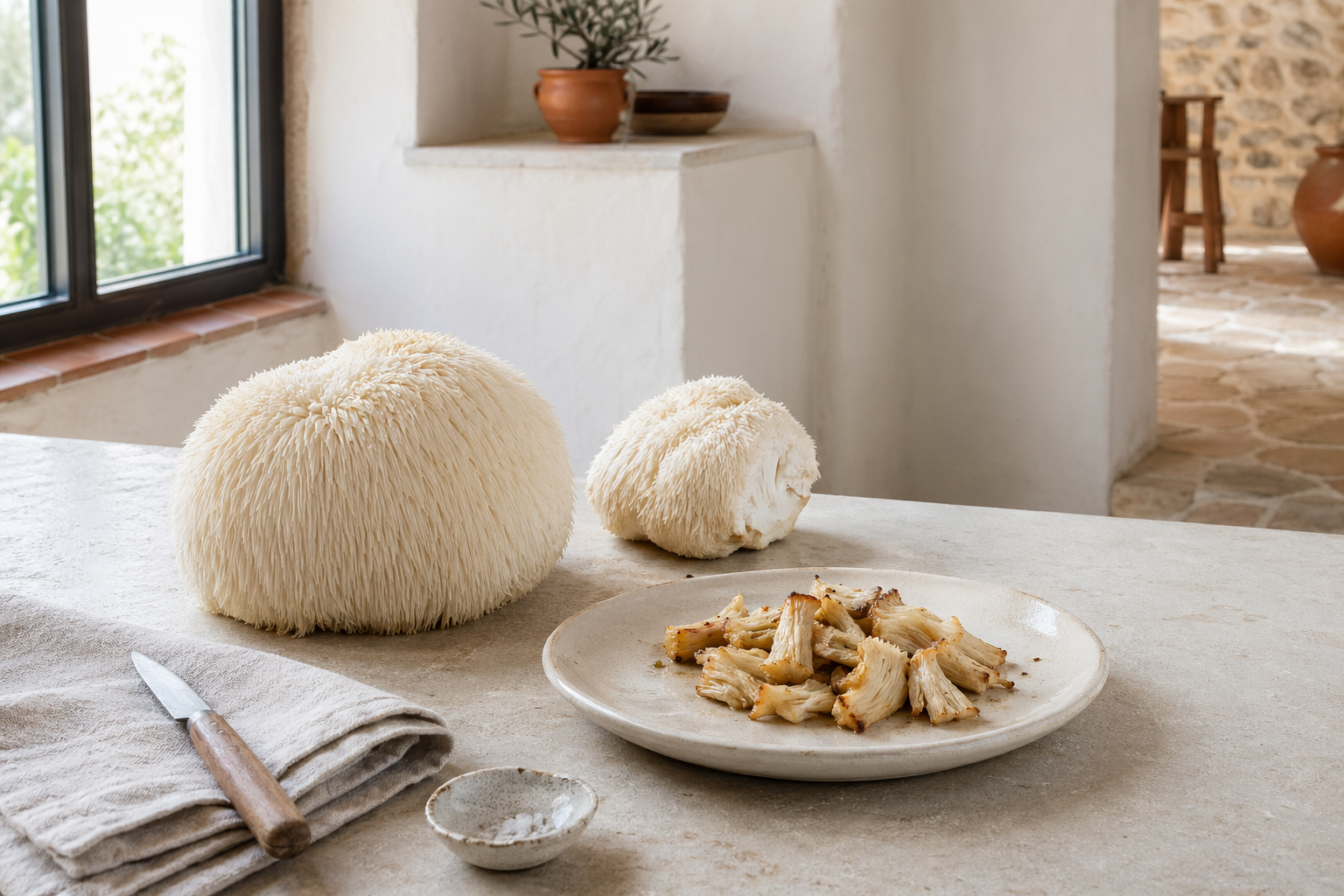
Summary
Lion's mane, or Hericium erinaceus, is an edible mushroom sold both as food and as a supplement for memory, focus, mood, stress, and nerve support. The strongest support is still for its food use, while supplement evidence is promising but limited.
Small randomized trials report possible benefits in mild cognitive impairment, certain cognitive tasks, and some mood or stress measures, but results are mixed and depend heavily on the exact preparation used. Fruiting body powders, extracts, mycelium products, and erinacine-enriched formulas differ in chemistry and should not be treated as interchangeable. Short-term use appears generally well tolerated, but long-term safety and interaction data remain limited.
Quick Facts
What is it useful for?
Small human trials suggest possible support for cognition, stress, and mood, but evidence is still mixed and product-specific.
Supplement types
Products include whole fruiting body powder, fruiting body extracts, mycelium, mixed biomass, and beta-glucan-standardized capsules or powders.
Interactions
Interaction data are limited. Caution is sensible with anticoagulant or antiplatelet drugs or supplements, especially before surgery.
Side effects
Short-term studies usually report no serious problems. Mild stomach upset or diarrhea can occur in some users.
Other possible benefits
Preclinical work suggests gut, nerve, and neuroprotective effects, but these are not yet well confirmed in humans.
Regulatory status
In the EU, fruiting body food use is better established than dehydrated mycelium powder. In the US, sale as a supplement does not prove effectiveness or authorize disease claims.
What We Already Know About It
Ingredient identity matters. Lion's mane is a real edible mushroom with culinary use, but the label "Lion's mane supplement" does not describe a single standardized intervention. Reviews consistently note that fruiting body materials are associated mainly with hericenones, while mycelium is associated mainly with erinacines. That means products made from different parts of the fungus likely differ in chemistry and should not be assumed to act the same way. PubMed review — Chemistry, Nutrition, and Health-Promoting Properties
Human evidence is selective. The clearest clinical signals come from small randomized trials using defined products, especially fruiting body powder in mild cognitive impairment and some cognitive measures in older adults, plus selected mood or stress outcomes in certain groups. At the same time, modern studies in healthy adults found only narrow effects or no meaningful broad benefit on cognition or mood, so the overall certainty is still moderate-to-low rather than strong. Frontiers in Nutrition — 2025 systematic review of Hericium erinaceus Mori et al. — mild cognitive impairment trial Nutrients — healthy adult pilot trial
Mechanisms remain mostly preclinical. Lion's mane is often discussed for possible neurotrophic, anti-inflammatory, and gut-related actions, but most of that support comes from preclinical work rather than replicated human outcomes. Human bioavailability data remain limited, and current evidence is not enough to conclude that Lion's mane reliably improves memory, prevents neurodegeneration, or treats mood disorders across the general population. PubMed review — Chemistry, Nutrition, and Health-Promoting Properties Frontiers in Nutrition — 2025 systematic review of Hericium erinaceus
Summary of Relevant Scientific Research
Systematic Map of the Evidence — Frontiers in Nutrition
A 2025 systematic review identified five randomized controlled trials, three pilot clinical trials, one cohort study, one case report, and many preclinical studies. Its main value is showing where the evidence is concentrated: small human studies on cognition, mood, sleep, and disease-specific pilot work, alongside a much larger laboratory literature. Frontiers in Nutrition — 2025 systematic review of Hericium erinaceus
Mild Cognitive Impairment Trial — Mori et al.
Thirty adults with mild cognitive impairment took placebo or Lion's mane tablets made from 96% dried fruiting body powder, totaling about 3 g/day for 16 weeks. Cognitive scores improved during treatment and then declined after discontinuation, suggesting a possible but product-specific signal rather than proof of a universal nootropic effect. Mori et al. — randomized placebo-controlled trial in mild cognitive impairment
Mood and Older-Adult Findings — Nagano et al. and Saitsu et al.
A 2010 trial in women using cookies with about 2 g/day of fruiting body powder found improvements in depression-related and indefinite complaint scores, while a 2019 study in adults over 50 using about 3.2 g/day reported MMSE improvement after age adjustment. Both studies are encouraging, but their benefits were limited and not broad across every measured outcome. Nagano et al. — small randomized placebo-controlled mood trial Saitsu et al. — randomized placebo-controlled trial in adults over 50
Healthy Adult Studies as a Reality Check — Nutrients and later trials
In healthy adults, a 2023 pilot found an acute improvement on one cognitive task after the first dose and lower subjective stress after 28 days, but most cognition and mood outcomes did not significantly change. A 2025 acute extract study and a 2022 four-week trial in healthy young adults also found no broad cognitive or mood benefit, showing that higher doses or stronger extracts do not guarantee results. Nutrients — pilot trial in healthy adults Surendran et al. — acute 10:1 fruiting body extract study PMC — 2022 null trial in healthy young adults
Specialized Mycelium Formulas — Pilot clinical studies
Product-specific pilot studies using specialized mycelium formulas are among the more intriguing findings. Erinacine A-enriched mycelia were studied in mild Alzheimer's disease for 49 weeks and reported slower cognitive decline and better contrast sensitivity, while a mostly mycelium mixed formula in overweight or obese adults reported better depressive-anxious mood and nocturnal rest quality. These results should not be assumed to apply to generic mycelium powders or blended products. PMC — pilot randomized trial of erinacine A-enriched mycelia in mild Alzheimer's disease PMC — mixed mycelium and fruiting body formula study
Beliefs, Myths & Unproven Claims
Myth: It is a proven memory and focus booster for everyone
The current human evidence does not support that level of certainty. Some trials found improvements in selected tasks or in people with mild impairment, while other studies in healthy adults showed little or no broad effect on overall cognition or mood. Mori et al. — mild cognitive impairment trial Nutrients — healthy adult pilot trial Surendran et al. — acute extract study PMC — 2022 null trial in healthy young adults
Myth: Fruiting body and mycelium are basically the same
They are not treated as equivalent in either chemistry reviews or EU regulatory discussions. Fruiting body material is associated mainly with hericenones, while mycelium is associated mainly with erinacines, and EU regulators noted that equivalence between dehydrated mycelium powder and the fruiting body had not been established. PubMed review — Chemistry, Nutrition, and Health-Promoting Properties European Commission consultation — Hericium erinaceus status
Myth: Higher beta-glucans automatically mean a better cognition product
Beta-glucans can be useful quality markers for mushroom polysaccharides, but they are not the same as the hericenones and erinacines often discussed in Lion's mane brain-related claims. A beta-glucan-standardized product may be meaningful, yet that standard alone does not prove that it matches the chemistry used in neurocognitive research. FDA GRAS notice — Lion's mane beta-glucan ingredient PubMed — analytical methods for Lion's mane compounds
Myth: Pilot disease studies prove it treats diseases
Interesting pilot work, including Alzheimer's research, does not justify saying that ordinary Lion's mane supplements treat Alzheimer's disease, depression, ADHD, cancer, or other conditions. FDA warning letters show that promising early science does not permit supplement sellers to market these products as unapproved drugs. PMC — pilot trial in mild Alzheimer's disease FDA warning letter — disease-treatment claims for mushroom products
Detailed Research Observations
Food Use Is the Strongest Established Case
Lion's mane has a long culinary and traditional-use history in East Asia, where it has been eaten as a mushroom food and also used in traditional wellness practices. From an evidence perspective, this matters because food use is the area with the strongest practical confidence. EU records further support that point: the fruiting body itself and certain fruiting-body-derived extract powders produced with water-based methods have been recognized as not novel, which gives ordinary food use and closely related preparations a clearer historical footing than newer mycelium ingredients. Traditional use helps explain why the mushroom became popular, but it is not the same as clinical proof for dementia, depression, or nerve-regeneration claims. European Commission document — non-novel fruiting body materials LiverTox — Lion's mane mushroom
The source material also matters for how strongly safety can be interpreted. LiverTox describes Lion's mane as an edible mushroom and notes that it has not been linked to clinically apparent liver injury in the reviewed literature. That is reassuring, but it supports the food case more directly than it supports broad neurocognitive claims for concentrated or specialized supplement forms. LiverTox — Lion's mane mushroom
Fruiting Body, Mycelium, and Manufacturing Are Not Equivalent
One of the most important distinctions in this category is what part of the fungus is actually being sold. The fruiting body is the visible mushroom that people cook and eat, while mycelium is the fungal root-like network grown in culture. Reviews commonly note that fruiting body material is associated mainly with hericenones, whereas mycelium is associated mainly with erinacines. That does not automatically make one form superior, but it does mean that products based on these materials are chemically different and should not be assumed to behave the same way in the body or in clinical studies. PubMed review — Chemistry, Nutrition, and Health-Promoting Properties
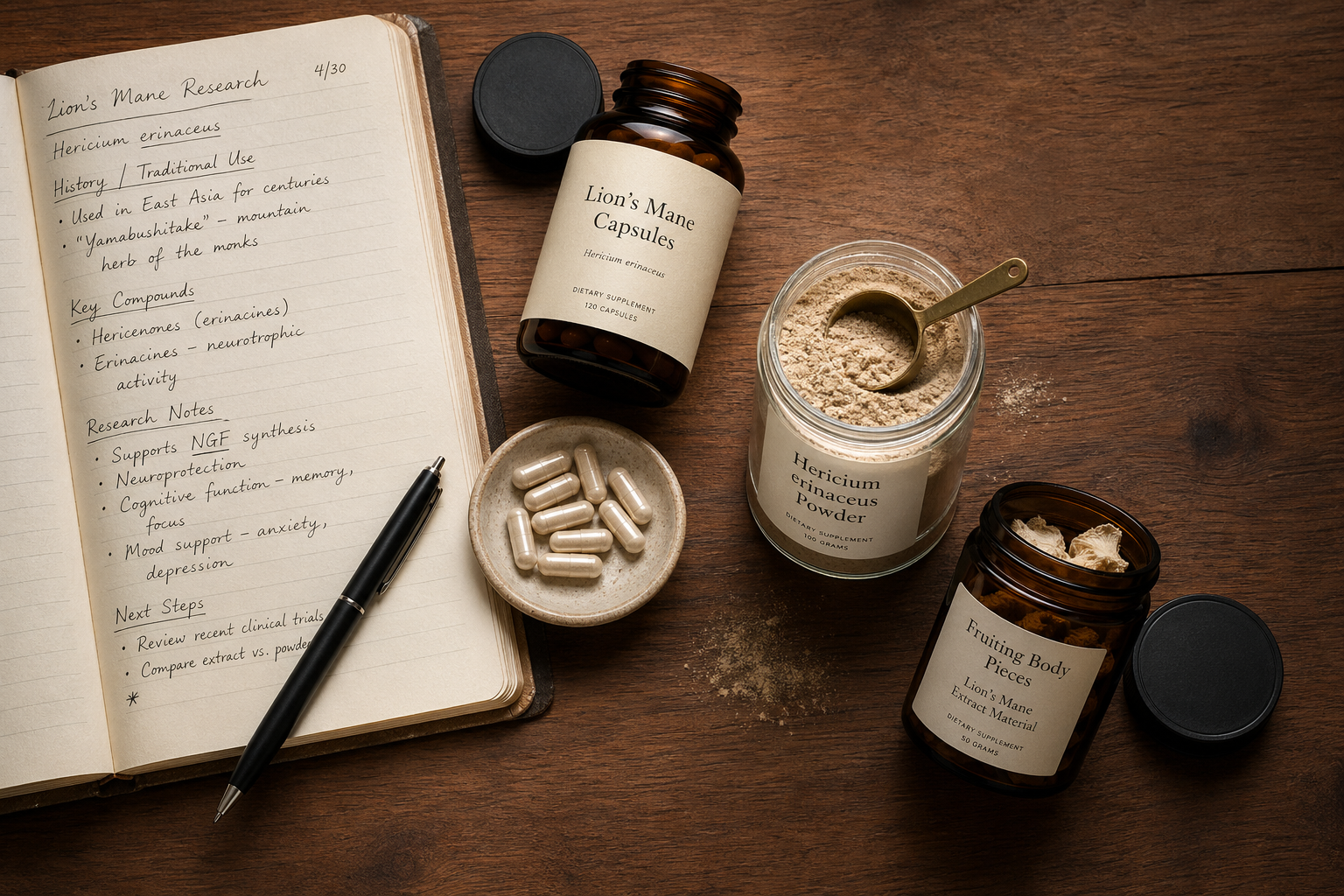
Manufacturing choices add another layer. Whole fruiting body powder stays closest to ordinary food use and resembles the material used in several older human trials. Fruiting body extracts can concentrate selected fractions depending on extraction method. Mycelium products may range from relatively pure cultured biomass to myceliated grain, where some of the finished powder may include growth substrate. Specialized fermentation products, such as erinacine A-enriched mycelia, are more specific still. These differences help explain why a label that simply says "Lion's mane" does not identify one uniform intervention. PubMed review — Chemistry, Nutrition, and Health-Promoting Properties PMC — pilot trial using erinacine A-enriched mycelia
Standardization and Labels Only Tell Part of the Story
Beta-glucan standardization is useful because it helps confirm mushroom polysaccharide content and can distinguish meaningful fungal material from fillers. But beta-glucans are not a direct proxy for Lion's mane's better-known neuroactive terpenoid families. The article notes that analytical methods now exist to quantify hericenones, hericenes, erinacines, and ergosterol in raw materials and products, which means manufacturers can, in principle, provide more informative chemistry than a generic mushroom blend label. PubMed — analytical methods for Lion's mane compounds FDA GRAS notice — Lion's mane beta-glucan ingredient
That has practical consequences for consumers. For a product marketed for brain health, the meaningful questions are what species is used, which part of the fungus is used, whether the material is whole powder or extract, what extraction method and ratio were used, what is standardized, and whether identity and contaminant testing were performed. Delivery formats such as gummies, coffee blends, or branded "focus" products do not tell a buyer whether the material resembles what was actually studied in trials. NCCIH — Using Dietary Supplements Wisely NIH ODS — Dietary Supplement Label Database
Human Cognition Evidence Shows a Signal, but It Remains Narrow
The best-known positive cognition study remains the 2009 mild cognitive impairment trial, where participants used about 3 g/day of dried fruiting body powder for 16 weeks. Cognitive scores improved during treatment and then declined after the product was stopped, suggesting that any effect may depend on continued intake. A later 2019 trial in adults over 50 used about 3.2 g/day of powdered fruiting body for 12 weeks and found MMSE improvement after age adjustment, though not across every measured cognitive test. Together, these trials support a plausible cognition signal, but mainly in defined contexts, with small samples and defined fruiting body products. Mori et al. — mild cognitive impairment trial Saitsu et al. — trial in adults over 50
Healthy-adult studies are much less impressive, and that is clinically important. A 2023 pilot in healthy adults found an acute improvement on one cognitive task after the first dose and lower subjective stress at day 29, but most cognition and mood outcomes did not significantly change. In another trial, a single 3 g dose of a 10:1 fruiting body extract did not improve composite global cognition or mood, and a separate 2022 four-week study at 10 g/day in healthy college-age adults also reported no meaningful cognitive benefit. These studies are a major reason broad memory-and-focus marketing claims should stay modest. Nutrients — pilot trial in healthy adults Surendran et al. — acute 10:1 extract study PMC — 2022 null trial in healthy young adults
Mood, Stress, Sleep, and Disease Pilots Are Promising but Product-Specific
The mood and stress literature offers some encouraging signals, but it is highly population-specific. In a 2010 cookie study, women consumed about 2 g/day of fruiting body powder for four weeks and showed improvement in depression-related and indefinite complaint scores, while sleep outcomes were not clearly significant. A later study in overweight or obese adults following a low-calorie diet reported better depressive-anxious mood and nocturnal rest quality using a mixed formula described elsewhere as 80% mycelium and 20% fruiting body extract. These studies suggest that mood-related effects are worth investigating further, but they also show why generalization is risky: the samples were small, the populations were specific, and the products were not equivalent. Nagano et al. — small randomized placebo-controlled mood trial PMC — mixed mycelium and fruiting body formula study
The Alzheimer's pilot study is especially noteworthy because it used erinacine A-enriched mycelia rather than an ordinary retail powder, and it followed participants for 49 weeks. The study reported slower cognitive decline and better contrast sensitivity versus placebo. Even so, it remains pilot-level evidence in a disease population using a specialized product, not proof that over-the-counter Lion's mane capsules treat Alzheimer's disease. This gap between promising science and marketing overreach is one of the most important practical lessons in the field. PMC — pilot randomized trial of erinacine A-enriched mycelia in mild Alzheimer's disease FDA warning letter — disease-treatment claims for mushroom products
Mechanism and Regulation Still Limit How Far the Evidence Can Be Taken
Lion's mane is often discussed as if its compounds clearly reach target tissues and produce predictable neurotrophic effects in humans. The article is more cautious. Most mechanistic enthusiasm still comes from preclinical work, and the chemistry review plus the 2025 systematic review both show that the field is biologically interesting without resolving the need for better human pharmacokinetic and formulation data. Source material, extraction method, dose, and product matrix may all influence which compounds are present and in what amounts. For now, it is reasonable to say Lion's mane has plausible active chemistry, but not that the human mechanism story is settled. PubMed review — Chemistry, Nutrition, and Health-Promoting Properties Frontiers in Nutrition — 2025 systematic review of Hericium erinaceus
Regulation reinforces the same message about ingredient identity. In the EU, consultations concluded that dehydrated Lion's mane mycelium powder is novel because significant pre-1997 consumption and equivalence to the fruiting body had not been established, while certain fruiting body extract powders were judged not novel. In the US, Lion's mane appears widely in capsules, powders, and blends under the supplement framework, but that tells consumers more about market availability than about equivalence, quality, or efficacy. Availability to sell is not the same as authoritative approval for cognition or mood claims. European Commission consultation — novel status of dehydrated mycelium powder European Commission document — non-novel fruiting body materials NIH ODS — Dietary Supplement Label Database
Regulatory Status (EU and US)
European Union
EU consultations indicate that the fruiting body of Hericium erinaceus and certain fruiting-body-derived extract powders made with water-based methods are not novel foods. By contrast, dehydrated mycelium powder was considered novel because significant pre-1997 consumption had not been established and equivalence with the fruiting body had not been shown. This means EU records treat fruiting body and mycelium as materially different ingredients rather than interchangeable label terms. European Commission consultation — Hericium erinaceus status European Commission document — non-novel fruiting body materials
United States
In the US, Lion's mane is widely sold as a dietary supplement in powders, capsules, and blends. Under the supplement framework, products do not need premarket proof of effectiveness for ordinary supplement marketing, though manufacturers remain responsible for safety and lawful labeling. FDA warning letters also show that Lion's mane supplements cannot legally be marketed as treatments for diseases such as Alzheimer's disease. Overall, market availability does not equal approved therapeutic use. NIH ODS — Dietary Supplement Label Database NCCIH — Using Dietary Supplements Wisely FDA warning letter — disease-treatment claims for mushroom products
Dosage and Standardization
Studied doses varied by form and population. Positive trials commonly used about 1.8-3.2 g/day of fruiting body powder for 4-16 weeks, while specialized erinacine A-enriched mycelia were studied at about 1.05 g/day. A single 3 g dose of 10:1 extract showed no broad acute benefit, and no universally accepted upper limit was identified.
Safety And Interactions
Overall, Lion's mane appears reasonably well tolerated in short-term studies and in ordinary food use. Human trials reviewed in the article generally reported no serious adverse events, and LiverTox states that Lion's mane has not been linked to serum enzyme elevations or clinically apparent liver injury in the available literature. Mild stomach discomfort or diarrhea has been reported in some users, which fits the broader picture of mostly mild gastrointestinal complaints when side effects occur. LiverTox — Lion's mane mushroom Mori et al. — mild cognitive impairment trial
A practical contraindication is mushroom allergy or known hypersensitivity to fungal products. Interaction data are limited, but an in vitro study found that hericenone B inhibited collagen-induced platelet aggregation, so caution is sensible with anticoagulants, antiplatelet drugs, or multiple supplements that may affect bleeding risk, especially before surgery. Pregnancy, breastfeeding, pediatric use, and complex medical conditions remain under-studied, so clinician oversight is prudent in those groups. PubMed — hericenone B and platelet aggregation NCCIH — Using Dietary Supplements Wisely
Conclusion
Lion's mane is best understood first as an edible mushroom food and only second as a still-developing supplement category. The food case is straightforward: the fruiting body has a real history of use, and short-term safety appears generally favorable.
The supplement case is more nuanced. Human studies suggest possible benefits for mild cognitive impairment, selected cognitive measures, and some mood or stress outcomes, but the clinical literature is still small, heterogeneous, and highly dependent on the exact material used. Fruiting body powder, fruiting body extract, mycelium, myceliated grain, mixed biomass, and erinacine-enriched mycelia are not interchangeable. Overall, Lion's mane is a legitimate culinary mushroom with promising but limited supplement evidence and a clear need for larger, better-standardized human trials before strong claims can be justified.
Disclaimer
Disclaimer: We attempt to do our best to find relevant, accurate and most up to date information available in both, the public domain and in the clinical and medical research community. We recommend reviewing scientific sources for official information on the subject. This post is not intended as medical advice. Each individual person's health conditions vary and we advise to consult a doctor before taking any supplements.