

 Deutsch
 Español
 Suomi
Suomi Français
 Bahasa Indonesia
 Italiano
 日本語
日本語 Português
 Tagalog
Summary
Panax ginseng, also called Asian or Korean ginseng, is the root of Panax ginseng C.A. Meyer and has a long traditional history as a tonic for weakness, recovery, and vitality. Modern products are commonly marketed for energy, cognition, stress resilience, immune support, sexual health, and blood sugar balance.
Current evidence is mixed. The best-supported uses are modest fatigue relief and some short-term improvements in fasting glucose or related cardiometabolic markers in prediabetes or type 2 diabetes. Evidence for cognition, athletic performance, immune support, and stress or wellbeing remains limited or preliminary, while sexual-health effects appear possible but small. Short-term use is generally well tolerated, but product quality, species identity, processing, and medicine interactions matter.
Quick Facts
What is it useful for?
Most plausibly for modest fatigue relief, with weaker evidence for short-term blood sugar support and some sexual-health outcomes.
Supplement types
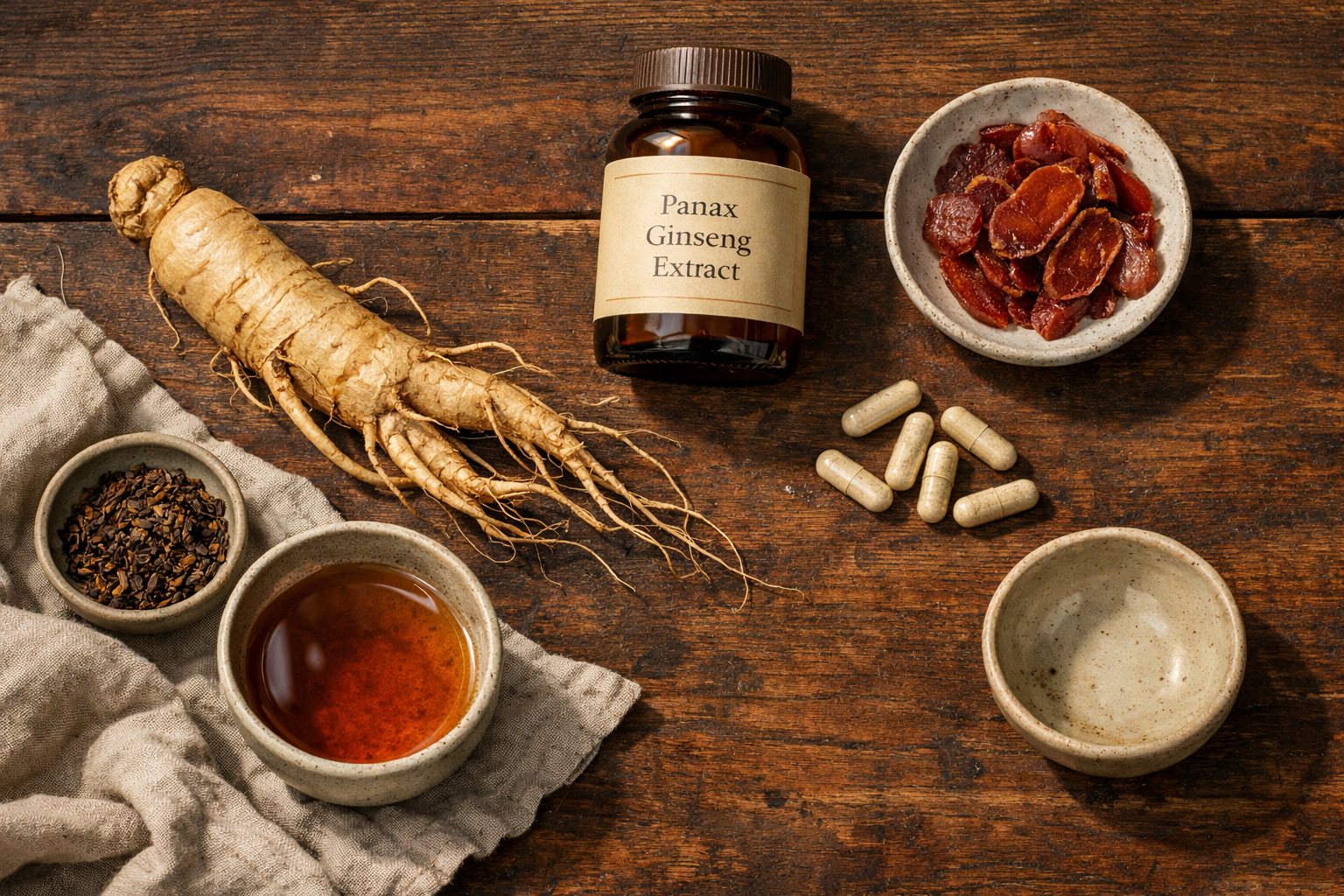
Products include dried root, powdered root, white ginseng, red ginseng, teas, and standardised extracts that can differ chemically.
Interactions
It may add to glucose-lowering or stimulating effects and may interact with warfarin, some antihypertensives, statins, and certain antidepressants.
Side effects
Short-term use is usually well tolerated, but insomnia, headache, stomach upset, nausea, vomiting, diarrhoea, constipation, or rash can occur.
Other possible benefits
Possible secondary benefits include short-term improvements in fasting glucose, some respiratory illness prevention findings, and modest wellbeing or stress effects, but results are mixed.
Regulatory status
In the EU, Panax ginseng root has traditional herbal status for fatigue and weakness. In the US, it is sold as a dietary supplement without FDA pre-approval.
What We Already Know About It
What it is. Panax ginseng refers to a specific species, not a catch-all name for every product sold as ginseng. Its most studied constituents are ginsenosides, and the form matters: white ginseng is dried root, while red ginseng is the same species after steaming and drying, which changes the chemical profile. Practical exposure also varies by species, plant part, extract ratio, and standardisation, so two products with the same milligram amount may not be equivalent. EMA — Panax ginseng Assessment Report; NCBI Bookshelf — Panax ginseng; PubMed — HPLC/MS authentication study
What the biology suggests. Ginsenosides are thought to influence neuroendocrine signalling, vascular function, inflammation, glucose metabolism, and immune activity, but these mechanisms do not automatically translate into large clinical effects. Clinically, the strongest recurring support is for modest fatigue relief and some short-term cardiometabolic improvements in prediabetes or type 2 diabetes. Evidence for cognition and physical performance is weak, sexual-health findings suggest only small benefits, and stress, wellbeing, and respiratory outcomes remain promising but preliminary. Overall, the evidence base is mixed rather than definitive. PubMed — Fatigue and physical performance meta-analysis; PubMed — Prediabetes and type 2 diabetes meta-analysis; Cochrane — Panax ginseng and cognition; PubMed — Ergogenic dose-response meta-analysis; Frontiers — Umbrella review of ginseng meta-analyses
Summary of Relevant Scientific Research
Balanced overview of uses and safety — NCCIH
NCCIH describes Asian ginseng as Panax ginseng and highlights ginsenosides as its main studied constituents. It notes possible benefits for fatigue, flu risk, cognition in some middle-aged adults, and cardiometabolic markers, while stressing that many popular claims remain limited, inconsistent, or too preliminary for broad conclusions. NCCIH — Asian Ginseng
Traditional status, forms, and quality standards — EMA
EMA distinguishes Panax ginseng root from other “ginseng” products, explains the white-versus-red processing difference, and supports traditional herbal medicinal use for symptoms of asthenia such as fatigue and weakness. The assessment report also outlines form-specific dosage ranges and a generally reassuring short-term safety profile, but not well-established clinical efficacy for broader claims. EMA — Ginseng Radix Monograph; EMA — Panax ginseng Assessment Report
Fatigue signal is stronger than performance — Meta-analyses and RCTs
Across randomized trials, Panax ginseng looks more convincing for fatigue reduction than for athletic enhancement. Meta-analytic and clinical-trial findings suggest improvement in overall fatigue and some mental-fatigue measures, but effect sizes are not dramatic and products, doses, and populations vary substantially. PubMed — Fatigue and physical performance meta-analysis; PMC — Disease-related fatigue review; PubMed — Fatigue randomized trial
Cognition claims remain unproven — Cochrane
Cochrane concluded that there is no convincing evidence that Panax ginseng enhances cognition in healthy participants and no high-quality evidence supporting its use in dementia. This makes broad “brain booster” or nootropic marketing stronger than the current evidence justifies. Cochrane — Panax ginseng and cognition
Metabolic effects appear modest — Systematic review in prediabetes and type 2 diabetes
A pooled review of randomized trials found improvements in fasting plasma glucose, HOMA-IR, total cholesterol, and some inflammatory markers. The signal supports Panax ginseng as a possible adjunct in some people, but heterogeneity between studies limits confidence in broad real-world conclusions. PubMed — Prediabetes and type 2 diabetes meta-analysis
Sexual health, immune, and stress findings are limited — Reviews and smaller trials
Sexual-health benefits appear possible but small, sports performance effects remain unconvincing, and immune or stress outcomes are still preliminary. The umbrella review found signals across several outcomes, but most included meta-analyses were low or critically low quality, so these areas remain research-led rather than settled. PubMed — Erectile dysfunction review; PubMed — Ergogenic dose-response meta-analysis; PMC — Acute respiratory illness trial; PubMed — Stress trial in high-stress adults; Frontiers — Umbrella review of ginseng meta-analyses
Beliefs, Myths & Unproven Claims
Myth: All ginseng is the same
Panax ginseng should not be treated as interchangeable with American ginseng or other products sold under the ginseng name. Chemical marker studies and EMA documents show that species and processing differences matter, including the fact that red ginseng is steamed Panax ginseng rather than a separate species. PubMed — HPLC/MS authentication study; EMA — Ginseng Radix Monograph; EMA — Panax ginseng Assessment Report
Myth: Panax ginseng is a proven nootropic
Some small studies and marketing materials suggest better focus or memory, but the strongest evidence summary does not support a proven cognitive-enhancing effect. Cochrane found no convincing evidence in healthy people and no high-quality evidence for dementia, so current nootropic claims are stronger than the evidence supports. Cochrane — Panax ginseng and cognition; NCCIH — Asian Ginseng
Myth: It reliably boosts sport performance or treats diabetes
The sports literature does not show a clear, consistent ergogenic effect, and diabetes research suggests only modest improvements in some biomarkers. Panax ginseng may be studied as an adjunct in selected settings, but it is not established as a proven performance enhancer or a replacement for standard diabetes care. PubMed — Ergogenic dose-response meta-analysis; PubMed — Prediabetes and type 2 diabetes meta-analysis; PubMed — Erectile dysfunction review
Myth: Natural means interaction-free and authentic
Official guidance warns that Panax ginseng may affect blood sugar and may interact with medicines such as warfarin, some antihypertensives, statins, and certain antidepressants. Product identity is also a real issue, with a review of commercial ginseng products estimating adulteration at about 24 percent. NCCIH — Herb-Drug Interactions Science; PMC — Ginseng authenticity review
Detailed Research Observations
Species, traditional use, and why product identity matters
Panax ginseng has been used in East Asian medicine for more than 2,000 years as a tonic associated with vitality, weakness, recovery, and general wellbeing. That historical background helps explain why modern products are still aimed at fatigue and convalescence. But traditional use is not the same as modern clinical proof, and the article repeatedly stresses that point because supplement marketing often blurs the line between longstanding reputation and demonstrated therapeutic effect. NCBI Bookshelf — Panax ginseng; EMA — Ginseng Radix Monograph
Product identity is a central practical issue. “Ginseng” is often used loosely, yet the topic here is specifically Panax ginseng, also called Asian or Korean ginseng. White and red ginseng are not different species; they are different processing forms of the same root, with steaming used to produce red ginseng and alter its ginsenoside profile. On top of that, the same species may be sold as dried root, powder, tea, or standardised extract with different drug-extract ratios and marker levels. A commercial review estimated adulteration in ginseng products at roughly 24 percent, which means results from authenticated study products cannot automatically be transferred to every label on a shop shelf. PubMed — HPLC/MS authentication study; EMA — Panax ginseng Assessment Report; PMC — Ginseng authenticity review
Fatigue relief is the most defensible use case
Among the common consumer claims, fatigue is where the evidence appears most supportable. A meta-analysis found that ginseng supplementation was more convincing for fatigue reduction than for physical performance improvement, and a separate review of disease-related fatigue reported overall benefit across randomized trials. Some Panax ginseng studies in symptomatic populations used doses around 1,000 to 2,000 mg per day, and a placebo-controlled trial reported improvements in some fatigue dimensions, including mental fatigue. PubMed — Fatigue and physical performance meta-analysis; PMC — Disease-related fatigue review; PubMed — Fatigue randomized trial
The article still frames this carefully. These findings do not show a caffeine-like stimulant effect or guarantee that everyone will feel a noticeable surge in energy. The more evidence-based interpretation is that Panax ginseng may modestly reduce fatigue, especially in people who are already fatigued, rather than reliably producing dramatic performance or alertness effects in healthy users. PubMed — Fatigue and physical performance meta-analysis
Cognition and mental performance remain uncertain
Panax ginseng is frequently marketed for memory, focus, and productivity, but the strongest evidence summary remains cautious. NCCIH notes that some small studies suggest possible cognitive benefits in certain middle-aged adults, which keeps the topic scientifically interesting. However, that signal is limited and does not amount to a broadly proven effect across healthy users. NCCIH — Asian Ginseng
Cochrane provides the clearest counterweight to nootropic marketing. It concluded that there is no convincing evidence that Panax ginseng enhances cognition in healthy participants and no high-quality evidence supporting its use in dementia. The practical reading of the literature is therefore not that cognitive benefits are impossible, but that any real effects may be subtle, subgroup-specific, or preparation-specific and currently unsupported by strong enough human evidence for confident public claims. Cochrane — Panax ginseng and cognition; NCCIH — Asian Ginseng
Metabolic, sexual-health, and sports findings are modest
Panax ginseng has also been studied for blood sugar and related cardiometabolic outcomes. The most useful current synthesis in adults with prediabetes or type 2 diabetes found improvements in fasting plasma glucose, HOMA-IR, total cholesterol, and some inflammatory markers. That supports a modest short-term signal, especially for fasting measures, but the studies were heterogeneous in preparation, population, and follow-up length. The article therefore presents Panax ginseng as a possible adjunct in some people, not as a stand-alone diabetes treatment or a substitute for medication, diet, or clinical care. PubMed — Prediabetes and type 2 diabetes meta-analysis; NCCIH — Asian Ginseng
Sexual-health and exercise claims also need restraint. In erectile dysfunction, a review found only a trivial effect on the main erectile function domain compared with placebo, though some secondary outcomes may improve. For sport and exercise, a dose-response meta-analysis did not establish a clear or reliable ergogenic effect in athletes and active participants. Taken together, these findings suggest Panax ginseng may help some people feel less fatigued without reliably making them stronger, faster, or clearly improving erectile outcomes. PubMed — Erectile dysfunction review; PubMed — Ergogenic dose-response meta-analysis; PubMed — Fatigue and physical performance meta-analysis
Immune, stress, safety, and regulatory realities
Immune and adaptogen-style claims are popular, but the article describes the human evidence as preliminary rather than settled. NCCIH notes possible reductions in flu risk, a small trial of Korean red ginseng reported preventive effects for acute respiratory illness, and small placebo-controlled studies have reported improvements in stress or tension outcomes. An umbrella review found signals of benefit across fatigue, sexual function, metabolic markers, menopausal symptoms, and respiratory disease, but also noted that most included meta-analyses were low or critically low quality. NCCIH — Asian Ginseng; PMC — Acute respiratory illness trial; PubMed — Stress trial in high-stress adults; PubMed — White ginseng stress study; Frontiers — Umbrella review of ginseng meta-analyses
Short-term oral use appears generally well tolerated, with commonly reported adverse effects including insomnia, headache, gastrointestinal upset, and hypersensitivity reactions such as itching or urticaria. But the article highlights several practical limits: long-term safety is less certain, interaction questions are clinically relevant, and regulation does not equal proof of broad efficacy. In Europe, EMA recognises Panax ginseng root for traditional herbal medicinal use in symptoms of asthenia such as fatigue and weakness. In the United States, it is sold as a dietary supplement without FDA pre-approval, so claims like “supports energy” should not be read as confirmation of disease benefit. PubMed — Safety review of randomized trials; EMA — Ginseng Radix Monograph; FDA — Dietary Supplement Q&A; FDA — Structure/Function Claims
Regulatory Status (EU and US)
European Union
In the EU medicinal context, Panax ginseng root is recognised by EMA as a traditional herbal medicinal product for symptoms of asthenia, including fatigue and weakness. This reflects traditional use and plausibility, not a declaration of well-established clinical efficacy for broader claims such as cognitive enhancement or sports performance. EMA — Ginseng Radix Monograph; EMA — Panax ginseng Assessment Report
United States
In the US, Panax ginseng is generally sold as a dietary supplement. FDA states that dietary supplements are not usually approved before marketing, and structure/function claims are not pre-approved and cannot legally claim to diagnose, treat, cure, or prevent disease. A label saying “supports energy” or “supports vitality” is therefore not proof of clinically established benefit. FDA — Dietary Supplement Q&A; FDA — Structure/Function Claims
For both regions, quality assurance is separate from efficacy. Programs described by USP and NSF can help with identity, purity, and manufacturing quality, but they do not prove that Panax ginseng works for a given health goal. USP — Dietary Supplements and Herbal Medicines; NSF — Certified for Sport
Dosage and Standardization
Typical studied ranges: dried root 2-6 g/day; powdered root 600-2,000 mg/day; extracts about 200-700 mg/day, with clinical studies using roughly 200-3,000 mg/day for 4-12 weeks.
Safety And Interactions
Short-term oral use appears generally well tolerated. The most documented side effects are usually mild and include insomnia, headache, stomach discomfort, nausea, vomiting, diarrhoea, constipation, and occasional hypersensitivity reactions such as itching or urticaria. Evidence is less complete for long-term use, rare adverse effects, and mixed commercial products of uncertain identity. PubMed — Safety review of randomized trials; EMA — Panax ginseng Assessment Report
Interaction risk is an important caution area. NCCIH advises that Panax ginseng may lower blood glucose, so it can complicate use alongside diabetes medicines. NCCIH also highlights mixed or uncertain interaction findings involving warfarin, calcium channel blockers and other antihypertensives, statins, and some antidepressants. NCCIH — Herb-Drug Interactions Science
EMA states that use is not established in people under 18 and is not recommended during pregnancy or lactation because adequate data are lacking. People with glucose-control issues should use extra caution, and anyone using Panax ginseng while also dealing with insomnia or combining it with stimulating products should watch for sleep disruption. EMA — Panax ginseng Assessment Report; NCCIH — Asian Ginseng
Conclusion
Panax ginseng is a real botanical with a long traditional history, meaningful pharmacology, and a research base that is promising in places but uneven overall. The clearest practical takeaway is that it is not a miracle tonic and not all ginseng products are interchangeable. The most defensible use case is modest fatigue relief, with some additional support for short-term improvements in fasting glucose and related cardiometabolic markers.
Sexual-health benefits may exist but appear small, while evidence for cognition and athletic performance is not convincing. Stress, wellbeing, and immune-related effects remain preliminary. Short-term safety looks reasonably good, but interactions, limited pregnancy and child safety data, and product authenticity remain important practical concerns. Overall, Panax ginseng may be useful in selected situations, but the evidence is mixed rather than strong.
Disclaimer
Disclaimer: We attempt to do our best to find relevant, accurate and most up to date information available in both, the public domain and in the clinical and medical research community. We recommend reviewing scientific sources for official information on the subject. This post is not intended as medical advice. Each individual person's health conditions vary and we advise to consult a doctor before taking any supplements.