
 Deutsch
 Español
 Suomi
Suomi Français
 Bahasa Indonesia
 Italiano
 日本語
日本語 Português
 Tagalog
Summary
Cordyceps in modern supplements usually refers to cultivated Ophiocordyceps sinensis mycelium products such as Cs-4 or to Cordyceps militaris fruiting body, mycelium, powders, or extracts. These are not interchangeable, because species, part used, cultivation method, and processing can meaningfully change composition.
Human evidence is strongest for modest endurance-related benefits, such as ventilatory threshold, metabolic threshold, or time-to-exhaustion. Immune biomarker changes have been reported, but proof for fewer infections, better sleep, testosterone support, anti-aging effects, cancer benefits, or blood-sugar benefits is much weaker. Short-term safety appears fairly good, yet product quality, interactions, and major EU versus US regulatory differences remain important practical issues.
Quick Facts
What is it useful for?
Cordyceps has the best human evidence for modest endurance and exercise-threshold support. Immune and many other benefits are less certain.
Supplement types
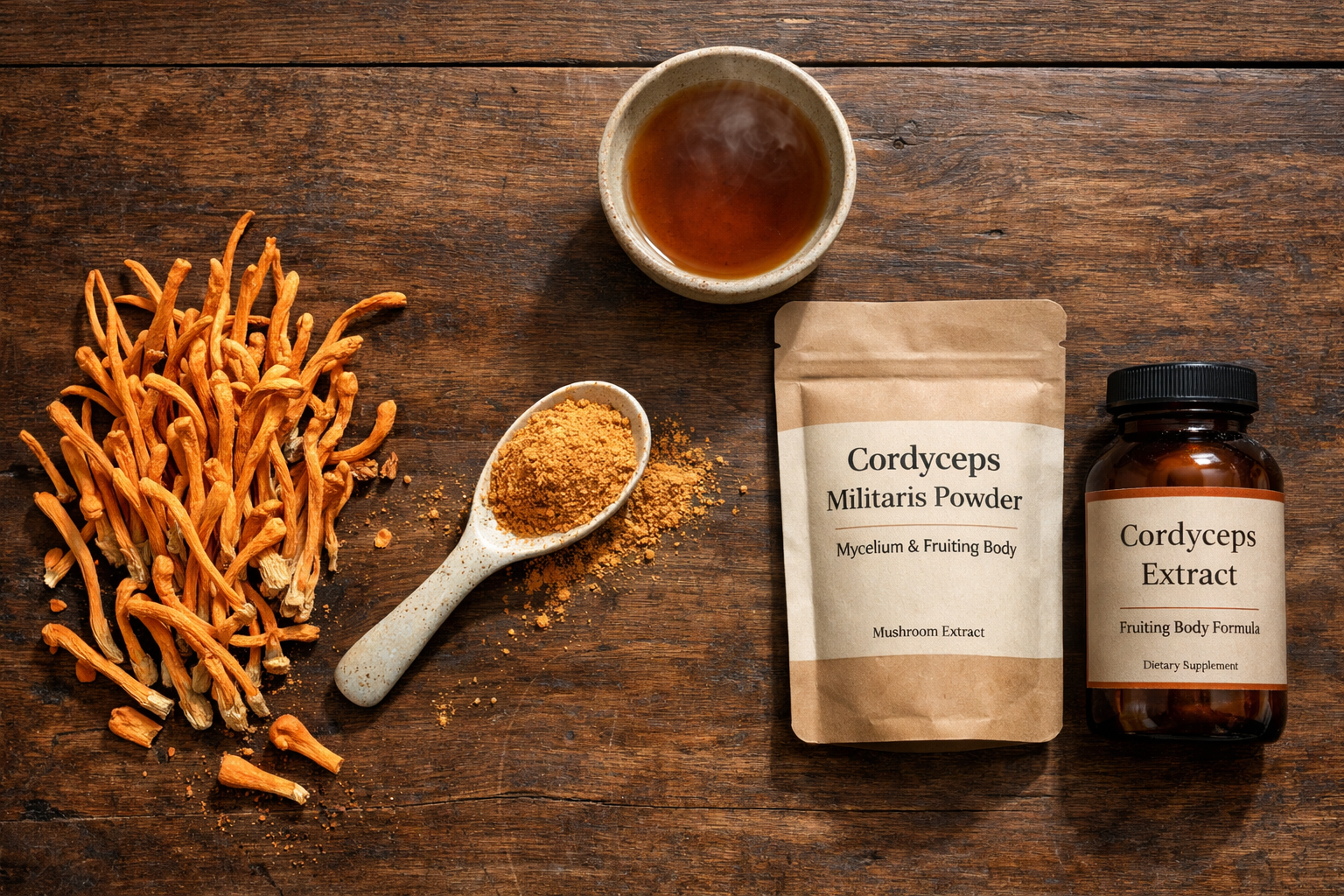
Common products include C. militaris fruiting body, cultured mycelium, powders, extracts, beverages, and O. sinensis mycelium products such as Cs-4.
Interactions
Practical cautions mainly involve blood thinners, glucose-lowering medicines, and immune-active combinations in people using immunosuppressants. Extra care is also noted for autoimmune disease, bleeding disorders, and upcoming surgery.
Side effects
Short-term trials usually report few serious adverse effects. Long-term safety data are limited, and product quality varies.
Other possible benefits
Immune-marker changes, kidney adjunct use, and respiratory adjunct use are under study. Many of these outcomes remain preliminary or low certainty.
Regulatory status
In the US, Cordyceps is sold as a dietary supplement. In the EU, species-specific novel-food status matters, especially for C. militaris, and no EFSA-approved benefit claim was identified in the supplied sources.
What We Already Know About It
Product identity matters. Modern Cordyceps supplements are usually based on either cultivated Ophiocordyceps sinensis mycelium, often sold as Cs-4, or on Cordyceps militaris fruiting body, mycelium, powder, or extract. These materials contain compounds such as cordycepin, polysaccharides, beta-glucans, adenosine-related nucleosides, ergothioneine, and other metabolites, but the profile varies by species, biological part, cultivation method, and manufacturing process. That is why one Cordyceps product should not be assumed equivalent to another.
Mechanistic plausibility is broad. Much of the interest in Cordyceps comes from chemistry that suggests possible effects on immune signaling, inflammation, oxidative stress, energy metabolism, and broader cell-signaling pathways. Cordycepin in particular is frequently highlighted because preclinical work links it to inflammatory, metabolic, respiratory, and tumor-related pathways. Even so, biological plausibility is not the same as proven clinical benefit, and much of this mechanistic literature remains animal- or cell-based rather than outcome-driven human research.
Human evidence is narrower. The strongest current human support is for exercise-related outcomes, especially modest improvements in endurance performance, ventilatory threshold, metabolic threshold, or time-to-exhaustion. Immune studies in healthy adults show reproducible changes in biomarkers such as NK-cell activity, but those findings have not clearly translated into fewer common respiratory infections. Disease-adjunct research in chronic kidney disease and COPD is clinically interesting, yet the evidence is low quality or context specific and should not be generalized into broad wellness claims.
Summary of Relevant Scientific Research
Product identity affects what you buy — PMC review and metabolomic comparison
Reviews of commercial Cordyceps products show that fruiting bodies, cultured mycelium, extracts, and retail formulas can differ substantially in composition, and metabolomic work shows cultured C. militaris overlaps with wild O. sinensis without being chemically identical. This supports treating species names and label details as meaningful distinctions rather than marketing decoration. (PMC — Cordyceps militaris products review; PubMed — metabolomic comparison of wild O. sinensis and cultured C. militaris)
Exercise findings are promising but modest — Cs-4 pilot trial and athlete meta-analysis
In older adults, 12 weeks of Cs-4 did not significantly improve VO2max, but metabolic and ventilatory thresholds improved. A later meta-analysis of fungal supplementation in athletes strengthened the endurance case by finding significant gains in endurance performance, ventilatory threshold, and VO2peak, while a recent review still described VO2max evidence as inconsistent. (PMC — Cs-4 exercise pilot trial; PubMed — systematic review and meta-analysis on fungal supplementation; PubMed — review on Cordyceps as an ergogenic aid)
Immune biomarkers change more clearly than illness outcomes — Placebo-controlled human trials
Placebo-controlled studies using 1.5 g/day of C. militaris found increases in NK-cell activity, lymphocyte proliferation, IL-2, IFN-gamma, and IgA. However, a 12-week trial did not show a significant reduction in upper respiratory infection incidence or symptom burden, so the evidence supports immunomodulation more than proven infection prevention. (PubMed — placebo-controlled immune study in healthy men; Journal of Nutrition and Health — 12-week C. militaris trial)
Clinical adjunct evidence should not be overgeneralized — CKD, COPD, and negative sleep trial
A Cochrane review found adjunctive Cordyceps preparations were associated with better creatinine-related measures and less proteinuria in chronic kidney disease, but judged the underlying evidence low quality. A COPD meta-analysis suggested possible adjunct benefit, whereas a randomized insomnia trial in depression was negative, underscoring that broad claims for sleep, mood, or disease treatment are not firmly supported. (PubMed — Cochrane review on chronic kidney disease; PubMed — meta-analysis on stable COPD; PubMed — randomized insomnia trial with C. militaris)
Beliefs, Myths & Unproven Claims
Myth: Cordyceps is a guaranteed VO2max booster
The evidence does not support a universal claim that Cordyceps reliably raises maximal aerobic capacity. Human studies more often show modest changes in ventilatory threshold, metabolic threshold, or time-to-exhaustion, while VO2max findings remain mixed. (PMC — Cs-4 exercise pilot trial; PubMed — review on Cordyceps as an ergogenic aid; PubMed — systematic review and meta-analysis on fungal supplementation)
Myth: Cordyceps prevents colds by “boosting immunity”
Human trials do show changes in immune markers such as NK-cell activity, cytokines, and IgA, but this has not clearly translated into fewer infections. In one 12-week randomized trial, biomarker improvements occurred without a significant reduction in upper respiratory infections or symptom burden. (PubMed — placebo-controlled immune study in healthy men; PubMed — study on cytokine and chemokine changes; Journal of Nutrition and Health — 12-week C. militaris trial)
Myth: All Cordyceps products are basically the same
This oversimplifies a category with meaningful differences in species, biological part, cultivation, and processing. Wild O. sinensis, cultured Cs-4 mycelium, and C. militaris powders or extracts are not chemically identical, so traditional reputation cannot simply be transferred to every modern product. (PMC — Cordyceps militaris products review; PubMed — metabolomic comparison of wild O. sinensis and cultured C. militaris)
Myth: Cordyceps is proven for cancer, anti-aging, testosterone, diabetes, or sleep
Much of the enthusiasm for these uses comes from mechanistic cordycepin research, animal work, or disease-adjunct studies rather than strong human supplement trials. A placebo-controlled insomnia trial in depression was negative, and clinical guidance notes that many widely promoted uses remain inadequately studied. (PubMed — systematic review of cordycepin; PubMed — randomized insomnia trial with C. militaris; MSKCC — Cordyceps monograph)
Detailed Research Observations
Species, form, and historical identity shape interpretation
Cordyceps has a long traditional history in East Asian medicine, especially for fatigue, weakness, lung support, kidney support, sexual vitality, and general strengthening. Historically, wild Ophiocordyceps sinensis was the prestige material, but it is scarce, expensive, and difficult to standardize. Modern supplement markets therefore rely much more on cultivated materials, especially Cs-4-type O. sinensis mycelium and Cordyceps militaris grown as fruiting bodies or mycelium. This means the average consumer is usually buying something different from the material described in older traditional texts, even when the product is marketed with the same legacy name. (MSKCC — Cordyceps monograph; PMC — Cordyceps militaris products review; PubMed — metabolomic comparison of wild O. sinensis and cultured C. militaris)
That distinction matters because product forms differ substantially. Consumers may encounter whole fruiting body powders, cultured mycelium, extracts standardized to beta-glucans or cordycepin, beverages, and multi-ingredient blends. Reviews comparing fruiting bodies, mycelium, and retail supplements report enough compositional variation that labels emphasizing fruiting body, mycelium, extraction, or marker compounds should not be dismissed as trivial. A standardized extract and a generic mushroom powder may both be called “Cordyceps,” yet they can represent materially different substances. (PMC — Cordyceps militaris products review; PubMed — review of C. militaris chemistry and bioactive compounds)
Exercise evidence points to modest endurance support, not dramatic performance gains
The best-supported human use case is exercise-related performance, but the pattern is narrower than marketing often suggests. In a double-blind placebo-controlled pilot trial, older adults taking Cs-4 at 333 mg three times daily for 12 weeks did not show a significant increase in VO2max, yet they did improve metabolic and ventilatory thresholds. That suggests better submaximal exercise tolerance rather than a major transformation in maximal aerobic power. The result is important because it illustrates how Cordyceps may help some endurance-related measures without supporting the strongest “performance booster” claims. (PMC — Cs-4 exercise pilot trial)
Later evidence strengthens the case, but still in a qualified way. A meta-analysis in athletes reported significant improvements in endurance performance, ventilatory threshold, and VO2peak in the Cordyceps subgroup, while a separate review concluded that time-to-exhaustion may be more consistently responsive than classic VO2max markers. At the same time, some studies are hard to interpret because formulations include more than one active ingredient. A preliminary endurance-training study combining Rhodiola and Cordyceps showed slight body-composition advantages but no clear metabolic benefits beyond training alone, and the blend design prevents confident attribution to Cordyceps itself. (PubMed — systematic review and meta-analysis on fungal supplementation; PubMed — review on Cordyceps as an ergogenic aid; PubMed — Rhodiola plus Cordyceps endurance study)
Immune modulation is plausible, but infection prevention remains uncertain
Human trials do show that Cordyceps can affect immune markers. In healthy male adults, 1.5 g/day of ethanol-treated C. militaris for 4 weeks increased NK-cell activity, lymphocyte proliferation, IL-2, and IFN-gamma compared with placebo. Another study reported changes in cytokines and chemokines after C. militaris use, which supports the idea that the body responds biologically to the ingredient. These are meaningful findings for mechanistic plausibility and for positioning Cordyceps as a functional-food ingredient, because they show consistent immunoregulatory signals rather than purely theoretical activity. (PubMed — placebo-controlled immune study in healthy men; PubMed — study on cytokine and chemokine changes)
The harder question is whether those biomarker shifts improve real-world health outcomes. In a 12-week placebo-controlled trial, 1.5 g/day of C. militaris extract increased NK-cell activity and IgA, yet it did not significantly reduce upper respiratory infection incidence or symptom burden. A more recent beverage trial suggests Cordyceps can be incorporated into a drink and still affect immune-response markers, which is relevant for functional foods, but this is still early evidence rather than proof of broad infection protection. The current evidence therefore supports immune modulation more clearly than it supports consumer claims about preventing colds or “boosting immunity” in a clinically established way. (Journal of Nutrition and Health — 12-week C. militaris trial; PMC — randomized Cordyceps beverage trial)
Disease-adjunct findings are interesting but highly context specific
Chronic kidney disease and COPD are two medical areas where Cordyceps has accumulated more formal clinical literature, largely because of its traditional association with kidney and lung support. In a Cochrane review of 22 studies with 1,746 participants, adjunctive Cordyceps preparations were associated with lower serum creatinine, higher creatinine clearance, and reduced proteinuria in non-dialysis chronic kidney disease. However, the review judged the underlying evidence low quality because of high or unclear risk of bias. A clinical trial on C. militaris in CKD also reported improvements in kidney and redox markers, but these findings remain within supervised disease settings rather than general wellness use. (PubMed — Cochrane review on chronic kidney disease; PubMed — clinical trial of C. militaris in CKD)
The same caution applies to respiratory evidence. A systematic review and meta-analysis suggests oral Cordyceps sinensis preparations may have benefit as an adjunct in stable COPD, which aligns with traditional lung-support claims. But this is not the same as showing that any Cordyceps supplement improves lung health in otherwise healthy consumers. Disease-adjunct evidence can be clinically relevant without justifying broad self-care claims, and the supplied sources repeatedly emphasize that the strongest claims outrun the available human data. (PubMed — meta-analysis on stable COPD)
Safety, product quality, and regulation are part of the evidence picture
Short-term human trials generally report Cordyceps as well tolerated, and animal toxicology on cultivated Chinese cordyceps is reassuring, but long-term human safety is not as well developed as the marketing implies. Practical cautions mainly involve anticoagulant or antiplatelet drugs, glucose-lowering medicines, and immunosuppressants. Extra care is also advised for autoimmune conditions, bleeding disorders, upcoming surgery, pregnancy, breastfeeding, and pediatric use, largely because evidence is insufficient rather than because harm has been firmly proven. Safety therefore depends not only on dose, but also on population and medical context. (PubMed — placebo-controlled immune study in healthy men; PubMed — randomized insomnia trial with C. militaris; PubMed — safety evaluation of cultivated Chinese cordyceps; MSKCC — Cordyceps monograph; WebMD — Cordyceps overview)
Quality and regulation add another layer. Wild O. sinensis has documented arsenic-species concerns, while cultivated materials are often preferred because they are easier to standardize and monitor. In Europe, species-specific novel-food status matters greatly: Dutch authority communications indicate Cordyceps sinensis is listed as not novel in food supplements, while C. militaris has been an enforcement target and has appeared in recent EU fraud and enforcement reports as a food ingredient not authorised in the EU. In the United States, Cordyceps is sold as a dietary supplement rather than an approved drug, which allows structure/function wording but not disease-treatment claims. (PubMed — arsenic species in Cordyceps sinensis habitats; Dutch NVWA — Cordyceps militaris inspection results; European Commission — August 2024 FFN report; European Commission — May 2025 FFN report; FDA — dietary supplements questions and answers)
Regulatory Status (EU and US)
European Union
In the EU, Cordyceps regulation is shaped heavily by the Novel Food framework. The European Commission describes its Novel Food Status Catalogue as a non-binding orientation tool, but in practice it strongly influences market access. The supplied sources also show that species distinction matters: Dutch authority communication indicates Cordyceps sinensis is listed as not novel in food supplements, while C. militaris has been the focus of enforcement attention. Recent EU fraud and enforcement reports from August 2024 and May 2025 also list C. militaris in food-supplement contexts as a food ingredient not authorised in the EU. No EFSA-approved benefit claim for Cordyceps was identified in the supplied sources. (European Commission — Novel Food Status Catalogue; Dutch NVWA — Cordyceps militaris inspection results; European Commission — August 2024 FFN report; European Commission — May 2025 FFN report)
United States
In the US, Cordyceps products are regulated as dietary supplements under the food umbrella rather than as approved drugs. Sellers may use lawful structure/function claims if they are truthful and non-misleading, but they may not market Cordyceps as treating disease. The FDA has also enforced that boundary in warning-letter practice. (FDA — dietary supplements questions and answers; FDA — structure/function claims for dietary supplements; FDA — warning letter citing unlawful disease claims)
Dosage and Standardization
There is no single evidence-based universal Cordyceps dose because study regimens are highly form specific. In the exercise pilot using Cs-4, participants took 333 mg three times daily for 12 weeks. In immune studies with C. militaris, 1.5 g/day was used for 4 weeks in one trial and for 12 weeks in another. A small COVID adjunct study used 500 mg three times daily.
Consumer-facing sources sometimes mention 3 to 6 g/day for generic Cordyceps products, but that is not a standardized, clinically validated dose across fruiting body powders, mycelium, extracts, beverages, or Cs-4-style preparations. No authoritative tolerable upper intake level was identified in the supplied sources.
Safety And Interactions
Short-term safety appears reasonably good, but the data are not complete. Human trials in healthy adults and in other clinical settings generally reported few serious adverse effects and no statistically significant excess of adverse reactions compared with placebo. Animal toxicology on cultivated Chinese cordyceps is also reassuring. Most human studies, however, are relatively small and short, so long-term safety, repeated high-dose use, and safety in medically complex populations remain less certain.
The main practical interaction cautions involve anticoagulant or antiplatelet drugs, glucose-lowering medicines, and immunosuppressants. These concerns are described mainly as precautionary but clinically relevant. People with autoimmune conditions, bleeding disorders, or upcoming surgery should be especially careful, and pregnancy, breastfeeding, and pediatric use remain areas where evidence is insufficient.
Product quality is also a safety issue. Wild O. sinensis has shown measurable arsenic species in habitat-based sampling, which supports the case for quality-controlled cultivated products. Because species, cultivation, substrate, and extraction all affect composition, safety depends not only on dose, but also on the exact product being consumed.
Conclusion
Cordyceps is best understood as a category of fungi and fungal preparations rather than a single standardized supplement. That matters because cultivated O. sinensis mycelium products such as Cs-4 and C. militaris fruiting body or mycelium products differ in chemistry, research history, and in some markets even regulatory status.
Across the current evidence, the clearest human support is for modest endurance-related benefits rather than dramatic athletic enhancement. Immune effects are plausible and supported by biomarker studies, but proof that these changes translate into fewer infections is weak. Short-term safety looks acceptable, yet interaction cautions, product quality, and EU versus US regulatory differences remain important practical limits.
Disclaimer
Disclaimer: We attempt to do our best to find relevant, accurate and most up to date information available in both, the public domain and in the clinical and medical research community. We recommend reviewing scientific sources for official information on the subject. This post is not intended as medical advice. Each individual person's health conditions vary and we advise to consult a doctor before taking any supplements.