

 Deutsch
 Español
 Suomi
Suomi Français
 Bahasa Indonesia
 Italiano
 日本語
日本語 Português
 Tagalog
Summary
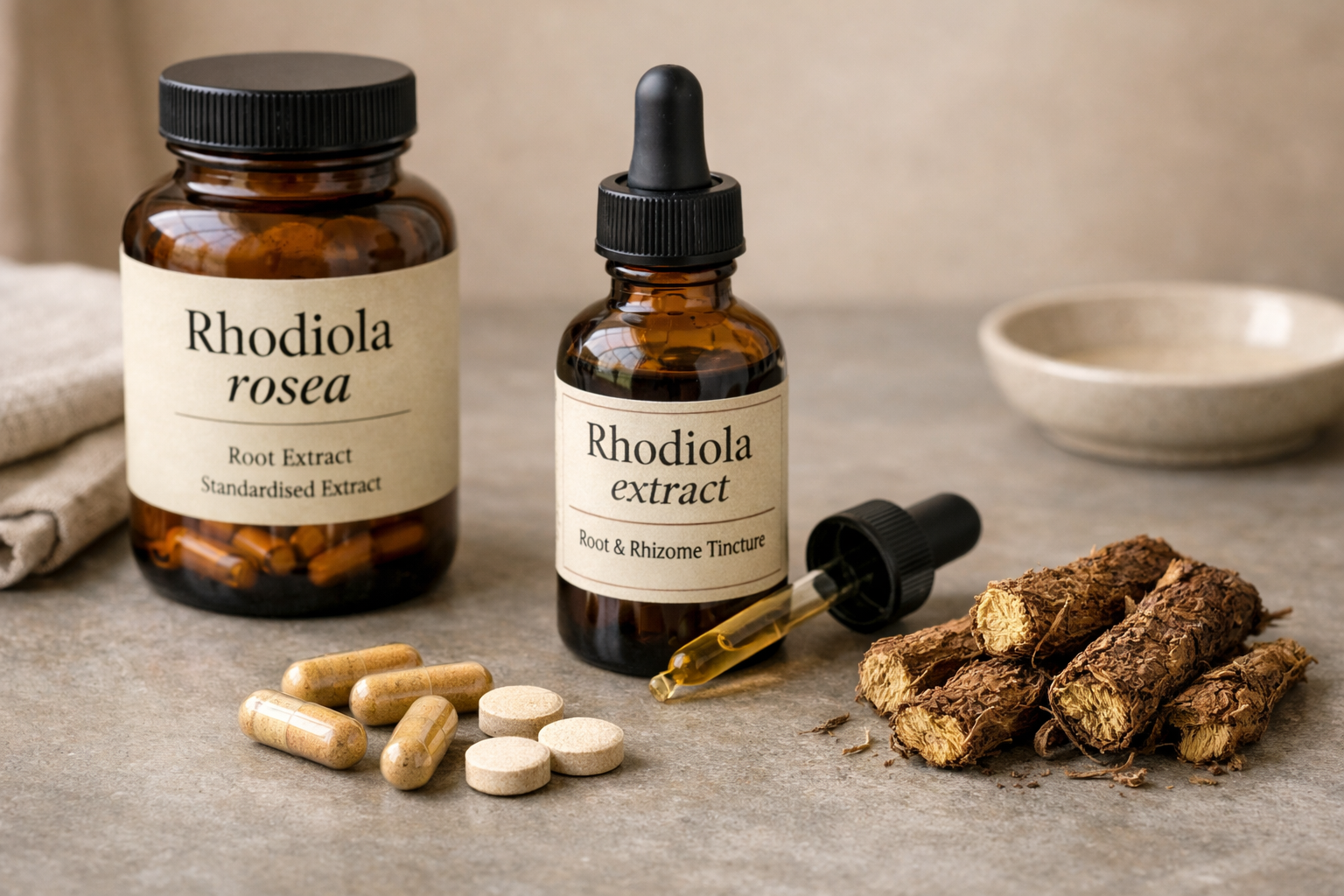
Rhodiola rosea is a botanical supplement made from the root and rhizome of a cold-climate plant. It is commonly sold as capsules, tablets, tinctures, and extracts, often standardized to rosavins and salidroside, and is mainly marketed for stress, fatigue, mood, mental performance, and exercise support.
Current evidence is promising but limited. Small human studies suggest possible short-term benefits for stress-related fatigue and some mild mood symptoms, but reviews repeatedly note mixed results, small trials, weak methods, and major product-quality differences. In practice, official positions remain cautious: the EU treats rhodiola mainly as a traditional herbal medicinal product, while U.S. guidance says its usefulness for health purposes is not yet reliably established.
Quick Facts
What is it useful for?
Mainly used for temporary stress-related fatigue. Possible benefits for mild mood symptoms or concentration remain limited and not firmly proven.
Supplement types
Dry extracts, non-standardized ethanolic extracts, tinctures, capsules, and tablets. Products may be standardized to rosavins and salidroside, but forms are not chemically interchangeable.
Interactions
Possible interactions involve medications more than supplements, especially antidepressants, some CYP2C9-metabolized drugs, losartan, hormone replacement therapy, and birth control medication.
Side effects
Short-term use is usually reasonably tolerated. Reported effects include insomnia, headache, dizziness, nausea, stomach upset, rash, itching, irritability, and altered salivation.
Other possible benefits
Possible additional benefits have been studied for mild mood symptoms, concentration, and some anaerobic exercise outcomes. Evidence remains preliminary.
Regulatory status
In the EU it is mainly recognized as a traditional herbal medicinal product for temporary stress symptoms. In the U.S. it is sold as a dietary supplement, and Canada permits supplement use but not food use.
What We Already Know About It
Adaptogenic framing. Rhodiola is usually described as an adaptogenic botanical made from the root and rhizome, but that concept is broader than what has been firmly proven in humans. Standardized extracts are commonly characterized by rosavins and salidroside, and the clearest human signal clusters around short-term stress-related fatigue rather than every advertised use. One randomized trial reported a reduced cortisol awakening response alongside improvements in fatigue and concentration, which is consistent with a stress-response effect, but direct human mechanistic proof remains limited. References: PubMed — Olsson 2009 stress-fatigue trial; Health Canada — Rhodiola rosea monograph.
Formulation matters. The supplied evidence does not establish a single confirmed biochemical pathway or the best-absorbed form. Instead, official monographs and market studies show that extract ratio, solvent system, and marker profile vary across products, and these differences affect practical dosing and comparability. Because commercial preparations are not chemically interchangeable, results seen with one standardized extract cannot simply be assumed for another bottle carrying the same herb name. This variability is one reason the overall evidence base remains moderate to preliminary rather than definitive. References: EMA — EU herbal monograph on Rhodiola rosea; PLOS ONE — 2026 U.S. product quality study; UCL/Phytomedicine — 2016 authenticity study.
Summary of Relevant Scientific Research
Public evidence benchmark — NCCIH
NCCIH states that there is not enough reliable evidence to determine whether rhodiola is useful for any health-related purpose, which makes it a conservative benchmark for interpreting smaller positive trials. Reference: NCCIH — Rhodiola.
Traditional use, not well-established medicine — EMA
The EMA concluded that rhodiola fits the traditional herbal medicinal product category for temporary relief of stress symptoms such as fatigue and exhaustion, but the clinical evidence was not strong enough for well-established medicinal use. References: EMA — EU herbal monograph on Rhodiola rosea; EMA — Assessment report on Rhodiola rosea.
Fatigue evidence remains mixed — BMC systematic review
A 2012 review of 11 clinical studies found the fatigue evidence insufficient and contradictory because many trials were small, poorly reported, or methodologically weak, although most reported adverse events were mild. Reference: BMC Complementary and Alternative Medicine — 2012 rhodiola review.
Stress-related fatigue trial — Olsson et al. 2009
In adults with stress-related fatigue, 576 mg per day of the standardized extract SHR-5 for 28 days improved anti-fatigue measures, concentration-related outcomes, and cortisol response, but the study was still relatively small and population-specific. Reference: PubMed — Olsson 2009 stress-fatigue trial.
Mood findings are suggestive, not equivalent to antidepressants — Depression studies
An open-label fatigue study reported improvements in mood and concentration, while a later review suggested possible benefit for mild-to-moderate depression and anxiety; however, a proof-of-concept trial found rhodiola less effective than sertraline. References: PubMed — 2017 open-label fatigue study; Global Psychiatry — 2020 mood and anxiety review; PubMed — Rhodiola vs sertraline trial.
Exercise effects are narrower than marketing claims — 2023 sports review
A 2023 systematic review of randomized trials found the better signal for anaerobic performance, not endurance performance, suggesting rhodiola may help only in specific training contexts rather than as a general sports enhancer. Reference: PubMed — 2023 sports performance review.
Beliefs, Myths & Unproven Claims
Myth: Rhodiola is proven for stress, mood, cognition, and performance all at once
The evidence does not support such a broad conclusion. Official U.S. guidance says usefulness for any health-related purpose is not yet reliably established, and reviews on fatigue and mood repeatedly describe the clinical literature as mixed, small, or methodologically weak. References: NCCIH — Rhodiola; BMC Complementary and Alternative Medicine — 2012 rhodiola review; Global Psychiatry — 2020 mood and anxiety review.
Myth: Rhodiola is basically a natural antidepressant
That claim overstates the evidence. In a proof-of-concept trial for major depressive disorder, rhodiola showed less antidepressant effect than sertraline, even though it caused fewer adverse events, so it should not be presented as equivalent to standard treatment. Reference: PubMed — Rhodiola vs sertraline trial.
Myth: It reliably boosts endurance
Current review evidence does not support a blanket endurance claim. The stronger signal in randomized trial data is for anaerobic performance, while endurance benefits remain unconfirmed and context-dependent. Reference: PubMed — 2023 sports performance review.
Myth: Any rhodiola product is the same and harmless because it is herbal
Quality studies found adulteration, missing expected markers, wide variation from label claims, and possible undisclosed synthetic salidroside in some products. Official sources also advise caution in pregnancy, breastfeeding, adolescence, bipolar-spectrum conditions, and when certain medicines are used. References: UCL/Phytomedicine — 2016 authenticity study; PLOS ONE — 2026 U.S. product quality study; Health Canada — Rhodiola rosea monograph.
Detailed Research Observations
Traditional use explains popularity, not proof
Rhodiola rosea has a long traditional history in Russia, Scandinavia, and other parts of Europe and Asia, where it has been used for endurance, work capacity, fatigue, mood, and adaptation to harsh environments. That background helps explain why it remains popular in modern supplement markets, but the supplied evidence repeatedly separates traditional use from modern proof of efficacy. European regulators reflect this distinction directly: they accept rhodiola in a traditional herbal framework while stopping short of saying the evidence supports well-established medicinal use. References: NCCIH — Rhodiola; BMC Complementary and Alternative Medicine — 2012 rhodiola review; EMA — Assessment report on Rhodiola rosea.
Products differ more than labels suggest
Commercial rhodiola supplements are usually made from the root and rhizome and sold as dry extracts, tinctures, capsules, or tablets. In practice, products may be standardized to rosavins and salidroside, but extract ratio, solvent system, and marker profile are not uniform. EMA focuses on dry ethanol extracts in solid oral forms, while Health Canada separately describes standardized dry extracts, non-standardized ethanolic dry extracts, and tinctures. Direct human bioavailability data are limited in the supplied material, so the safest conclusion is not that one form is best absorbed, but that formulation and standardization affect comparability and dose interpretation. References: EMA — EU herbal monograph on Rhodiola rosea; Health Canada — Rhodiola rosea monograph; PLOS ONE — 2026 U.S. product quality study.
Stress-related fatigue is the clearest clinical niche
The strongest human signal is not for general energy enhancement in everyone, but for selected adults with stress-related fatigue. The Olsson randomized placebo-controlled trial found benefits for fatigue and concentration, along with a reduced cortisol awakening response, after 576 mg per day of a standardized extract for 28 days. Even so, the broader fatigue literature does not fully confirm this result. A systematic review found the evidence insufficient and contradictory because many studies were small, poorly reported, or methodologically weak. The most balanced interpretation is that rhodiola shows a plausible short-term anti-fatigue effect in specific stressed populations, but still needs larger, better-controlled replication. References: PubMed — Olsson 2009 stress-fatigue trial; BMC Complementary and Alternative Medicine — 2012 rhodiola review.
Mood and cognition findings remain supportive but limited
Rhodiola is often marketed for mood, concentration, and mental performance, and there is some supportive evidence, but the supplied literature does not justify strong claims. An open-label 8-week study in people with prolonged or chronic fatigue symptoms reported improvements in fatigue, stress symptoms, mood, concentration, quality of life, and general health, yet the lack of placebo control means expectation effects and other biases could explain part of the benefit. A later systematic review concluded rhodiola may help mild-to-moderate depression, mild anxiety, and overall mood, but also emphasized the small number of trials and persistent methodological problems. The comparison trial against sertraline is especially useful because it showed rhodiola was not equivalent to standard antidepressant therapy. References: PubMed — 2017 open-label fatigue study; Global Psychiatry — 2020 mood and anxiety review; PubMed — Rhodiola vs sertraline trial.
Exercise claims should be narrower than marketing suggests
Public messaging often treats rhodiola as a broad sports-performance enhancer, but the stronger current interpretation is more conditional. A 2023 systematic review of randomized controlled trials concluded that chronic supplementation appears to help anaerobic exercise performance more than endurance performance. That means rhodiola should not be assumed to reliably improve long-duration stamina, and any exercise-related effect may depend on training context, extract type, and study design. The evidence base does not support universal claims that it is a dependable performance aid for all athletes. Reference: PubMed — 2023 sports performance review.
Quality and contamination are major real-world variables
One of the most important practical findings in the supplied evidence is that market quality does not always match label claims or research materials. The 2016 authenticity study found that a notable share of products labeled as Rhodiola rosea lacked expected rosavin markers or appeared adulterated with other Rhodiola species or unrelated material, and one mislabeled sample appeared to contain 5-HTP rather than authentic rhodiola. The 2026 PLOS ONE study of 10 U.S. products found wide variation in rosavin and salidroside content, notable divergence from advertised amounts, and one product with likely undisclosed synthetic salidroside. Trace arsenic, cobalt, and lead were detected in all tested capsule products, although pesticide limits were not exceeded. These findings help explain why results from clinical studies may not translate well to poorly made retail products. References: UCL/Phytomedicine — 2016 authenticity study; PLOS ONE — 2026 U.S. product quality study.
Regulation separates supplement use from food use
Rhodiola sits in different regulatory categories depending on jurisdiction and product format. In the European Union, it is mainly positioned as a traditional herbal medicinal product for temporary relief of stress symptoms such as fatigue and exhaustion, rather than as a well-established medicine. In the United States, it may appear in dietary supplements, but sellers cannot lawfully make drug-style disease claims, and FDA also states that rhodiola is not approved as a food additive in conventional foods. Canada draws the line especially clearly: it allows adult oral natural health product use under a monograph, while separately concluding that rhodiola root extract should not be used as a supplemental ingredient in foods. These distinctions show that a capsule supplement and a rhodiola-fortified food are not treated the same way by regulators. References: EMA — Assessment report on Rhodiola rosea; FDA — Import alert on Rhodiola rosea in conventional foods; Health Canada — Decision on Rhodiola rosea root extract in foods.
Regulatory Status (EU and US)
European Union
In the EU, rhodiola is mainly framed through the traditional herbal medicinal product pathway. The EMA monograph recognizes it for temporary relief of stress symptoms such as fatigue and exhaustion, but the assessment report states that the evidence was not strong enough for well-established medicinal use. References: EMA — EU herbal monograph on Rhodiola rosea; EMA — Assessment report on Rhodiola rosea.
United States
In the U.S., rhodiola can be sold in dietary supplements, but that does not mean FDA has approved it for efficacy. Sellers may not legally market rhodiola with disease-treatment claims, and FDA has challenged claims that a rhodiola product could reduce cancer risk or improve heart-related outcomes. FDA also states rhodiola is not approved as a food additive in conventional foods. References: FDA — Warning letter on rhodiola claims; FDA — Import alert on Rhodiola rosea in conventional foods.
Canada context
Canada allows oral rhodiola use under a Natural Health Product monograph for adults, but explicitly excludes foods and food-like dosage forms. Health Canada also concluded that available evidence was inadequate to support rhodiola root extract as a supplemental ingredient in foods. References: Health Canada — Rhodiola rosea monograph; Health Canada — Decision on Rhodiola rosea root extract in foods.
Dosage and Standardization
Adults: EMA lists 144–200 mg per dose, 1–2 times daily, for 144–400 mg/day. Health Canada allows standardized dry extracts up to 680 mg/day. Trials often used about 400–600 mg/day, but extract types are not interchangeable.
Safety And Interactions
Short-term adult use appears reasonably well tolerated, and NCCIH describes rhodiola as possibly safe for up to 12 weeks. Reported side effects include dizziness, headache, insomnia, altered salivation, nausea, abdominal pain, diarrhoea, rash, and itching. Most adverse events reported in trials and reviews were mild, but long-term safety remains limited. References: NCCIH — Rhodiola; EMA — EU herbal monograph on Rhodiola rosea; BMC Complementary and Alternative Medicine — 2012 rhodiola review.
Pregnancy and breastfeeding safety are not established, and EMA does not recommend use in these groups or below age 18 because data are insufficient. Health Canada also advises against use in bipolar disorder or bipolar spectrum disorder and recommends stopping use if irritability or insomnia occurs. References: EMA — EU herbal monograph on Rhodiola rosea; Health Canada — Rhodiola rosea monograph.
Interaction risk is plausible and deserves medication review. The supplied sources mention a losartan interaction case, caution with antidepressants, hormone replacement therapy, and birth control medication, and a human study suggesting reduced CYP2C9 activity with a commercial rhodiola product. The clinical importance of routine interactions is still uncertain, but people using prescription medicines should treat rhodiola as an active supplement rather than a neutral wellness herb. References: NCCIH — Rhodiola; Health Canada — Rhodiola rosea monograph; PubMed — CYP2C9 interaction study.
Conclusion
Rhodiola rosea is a promising but not fully proven botanical. The strongest human signal is for short-term stress-related fatigue, with some possible support for mild mood symptoms and limited, context-specific exercise benefits.
Overall, the evidence remains preliminary to moderate for selected short-term uses and limited for broader claims. Product quality is a major real-world issue, and current regulatory positions are more cautious than many supplement labels suggest. Better standardized trials and longer safety follow-up are still needed.
Disclaimer
Disclaimer: We attempt to do our best to find relevant, accurate and most up to date information available in both, the public domain and in the clinical and medical research community. We recommend reviewing scientific sources for official information on the subject. This post is not intended as medical advice. Each individual person's health conditions vary and we advise to consult a doctor before taking any supplements.