

 Deutsch
 Español
 Suomi
Suomi Français
 Bahasa Indonesia
 Italiano
 日本語
日本語 Português
 Tagalog

1. What is alpha-lipoic acid?
Alpha-lipoic acid is a sulfur-containing compound that the body makes in small amounts. It is also sold as a dietary supplement. Its main scientific claim to fame is redox activity, which means it can take part in electron-transfer reactions involved in oxidative stress.
In supplement marketing, ALA is often called a “universal antioxidant” because it works in both water- and fat-rich parts of cells and can help recycle other antioxidant systems. That is a reasonable starting point, but skin aging is not simply an antioxidant shortage. UV light, pollution, inflammation, glycation, collagen breakdown, pigment signaling, barrier changes, and ordinary aging all interact.
So the useful question is not whether ALA can affect skin biology. In controlled models, it can. The real question is whether topical or oral ALA leads to visible, reliable improvements in human skin.
2. How it works in skin
ALA has several plausible ways into the skin-health conversation.
UV radiation and pollution can raise levels of reactive oxygen species — unstable molecules that can damage lipids, proteins, and DNA. In theory, a redox-active compound such as ALA could reduce some of that oxidative burden. ALA may also affect inflammatory signaling, which is relevant because ongoing low-grade inflammation can contribute to barrier disruption, redness, and slower tissue repair.
Laboratory studies add more detail. In human dermal fibroblasts, ALA increased type I collagen expression and collagen deposition through a TGF-beta-Smad pathway. In a skin-on-a-chip model, ALA increased epidermal structural proteins such as filaggrin, involucrin, keratin 10, and collagen IV. In a reconstructed UVB-exposed skin model, ALA reduced melanin production without harming cell viability.
Those findings help explain why cosmetic formulators are interested in ALA. They do not prove that a capsule or face cream will smooth wrinkles, fade pigmentation, or rebuild sun-damaged collagen in everyday use.
3. What the evidence says
The human evidence is much thinner than the marketing around ALA often implies.
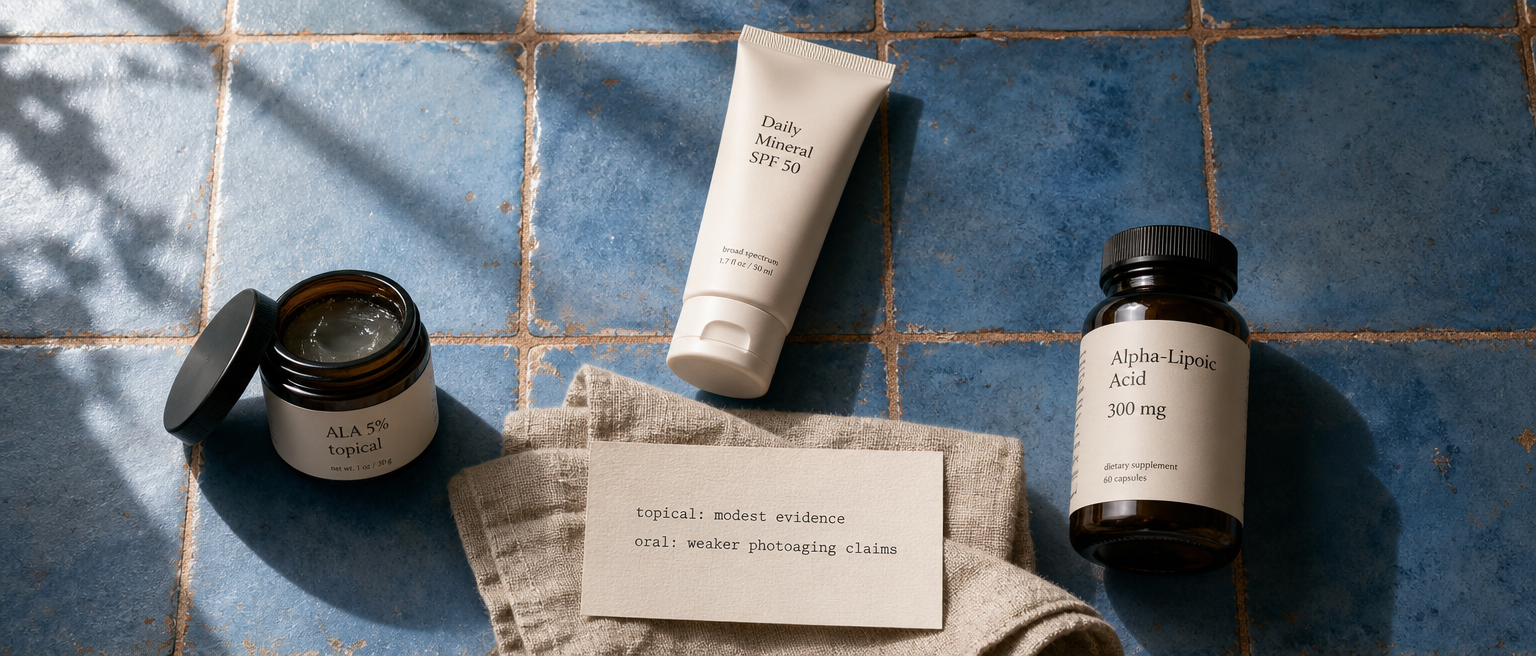
 Topical signal: Small 5% ALA split-face trials suggest modest cosmetic improvement.
 Photoprotection doubts: One study found topical ALA ineffective as a UV antioxidant shield.
 Mixed models: Lab effects vary by dose, exposure, and formulation.
- A 2003 split-face trial tested a 5% ALA cream in 33 women with photoaged facial skin. After 12 weeks, self-ratings, clinician ratings, photography, and laser profilometry favored the ALA side. The objective roughness measure improved by 50.8% on the ALA side versus 40.7% on the vehicle side. That is a signal, but both sides improved a lot, so the added value of ALA may have been modest.
- A 2016 study tested a 5% cubosomal ALA gel in 20 women for six months. The ALA-treated side scored better on a global aesthetic scale and showed a greater increase in epidermal thickness. This suggests delivery system and penetration may be important, but it is still a small study with formulation-specific results.
- A study in the Journal of Investigative Dermatology reached a directly cautionary conclusion: topical ALA was ineffective as a photoprotective antioxidant for skin. That weakens claims that ALA acts like an antioxidant shield against UV damage.
Preclinical findings are mixed too. Some cell and skin-model studies suggest possible benefits for collagen, epidermal structure, or pigmentation. Others are less encouraging. In UVA-irradiated human fibroblasts, ALA did not improve viability, collagen synthesis, or collagen degradation over 48 hours. In UVB-exposed fibroblasts, one concentration helped preserve collagen deposition, but higher concentrations did not, and collagen degradation was not prevented.
Taken together, the evidence points to a real but delicate idea: ALA may affect skin pathways under certain conditions, doses, and formulations. It is not yet a proven broad-spectrum anti-photoaging ingredient.
Trial details and safety sources are listed in the References section below.
4. Oral versus topical use
Topical ALA has the stronger cosmetic case because the few direct skin-aging trials used topical 5% formulas. Even there, the evidence is early. Results may depend on the base cream, gel structure, penetration enhancers, packaging, and stability.
Oral ALA is a different story. Human pharmacokinetic research shows that ALA is absorbed, but absolute bioavailability is limited, partly because the liver extracts and metabolizes much of it. In one study using 600 mg daily, no accumulation was seen over four days. That does not rule out systemic effects, but it helps explain why swallowing ALA may not deliver large, sustained amounts of free ALA to the skin.
There are oral studies in skin-related medical settings, but they do not prove beauty benefits. In vitiligo, an antioxidant pool containing ALA, vitamins C and E, and polyunsaturated fatty acids improved some outcomes alongside narrow-band UVB treatment. Because this was a multi-ingredient therapy in a pigment disorder, it cannot show what ALA alone does for wrinkles or everyday sun damage.
A newer trial in breast cancer radiotherapy found that oral ALA reduced signs of radiation-induced dermatitis and lowered IL-6, an inflammatory marker. That is a meaningful signal for acute inflammatory skin injury. It should not be stretched into proof that ALA supplements reverse photoaging in healthy adults.
A 2025 systematic review of oral skin health supplements for photoaging found stronger randomized evidence for ingredients such as collagen, flavanols, and some polyphenols. ALA did not appear to have built a comparable healthy-skin photoaging trial base.
5. Practical considerations
For someone curious about ALA for skin, the evidence points more toward topical experimentation than oral supplementation.
A topical product using around 5% ALA is closest to the small human trials. Even then, expectations should stay modest: possible improvement in roughness or overall appearance, not dramatic wrinkle reversal or sunscreen-like protection. Formula quality also counts. ALA can be vulnerable to light-related instability, which is awkward for an ingredient promoted for sun-related oxidative stress. Packaging, pH, delivery system, and freshness may all affect whether the product performs as intended.
ALA should not replace sunscreen, protective clothing, retinoids, vitamin C, niacinamide, other topical antioxidants, or other skin-care tools with a broader evidence base. If used, it is best viewed as a secondary ingredient rather than the centerpiece of a photoaging routine.
For oral ALA, there is no established cosmetic dose for skin aging. Supplement doses commonly fall around 100 to 600 mg once or twice daily, but those doses come mostly from general supplement use and metabolic research, not skin-photoaging trials.
If you are comparing supplement labels, ALA form differences can complicate oral claims, but they do not create direct evidence for skin photoaging.
6. Safety
ALA is generally well tolerated at typical supplement doses, but it is not risk-free. Oral side effects can include nausea, heartburn, abdominal discomfort, constipation or diarrhea, headache, dizziness, and vomiting. It may also interact with medications, especially for people managing blood sugar.
Topical ALA can irritate or sensitize skin. Contact dermatitis has been reported from an anti-wrinkle cream containing ALA, and delayed hypersensitivity has also been reported with an ALA supplement. These reactions appear uncommon, but facial skin is sensitive, and irritation can worsen redness, dryness, or pigmentation in reactive skin.
People who are pregnant, breastfeeding, taking diabetes medication, undergoing cancer treatment, or managing a chronic condition should check with a clinician before using oral ALA. Anyone trying topical ALA should patch test first and avoid applying it to broken or inflamed skin.