

 Deutsch
 Español
 Suomi
Suomi Français
 Bahasa Indonesia
 Italiano
 日本語
日本語 Português
 Tagalog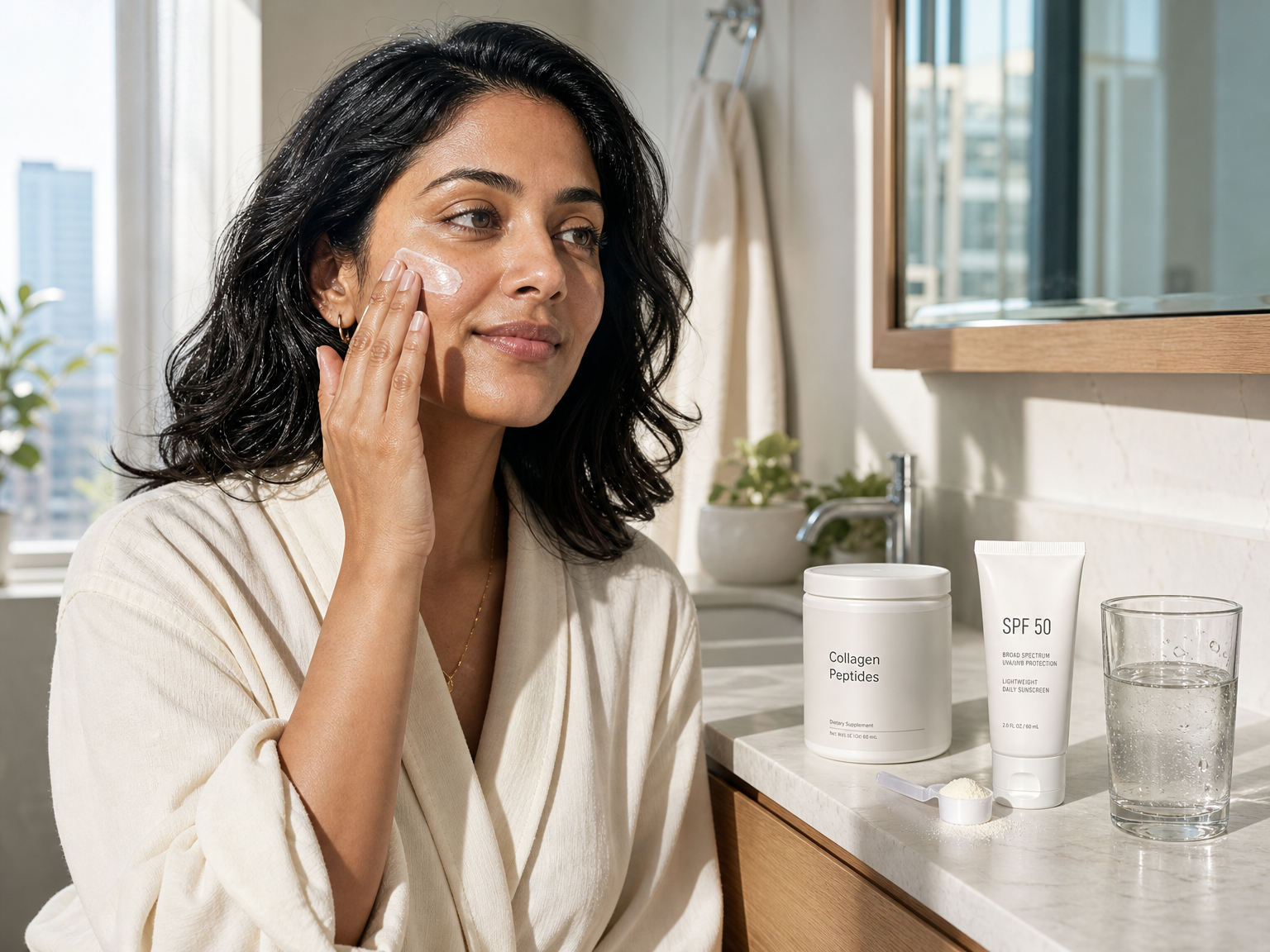

1. What photoaging does to skin
Photoaging is the visible and structural damage that builds up after years of ultraviolet light exposure. It is not the same as ordinary chronological aging, although the two often overlap.
UV light can set off inflammation, oxidative stress, pigment changes, and changes in the skin’s connective tissue. One important pathway involves matrix metalloproteinases, often shortened to MMPs. These are enzymes that break down collagen and other parts of the skin’s support structure. In chronically sun-damaged human skin, researchers have found lower total collagen and reduced markers of new collagen formation compared with less exposed skin.
That is the problem collagen supplements are marketed toward. Sun-damaged skin has often lost some of its organised collagen network. The harder question is whether eating collagen peptides can meaningfully rebuild that network in living human skin.
2. What collagen peptides are
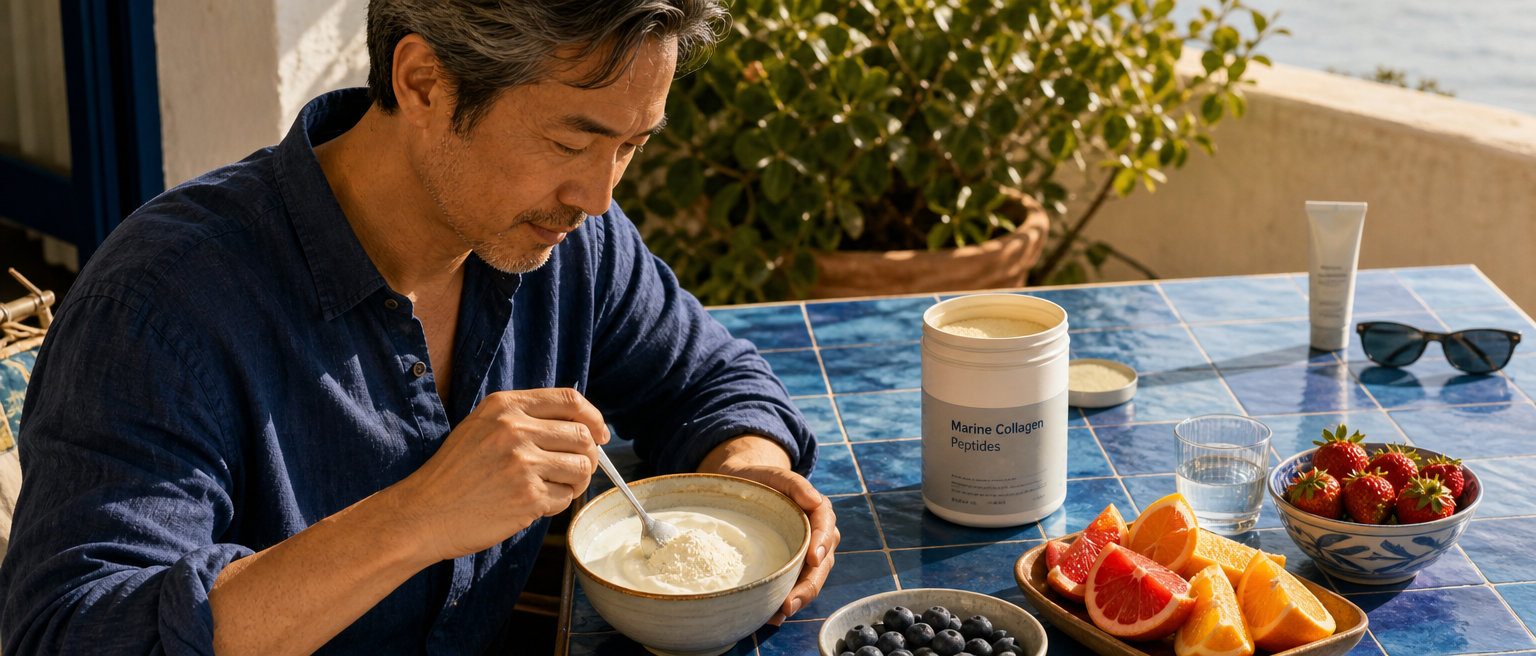
Collagen peptides are collagen proteins that have been broken into smaller pieces, usually described as hydrolyzed collagen or low-molecular-weight collagen peptides. They may come from bovine, porcine, chicken, or marine sources.
After digestion, collagen does not travel intact to the face and “fill in” wrinkles. It is broken down into amino acids and small peptides. Some hydroxyproline-containing peptides can be detected in the blood after ingestion, and small studies suggest they may reach skin tissue. Mechanistic work also suggests collagen peptides may influence fibroblasts, the skin cells that make collagen and other matrix proteins.
In cell studies, collagen hydrolysate has increased procollagen I and collagen I content while reducing activity of MMP-1 and MMP-2. In UVB-exposed mice, oral collagen peptide has helped reduce skin dehydration and appeared to affect hyaluronic acid-related pathways. These findings make the idea biologically plausible, but they do not prove that a supplement repairs years of human sun damage.
3. What the human evidence says
The clearest answer comes from looking across trials, rather than leaning on any single study.
A 2025 systematic review and meta-analysis looked at dietary supplements for skin photoaging in healthy adults. It included 40 randomized controlled trials with 2,119 participants. For collagen, 14 studies were reviewed and 8 were included in a collagen-specific meta-analysis. Collagen improved one measure of skin elasticity, known as R2, compared with placebo. But only flavanols clearly increased minimal erythema dose — a measure related to how much UV exposure triggers redness. Collagen was not shown to meaningfully improve UV tolerance.
Several individual trials in photoaged or dry skin are encouraging. In a 12-week trial of 100 adults with photoaged and dry facial skin, low-molecular-weight collagen peptides improved crow’s-feet photo scale score, wrinkle volume, roughness, elasticity, hydration, and transepidermal water loss compared with placebo. Another 12-week trial in 64 women aged 40 to 60 with photoaged skin found that 1,000 mg per day improved hydration, elasticity, and wrinkling. A shorter four-week trial reported improved elasticity, especially in sun-exposed areas.
Even so, the literature is not straightforward. A newer systematic review and meta-analysis of 23 randomized trials found that apparent benefits for hydration, elasticity, and wrinkles disappeared when the analysis was restricted to studies without pharmaceutical-company funding. That does not prove collagen never works. It does mean the overall evidence is vulnerable to sponsorship bias, small-study effects, and selective optimism.
One reality-check trial is also worth noting. In postmenopausal women with stage I dermatoporosis, a condition involving fragile, aged skin, oral hydrolyzed collagen at 5 g/day and topical hydrolyzed collagen for six months did not improve forearm skin clinically, histologically, biophysically, or in quality of life. Dermatoporosis is not identical to photoaging, but it is a useful warning against treating collagen as a dependable repair therapy for damaged skin.
In short, the human evidence points more toward skin-quality changes than true sun-damage repair:
 Hydration and texture: These are the most believable benefits.
 Elasticity and fine lines: Measures may improve modestly in some people.
 UV repair: DNA repair and solar elastosis reversal have not been convincingly shown.
4. Realistic benefits versus exaggerated claims
A realistic claim would be: “Collagen peptides may modestly improve hydration, elasticity, and fine wrinkle appearance after 8 to 12 weeks.”
An exaggerated claim would be: “Collagen repairs sun damage” or “collagen reverses UV aging.” Those statements go beyond the evidence.
Regulatory guidance helps draw the line. For claims about protection from UV-induced skin damage, EFSA notes that direct measures such as oxidative damage in skin or reduction in UV-induced DNA damage are needed; skin redness alone is not enough. Most collagen trials do not measure those outcomes. They measure how skin looks or behaves at the surface: hydration, elasticity, wrinkles, roughness, and water loss.
That difference is important. Better hydration can make skin look smoother. Improved elasticity readings can suggest better skin function. Reduced transepidermal water loss may point to a stronger barrier. None of those findings automatically means accumulated UV mutations, deep collagen fragmentation, or solar elastosis have been repaired.
5. Practical considerations
Most oral collagen products studied are hydrolyzed collagen or low-molecular-weight collagen peptides. Common study doses range from about 1 to 10 g per day, with many studies using 2.5 to 5 g per day. Some photoaged-skin trials used 1 g per day of low-molecular-weight peptides. Trial lengths are usually 4 to 12 weeks, with some extending longer.
If someone chooses to try collagen, a fair self-test is 8 to 12 weeks. Look for subtle changes: less dryness, slightly smoother texture, or small changes in fine lines. If there is no noticeable change after that, continuing indefinitely may not be worthwhile.
Collagen should sit below proven photoaging measures. Daily broad-spectrum sunscreen, shade, hats, and avoiding tanning are still the first line. Prescription retinoids, pigment-directed treatments, resurfacing procedures, and evaluation of actinic keratoses or suspicious lesions belong with a dermatologist.
If you are comparing oral options, separate collagen from supplement categories studied for UV stress, such as carotenoids, astaxanthin, or Polypodium leucotomos. Basic nutrition still matters too; vitamin C is part of normal collagen formation.
Topical collagen is a separate issue. Collagen is a large protein, and consumer medical sources note that it is not absorbed through skin in a way that rebuilds dermal collagen. Topical products may moisturize or create a temporary smoothing feel, but that is different from structural repair.
6. Safety
Short-term collagen peptide use appears generally well tolerated in trials up to about 24 weeks. Reported issues are usually mild and can include digestive discomfort, fullness, or aftertaste.
The more practical safety questions are product source and quality. Marine collagen may be an issue for people with fish or shellfish allergy, while bovine or porcine products may not suit some allergy, dietary, or religious needs. Supplements are not approved by the FDA for safety and effectiveness before marketing, and quality can vary between brands. Contamination and misleading labelling are general supplement concerns.
People who are pregnant, managing chronic disease, highly allergic, taking multiple supplements, or using medications should check with a healthcare professional before adding collagen.