

 Deutsch
 Español
 Suomi
Suomi Français
 Bahasa Indonesia
 Italiano
 日本語
日本語 Português
 Tagalog

1. What oral hyaluronic acid is
Hyaluronic acid is a water-binding molecule that occurs naturally in the skin, joints, eyes, and connective tissue. In skin, it helps keep the outer layers hydrated and supports the plump, flexible look people associate with well-moisturized skin.
Most people know topical hyaluronic acid from serums and creams. Oral hyaluronic acid is different: it is swallowed as a capsule, tablet, powder, or drink, often as hyaluronic acid or sodium hyaluronate. The key question is whether enough of it, or enough of its smaller breakdown products, can reach the body in a way that changes the skin from within.
Animal absorption studies suggest that this is possible. Research in rats found that orally administered hyaluronic acid can be broken down by gut bacteria into smaller pieces, absorbed in the large intestine, and distributed to tissues including skin. Another rat study found that smaller molecular weights may be absorbed more readily and detected in blood and lymph. These studies do not prove skin benefits in people, but they do make the idea more biologically credible.
2. How sun exposure changes hyaluronic acid in skin
Sunlight, especially ultraviolet B radiation, can disturb the skin’s own hyaluronic acid system. Acute UV exposure does not simply lower hyaluronic acid everywhere. A human and cell study found a more complicated pattern: after UVB exposure, hyaluronic acid increased in the epidermis, the outer layer of skin, but decreased in the dermis, the deeper layer that gives skin much of its structure.
Chronic UV exposure appears more damaging. In a mouse study, repeated UVB exposure caused a marked loss of dermal hyaluronic acid and reduced the activity of hyaluronic-acid synthases, the enzymes that help skin make hyaluronic acid. That offers a reasonable explanation for why sun-damaged skin often looks dry, crepey, and less resilient.
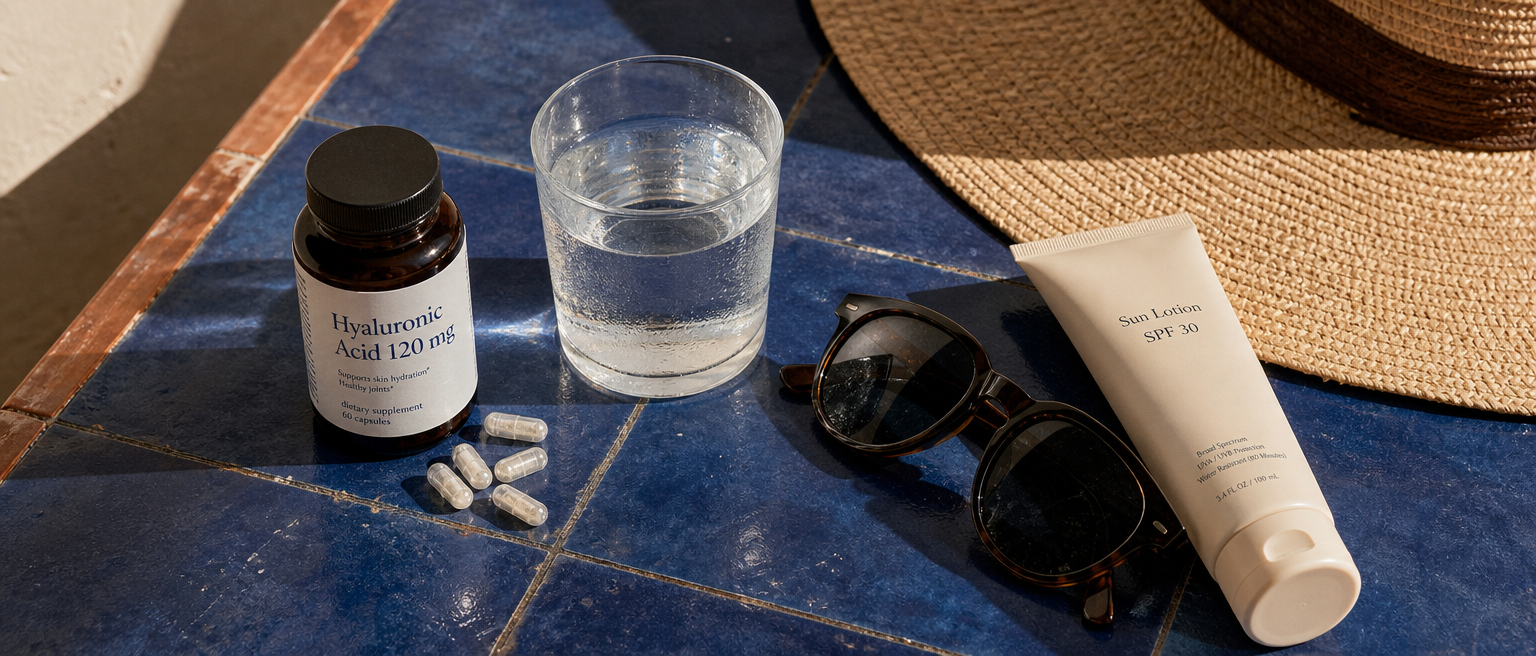
This biology is the main reason oral hyaluronic acid is interesting for sun-exposed skin. If UV exposure disrupts hyaluronic acid metabolism, then improving hydration or influencing hyaluronic acid turnover could, in theory, help skin cope better. But a plausible theory is not the same as proof in humans.
3. What the human evidence says
The strongest human evidence is not sun-specific. A 2025 meta-analysis pooled seven randomized placebo-controlled trials of oral hyaluronic acid for skin outcomes. It found statistically significant improvements in general skin hydration, elasticity, and wrinkle depth. Effects on firmness, wrinkle volume, and transepidermal water loss were directionally favorable but not statistically significant. Transepidermal water loss means water escaping through the skin barrier; lower values generally suggest better barrier function.
Several individual trials point in the same direction:
- In a 2025 trial of 150 healthy adults, 120 mg per day of high-molecular-weight sodium hyaluronate for 12 weeks improved facial hydration and elasticity, reduced transepidermal water loss, and improved periorbital wrinkle depth. It did not meaningfully change red areas or color measures, which weakens claims about post-UV redness recovery.
- In a 2021 trial, 120 mg per day for 12 weeks improved wrinkle assessment, water content in the stratum corneum, transepidermal water loss, and elasticity in adults aged 35 to 64.
- In a 2017 trial in Japanese adults with crow’s-feet wrinkles, oral hyaluronan improved wrinkle volume and area over 12 weeks. Crow’s feet are common in sun-exposed facial skin, so this is relevant to photoaging appearance, but the study did not test UV injury or sun-damage reversal.
- In a 2014 study of people with dry skin, 120 mg per day for 6 weeks improved skin moisture, with some benefit persisting briefly after stopping.
 Hydration: Human trials show modest improvements over 6–12 weeks.
 Wrinkles: Fine-line measures may improve, but effects are not dramatic.
 UV claims: Human sun-exposure evidence is still limited.
Taken together, these studies suggest that oral hyaluronic acid can improve hydration and may soften some visible aging-related signs. That is useful because sun-damaged skin often overlaps with dryness, fine lines, and barrier discomfort. Still, the trials largely enrolled people with general dryness or aging signs, not people selected for measured photodamage.
Sources: Journal of Drugs in Dermatology meta-analysis; Scientific Reports trial; Nutrients trial; Clinical, Cosmetic and Investigational Dermatology trial; Journal of Clinical Biochemistry and Nutrition trial.
4. What UV-specific research adds
The most directly relevant UV research comes from animal studies. In UV-irradiated hairless mice, repeated oral hyaluronic acid reduced UV-related skin dryness and epidermal thickening. Lower-molecular-weight hyaluronic acid had stronger effects and increased HAS2 expression, one of the skin’s hyaluronic-acid-making signals.
Another mouse study found that oral hyaluronic acid given before and during UVB exposure improved wrinkle appearance and favorably changed collagen, MMP-1, IL-1β, and IL-6. In plain English, that suggests possible effects on collagen breakdown and inflammation in a UVB photoaging model.
These findings are encouraging, but they are not enough to say oral hyaluronic acid prepares human skin for the sun. Mouse UVB models are controlled and intense; real-world sunlight exposure varies by season, skin tone, sunscreen use, geography, and behavior. Animal studies can also detect tissue changes that may not translate into visible or meaningful outcomes in people.
There are also newer studies of mixed oral ingredients that contain hyaluronic acid. One 2025 trial of a hyaluronic acid matrix ingredient with sulfated glycosaminoglycans and collagen reported improvements in hydration, brightness, smoothness, roughness, wrinkles, and a reduced erythema index. Erythema means redness. This is interesting for environmental stress, but because the product was not pure hyaluronic acid, the result cannot be credited to hyaluronic acid alone.
More broadly, research on supplements for UV damage is best understood as supportive, not as a substitute for sunscreen or protective habits.
5. Practical considerations
Most human skin trials used around 60 to 120 mg per day, often for 6 to 12 weeks. Some safety summaries discuss 100 to 200 mg per day as tolerable in human studies, and proposed food-use intake around 250 mg per day. That does not mean higher is better, and it does not create an official upper limit for supplements.
If you choose to try oral hyaluronic acid, a practical trial would be 8 to 12 weeks at a dose similar to those used in human studies, while keeping expectations modest. Look for changes in dryness, comfort, and fine lines rather than dramatic repair of sun spots, deep wrinkles, or leathery texture. If actinic damage is a concern, dermatologist-led care matters more than hydration supplements.
Product details may also influence results. Studies vary by molecular weight, source, and formulation. Some products combine hyaluronic acid with collagen, vitamin C, glycosaminoglycans, or plant extracts, which makes it harder to know which ingredient is doing what.
6. Safety
Short-term oral hyaluronic acid appears generally well tolerated in the available studies. The FDA GRAS notice for sodium hyaluronate summarizes toxicology and human tolerability data, but it is not proof that a supplement improves skin, and it notes limited chronic data beyond 90 days.
People who are pregnant, breastfeeding, taking multiple medicines, managing chronic illness, or buying supplements for children should be more cautious. Dietary supplements are regulated differently from medicines and are not preapproved for effectiveness. Product quality also varies; an FDA warning about some hyaluronic-acid-labeled products containing undeclared ingredients reinforces the need to buy from reputable brands with independent testing.