

 Deutsch
 Español
 Suomi
Suomi Français
 Bahasa Indonesia
 Italiano
 日本語
日本語 Português
 Tagalog

1. What counts as intermittent fasting?
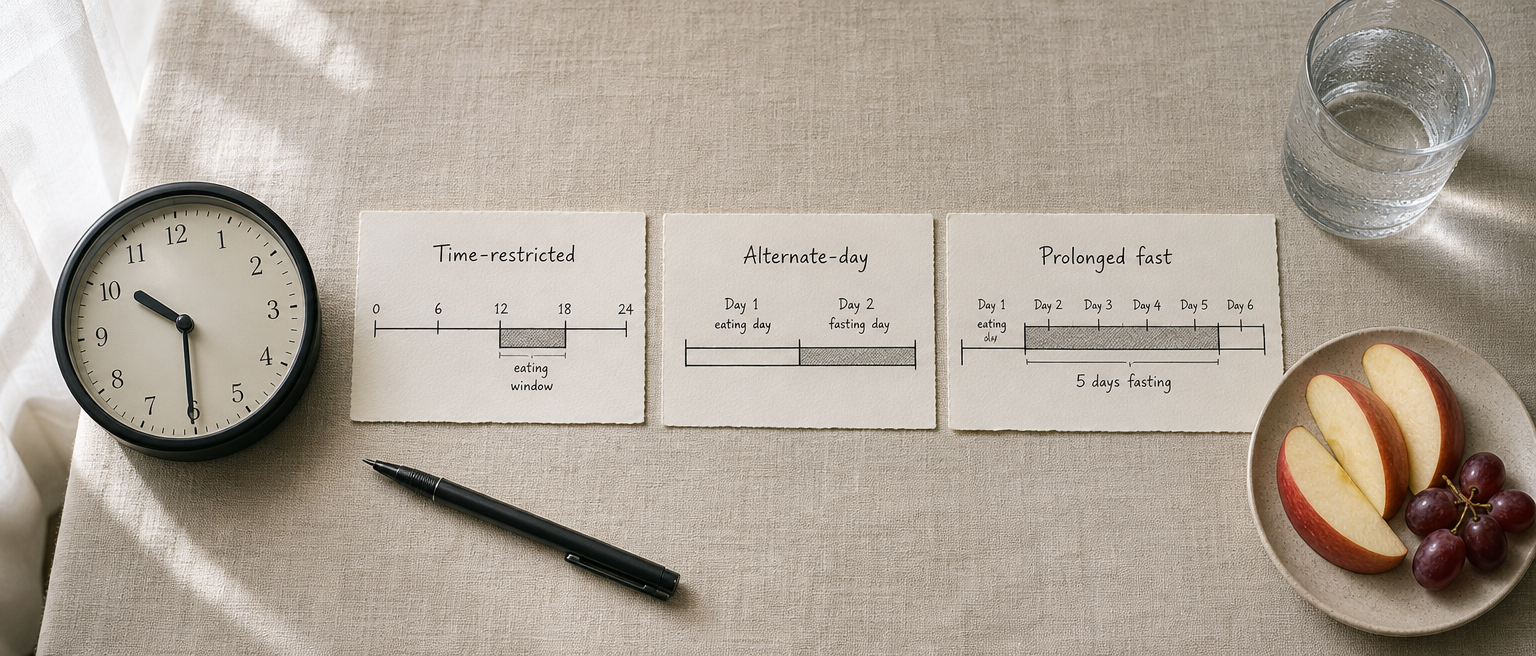
“Intermittent fasting” is often used as a broad label, so the details are important. A 2024 international consensus describes intermittent fasting as repeated fasting periods lasting up to 48 hours. Time-restricted eating is one common version: you eat during a set part of the day and fast for the rest. Many people use a 6- to 10-hour eating window, or fast for up to about 16 hours overnight.
That is very different from prolonged fasting. The same consensus defines prolonged fasting as at least 4 consecutive days without normal food intake. A 14:10 or 16:8 schedule is not the same exposure as a 5-day water fast or a “cleanse” that severely restricts calories.
2. What the evidence says about safety
In lower-risk adults with overweight or obesity, short-term intermittent fasting does not appear clearly more dangerous than other diet approaches. A Cochrane review of 22 studies involving 1,995 adults found that intermittent fasting may make little to no difference to weight loss or quality of life compared with traditional dietary advice. The review also found that evidence on adverse events was very uncertain.
A 2024 meta-analysis of 15 randomized trials and 1,365 adults found no significant increase in fatigue, headache or dropout compared with control diets. Dizziness was numerically higher in one subgroup using non-early time-restricted eating, but the result was not a simple “fasting is dangerous” finding.
The big caveat is that these studies mostly included selected adults, often with overweight or obesity, and usually followed people for months rather than years. Frail older adults, people with complex medical conditions, pregnant people, adolescents and people with eating-disorder histories are often not well represented in trials.
 Tolerability: Ordinary, supervised fasting appears tolerable for many lower-risk adults short term.
 Harms: Evidence on side effects is weaker than evidence on weight outcomes.
 Risk: Longer, stricter fasting raises concern, especially with illness or medication.
Sources: 2024 international consensus; Cochrane review; 2024 Nutrition Journal meta-analysis.
3. Common side effects
The most common side effects are not usually dramatic, but they can still feel unpleasant. People may feel hungry, tired, light-headed, headachy, constipated or irritable, especially in the first days or weeks. Some report mood changes or trouble concentrating. Others find that skipping breakfast leads them to overeat later.
Dizziness and headaches can be linked to eating less, changing caffeine habits, dehydration, low blood sugar, or shifts in salt intake. Constipation may happen when a shorter eating window makes it harder to get enough fiber, fluid and regular meals.
Menstrual-cycle changes are sometimes reported clinically. Current trial evidence does not show a consistent pattern of major reproductive hormone disruption in all women, but the research is still small and mixed. Missed periods, irregular cycles, worsening fatigue or feeling cold and run-down are signs to stop and seek advice, especially if fasting has led to a large calorie deficit.
4. Bigger risks with aggressive or prolonged fasting
Multi-day fasting has a different risk profile. Official safety guidance warns that fasting can cause headaches, fainting, weakness and dehydration, and that severe food restriction may not provide enough nutrients. Going without food for days can also lead to dangerous electrolyte shifts.
A review of prolonged water fasting found common adverse effects including hunger, headaches, nausea, vomiting, dry mouth, fatigue, insomnia and dizziness. In some studies, sodium and chloride fell just below acceptable limits after 8 to 10 days. Limited body-composition data suggested that a large share of weight lost during 8- to 10-day water fasts may be lean mass, raising concern about muscle loss. More serious problems, including metabolic acidosis and abnormal liver tests, have also been described.
Extreme case reports do not prove what will happen to everyone, but they show what can go wrong when fasting is taken too far. One report of a 44-day water-only fast found major body-mass loss, a large fat-free-mass component and biochemical signs of thiamine, riboflavin and vitamin K deficiency.
5. Who should avoid fasting or get medical supervision?
Some people should not treat fasting as a casual wellness experiment.
Pregnancy and breastfeeding are times of high nutrient demand. Ramadan-style fasting studies in pregnancy have not shown a clear effect on birthweight overall, but researchers stress that this is not proof of safety. Intentional weight-loss fasting during pregnancy or breastfeeding should not be started without obstetric or medical guidance.
Children and adolescents are still growing. Pediatric experts generally advise against restrictive dieting during this stage, and observational studies link intermittent fasting in adolescents and young adults with more eating-disorder behaviors and distress. Anyone with a current or past eating disorder, binge-restrict cycle, compulsive tracking, or fear of eating outside a rule-based window should avoid fasting unless a specialist explicitly recommends it.
Diabetes needs particular caution. Fasting can increase the risk of hypoglycemia, especially for people using insulin, sulfonylureas or other insulin secretagogues. In one trial of adults with type 2 diabetes, 2 low-calorie fasting days per week increased hypoglycemia risk despite medication reduction. SGLT2 inhibitors may also raise concern for ketoacidosis when combined with prolonged fasting, dehydration or illness. Medication timing and dosing should be adjusted before fasting, not after a low-blood-sugar episode.
Frail, underweight or sarcopenic people should be cautious because they have less reserve to tolerate muscle loss, dizziness or missed nutrition. Older adults are often excluded from trials, and the National Institute on Aging notes that there is not enough evidence to recommend fasting regimens to the public, especially while older-adult safety remains uncertain.
People undergoing active cancer treatment should not fast on their own. Reviews of fasting during chemotherapy find few small studies and no clear proof of benefit for side effects or quality of life. Because unintentional weight loss can worsen cancer outcomes, fasting during active treatment belongs under oncology supervision or in a clinical trial.
6. Practical considerations
If a lower-risk adult wants to try fasting, the gentlest starting point is usually a consistent overnight fast rather than multi-day restriction. A 12:12 or 14:10 pattern is less extreme than alternate-day fasting or long water fasts. Eating enough protein, fiber-rich foods, fluids and electrolytes during the eating window is more important than making the window as small as possible.
Stop fasting and seek advice if you faint, have repeated dizziness, confusion, heart palpitations, severe weakness, vomiting, signs of dehydration, missed periods, binge eating, or obsessive anxiety around food timing.