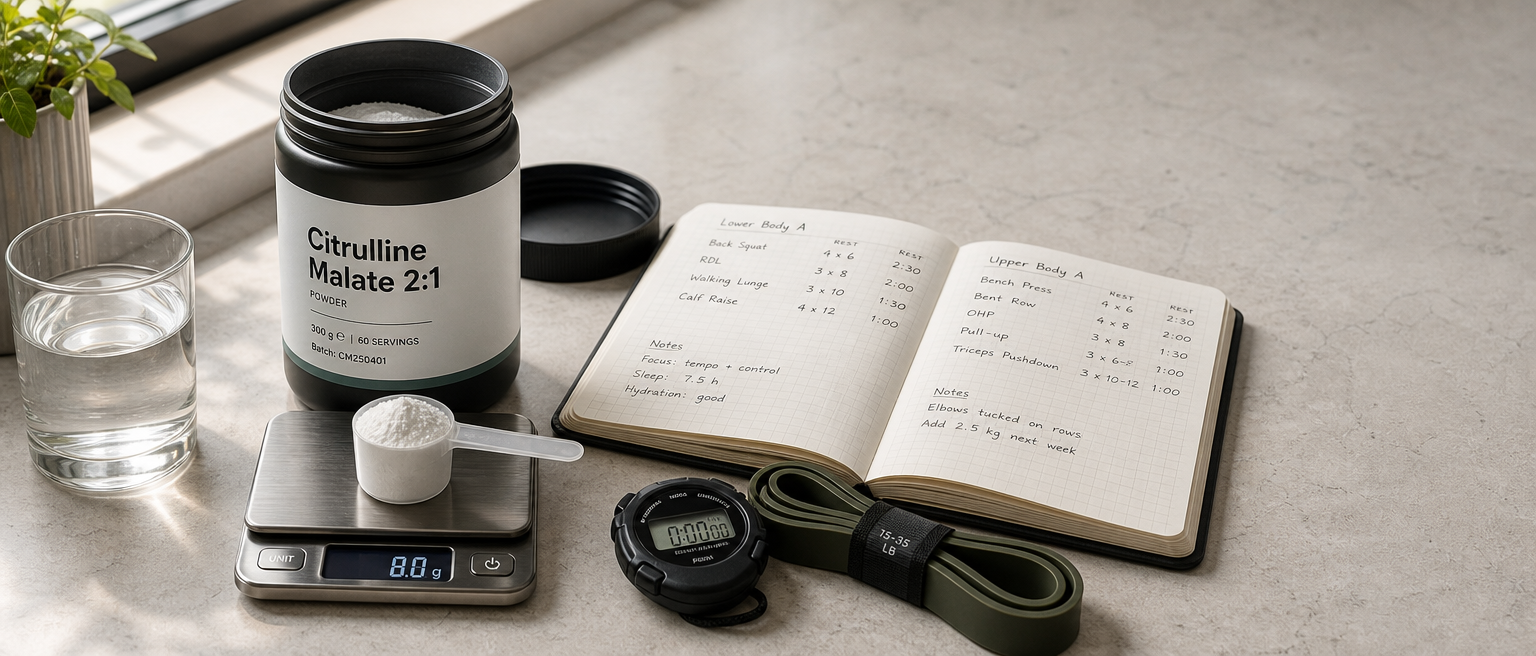
Citrulline malate is sold as a shortcut to bigger pumps, better endurance, more reps, and faster recovery. The research tells a narrower story: when it helps, the benefit is usually small, short-term, and most likely to show up during repeated hard efforts rather than one-off strength or endurance tests.
Citrulline malate’s benefit, when present, is usually small and specific.
A Pre-Workout Claim Under Review
Citrulline malate is common in pre-workout formulas because it sounds biologically persuasive: citrulline is tied to nitric oxide, and malate is tied to cellular energy metabolism. Athletes use it for pumps, endurance, more reps, and recovery, but those are different performance questions. This review separates the marketing claim from the exercise contexts where researchers have actually tested it. The aim is not to decide whether it is “good” or “bad,” but to clarify what kind of benefit is plausible.
The evidence ladderBuilding confidence in the science
Mechanistic RationaleNitric oxide, ammonia handling, and energy pathways
Early Positive TrialsSome repeated-set lifting studies reported more reps
Mixed ReplicationResistance, sprint, and endurance trials disagree
Pooled ReviewsMeta-analyses show small or unclear effects
Low-Confidence EffectMost plausible for acute repeated efforts
The pre-workout middle ground.
Citrulline malate sits between a plausible mechanism and a mixed results file. Its case starts with citrulline malate and L-citrulline: the citrulline portion can raise arginine, which can support nitric oxide production, while malate is often discussed in relation to cellular energy. But performance is tested in real workouts, not pathways alone. The question is whether those mechanisms translate into more work, less fatigue, or faster repeats when training gets hard.
The strongest signal is fatigue management, not a bigger one-rep max.
How Citrulline Malate Works
Citrulline malate combines two compounds with different proposed roles. L-citrulline can raise blood arginine, and arginine is a precursor to nitric oxide, a molecule involved in blood-vessel relaxation. Citrulline also participates in the urea cycle, which helps the body convert ammonia into urea for removal during hard exercise. Malate is part of the tricarboxylic acid cycle, often called the Krebs cycle, which helps cells generate energy. These mechanisms are plausible, but plausible biology does not automatically produce a measurable workout benefit. The best practical hypothesis is narrower: citrulline malate may help some athletes maintain output as fatigue accumulates, rather than directly increasing maximal force.
Nitric Oxide Pathway
Citrulline can raise arginine, which the body uses to make nitric oxide.
Ammonia Handling
Citrulline participates in the urea cycle, a pathway for clearing fatigue-related ammonia.
Energy Metabolism
Malate is part of the Krebs cycle, but its added performance role remains uncertain.
Fatigue Resistance
The practical target is maintaining output across repeated hard efforts.
What the Evidence Shows
The clinical picture is mixed because studies test different outcomes: maximal strength, repeated repetitions, sprint repeats, steady endurance, soreness, perceived exertion, and oxygen-use markers. A result in one category does not automatically apply to another. The evidence is strongest when judged by exercise type, not by the broad promise of “performance.” Overall, current reviews suggest any average benefit is small, acute, and uncertain. That does not make citrulline malate useless, but it does mean it should not be treated like a reliable all-purpose performance enhancer. The best-fit setting is fatigue-sensitive work where maintaining output over repeated efforts matters.
Pooled Evidence
The newest meta-analysis found a small acute performance effect, while NIH guidance still describes the evidence as limited and conflicting.1, 2
Mechanisms and Limits
Mechanisms remain plausible, but reviews do not show clear aerobic benefits or reliable maximal-strength gains.3, 4, 5
Repeated-Set Lifting
Some repeated-set lifting trials are positive, yet similar protocols have found no benefit and raised product-quality concerns.6, 7, 8, 9
Malate and Sprinting
Direct testing has not proved malate adds value, while a small sprint study suggests a narrow repeated-sprint use case.10, 11
How to Test Citrulline Malate
If you decide to try it, treat citrulline malate as an experiment for specific workouts rather than a guaranteed performance enhancer. The right question is whether it helps you repeat hard efforts with the same dose, timing, product, and training conditions.
Use it for repeated sets, higher-rep lifting, or repeated sprint work
Start with the common studied dose of 8 g before training
Check the ratio, citrulline amount, and third-party testing
Open quick facts →
Citrulline Malate Quick Facts
The quick version: citrulline malate is not useless, but it is often oversold.
8 gCommon acute dose before training
40–60 minTypical pre-workout timing
LowOverall certainty for a small benefit
Best-fit use case
The most plausible benefit is maintaining output during repeated hard efforts, such as later sets in resistance training or repeated sprint-style work.
Weakest performance claim
Maximal strength and explosive power have weak support. Current reviews and direct trials do not show citrulline malate reliably increases one-off force production.
Important label nuance
Citrulline malate is not pure citrulline by weight. In a 2:1 blend, 8 g of citrulline malate provides about 5.3 g citrulline if the ratio is accurate.
When a meta-analysis finds an effect size around 0.16, the average benefit is small. It may matter in narrow performance settings, especially for trained athletes where small differences can be meaningful, but it is not the kind of effect most people will feel every workout. A small pooled effect also means individual results vary. Some people, protocols, and products may show no measurable change.
The low certainty rating matters. Low certainty does not mean the supplement does nothing. It means the evidence is not stable enough to be highly confident in the exact size or reliability of the effect. Small sample sizes, different exercise tests, different participant groups, and possible publication bias all reduce confidence.
Strength, Power, and Muscular Endurance Are Different Claims
A common marketing mistake is to treat all gym performance as one thing. Maximal strength is the highest force you can produce, such as a one-rep max. Power is force produced quickly, such as a jump or explosive lift. Muscular endurance is the ability to keep producing work across repeated reps or sets.
Citrulline malate fits the muscular-endurance claim better than the maximal-strength claim. The positive trials often show more repetitions in later sets, not a higher maximum lift. That pattern fits a fatigue-delay hypothesis more than a direct force-production effect, and it is closer to the context where supplements for repeated hard efforts are usually judged.
Endurance and Cardiovascular Performance Are Still Uncertain
Because citrulline is linked to nitric oxide, many people assume it should improve running, cycling, or cardiovascular performance. The evidence is not that clear. Pooled aerobic data do not show a statistically significant improvement in classic endurance outcomes, and many studies do not show clear changes in perceived exertion, lactate, or oxygen-use measures.
That does not rule out all running-related benefits. The repeated 100 m sprint study suggests citrulline malate may help in a very specific situation: performing another maximal sprint after a long recovery. But that is different from improving a 5K, marathon training run, or general aerobic fitness.
The Malate Question Is Under-Discussed
Many products emphasize citrulline malate rather than L-citrulline, implying that malate adds something important. Mechanistically, that is possible because malate participates in energy pathways. But current human evidence has not shown a clear extra performance advantage from malate when the citrulline dose is matched.
This matters when comparing citrulline malate vs L-citrulline. If the active performance signal mostly comes from citrulline, then the total citrulline dose may matter more than the total citrulline malate weight. A product labeled 8 g citrulline malate may not provide the same citrulline exposure as 8 g pure L-citrulline.
Who Should Be Cautious
Citrulline is generally well tolerated in short-term studies, but pre-workout use can still cause gastrointestinal discomfort in some people, especially at higher doses. People taking blood-pressure medication, nitrate drugs, or erectile-dysfunction medications should be cautious because nitric-oxide-related supplements may interact with blood-vessel regulation. Anyone with cardiovascular disease, kidney disease, or complex medical conditions should ask a clinician before using it.
For healthy adults, the practical question is usually not whether citrulline malate is dangerous. It is whether the likely small and inconsistent benefit is worth the cost, the dose, and the possibility that the product may not contain the ratio you expect.
Disclaimer: We attempt to do our best to find relevant, accurate and most up to date information available in both, the public domain and in the clinical and medical research community. We recommend reviewing scientific sources for official information on the subject. This post is not intended as medical advice. Each individual person's health conditions vary and we advise to consult a doctor before taking any supplements.


 Deutsch
 Español
 Suomi
Suomi Français
 Bahasa Indonesia
 Italiano
 日本語
日本語 Português
 Tagalog