 Deutsch
 Español
 Suomi
Suomi Français
 Bahasa Indonesia
 Italiano
 日本語
日本語 Português
 Tagalog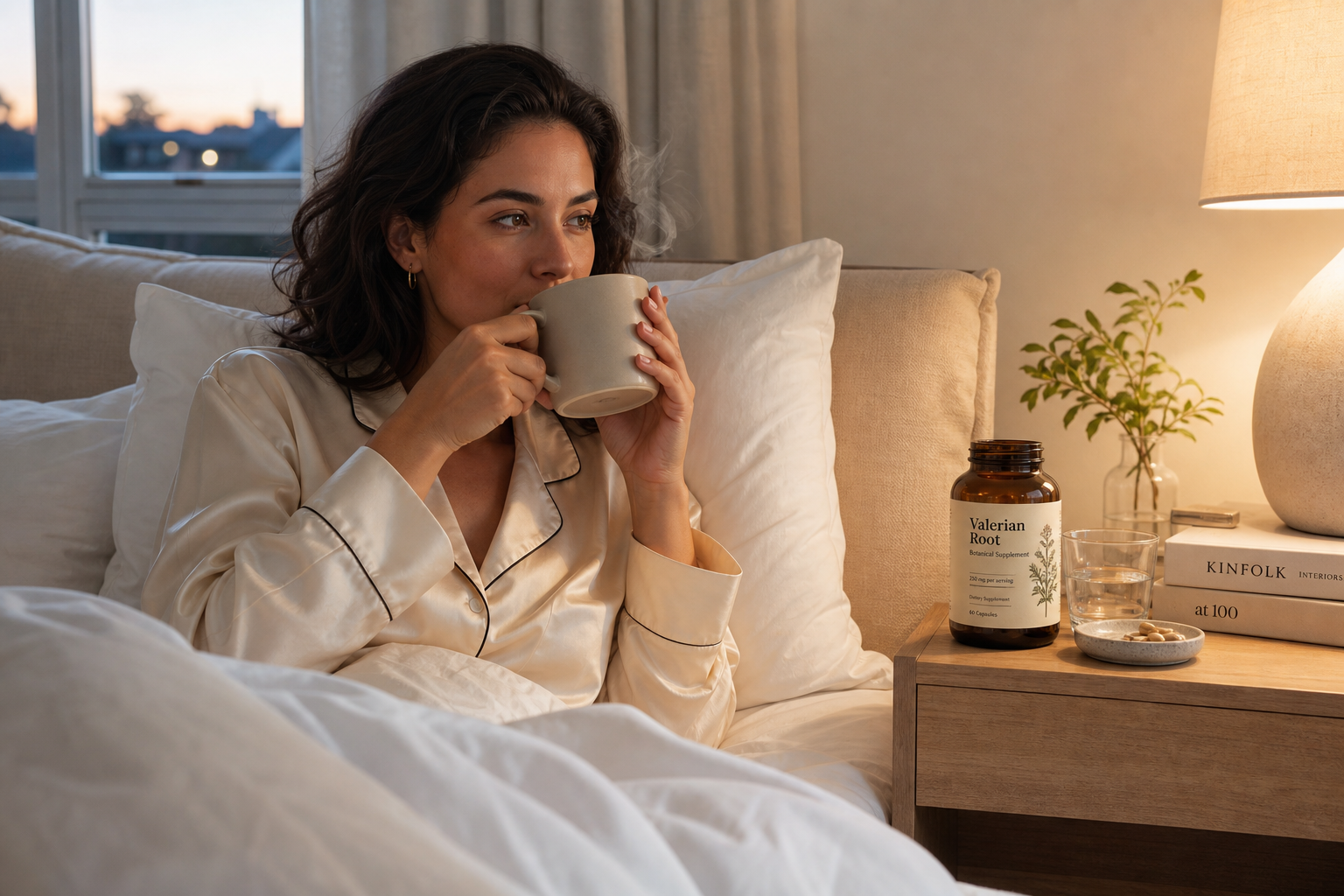
Summary
Valerian is a traditional calming herb made mainly from Valeriana officinalis root and rhizome. It is marketed for sleep support, relaxation, stress relief, and mild nervous tension, but it should be viewed as a botanical supplement, not a vitamin-like nutrient.
Human evidence is mixed. Some trials report subjective sleep improvement, but higher-level reviews and sleep medicine guidance do not show consistent clinically meaningful benefit for chronic insomnia. Evidence for anxiety disorders is thinner. Short-term use is generally tolerated in adults, although drowsiness interactions, pregnancy and breastfeeding uncertainty, rare liver injury reports, and product-quality differences are important cautions.
Quick Facts
What is it useful for?
Valerian is mainly used for sleep support, relaxation, and mild nervous tension, but evidence is mixed and not strong for chronic insomnia.
Supplement types
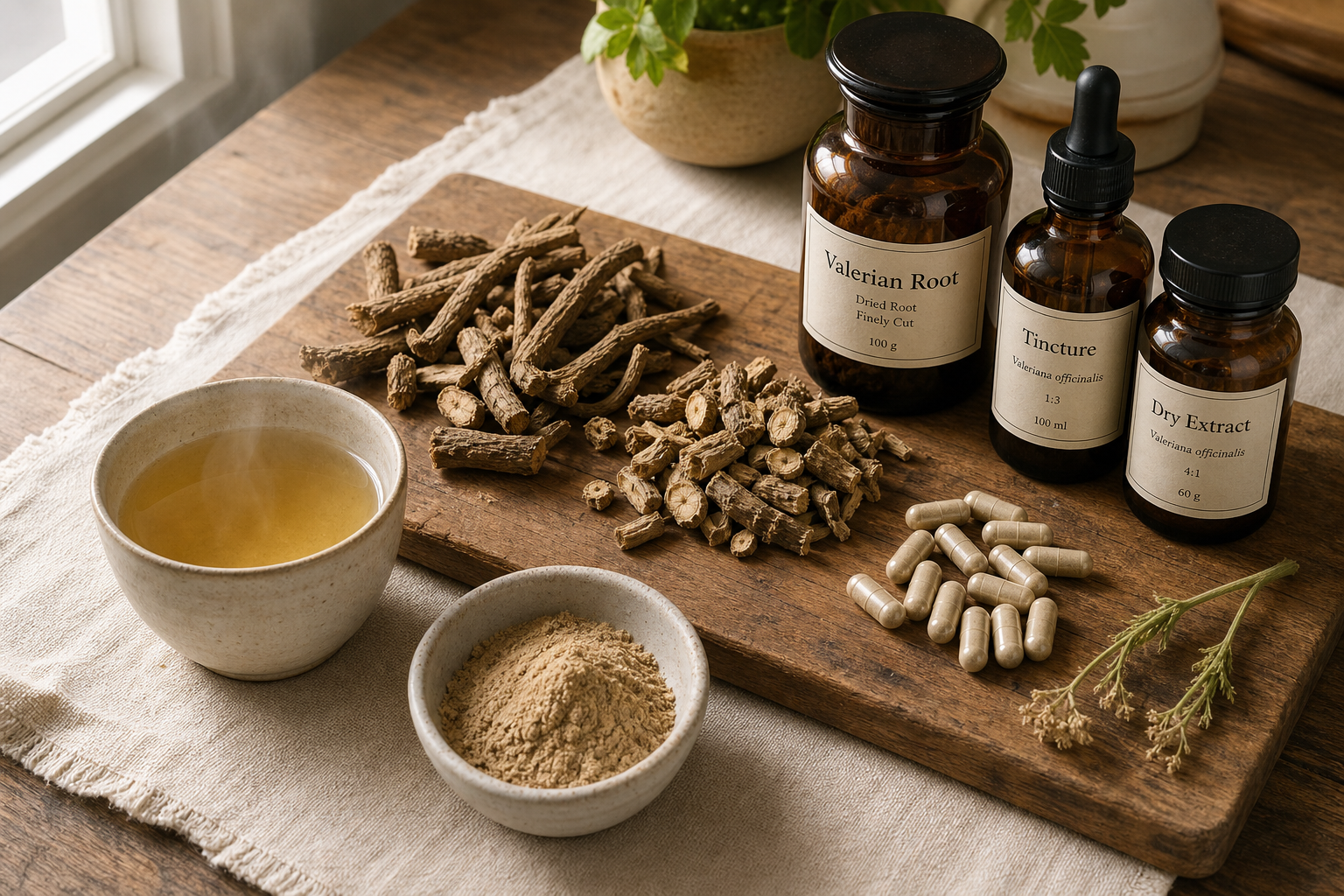
It is sold as capsules, tablets, teas, powders, tinctures, liquid extracts, and dry extracts; these forms are not automatically equivalent.
Interactions
Valerian may add to drowsiness from alcohol, sedative medicines, and other calming or sleep-promoting products.
Side effects
Reported effects include headache, stomach upset, vivid dreams, mental dullness, excitability, uneasiness, nausea, and abdominal cramps.
Other possible benefits
It is marketed for stress and anxiety, but there is not enough good evidence to confirm clear benefits for anxiety disorders.
Regulatory status
In the U.S. it is a botanical dietary supplement; in Europe some valerian root products are herbal medicines under a separate route.
What We Already Know About It
Botanical identity. Valerian is reasonably established as a botanical supplement built mainly around Valeriana officinalis root preparations, often including the rhizome. Its chemistry is complex, and the relaxing effects discussed in the literature probably do not come from one confirmed active ingredient. Valerenic acids and related compounds are commonly used as quality markers, but the NIH notes that there is no scientific agreement on the exact mechanism of action, and the overall effect may reflect multiple constituents acting together. NIH ODS — Botanical Dietary Supplements Backgrounder; NIH ODS — Valerian Fact Sheet.
Clinical picture. The strongest clinical evidence concerns sleep, and even there the findings are mixed. Some small trials report subjective improvements in sleep quality or insomnia symptoms, but larger evidence summaries and clinical guidance do not show a consistent, clinically meaningful benefit for chronic insomnia. Evidence for anxiety disorders is weaker still, with Cochrane concluding that it is insufficient. The most accurate evidence-based summary is that valerian is plausibly active as a calming herb, appears reasonably safe for short-term adult use, but has limited to inconsistent proof for the outcomes consumers most often seek. Product variability is likely one reason results are inconsistent. AASM — Insomnia Pharmacological Treatment Guideline; PubMed — Valente 2024 Umbrella Review; Cochrane — Valerian for Anxiety Disorders.
Summary of Relevant Scientific Research
U.S. supplement classification — FDA
The FDA explains that dietary supplement ingredients can include herbs and other botanicals, and that supplements may be sold as pills, capsules, tablets, liquids, powders and tea-like products when labeled as dietary supplements. For valerian, this supports classifying it as a botanical supplement rather than a nutrient such as a vitamin or mineral. FDA — Dietary Supplement Questions and Answers.
Botanical preparation differences — NIH Office of Dietary Supplements
The NIH botanical backgrounder describes teas, infusions, decoctions, tinctures and extracts, and notes that extracts may be dried into capsules or tablets. It also states that different preparations can have different strengths and constituent concentrations, and that “standardization” is not legally defined in the U.S. NIH ODS — Botanical Dietary Supplements Backgrounder.
Valerian evidence overview — NCCIH and NIH ODS
NCCIH and the NIH ODS describe valerian as an herb mainly used for sleep-related purposes, usually from root and rhizome. They conclude that insomnia evidence is inconclusive and that evidence is insufficient for anxiety, stress, depression, PMS and other conditions. NCCIH — Valerian; NIH ODS — Valerian Fact Sheet.
European herbal monograph — European Medicines Agency
The EMA herbal monograph recognises certain valerian root preparations for relief of mild nervous tension and sleep disorders in the herbal medicinal product context. It stresses that effects may come on gradually over 2 to 4 weeks and lists preparation-specific adult doses and safety warnings. EMA — Valeriana officinalis Root Monograph.
Insomnia guideline recommendation — American Academy of Sleep Medicine
The 2017 AASM guideline gives a weak recommendation against valerian for adult sleep-onset or sleep-maintenance insomnia. Its evidence review found small or marginal improvements, low to very low quality evidence for most outcomes, and no clear clinically meaningful benefit in chronic insomnia care. AASM — Insomnia Pharmacological Treatment Guideline.
Umbrella review on insomnia — Valente et al., 2024
This high-level synthesis concluded that, despite widespread use and a generally good safety profile, the overall evidence did not show efficacy for insomnia. The review highlights cumulative weaknesses such as small studies, mixed preparations, inconsistent outcomes and conflicting subjective versus objective findings. PubMed — Valente 2024 Umbrella Review.
Randomised trial meta-analysis — Fernandez-San-Martin et al., 2010
The meta-analysis examined 18 randomised controlled trials with 1,317 participants. It found no significant improvement in sleep latency or visual-analogue sleep-quality scores versus placebo, although some dichotomous self-reported sleep-quality outcomes favored valerian; major product heterogeneity limited interpretation. NCBI Bookshelf — DARE Valerian Meta-analysis Appraisal.
Anxiety disorder evidence — Cochrane
The Cochrane review found only one small study and concluded there was insufficient evidence to determine valerian’s efficacy or safety versus placebo or diazepam in anxiety disorders. This contrasts with broad consumer marketing for calm, stress and anxiety. Cochrane — Valerian for Anxiety Disorders.
Product quality and standardisation — Bent, Houghton, Alzweiri and Raal
Quality studies show that valerian products can differ substantially. Bent et al. noted that few trials clearly specified standardisation to valerenic acids, while Houghton found a wide range of valerenic acid and derivative content across commercial teas, capsules, tablets and liquids; other analytical work highlights quality markers and chemical variability in raw material. PMC — Valerian Systematic Review and Meta-analysis; PubMed — Houghton Commercial Valerian Preparations; PubMed — Valerian Quality Attributes Study; PubMed — Wild Valeriana officinalis Chemical Variability.
Beliefs, Myths & Unproven Claims
Valerian is a nutrient for sleep
Valerian is not a nutrient in the way a vitamin or mineral is. In regulatory and practical terms it is better classified as an herb or botanical supplement. This matters because consumers may assume a capsule has a clearly defined active dose, while valerian products can differ by plant part, extraction method and chemical profile. FDA — Dietary Supplement Questions and Answers; NIH ODS — Botanical Dietary Supplements Backgrounder.
Valerian is proven for insomnia and anxiety
This overstates the evidence. Some users and smaller trials report subjective benefits, especially around sleep quality, but higher-level reviews and the American Academy of Sleep Medicine do not support valerian as an effective chronic insomnia treatment in adults. For anxiety disorders, the evidence is largely insufficient. Traditional use for calm or mild nervous tension should not be presented as strong clinical proof for diagnosed insomnia or anxiety disorders. PubMed — Valente 2024 Umbrella Review; AASM — Insomnia Pharmacological Treatment Guideline; Cochrane — Valerian for Anxiety Disorders; EMA — Valeriana officinalis Root Monograph.
All valerian forms are interchangeable
Teas, powders, tinctures, capsules and extracts should not be treated as automatically equivalent. The NIH notes that different preparations have different strengths and that standardisation is not legally defined in the U.S. A valerenic-acid standard may improve batch consistency, but it does not by itself prove better sleep outcomes. “Natural” also does not mean risk-free, because sedation interactions, driving impairment, uncertain pregnancy safety and rare liver injury reports are documented concerns. NIH ODS — Botanical Dietary Supplements Backgrounder; PMC — Valerian Systematic Review and Meta-analysis; NCBI Bookshelf — LiverTox Valerian.
Detailed Research Observations
Traditional background and identity
Valerian has a long history as a calming and sleep-associated herb, and modern products still mostly rely on the underground parts of the plant, especially root and rhizome. That historical use helps explain why valerian remains common in sleep and relaxation formulas, but long use is not the same as strong proof. The best-known evidence base is centered on common valerian, Valeriana officinalis. Reviews of the Valerianaceae family also show that other valerian species have different phytochemical profiles and traditional uses, so products labeled “valerian” should not automatically be treated as equivalent. NCCIH — Valerian; EMA — Valerianae radix; PMC — Valerianaceae Family Review.
Herbal supplement, not nutrient
From a regulatory standpoint, valerian fits better in the herbal or botanical category than in the nutrient category. FDA guidance states that dietary supplement ingredients can include herbs and other botanicals, and that such products may be sold as tablets, capsules, powders, liquids or tea-like products when labeled as supplements. That means valerian is not a nutrient in the way magnesium, iron or vitamin D are nutrients. In Europe, valerian can also appear under an herbal medicinal product framework, but that does not make it an essential nutrient or an automatically approved food-supplement ingredient with authorised health claims. FDA — Dietary Supplement Questions and Answers; EMA — Valerianae radix.
Plant parts and compounds
The literature repeatedly points back to valerian root material, often including rhizome, rather than leaves or flowers. The NIH notes that valerian’s relaxing effect may come from multiple constituents rather than one established active compound. Valerenic acid and related sesquiterpenes are often discussed and frequently used as standardisation markers, but there is no scientific agreement that one constituent, one percentage or one extract profile is the clinically optimal form. This is why front-label milligrams alone can mislead consumers comparing products. NIH ODS — Botanical Dietary Supplements Backgrounder; NIH ODS — Valerian Fact Sheet; PMC — Valerianaceae Family Review.
Human evidence for sleep is mixed
Sleep is the main modern use, but the trial record is inconsistent. The NIH health professional fact sheet summarises both positive and negative randomised trials: a 400 mg aqueous extract improved some subjective sleep measures in volunteers, and a 28-day trial using 600 mg of a standardized dried-root extract improved several insomnia symptom ratings. However, another placebo-controlled crossover study using 600 mg standardized valerian found no effect on 14 of 15 objective and subjective outcomes. This pattern shows that even reasonably characterised products do not produce consistent results. NIH ODS — Valerian Fact Sheet.
Subjective versus objective sleep outcomes
The 2010 meta-analysis of 18 randomised trials found no significant improvement in sleep latency or visual-analogue sleep-quality scores versus placebo, although some simple self-reported sleep-quality outcomes favored valerian. This distinction is important: some people may feel they sleep better with valerian, but more quantitative evidence has not reliably shown strong benefit. The 2024 umbrella review goes further, concluding that despite a good safety profile there is no evidence of efficacy for insomnia overall. A careful consumer message is therefore “may help some people subjectively,” not “proven sleep aid.” NCBI Bookshelf — DARE Valerian Meta-analysis Appraisal; PubMed — Valente 2024 Umbrella Review.
Guideline-level interpretation
Clinical guidelines matter because they weigh evidence quality rather than isolated positive trials. The 2017 American Academy of Sleep Medicine guideline gives a weak recommendation against valerian for adult sleep-onset or sleep-maintenance insomnia, based on low-quality evidence and lack of clinically meaningful benefit. A more favorable 2020 review argued that valerian may be safe and effective and suggested preparation quality could explain conflicting results, but it pooled heterogeneous populations, formulations and outcomes. In plain terms, reviews partly disagree because the underlying studies are inconsistent, while stronger guideline-level interpretation remains skeptical. AASM — Insomnia Pharmacological Treatment Guideline; SAGE Journals — 2020 Valerian Review; PubMed — Valente 2024 Umbrella Review.
Anxiety, stress and relaxation claims
Valerian is often marketed for calm, stress, relaxation and anxiety, yet the human evidence for anxiety disorders is notably weaker than the sleep literature. Cochrane found only one small study and concluded that evidence was insufficient to determine efficacy or safety for anxiety disorders. NCCIH similarly states there is not enough evidence to draw conclusions for anxiety, stress, depression, PMS or other conditions. This does not prove valerian has no relaxing effects, but it means broad anti-anxiety claims are not well supported by current clinical evidence. Cochrane — Valerian for Anxiety Disorders; NCCIH — Valerian.
Forms, extracts and consistency
Consumers encounter valerian as teas, powdered root, capsules, tablets, tinctures, liquid extracts and dry extracts. These forms are not interchangeable milligram for milligram. Water, alcohol and mixed solvents can extract different patterns of constituents, and teas or simple powders may not deliver the same profile as a dry extract concentrated to a specific ratio. The EMA monograph lists different adult doses depending on preparation, while the NIH botanical backgrounder states that different preparations have different strengths. In practice, better-characterised human research tends to involve root extracts rather than casual tea use. NIH ODS — Botanical Dietary Supplements Backgrounder; EMA — Valeriana officinalis Root Monograph.
Standardisation helps, but only to a point
Standardisation can improve reproducibility, but it should not be oversold. Bent et al. noted that only 2 of 16 studies in their review specified standardisation to a percentage of valerenic acids, and the optimal valerenic-acid content remains unknown. Houghton analysed 31 commercial preparations and found a very wide range of valerenic acid and derivative content across teas, capsules, tablets and liquids. Standardized products tracked added valerian root better than non-standardized ones, but neither study proves that a higher valerenic-acid number automatically means better clinical performance. PMC — Valerian Systematic Review and Meta-analysis; PubMed — Houghton Commercial Valerian Preparations.
Species, origin and raw-material variability
Source differences matter, but not in a simple “country A is better than country B” way. Analytical research on wild-growing V. officinalis found substantial developmental and chemical variability without a simple relationship to region of origin. Other studies show that quality attributes such as acetoxy-valerenic acid and total essential oil content are relevant for pharmacy-grade material. Beyond V. officinalis, species such as V. jatamansi can vary by genotype and environment, reinforcing that global online products may differ chemically even when marketed under a broad valerian identity. Detailed labeling of species, plant part, extract type and batch quality is therefore more meaningful than country-of-origin marketing alone. PubMed — Valerian Quality Attributes Study; PubMed — Wild Valeriana officinalis Chemical Variability; PubMed — Valeriana jatamansi Genotype and Environment Study; PMC — Valerianaceae Family Review.
Adverse effects and evidence gaps
Short-term use appears generally tolerated in most adults, but valerian is not risk-free. Headache, stomach upset, mental dullness, vivid dreams, excitability and gastrointestinal symptoms are reported, and rare cases of clinically apparent liver injury have been linked to valerian, sometimes in multi-herb products. The EMA monograph also warns that valerian may impair the ability to drive or use machines, and it does not recommend use in children under 12 or during pregnancy and breastfeeding. Head-to-head comparisons between common consumer forms are limited, long-term safety is not well established, and the U.S. supplement market has no legally defined meaning for “standardized.” NCCIH — Valerian; NCBI Bookshelf — LiverTox Valerian; EMA — Valeriana officinalis Root Monograph; NIH ODS — Botanical Dietary Supplements Backgrounder.
Regulatory Status (EU and US)
United States
In the United States, valerian is regulated as a botanical dietary supplement ingredient rather than as a nutrient or an FDA-approved insomnia drug. FDA guidance states that dietary supplement ingredients may include herbs and botanicals, and that supplements can be sold as pills, capsules, tablets, powders, liquids and tea-like products. This permits general supplement marketing within U.S. law, but it does not mean valerian is approved to diagnose, treat or cure insomnia. FDA — Dietary Supplement Questions and Answers.
European Union
In Europe, valerian occupies overlapping but distinct spaces. EMA’s herbal monograph and product page relate to herbal medicinal products that meet pharmaceutical quality requirements, and EMA notes that foods, food supplements, cosmetics and medical devices do not follow the same criteria. For EU food supplements, botanical health claims remain complex: vitamin and mineral claims are more straightforward, while many botanical function claims have remained under separate ongoing consideration. EMA — Valerianae radix; EMA — Valeriana officinalis Root Monograph; European Commission — Health Claims; European Commission — EU Register of Health Claims.
Dosage and Standardization
The most consistent adult dose range in institutional summaries is roughly 300–600 mg per day for short-term use, especially root extracts used around bedtime. NCCIH states that valerian has commonly been used at 300–600 mg daily for up to 6 weeks, and ODS cites trials using 400 mg aqueous extract and 600 mg standardized dried-root extract. EMA gives preparation-specific adult dosing, including 400–600 mg for certain dry extracts and about 0.3–3 g of comminuted valerian root as an infusion in 150 mL boiling water. Benefit may require 2–4 weeks, and no universal upper intake level is established. NCCIH — Valerian; NIH ODS — Valerian Fact Sheet; EMA — Valeriana officinalis Root Monograph.
Safety And Interactions
Short-term valerian use appears generally well tolerated in most adults. Reported side effects include headache, stomach upset, mental dullness, excitability, uneasiness, vivid dreams, and gastrointestinal symptoms such as nausea or abdominal cramps. More serious harm appears uncommon, but LiverTox reports rare cases of clinically apparent liver injury linked to valerian, sometimes in multi-herb products. NCCIH — Valerian; EMA — Valeriana officinalis Root Monograph; NCBI Bookshelf — LiverTox Valerian.
The main interaction concern is additive sedation with alcohol, sedative medicines, and other sleep-promoting or calming products. EMA also warns that valerian can impair the ability to drive or use machines. Long-term safety is unknown, pregnancy and breastfeeding safety are not established, and EMA does not recommend valerian in children under 12 years. Rare withdrawal-type symptoms after abrupt discontinuation following chronic use have also been described. NCCIH — Valerian; EMA — Valeriana officinalis Root Monograph; NCBI Bookshelf — LiverTox Valerian.
Conclusion
Valerian is best understood as a traditional herbal supplement based mainly on Valeriana officinalis root preparations, not as a nutrient. Its main consumer uses are sleep support, relaxation and stress relief, but current human evidence does not support strong claims for chronic insomnia, and evidence for anxiety disorders is insufficient.
The practical takeaway is that product form and source matter. Tea, powder, tincture, capsule and dry extract are not the same thing, and differences in species, plant part, extraction method and standardisation likely contribute to inconsistent results. Short-term use appears reasonably tolerated for many adults, but interactions with alcohol or sedatives, next-day drowsiness, uncertain pregnancy and breastfeeding use, and rare liver injury reports mean caution is still appropriate.
Disclaimer
Disclaimer: We attempt to do our best to find relevant, accurate and most up to date information available in both, the public domain and in the clinical and medical research community. We recommend reviewing scientific sources for official information on the subject. This post is not intended as medical advice. Each individual person's health conditions vary and we advise to consult a doctor before taking any supplements.