

 Deutsch
 Español
 Suomi
Suomi Français
 Bahasa Indonesia
 Italiano
 日本語
日本語 Português
 Tagalog
Summary
Glucosamine is an amino sugar involved in cartilage and connective tissue structure and is used mainly for knee osteoarthritis. It is not a classic essential nutrient, and ordinary foods do not provide the amounts typically used in clinical studies.
The evidence is mixed and depends strongly on formulation. The strongest support is for specific standardized prescription crystalline glucosamine sulfate products, while glucosamine hydrochloride has often shown little or no meaningful benefit in major trials. Claims that glucosamine reliably rebuilds cartilage or works broadly for all arthritis are not established. Overall, it may provide modest symptom relief for some people, but benefits are inconsistent and not guaranteed.
Quick Facts
What is it useful for?
Mainly knee osteoarthritis symptom management, with modest and product-dependent benefits.
Supplement types
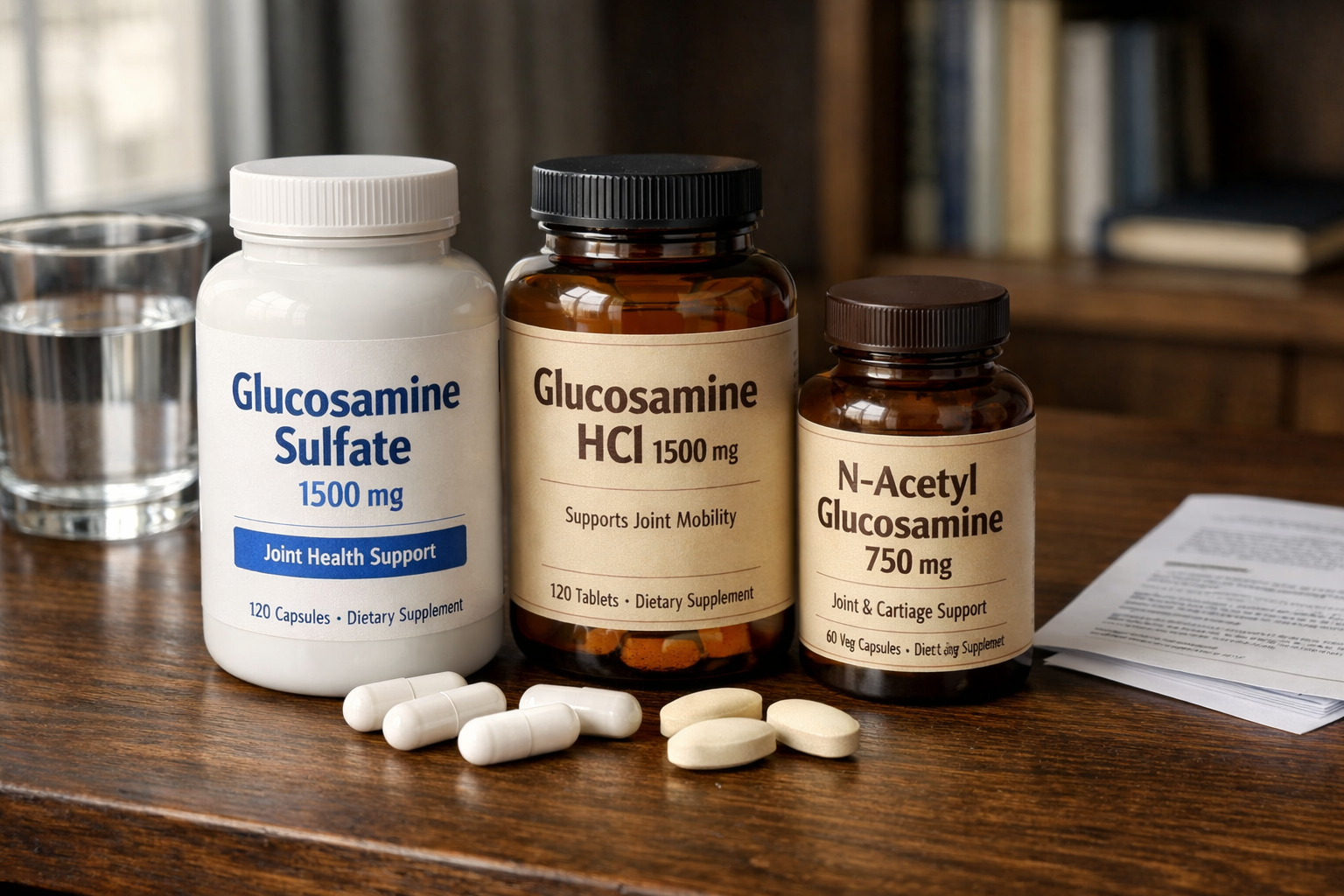
The main forms are glucosamine sulfate, glucosamine hydrochloride, and N-acetyl glucosamine, and they are not interchangeable.
Interactions
The clearest interaction concern is with warfarin or other vitamin K antagonists. Caution is also noted for diabetes or prediabetes, asthma, glaucoma, and some mineral-restricted diets.
Side effects
Usually mild digestive effects such as nausea, heartburn, diarrhea, or constipation, with occasional headache, drowsiness, skin reactions, or worsening asthma.
Other possible benefits
Some studies explored structural effects in joints, but reliable cartilage repair or broad arthritis benefits have not been established.
Regulatory status
In the U.S. it is mainly sold as a dietary supplement. In the EU, broad joint-maintenance claims are not supported for the general population, though some products have been regulated as medicines.
What We Already Know About It
Biological role. Glucosamine is an endogenous amino sugar involved in the formation of glycosaminoglycans and other connective-tissue components, which is why it became a candidate joint supplement. Laboratory and pharmacokinetic work suggests it may influence glycosaminoglycan and hyaluronic-acid production, support type II collagen expression, and affect inflammatory or catabolic pathways linked to cartilage breakdown. Proposed actions include effects on prostaglandin E2, NF-kB signaling, and matrix metalloproteinases, making glucosamine mechanistically plausible for osteoarthritis. Henrotin et al. — Arthritis Research & Therapy review; NCBI Bookshelf — Glucosamine overview
Clinical translation. Plausible biology has not translated into uniform human benefit. The clinical evidence is formulation-dependent, with the best support clustered around prescription crystalline glucosamine sulfate, while glucosamine hydrochloride has repeatedly shown weak or null effects in larger trials and pooled analyses. Evidence for structural benefits such as reliable cartilage repair, regrowth, or disease modification remains weak, with inconsistent imaging and joint-space findings. Overall, glucosamine has a narrower evidence base than many labels suggest: modest, inconsistent symptom relief in knee osteoarthritis rather than proven broad joint restoration. PubMed — Wu et al. 2013 meta-analysis; PubMed — Runhaar et al. 2017 OA Trial Bank analysis; NCCIH — Glucosamine and Chondroitin for Osteoarthritis; PubMed — ESCEO 2019 recommendations
Summary of Relevant Scientific Research
Consumer Overview of the Evidence — NCCIH
NCCIH summarizes glucosamine as a supplement with mixed knee osteoarthritis results and notes that regulation differs across countries, which affects formulation quality and consistency. NCCIH — Glucosamine and Chondroitin for Osteoarthritis
Formulation Matters — Wu et al. 2013 meta-analysis
This meta-analysis found that glucosamine sulfate showed at most a small and heterogeneous pain effect, while glucosamine hydrochloride showed essentially no meaningful benefit, reinforcing that products should not be treated as equivalent. PubMed — Wu et al. 2013 meta-analysis
Negative Overall Result in a Landmark Trial — GAIT study
In the NIH-funded GAIT trial, glucosamine hydrochloride 500 mg three times daily did not provide meaningful overall symptom benefit versus placebo for knee osteoarthritis. An exploratory subgroup signal with combined glucosamine and chondroitin did not settle the question. NEJM Journal Watch — GAIT knee osteoarthritis trial
No Clear Responder Subgroups — Runhaar et al. 2017
In high-quality knee and hip osteoarthritis trials, individual-patient-data meta-analysis found no statistically significant main effect of oral glucosamine and no convincing evidence that predefined subgroups were clear responders. PubMed — Runhaar et al. 2017 OA Trial Bank analysis
Structural Claims Remain Weak — GAIT structural study and MRI trial
Longer-term structural evidence has not confirmed reliable cartilage benefit. NCCIH cites a 2-year GAIT structural study with no joint-space advantage over placebo, and an MRI-based randomized trial found no improvement in joint structure or cartilage-related biomarkers. NCCIH — Glucosamine and Chondroitin for Osteoarthritis; PubMed — MRI trial in chronic knee pain
Beliefs, Myths & Unproven Claims
Myth: Glucosamine rebuilds worn cartilage
This claim goes beyond the human evidence. Mechanistic studies make cartilage support plausible, but important structural studies using joint-space width and MRI have not shown reliable cartilage regrowth or repair in people. A more accurate description is that glucosamine has been studied for symptom relief and possible slowing of progression, not proven cartilage rebuilding. NCCIH — Glucosamine and Chondroitin for Osteoarthritis; PubMed — MRI trial in chronic knee pain
Myth: All glucosamine products are basically the same
The forms differ in evidence base and likely practical usefulness. Glucosamine sulfate, glucosamine hydrochloride, and N-acetyl glucosamine are not interchangeable, and the strongest clinical case in osteoarthritis is for prescription crystalline glucosamine sulfate rather than generic hydrochloride products. PubMed — Wu et al. 2013 meta-analysis; PubMed — ESCEO 2019 recommendations; Mayo Clinic — Glucosamine overview
Myth: Natural means risk-free, and shellfish sources are superior
Safety is generally good, but that does not mean risk-free. Warfarin interaction concerns, uncertainty in pregnancy and breastfeeding, and cautions for asthma, diabetes or prediabetes, and some allergies all remain relevant. The sources also do not show convincing human evidence that shellfish-derived glucosamine works better than fermentation-based or vegan sources when the final form and dose are comparable. Mayo Clinic — Glucosamine overview; ANSES — Safety opinion on glucosamine; PubMed — Shrimp allergen challenge study
Detailed Research Observations
Biological Role and Why Food Is Not the Main Source
Glucosamine is an amino monosaccharide produced in the body and involved in glycosaminoglycans and other components of cartilage and connective tissue. That biological role explains why it became a prominent ingredient in joint-health products. However, it is better viewed as a structural compound relevant to cartilage metabolism than as an essential nutrient with a recommended intake. EFSA’s assessment reflects this distinction: glucosamine can be described chemically and biologically, but that alone does not establish a cause-and-effect health claim for maintenance of normal joints in the general population. EFSA Journal — Glucosamine and maintenance of normal joints; Henrotin et al. — Arthritis Research & Therapy review
For consumers, this also means food is not a practical substitute for the products studied in osteoarthritis trials. There is no established glucosamine deficiency syndrome, and ordinary diets do not provide well-quantified amounts comparable with the 1,500 mg daily regimens used in research. Historically, commercial raw materials came from chitin-rich shells and similar sources that are not normal therapeutic food sources. In practical terms, glucosamine functions as a supplement or medicine rather than as a meaningful everyday dietary source. EFSA Journal — Glucosamine and maintenance of normal joints; NCCIH — Glucosamine and Chondroitin for Osteoarthritis
Why Formulation Matters More Than the Label
Much of the confusion around glucosamine comes from treating all forms as interchangeable. The three names consumers most often see are glucosamine sulfate, glucosamine hydrochloride, and N-acetyl glucosamine. The source article repeatedly stresses that they are not equivalent in evidence base or practical usefulness. Mayo Clinic explicitly notes they are not interchangeable, and pooled evidence supports that position. In osteoarthritis, the more favorable evidence profile belongs to glucosamine sulfate overall, though even that evidence is mixed and sensitive to product quality. Mayo Clinic — Glucosamine overview; PubMed — Wu et al. 2013 meta-analysis
This distinction becomes even more important when discussing over-the-counter supplements versus standardized prescription products. ESCEO specifically separates prescription crystalline glucosamine sulfate from other preparations and gives it the most favorable modern guidance language for knee osteoarthritis. N-acetyl glucosamine remains biologically interesting but has a much smaller and older osteoarthritis evidence base, so it should not be presented as an equally supported substitute. The article’s practical point is that a label stating “glucosamine” does not reliably tell consumers whether the product resembles the versions that were actually studied. PubMed — ESCEO 2019 recommendations; PubMed — N-acetyl glucosamine study
Sulfate Versus Hydrochloride in Clinical Trials
The strongest positive language in the source article is reserved for prescription crystalline glucosamine sulfate, especially in European guidance. Pharmacokinetic and mechanistic reviews suggest sulfate preparations may achieve more favorable exposure than hydrochloride in some contexts, and the best clinical evidence clusters around standardized crystalline products rather than around glucosamine products in general. This does not prove that every sulfate product works, but it does support the idea that formulation quality is a central reason why published results differ so widely. PubMed — ESCEO 2019 recommendations; Henrotin et al. — Arthritis Research & Therapy review; PubMed — Pharmacokinetic study
By contrast, much of the skepticism in the United States comes from studies using glucosamine hydrochloride. The NIH-funded GAIT trial did not find meaningful overall symptomatic benefit for glucosamine hydrochloride in knee osteoarthritis, and longer-term follow-up also failed to clearly establish superiority for glucosamine or its combination with chondroitin. A formulation-specific meta-analysis reached a similar conclusion, finding essentially no meaningful pain benefit for glucosamine hydrochloride. The article therefore cautions against generalizing positive results from prescription crystalline sulfate studies to generic hydrochloride supplements. NEJM Journal Watch — GAIT knee osteoarthritis trial; PubMed — GAIT long-term follow-up; PubMed — Wu et al. 2013 meta-analysis
Cartilage Repair Claims Versus Structural Evidence
The largest gap between marketing and evidence appears in claims that glucosamine rebuilds or regrows cartilage. Mechanistic studies help explain why that idea became popular: glucosamine may support glycosaminoglycan synthesis, hyaluronic acid production, type II collagen expression, and anti-catabolic signaling. But the source article is careful to separate biological plausibility from proven clinical outcomes. Structural claims require human evidence showing reliable benefit on imaging or joint-space measures, and those data remain mixed at best. Henrotin et al. — Arthritis Research & Therapy review; NCBI Bookshelf — Glucosamine overview
Some long-term studies have suggested slower joint-space narrowing, and one two-year randomized trial found structural benefit for a glucosamine-plus-chondroitin combination rather than clearly for glucosamine alone. However, several important studies did not confirm these effects. NCCIH summarizes a two-year GAIT structural study that found no advantage over placebo for joint-space width, and an MRI-based randomized trial found no structural improvement with oral glucosamine in chronic knee pain. The most defensible conclusion from the article is therefore cautious: structural evidence is inconsistent and does not justify claims that glucosamine reliably repairs or regrows knee cartilage in humans. ScienceDirect — Structural outcome review; NCCIH — Glucosamine and Chondroitin for Osteoarthritis; PubMed — MRI trial in chronic knee pain
Regulation and Guidelines Explain the Confusion
The article highlights that glucosamine occupies different regulatory categories in different regions, which helps explain the uneven consumer experience. In the United States, it is mainly sold under the dietary supplement framework, where product variability is a real concern. In parts of Europe, some formulations have been regulated as medicines, which can allow tighter standardization. EFSA concluded that the evidence does not establish a cause-and-effect relationship between glucosamine consumption and maintenance of normal joints in the general population, and FDA denied qualified health claims linking glucosamine to reduced osteoarthritis risk, joint degeneration, or cartilage deterioration. EMA — Glucomed referral information; EFSA Journal — Glucosamine and maintenance of normal joints; FDA — Qualified Health Claims Denial Letters
Medical guidelines then add another layer of disagreement. ESCEO supports prescription crystalline glucosamine sulfate for knee osteoarthritis, AAOS states that some supplements including glucosamine may help but the evidence is inconsistent, and the ACR/AF guideline strongly recommends against glucosamine, emphasizing the lack of reliable benefit in better-controlled or non-industry-funded studies. Individual-patient-data meta-analysis also has not identified clear responder subgroups. The article’s bottom line is not that glucosamine never helps, but that any benefit is probably modest, limited to some people, and more plausible with specific standardized sulfate formulations than with generic alternatives. PubMed — ESCEO 2019 recommendations; AAOS — Osteoarthritis of the Knee guideline; AAFP — ACR/AF guideline summary; PubMed — Runhaar et al. 2017 OA Trial Bank analysis
Regulatory Status (EU and US)
European Union
EFSA concluded that available evidence does not establish a cause-and-effect relationship between glucosamine consumption and maintenance of normal joint cartilage in the general population, so broad EU-level joint-maintenance claims are not supported. At the same time, some glucosamine products have existed in Europe as medicinal products, which helps explain why discussion around certain formulations can sound more favorable than general health-claim law would allow. EFSA Journal — Glucosamine and maintenance of normal joints; EMA — Glucomed referral information
United States
In the U.S., glucosamine is generally sold as a dietary supplement rather than as an FDA-approved osteoarthritis drug. FDA has denied qualified health claims stating that glucosamine reduces osteoarthritis risk, joint degeneration, or cartilage deterioration. Guidelines are also split: ESCEO supports prescription crystalline glucosamine sulfate, while AAOS and ACR/AF describe the evidence as inconsistent or recommend against routine use. FDA — Qualified Health Claims Denial Letters; PubMed — ESCEO 2019 recommendations; AAOS — Osteoarthritis of the Knee guideline; AAFP — ACR/AF guideline summary
Dosage and Standardization
Most studied: 1,500 mg daily.
Common regimens: 500 mg three times daily or 1,500 mg once daily, especially with prescription crystalline glucosamine sulfate.
Important: Forms are not equivalent, and higher self-dosing is not supported.
Safety And Interactions
General safety: Glucosamine is generally well tolerated. The best-established side effects are mild gastrointestinal complaints such as nausea, heartburn, diarrhea, and constipation, with occasional headache, drowsiness, or skin reactions. Mayo Clinic — Glucosamine overview; Cochrane Review — Glucosamine for Osteoarthritis
Interactions and cautions: The clearest interaction concern is with warfarin or other vitamin K antagonists, where reports of raised INR and bleeding risk have led to repeated warnings. Monitoring concerns have also been raised for diabetes or prediabetes, asthma worsening, glaucoma or elevated eye pressure, and the mineral load of some formulations in people on sodium-, potassium-, or calcium-restricted diets. ANSES — Safety opinion on glucosamine; NCBI Bookshelf — Glucosamine overview
Special populations: Pregnancy, breastfeeding, and childhood use are not well studied, so routine use is generally avoided. Shellfish allergy requires label review and individualized caution, even though one small product-specific study suggested certain shrimp-derived products lacked clinically relevant shrimp allergen. PubMed — Shrimp allergen challenge study
Conclusion
Glucosamine is biologically relevant to cartilage, but the evidence supports a cautious view rather than bold claims. Its main studied use is knee osteoarthritis, where any benefit appears modest, inconsistent, and highly dependent on formulation, with the strongest support for prescription crystalline glucosamine sulfate.
It should not be presented as a proven cartilage-repair supplement or a reliable treatment for all arthritis. Overall, glucosamine remains a plausible but inconsistent option with generally good tolerability, important interaction cautions, and a much stronger case for careful product selection than for broad marketing promises.
Disclaimer
Disclaimer: We attempt to do our best to find relevant, accurate and most up to date information available in both, the public domain and in the clinical and medical research community. We recommend reviewing scientific sources for official information on the subject. This post is not intended as medical advice. Each individual person's health conditions vary and we advise to consult a doctor before taking any supplements.