

 Deutsch
 Español
 Suomi
Suomi Français
 Bahasa Indonesia
 Italiano
 日本語
日本語 Português
 Tagalog
Summary
SAM-e is a body-made compound formed from methionine and ATP that serves as a major methyl donor in core metabolic reactions. As a supplement, it is mainly studied for depression, osteoarthritis symptoms, and some liver-related conditions, but it is better understood as an endogenous metabolite than as a classic nutrient.
The evidence is mixed rather than definitive. Depression has the strongest clinical interest, especially as adjunctive treatment, while osteoarthritis evidence is older and weaker and liver findings vary by condition. Formulation also matters because oral SAM-e is unstable, poorly absorbed, and labels may reflect stabilized salt weight rather than net active SAM-e.
Quick Facts
What is it useful for?
The best-studied uses are depression, osteoarthritis symptoms, and some liver-related conditions, but the evidence is mixed rather than definitive.
Supplement types
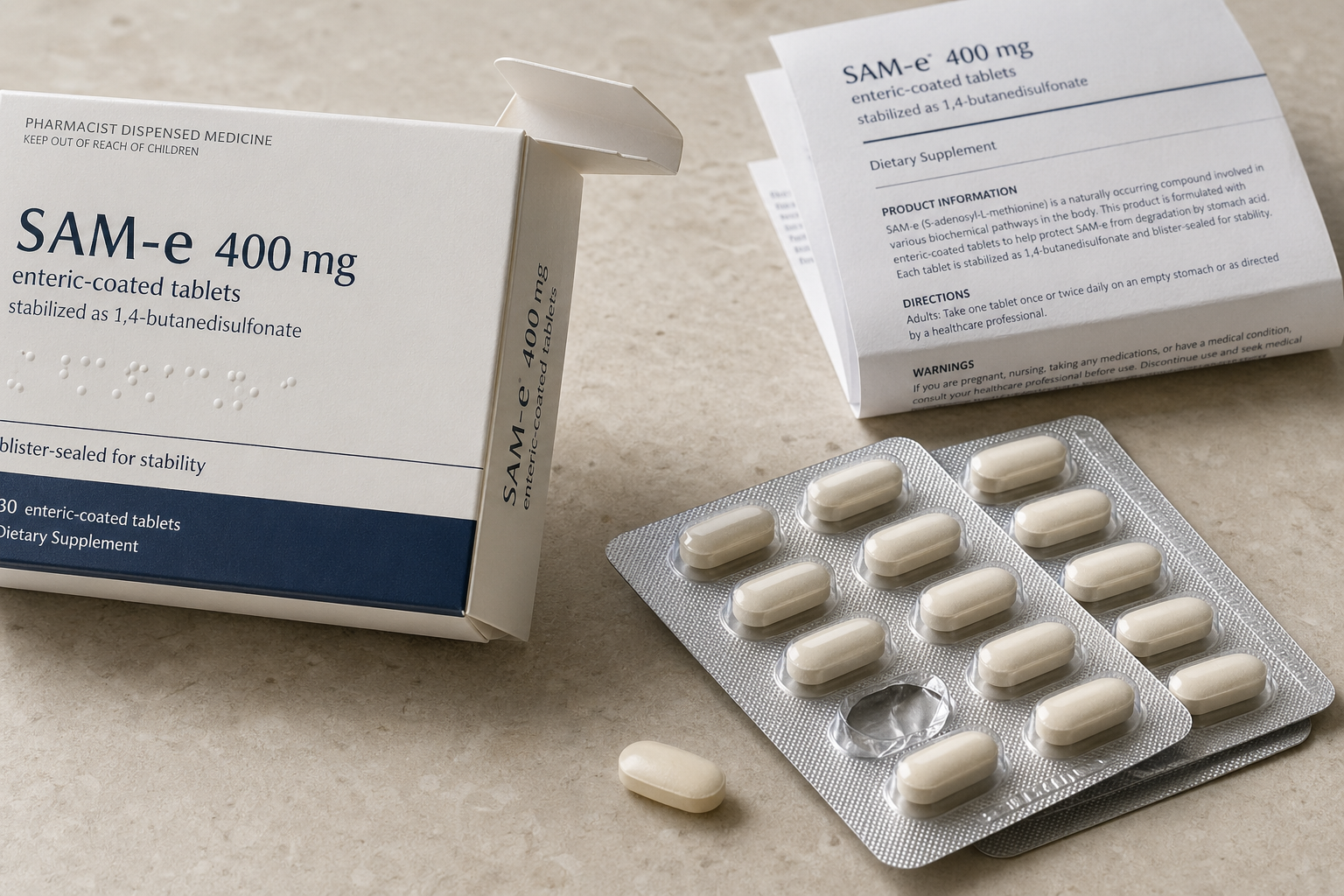
SAM-e is usually sold as stabilized salt forms such as tosylate disulfate or 1,4-butanedisulfonate, often in enteric-coated tablets.
Interactions
SAM-e may interact with serotonergic medicines or supplements and can also be problematic with levodopa. Caution is also emphasized in bipolar disorder.
Side effects
Commonly reported effects include digestive upset, insomnia, sweating, anxiety, dizziness, and irritability. Mania or hypomania risk is a key concern in bipolar disorder.
Other possible benefits
Mechanistic and limited clinical research has also explored liver health and related methylation-dependent pathways.
Regulatory status
In the U.S. SAM-e is sold as a dietary supplement. In Europe, claims are more tightly regulated and classification may differ by country; some related products have been used as prescription medicines.
What We Already Know About It
Core biology. SAM-e is synthesized inside cells from methionine and ATP and functions as a central methyl donor in many reactions tied to neurotransmitters, phospholipids, and one-carbon metabolism. Because of that role, it is better described as an endogenous metabolite or cofactor than as a classic essential nutrient that must itself be obtained from the diet. PubMed — SAM-e metabolism and liver disease; PubMed — SAM-e in liver health, injury, and cancer; NCCIH — SAMe in Depth.
Clinical evidence. The strongest human research is in depression, but even there the picture is mixed. Cochrane found no strong evidence that SAM-e monotherapy clearly outperforms placebo or standard antidepressants, while adjunctive use with SSRIs appears more promising but remains supported by low-quality evidence. Osteoarthritis findings come largely from older, weaker studies, and liver-related results are condition-specific rather than uniformly positive. Cochrane — SAM-e for depression in adults; Systematic review — SAM-e in major depressive disorder; Cochrane-related review — Osteoarthritis of the knee or hip; PubMed — 2024 liver health systematic review.
Formulation science. A relatively well-supported point is that formulation matters. Oral SAM-e is chemically unstable and poorly absorbed, so salt form, enteric coating, packaging, and the difference between salt weight and net active yield are meaningful scientific issues rather than mere marketing language. What remains less established is whether one retail form is clearly superior across clinical outcomes. BMC Pharmacology and Toxicology — Oral SAM-e pharmacokinetics; USP — Ademetionine 1,4-butanedisulfonate monograph.
Summary of Relevant Scientific Research
Depression in adults — Cochrane
Across eight randomized trials involving 934 adults, Cochrane found no strong evidence that SAM-e monotherapy was clearly better than placebo, imipramine, or escitalopram on core depression outcomes. Low-quality evidence suggested possible benefit when SAM-e was added to SSRIs, and mania or hypomania events were reported in some treated participants. Cochrane — SAM-e for depression in adults.
Major depressive disorder review — Systematic review
A clinician-oriented review covering 11 treatment arms and 1,011 participants found several comparisons versus standard antidepressants with no significant difference. Its main message was caution: biologically plausible and clinically interesting, but limited by older trials, small samples, mixed formulations, and inconsistent study quality. Systematic review — SAM-e in major depressive disorder.
Osteoarthritis evidence — Cochrane-related summary
Historical osteoarthritis trials sometimes suggested symptom benefit and encouraging head-to-head comparisons with NSAIDs, but placebo-controlled studies were judged too small, weak, and heterogeneous for firm interpretation. The evidence is therefore suggestive rather than well established by current standards. Cochrane-related review — Osteoarthritis of the knee or hip.
Liver-health research breadth — Recent systematic review
A 2024 review identified 15 liver-related studies and confirmed continued interest in SAM-e across multiple liver-health settings. The studies covered different diseases and designs, so the evidence does not support one blanket claim that SAM-e works for “liver disease” as a whole, and pregnancy guidance favors ursodeoxycholic acid for intrahepatic cholestasis of pregnancy. PubMed — 2024 liver health systematic review; PubMed — Guidance on intrahepatic cholestasis of pregnancy.
Formulation and absorption — Pharmacokinetic and USP sources
Oral SAM-e shows low and variable bioavailability. One pharmacokinetic study reported roughly 2.1 to 2.6 percent oral bioavailability for older formulations and around 9 percent for the studied novel formulation, while USP data explain why some stabilized salts contain only about 50 to 56 percent SAM-e by weight. BMC Pharmacology and Toxicology — Oral SAM-e pharmacokinetics; USP — Ademetionine 1,4-butanedisulfonate monograph.
Beliefs, Myths & Unproven Claims
SAM-e is just another nutrient deficiency problem
That framing is too simplistic. SAM-e is made by the body from methionine and ATP, so the more accurate description is an endogenous compound involved in metabolism rather than a classic essential nutrient with its own dietary requirement. Public guidance points to methionine in food as the precursor, not to SAM-e as something people normally need to obtain directly from the diet. PubMed — SAM-e metabolism and liver disease; NCCIH — SAMe in Depth.
SAM-e is a proven natural antidepressant or NSAID substitute
The evidence does not support that level of certainty. For depression, the most interesting signal is adjunctive use, but overall certainty remains low; for osteoarthritis, some older trials were encouraging, yet reviewers judged the evidence too small and inconsistent for strong conclusions. It may be worth discussing with a clinician in selected cases, but it should not be presented as established equivalent care. Cochrane — SAM-e for depression in adults; Systematic review — SAM-e in major depressive disorder; Cochrane-related review — Osteoarthritis of the knee or hip.
Marketing terms automatically mean better results
Claims such as “naturally derived,” “fermented,” or “clinically active isomer” may reflect real chemistry and manufacturing details, especially around salt form, S,S isomer preservation, enteric coating, and protection from degradation. But the supplied evidence does not show that source rhetoric by itself predicts better clinical outcomes. Stability may matter; vague branding language is not proof. PubMed — Ademetionine impurity and manufacturing paper; BMC Pharmacology and Toxicology — Oral SAM-e pharmacokinetics; ODS DSLD — Example SAM-e label.
Detailed Research Observations
Biological role and nutrient status
SAM-e sits at the center of methylation biology. It is synthesized from methionine and ATP and then used as a methyl donor in reactions tied to neurotransmitter handling, membrane chemistry, sulfur metabolism, and redox balance. That biochemical role explains why the most accurate consumer description is not “a vitamin-like nutrient you must eat,” but rather an endogenous metabolite or cofactor that the body normally produces. PubMed — SAM-e metabolism and liver disease; PubMed — SAM-e in liver health, injury, and cancer.
The distinction matters because it changes how supplementation should be framed. The supplied sources describe methionine from food as the precursor, not SAM-e itself as a dietary requirement with a classic deficiency syndrome. In practical terms, SAM-e supplementation is better understood as taking a stabilized version of a naturally occurring body compound that may influence pathways already known to depend on methyl donation, rather than correcting a recognized lack of SAM-e-rich foods. NCCIH — SAMe in Depth; PubMed — SAM-e metabolism and liver disease.
Depression evidence and what it means in practice
Interest in SAM-e for mood developed from a plausible biochemical rationale: methylation pathways intersect with neurotransmitter synthesis and regulation. But the clinical literature is harder to interpret than a single headline claim suggests because studies vary by oral versus injectable use, monotherapy versus add-on therapy, and trial quality. Cochrane found no strong evidence that SAM-e alone clearly beats placebo or standard antidepressants, while low-quality evidence suggested possible adjunctive benefit when added to SSRIs. Cochrane — SAM-e for depression in adults; Systematic review — SAM-e in major depressive disorder.
The most defensible practical takeaway is therefore cautious rather than absolute. The evidence does not cleanly support “SAM-e works” or “SAM-e does not work”; it suggests that if there is a clinically relevant niche, it may be as adjunctive therapy for some adults already under care, not as a do-it-yourself replacement for evidence-based psychiatric treatment. That nuance matters even more because mania or hypomania has been reported, and public-facing institutional guidance warns against casual use in bipolar-spectrum illness. Cochrane — SAM-e for depression in adults; NCCIH — SAMe in Depth; Mayo Clinic — SAM-e.
Osteoarthritis history and liver rationale
SAM-e became popular as a joint supplement partly because older osteoarthritis studies suggested symptom relief and, in some comparisons, NSAID-like performance with fewer side effects. The modern problem is not total absence of positive findings but the age and quality of the evidence base. The trials were small, dated, and methodologically inconsistent, and reviewers concluded that placebo-controlled evidence was too weak and heterogeneous for firm interpretation. That leaves osteoarthritis as a story of historical promise rather than strong current proof. Cochrane-related review — Osteoarthritis of the knee or hip.
Liver research follows a similar pattern of strong rationale but uneven proof. Mechanistic reviews explain why low hepatic SAM-e has been linked to steatosis, injury, altered redox balance, and related pathology, so researchers have studied supplementation in multiple liver-related conditions. But the recent systematic review spans different diseases and designs, meaning the evidence cannot be compressed into one broad consumer claim that SAM-e “works for liver disease.” Pregnancy is an especially important boundary case: guidance for intrahepatic cholestasis of pregnancy supports ursodeoxycholic acid as first-line treatment rather than SAM-e self-treatment. PubMed — SAM-e in liver health, injury, and cancer; PubMed — 2024 liver health systematic review; PubMed — Guidance on intrahepatic cholestasis of pregnancy.
Salt forms, net yield, and why packaging matters
One of the most useful practical observations in the SAM-e market is the difference between salt weight and net active yield. USP information on ademetionine 1,4-butanedisulfonate shows that the stabilized salt is only about 50 to 56 percent SAM-e by weight. That helps explain why labels may show a larger salt amount while delivering a lower net amount of actual SAM-e. The supplied label examples show the same pattern, such as 400 mg of a stabilized salt corresponding to 200 mg SAM-e, or 800 mg corresponding to 400 mg SAM-e. USP — Ademetionine 1,4-butanedisulfonate monograph; ODS DSLD — Example SAM-e label; ODS DSLD — Additional SAM-e label.
Bioavailability adds another layer. Oral SAM-e is unstable and poorly absorbed, and one pharmacokinetic study estimated only about 2.1 to 2.6 percent bioavailability for older literature formulations, compared with around 9 percent for the sponsor’s studied novel formulation. Even without overgeneralizing sponsor data, the broader conclusion is clear: enteric coating, blister packaging, and protection of the active form are scientifically relevant issues, though they should not be mistaken for guaranteed superiority in clinical outcomes. BMC Pharmacology and Toxicology — Oral SAM-e pharmacokinetics; ODS DSLD — Example SAM-e label.
Manufacturing claims and the main evidence gaps
The best-supported way to discuss sourcing is to say that supplement SAM-e is manufactured rather than meaningfully extracted from food. A recent impurity paper provides indirect evidence that at least some modern ademetionine production uses yeast-based bioprocessing or fermentation systems, and retail labels often emphasize fermentation source, solvent-free processing, or preservation of the S,S isomer. Those descriptions may reflect real manufacturing facts, but the supplied evidence does not show that “fermentation-derived” or “naturally derived” products necessarily produce better health outcomes than other properly manufactured SAM-e products. PubMed — Ademetionine impurity and manufacturing paper; ODS DSLD — Example SAM-e label.
The broader literature is limited more by inconsistency than by total lack of research. Trials vary by indication, dose, route, formulation, outcome measure, and era, and some mood and liver studies used prescription or parenteral products that are not directly interchangeable with over-the-counter oral tablets. Long-term safety data remain limited, pregnancy data remain limited, and product-level claims often run ahead of comparative clinical proof. The most evidence-based bottom line is therefore cautious, formulation-aware, and indication-specific. NCCIH — SAMe in Depth; Systematic review — SAM-e in major depressive disorder; PubMed — 2024 liver health systematic review; BMC Pharmacology and Toxicology — Oral SAM-e pharmacokinetics.
Regulatory Status (EU and US)
United States
In the United States, SAM-e is generally marketed as a dietary supplement under the DSHEA framework. That means it is regulated differently from prescription drugs and does not go through the same premarket efficacy approval process as an FDA-approved medicine for depression, osteoarthritis, or liver disease. FDA — Information for consumers using dietary supplements.
European Union
In Europe, health claims on foods and supplements must be scientifically substantiated and authorized under EU rules, while substances outside the harmonized vitamin-and-mineral framework can involve member-state monitoring, notification, or classification differences. This means the regulatory position and marketing language may not be identical across countries. European Commission — Nutrition and health claims; European Commission — Food supplements.
Mayo Clinic also notes that a synthetic version of SAM-e is sold as a supplement in the U.S. and used as a prescription drug in some European countries. That difference shows that classification and route to market can vary by region, not that efficacy is automatically greater in one market than another. Mayo Clinic — SAM-e.
Dosage and Standardization
Study ranges: There is no universally established daily requirement; oral depression studies commonly used about 800–1,600 mg/day.
Product notes: Many retail tablets provide 200 or 400 mg net SAM-e from a larger stabilized salt amount, and results may not translate across different formulations or routes.
Safety And Interactions
The most commonly described side effects are gastrointestinal and nervous-system related, including nausea, digestive upset, constipation or diarrhea, sweating, dizziness, anxiety, irritability, and insomnia. Short-term tolerability is reasonably established, but long-term safety data remain limited. NCCIH — SAMe in Depth; Mayo Clinic — SAM-e.
The most important psychiatric precaution is bipolar disorder. Mania or hypomania has been reported in clinical research, and both NCCIH and Mayo Clinic caution that SAM-e may not be safe for people with bipolar disorder. Interaction concerns are strongest with serotonergic medicines or supplements and with levodopa, so people using those therapies should not add SAM-e without clinician input. Cochrane — SAM-e for depression in adults; NCCIH — SAMe in Depth; Mayo Clinic — SAM-e.
Safety in pregnancy, breastfeeding, and some special populations is not well established. NCCIH notes limited pregnancy data, and immunocompromised people are sometimes flagged because of a theoretical Pneumocystis concern. For liver symptoms during pregnancy, specialist care is essential because guideline-supported management for intrahepatic cholestasis of pregnancy prioritizes ursodeoxycholic acid rather than over-the-counter supplements. NCCIH — SAMe in Depth; PubMed — Guidance on intrahepatic cholestasis of pregnancy.
Conclusion
SAM-e is a biologically important compound with a clearer biochemical role than many supplement claims suggest. It has credible research interest in mood, osteoarthritis, and liver-related conditions, but the human evidence is uneven. Depression has the best support, especially as a possible adjunctive use, while osteoarthritis evidence is older and weaker and liver findings remain too condition-specific for a broad promise.
The most balanced reading is that SAM-e shows preliminary-to-moderate promise in selected contexts, not strong all-purpose proof. Formulation quality, net active yield, and safety screening matter more than vague “natural source” marketing, and clinician-aware use is the most cautious approach given the interaction and contraindication concerns.
Disclaimer
Disclaimer: We attempt to do our best to find relevant, accurate and most up to date information available in both, the public domain and in the clinical and medical research community. We recommend reviewing scientific sources for official information on the subject. This post is not intended as medical advice. Each individual person's health conditions vary and we advise to consult a doctor before taking any supplements.