
 Deutsch
 Español
 Suomi
Suomi Français
 Bahasa Indonesia
 Italiano
 日本語
日本語 Português
 Tagalog
Summary
St John’s wort is a botanical supplement made from Hypericum perforatum. The strongest evidence supports certain standardized oral extracts for mild to moderate depressive symptoms or depressive episodes, while evidence for severe depression and many other promoted uses is weaker or insufficient.
Its benefits are highly product-specific. Teas, tinctures, topical oils, and generic whole-herb products should not be assumed to work like the studied dry extracts. The main safety concern is unusually important drug interaction risk, because St John’s wort can reduce the effectiveness of medicines such as oral contraceptives, transplant drugs, anticoagulants, HIV treatments, digoxin, and some cancer medicines.
Quick Facts
What is it useful for?
The strongest evidence supports certain standardized oral extracts for mild to moderate depression or depressive symptoms.
Supplement types
It is sold as tea, capsules, tablets, tinctures, liquid extracts, standardized extracts, oils, and topical products.
Interactions
It can interact with serotonergic supplements and many medicines through major enzyme and transporter effects, including oral contraceptives, warfarin, transplant drugs, HIV treatments, digoxin, and some cancer medicines.
Side effects
Reported side effects are often mild and can include digestive upset, dizziness, tiredness or drowsiness, and photosensitivity.
Other possible benefits
Traditional uses include temporary mental exhaustion, mild skin irritation, wound care, mild gastrointestinal discomfort, and nervous restlessness with sleep difficulty.
Regulatory status
In the US it is a botanical dietary supplement. In Europe, some preparations have herbal medicinal monograph support, with well-established use for certain standardized dry extracts and traditional-use status for several other indications.
What We Already Know About It
What it is. St John’s wort is best described as a herbal or botanical supplement made from Hypericum perforatum, not as a nutrient like a vitamin or mineral. What is reasonably established is narrower than its marketing suggests: the most consistent clinical support is for certain standardized oral extracts used for mild to moderate depressive symptoms or depressive episodes. Evidence for severe depression is weaker, and evidence for many other promoted uses remains limited or insufficient. In practical terms, the plant has meaningful support, but mainly for specific extract types and not for the entire category of retail products. NIH ODS — Dietary Supplements Overview; NCCIH — St. John’s Wort; Systematic Reviews — Apaydin et al.; Cochrane Review — St John’s wort for major depression
Why products differ. Chemically, St John’s wort contains hypericin, pseudohypericin, hyperforin, and flavonoids. Older standardization often emphasized hypericin, but later work suggests hyperforin is a major contributor both to antidepressant pharmacology and to many drug interactions. This helps explain why products with similar herb weights may behave differently in practice: extraction method, plant source, and constituent profile matter. Safety is clearest in one crucial respect: St John’s wort can induce CYP3A4, CYP2C9, CYP2B6, CYP2C19, and P-glycoprotein, which can lower exposure to many medicines and make self-care use unusually risky compared with most supplements. EMA HMPC Monograph — Hypericum perforatum; Journal of Pharmacy and Pharmacology — Hyperforin and Hypericin Review; PMC Review — Hyperforin and Interaction Risk
Summary of Relevant Scientific Research
Benefit in Mild to Moderate Depression — Cochrane Review
Across 29 trials involving 5,489 patients, Cochrane found that St John’s wort extracts were more effective than placebo and similarly effective to standard antidepressants, with fewer side effects overall. The review also noted meaningful variation across countries and study characteristics, so the findings should not be generalized to every retail product. Cochrane Review — St John’s wort for major depression
Product-Specific Efficacy Matters — Apaydin et al.
This systematic review concluded that St John’s wort monotherapy was superior to placebo and, in mild to moderate depression, not meaningfully different from standard antidepressants for symptom improvement. It also highlighted that widely studied extracts such as LI 160 account for much of the evidence base, reinforcing that the clinical data belong to specific standardized preparations. Systematic Reviews — Apaydin et al.
Supportive but Limited Update — Zhao et al. 2023
A 2023 meta-analysis of 14 trials and 2,270 patients reported reduced depressive symptoms versus SSRIs and a tendency toward fewer side effects, but heterogeneity was substantial. The direction of evidence remained supportive, while differences in study methods, products, and populations limited certainty. Advances in Clinical and Experimental Medicine — Zhao et al. 2023
Other Uses Remain Unclear — NCCIH
NCCIH identifies Hypericum perforatum as the source plant and states that evidence suggests it may help mild or moderate depression, while evidence for other conditions remains insufficient. It also emphasizes that the herb can interact in dangerous, sometimes life-threatening ways with many medicines. NCCIH — St. John’s Wort
Human Interaction Studies Show Large Effects — Pharmacokinetic Studies
Landmark human studies showed that St John’s wort can sharply reduce drug exposure. In healthy volunteers, indinavir exposure fell by about 57%, and another study found reduced digoxin exposure and trough levels. These findings explain why interaction risk dominates the safety discussion more than classic side effects alone. PubMed — Indinavir Interaction Study; PubMed — Digoxin Interaction Study
Beliefs, Myths & Unproven Claims
Myth: It is a mood nutrient
St John’s wort is not a nutrient in the way vitamin D, magnesium, or iron are nutrients. In US supplement policy it fits the category of a botanical or herbal dietary supplement, and the article stresses that people should think of it as a pharmacologically active herbal preparation rather than as simple deficiency support. NIH ODS — Dietary Supplements Overview; NIH ODS — Botanical Supplement Category
Myth: All forms are basically equivalent
The evidence for depression mainly comes from specific standardized dry extracts, not from teas, whole-herb powders, tinctures, or topical oils. The article also notes that a label emphasizing hypericin does not guarantee a well-characterized antidepressant product, because hyperforin appears highly relevant both to effect and to interaction risk. EMA HMPC Monograph — Hypericum perforatum; Systematic Reviews — Apaydin et al.; PMC Review — Hyperforin and Interaction Risk
Myth: Natural means low-risk and broadly useful
St John’s wort is presented as one of the clearest cases where “natural” does not mean low-risk, because it can make important medicines work less well. Claims for anxiety, ADHD, IBS, OCD, smoking cessation, hormone balancing, or general sleep support are described as uncertain or unsupported unless backed by product-specific data. NCCIH — St. John’s Wort; FDA — Drug-Herbal Interactions; NICE Guidance — Depression in Children and Young People
Detailed Research Observations
Which use is actually supported best
The article draws a sharp line between the herb’s broad reputation and its narrower evidence base. St John’s wort is the common name for Hypericum perforatum, and the medically relevant material is the herb or aerial parts rather than an isolated nutrient. Historically it has been used for mood complaints, wounds, skin irritation, ulcers, and digestive discomfort, but modern evidence does not support all of those uses equally. The best-supported clinical use is depression, especially mild to moderate presentations, where multiple reviews found that certain extracts outperformed placebo and performed similarly to standard antidepressants in many cases. At the same time, the article stresses that evidence is less secure for severe depression and that non-depression uses remain limited, inconsistent, or insufficient in official and evidence-review sources. NCCIH — St. John’s Wort; EMA HMPC Monograph — Hypericum perforatum; Systematic Reviews — Apaydin et al.; Cochrane Review — St John’s wort for major depression; Advances in Clinical and Experimental Medicine — Zhao et al. 2023
Why forms, extracts, and labels are not interchangeable
One of the most important practical observations is that St John’s wort is sold in many forms—tea, comminuted herb, capsules, tablets, powdered herb, tinctures, liquid extracts, expressed juice, standardized extracts, oils, and topical preparations—but these are not equivalent products in different packaging. The depression literature mostly used standardized oral dry extracts, whereas tea and topical preparations appear mainly in traditional-use contexts. The article also explains that many products were historically standardized mainly to hypericin, while later work suggests hyperforin is likely a major contributor both to antidepressant activity and to interaction risk. This makes herb weight alone an incomplete dosing guide. Extraction solvent, drug-extract ratio, plant source, and constituent stability all shape what compounds are actually present, so two products with similar front-label claims may still behave quite differently. EMA HMPC Monograph — Hypericum perforatum; Journal of Pharmacy and Pharmacology — Hyperforin and Hypericin Review; PMC Review — Hyperforin and Interaction Risk; PubMed — Product Analysis Study; PubMed — Hypericin and Hyperforin Variability Study
Why interactions dominate the safety profile
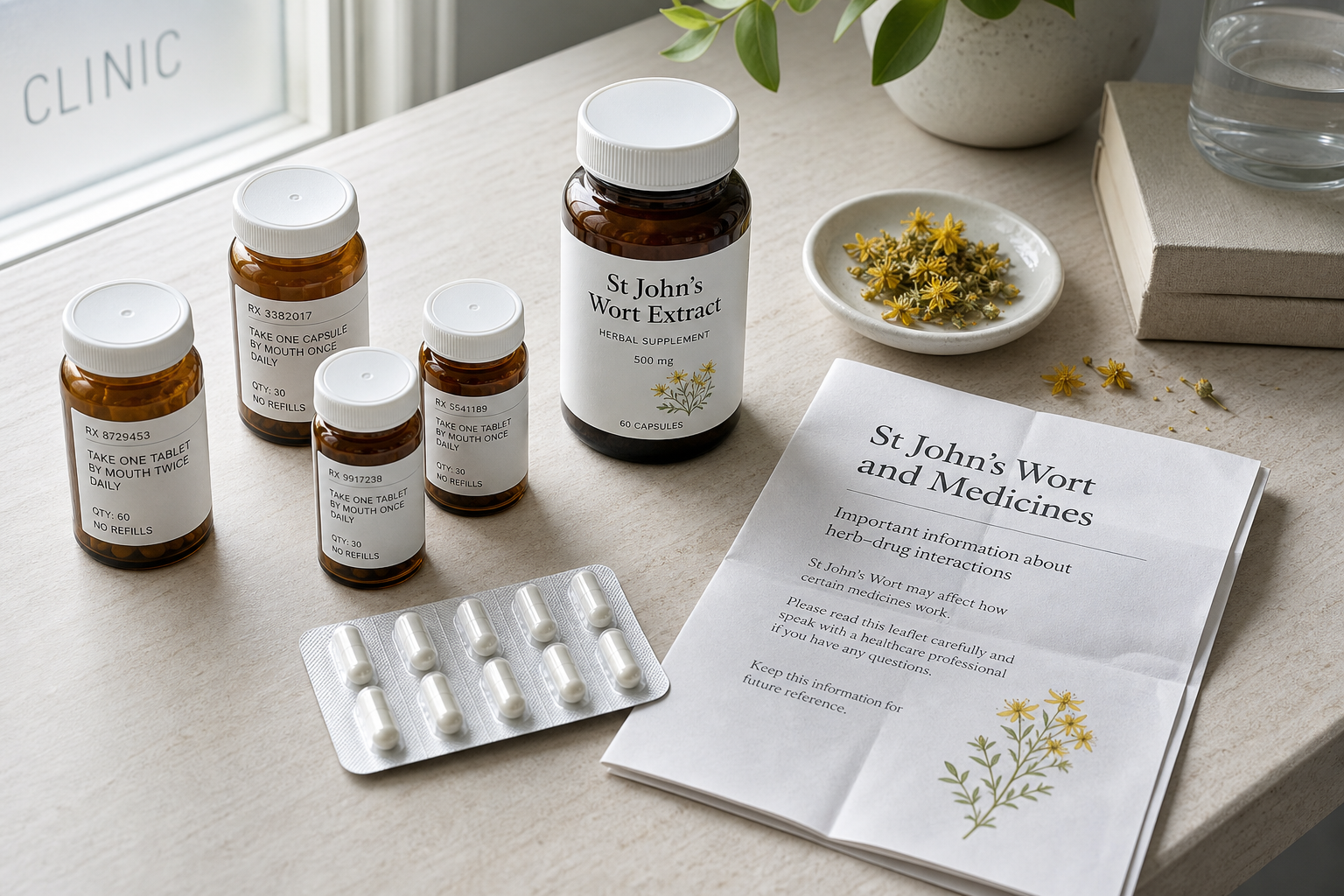
The article repeatedly returns to the same point: the defining hazard of St John’s wort is not dramatic toxicity from the herb alone, but its ability to make many medicines work less well. Mechanistically, it induces CYP3A4 and P-glycoprotein, with additional effects on CYP2B6, CYP2C9, and CYP2C19, and hyperforin appears to be a main driver. The practical result is reduced drug exposure rather than a simple nuisance side effect. Oral contraceptives may become less reliable, antiretrovirals may fail, immunosuppressant levels may drop, and digoxin exposure can decrease. The article highlights antidepressants and other serotonergic drugs, hormonal contraceptives, warfarin, cyclosporine, tacrolimus, HIV drugs, digoxin, some antiepileptics, some statins, methadone, and certain cancer drugs as especially important examples. Human pharmacokinetic studies and agency warnings are central to this conclusion, which is why the supplement is described as unusually risky in self-care. PubMed — Indinavir Interaction Study; PubMed — Digoxin Interaction Study; PubMed — Review of Drug Interactions; FDA — Drug-Herbal Interactions; NCCIH — St. John’s Wort
Quality and authenticity vary across the marketplace
The article also emphasizes that even if the herb itself has evidence, the marketplace may not consistently deliver products that resemble those used in research. Studies on raw materials show variation related to geography, subspecies boundaries, value chains, and processing quality, and these differences can change the final constituent balance. Finished-product investigations add another concern: some commercial St John’s wort products have shown authenticity problems, including possible substitution with other Hypericum species or distinct chemotypes, and in some cases adulteration with food dyes. Separate analytical work found that products with apparently similar label claims can still differ materially in hypericin and hyperforin content, including batch-to-batch differences. The article uses these findings to explain why third-party quality practices, authenticated sourcing, and manufacturer transparency matter much more here than they might for a simpler single-compound supplement. Frontiers in Plant Science — Raw Material Variability; UCL Discovery — Authenticity of Commercial St John’s Wort Products; PubMed — Hypericin and Hyperforin Variability Study; PubMed — Product Analysis Study
The low-hyperforin idea is interesting, but not a proven safety solution
The article treats low-hyperforin extracts as a useful nuance rather than a settled answer. Some researchers have argued that lower-hyperforin products may reduce interaction risk, and reviews note that marketed preparations vary widely in hyperforin content. However, the EMA revision opinion says no clearly established interaction-free dose range has been defined, and even lower-hyperforin preparations do not remove regulatory concern in self-medication. The broader evidence gaps remain important: which exact preparations offer the best balance of benefit and risk, how low-hyperforin strategies perform in real-world practice, how findings from classic European extracts translate to today’s global supplement market, and how to advise special populations such as pregnant or breastfeeding people, children, and people taking multiple medicines. The article’s practical message is that lower hyperforin may mean lower risk, but not proven safety. PMC Review — Hyperforin and Interaction Risk; EMA HMPC Opinion — Revision of Hypericum Monograph; NCBI Bookshelf — St. John’s Wort and Lactation; NCBI Bookshelf — St. John’s Wort and Pregnancy
Regulatory category does not equal evidence standard
The EU and US discussion in the article is not just legal background; it helps explain why labels can be misleading. In the United States, St John’s wort is treated as a botanical dietary supplement rather than an FDA-approved drug, so it can be sold legally but is not approved to treat depression. In Europe, some Hypericum preparations fall within the herbal medicinal framework, where the EMA monograph recognizes well-established use for certain standardized dry extracts in mild to moderate depressive episodes and traditional use for several lower-evidence indications. The article stresses that these systems are not interchangeable. A food supplement, a standardized extract used in trials, and a registered herbal medicinal product may all contain “St John’s wort,” yet they do not necessarily share the same evidence base, permitted claims, or risk profile. NIH ODS — Dietary Supplements Overview; FDA — Drug-Herbal Interactions; EMA HMPC Monograph — Hypericum perforatum
Regulatory Status (EU and US)
United States
In the United States, St John’s wort is regulated primarily as a botanical dietary supplement rather than as an FDA-approved medicine. It may be sold legally in supplement form, but it is not approved by FDA to treat depression, and supplement marketing cannot make drug-style disease-treatment claims. FDA guidance and consumer warnings focus especially on its ability to alter drug exposure and reduce the effectiveness of important medicines. NIH ODS — Dietary Supplements Overview; FDA — Drug-Herbal Interactions; FDA Consumer Update — Drug and Herbal Interactions
European Union
In Europe, the picture is more layered. The EMA herbal monograph gives certain Hypericum perforatum preparations well-established use status for mild to moderate depressive episodes and traditional-use status for several other indications, but those positions apply to defined herbal medicinal preparations rather than automatically to every supplement on the market. The EMA revision opinion also notes concern that clinically relevant herb-drug interactions are difficult to manage and that no clearly established interaction-free dose range has been defined. EMA HMPC Monograph — Hypericum perforatum; EMA HMPC Opinion — Revision of Hypericum Monograph
Practical takeaway: a St John’s wort product may be legal in both markets without having the same evidence standard, permitted claims, or safety profile as a standardized extract studied in trials or a registered herbal medicinal product. NCCIH — St. John’s Wort; EMA HMPC Monograph — Hypericum perforatum
Dosage and Standardization
Studied oral extracts: common regimens include 300 mg one to three times daily, 300–600 mg one to three times daily, or 600–900 mg once daily. Across studies, daily totals are often about 500–1,800 mg depending on the extract. Tea dosing is different and belongs mainly to traditional-use contexts.
Safety And Interactions
Interaction risk: St John’s wort can induce CYP3A4, CYP2B6, CYP2C9, CYP2C19, and P-glycoprotein, lowering blood levels and effectiveness of medicines including oral contraceptives, warfarin and related anticoagulants, cyclosporine, tacrolimus and other immunosuppressants, HIV medicines, digoxin, some antiseizure medicines, methadone, some statins, and certain cancer drugs.
Serotonergic combinations: Combining it with SSRIs, SNRIs, or other serotonergic medicines or supplements can raise the risk of serotonin-related toxicity.
Other safety points: Reported side effects include digestive upset, dizziness, fatigue or drowsiness, and photosensitivity. Pregnancy use is generally not recommended, breastfeeding data are limited, children and adolescents should not routinely use it for depression, and people awaiting surgery may be advised to stop it at least five days beforehand.
Conclusion
St John’s wort is best understood as a pharmacologically active herbal supplement rather than a nutrient. Certain standardized oral extracts have the best evidence for mild to moderate depressive symptoms, while evidence for severe depression and many other promoted uses remains limited, mixed, or insufficient.
It is also not one uniform product category. Extract type, standardization, hyperforin content, raw-material quality, and manufacturing practices can influence both effectiveness and safety, and clinically important drug interactions are well documented. The most balanced view is cautious respect rather than either hype or dismissal.
Disclaimer
Disclaimer: We attempt to do our best to find relevant, accurate and most up to date information available in both, the public domain and in the clinical and medical research community. We recommend reviewing scientific sources for official information on the subject. This post is not intended as medical advice. Each individual person's health conditions vary and we advise to consult a doctor before taking any supplements.