

 Deutsch
 Español
 Suomi
Suomi Français
 Bahasa Indonesia
 Italiano
 日本語
日本語 Português
 Tagalog
Summary
Saw palmetto is a botanical supplement made from the dried ripe fruit of Serenoa repens. It is most often marketed for urinary symptoms linked to enlarged prostate, and it is also sold for hair loss and other hormone-related concerns.
The clearest clinical evidence suggests that saw palmetto used alone is unlikely to provide meaningful benefit for benign prostatic hyperplasia-related urinary symptoms. Evidence for hair loss and other uses is still limited and inconsistent. Saw palmetto is generally well tolerated, but practical differences in extract type, standardization, authenticity, and overall product quality are central to understanding what a given supplement may or may not represent.
Quick Facts
What is it useful for?
It is mainly used for urinary symptoms linked to enlarged prostate, but the best evidence suggests little or no meaningful benefit when used alone. It is also marketed for prostate comfort and male-pattern hair loss.
Supplement types
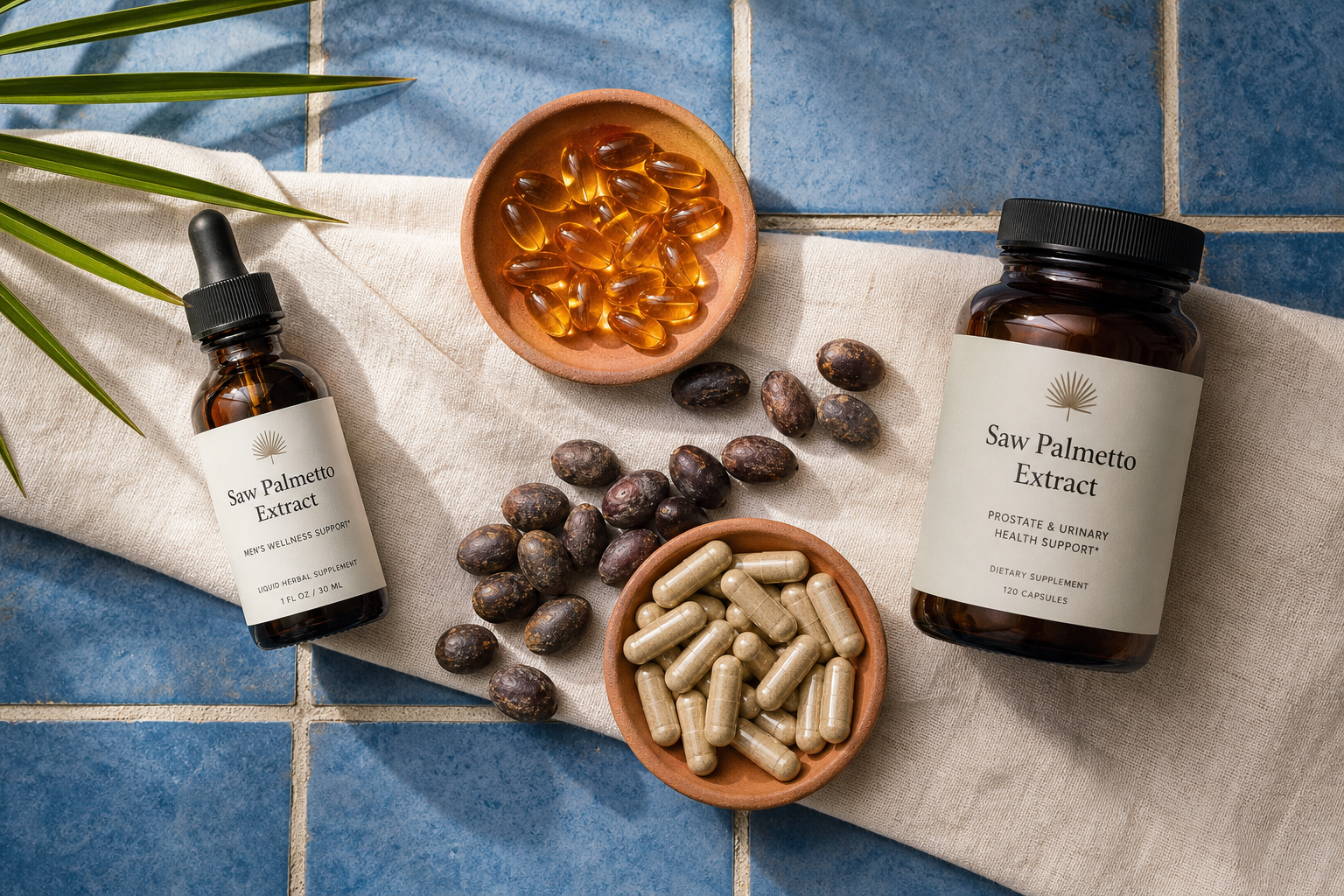
Products include whole berry powder, lipid-rich extracts, softgels, capsules, liquids, and tinctures. These forms are not chemically interchangeable.
Interactions
It may add to bleeding risk when combined with anticoagulants, antiplatelet medicines, or other products that affect clotting. Extra caution is advised before surgery.
Side effects
Reported side effects are usually mild and include stomach upset, headache, and dizziness. Rare liver injury and pancreatitis have also been reported.
Other possible benefits
Hair-loss research shows early positive signals, but the evidence is limited, mixed, and not established. Support for chronic prostatitis or pelvic pain is not convincing.
Regulatory status
In the EU it is framed mainly as a herbal medicinal ingredient with extract-specific distinctions. In the U.S. it is commonly sold as a dietary supplement without FDA preapproval for effectiveness.
What We Already Know About It
What is established. Saw palmetto is a botanical ingredient derived from the dried ripe fruit of Serenoa repens, and its best-studied use is for lower urinary tract symptoms associated with benign prostatic hyperplasia. The strongest modern clinical evidence does not support a meaningful benefit when saw palmetto is used alone for that purpose. This conclusion rests on more than one isolated trial: a recent Cochrane review and major randomized studies found little or no important advantage over placebo for symptom scores, quality of life, urinary flow, prostate size, residual urine, or PSA. Cochrane Review — Serenoa repens for benign prostatic hyperplasia; PubMed — Bent et al. 2006 placebo-controlled trial; JAMA — CAMUS trial
Why product type matters. Saw palmetto is not a single uniform substance, and it is not understood like a nutrient with a recommended intake. Lipophilic extracts contain fatty acids, sterols, and related compounds that have been discussed in relation to androgen-related pathways, but the clinical importance of these mechanisms is not firmly settled. Interpretation is further complicated because whole berry powders, tinctures, hexane extracts, ethanolic extracts, and supercritical CO2 extracts can differ substantially in chemistry, standardization, and authenticity. That means evidence from one preparation cannot automatically be transferred to another, especially for hair loss and other emerging uses where the data remain limited and inconsistent. EMA assessment report — Serenoa repens fruit; Epistemonikos — saw palmetto and alopecia review summary; PubMed — chronic prostatitis/chronic pelvic pain review; PubMed — metabolomics comparison of saw palmetto extracts
Summary of Relevant Scientific Research
Little or no benefit for BPH symptoms — Cochrane Review
Across 27 studies involving 4,656 participants, saw palmetto used alone produced little to no difference versus placebo for urinary symptom scores or quality of life in both shorter and longer follow-up. Adverse events were similar to placebo, and the review noted that combination products are harder to interpret than saw palmetto alone. Cochrane Review — Serenoa repens for benign prostatic hyperplasia
Landmark placebo trial found no meaningful improvement — New England Journal of Medicine
The Bent et al. randomized trial found that saw palmetto did not significantly improve symptom scores, urinary flow, prostate size, residual urine, quality of life, or PSA compared with placebo over one year. This trial helped shift opinion away from earlier, smaller, more favorable studies. PubMed — Bent et al. 2006 placebo-controlled trial
Higher doses still failed to beat placebo — JAMA CAMUS Trial
The CAMUS study tested escalating doses up to three times the usual amount and still found no benefit over placebo for lower urinary tract symptoms. That result makes a simple “the dose was too low” explanation much less convincing for the extract that was studied. JAMA — CAMUS trial
Hair-loss findings remain early and mixed — Systematic Review and Network Meta-analysis
A 2020 review and a later network meta-analysis found some favorable signals for androgenetic alopecia and related thinning, but both emphasized small samples, heterogeneous methods, and weak direct comparisons across products. The evidence supports further study more than firm efficacy claims. Epistemonikos — saw palmetto and alopecia review summary; PubMed — network meta-analysis on hair-loss treatments
Composition and authenticity vary across products — EMA, USP, and analytical studies
Regulatory and analytical sources show that extraction method and product standardization materially affect composition. EMA distinguishes major extract types, USP sets identity and composition criteria, and commercial variability studies found meaningful differences across products, reinforcing that generic “saw palmetto” labeling can hide major quality differences. EMA assessment report — Serenoa repens fruit; USP monograph — saw palmetto; Journal of the American College of Clinical Pharmacy — variability of commercial saw palmetto products
Beliefs, Myths & Unproven Claims
“Saw palmetto is a proven natural treatment for enlarged prostate”
This belief is not well supported by current evidence. The strongest modern trials and the most recent Cochrane review found little or no clinically meaningful benefit when saw palmetto was used alone for urinary symptoms related to benign prostatic hyperplasia, showing that long market use is not the same as proof of effectiveness. Cochrane Review — Serenoa repens for benign prostatic hyperplasia; PubMed — Bent et al. 2006 placebo-controlled trial; Mayo Clinic — benign prostatic hyperplasia overview
“If the usual dose does not work, just take much more”
The CAMUS trial directly weakens this idea. Participants received escalating doses up to triple the usual amount, yet saw palmetto still did not outperform placebo for lower urinary tract symptoms, so lack of benefit cannot be explained away simply as underdosing for the studied extract. JAMA — CAMUS trial
“All saw palmetto products are basically the same”
This is not supported by the chemistry or regulatory literature. Whole berry powders, tinctures, softgel extracts, and multi-ingredient blends may contain very different profiles of fatty acids and phytosterols, so one product should not be assumed to reproduce the findings of another. PMC — composition comparison of saw palmetto products; PubMed — metabolomics comparison of saw palmetto extracts
“Saw palmetto clearly works for hair loss”
Hair-loss claims are better described as promising but unproven. Small studies and reviews suggest possible benefit in androgenetic alopecia and related thinning, but the trials are few, heterogeneous, and often involve combination products or varied outcome measures. Epistemonikos — saw palmetto and alopecia review summary; PubMed — network meta-analysis on hair-loss treatments
Detailed Research Observations
What saw palmetto actually is
Saw palmetto is best understood as a botanical supplement ingredient rather than a nutrient. Official descriptions identify it as the dried ripe fruit of Serenoa repens, and in the United States it is usually sold within the dietary supplement framework under food law rather than drug approval law. That distinction matters because concepts such as deficiency states, essentiality, or recommended daily intake do not really fit this ingredient. From both a scientific and regulatory perspective, saw palmetto is an herbal material whose identity depends on the plant source and the manufacturing process used to prepare it. NCCIH — Saw Palmetto fact sheet; EMA — Saw palmetto fruit overview; FDA — Dietary Supplements
This also helps explain why consumer expectations can become distorted. Saw palmetto is often marketed like a general men’s health ingredient, but the better framework is botanical, product-specific, and preparation-dependent. Historical use may support interest and basic plausibility, yet it does not substitute for modern evidence showing what a specific extract does in a specific clinical setting. EMA assessment report — Serenoa repens fruit
Forms on the market and why extraction matters
Consumers encounter saw palmetto as whole berry powder, dried berry capsules, lipid or sterol extracts, softgels, liquids, and tinctures. That variety is not merely cosmetic. The preparations most closely linked to clinical use have historically been lipophilic extracts rather than raw berry powder, and monograph literature commonly points to extract-based use around 320 mg per day. Composition studies also show that powders, tinctures, liquids, and dried berries can differ substantially in fatty acids and phytosterols, so a label that simply says “saw palmetto” can conceal major differences in the actual material being sold. NCBI Bookshelf — Saw Palmetto monograph; PMC — composition comparison of saw palmetto products; EMA assessment report — Serenoa repens fruit
Extraction method is part of ingredient identity, not a trivial manufacturing detail. EMA distinguishes hexane, ethanol, and supercritical CO2 extracts, and analytical work shows that these are chemically similar in some respects but not identical. EMA considers only the hexane extract sufficiently supported for well-established medicinal use, while ethanolic extracts are limited to traditional-use status and supercritical CO2 extracts were not considered sufficiently supported for well-established use. EMA assessment report — Serenoa repens fruit; PubMed — metabolomics comparison of saw palmetto extracts
The best-studied use: urinary symptoms in enlarged prostate
The leading commercial claim for saw palmetto has long been relief of lower urinary tract symptoms associated with benign prostatic hyperplasia. This is also the use with the most mature evidence base, which is why the conclusion is comparatively firm. The Cochrane review found little to no difference from placebo in symptom scores and quality of life, while the 2006 placebo-controlled trial in the New England Journal of Medicine found no meaningful improvement in symptoms, urinary flow, prostate size, residual volume, or PSA. Cochrane Review — Serenoa repens for benign prostatic hyperplasia; PubMed — Bent et al. 2006 placebo-controlled trial
The dose-escalation argument was also tested directly. In the CAMUS trial, participants received up to three times the usual dose, yet saw palmetto still did not outperform placebo for lower urinary tract symptoms. Taken together, these findings make saw palmetto alone one of the clearer examples of a supplement that is popular, extensively studied, and still not convincingly effective for its main claim. JAMA — CAMUS trial
Other claimed uses: hair loss and pelvic pain
Outside BPH-related symptoms, the evidence becomes much less settled. Hair-loss research has shown enough positive signal to justify continued investigation, but not enough to support strong efficacy claims. A 2020 systematic review identified a small body of randomized and prospective studies suggesting possible benefit in androgenetic alopecia and related thinning, while a later network meta-analysis also found some favorable findings in parts of the analysis. Even so, both sources emphasized heterogeneity, limited sample sizes, and the use of varying products and outcomes. Epistemonikos — saw palmetto and alopecia review summary; PubMed — network meta-analysis on hair-loss treatments
The evidence for chronic prostatitis or chronic pelvic pain syndrome is weaker still. Review-level evidence did not show significant benefit in that setting, which means broad “men’s health” positioning can imply a level of proof that the literature does not actually support. The most accurate reading is narrow: hair-loss data are preliminary, while pelvic pain evidence is not convincing. PubMed — chronic prostatitis/chronic pelvic pain review; NCCIH — Saw Palmetto fact sheet
Species identity, standardization, and adulteration
Product quality is a major practical issue in this category. A DNA barcoding study of U.S. products found that not all supplements sold as saw palmetto actually contained authentic saw palmetto, and some contained related species that should not legally be sold as saw palmetto dietary supplements in the United States. This means sourcing is not only about where the plant was grown; it also concerns whether the ingredient is the correct species in the first place. Scientific Reports — DNA barcoding of saw palmetto supplements
Even authentic products can vary sharply in composition. USP sets expectations for identity and composition, while commercial variability studies found that products standardized to at least 80 percent total fatty acids were more likely to align with established quality benchmarks. EMA also notes differences in free versus esterified fatty acids and warns about confusion created by products containing olive oil. Botanical forensics literature adds that some adulterated products may mimic a plausible fatty acid profile using oil mixtures, so stronger authentication may require both species verification and broader phytochemical testing. USP monograph — saw palmetto; Journal of the American College of Clinical Pharmacy — variability of commercial saw palmetto products; PMC — botanical forensics and adulteration review; EMA assessment report — Serenoa repens fruit
Safety in context and why interpretation stays difficult
Safety is often described as generally favorable, and that broad description is fair, but it should not be simplified too much. NCCIH identifies mild digestive symptoms, dizziness, and headache as the more common side effects and notes that saw palmetto does not appear to affect PSA readings. At the same time, LiverTox and the EMA assessment report discuss rare reports of liver injury and pancreatitis, and practical guidance from EMA and Mayo Clinic supports caution around anticoagulants, antiplatelet medicines, and surgery because of bleeding-related concerns. NCCIH — Saw Palmetto fact sheet; NCBI Bookshelf — LiverTox saw palmetto; Mayo Clinic — herbal supplements overview for saw palmetto; EMA assessment report — Serenoa repens fruit
One reason the evidence base remains messy is that the market and the science are poorly aligned. Clinical discussions often refer broadly to “saw palmetto,” yet products differ by authentication, extraction solvent, fatty acid profile, standardization, and whether they are used alone or in blends. That helps explain why consumers still see confident claims online despite strong negative evidence for the best-known use: the term covers a category of variable products rather than one uniform intervention. Cochrane Review — Serenoa repens for benign prostatic hyperplasia; Journal of the American College of Clinical Pharmacy — variability of commercial saw palmetto products
Regulatory Status (EU and US)
European Union
In Europe, saw palmetto is framed mainly as a herbal medicinal ingredient rather than a nutrient. EMA distinguishes among preparations instead of treating every saw palmetto product as equivalent. According to the EMA assessment materials, only the hexane extract is considered sufficiently supported for well-established medicinal use, while ethanolic extracts are limited to traditional-use status and supercritical CO2 extracts were not considered sufficiently supported for well-established medicinal use. EMA — Saw palmetto fruit overview; EMA assessment report — Serenoa repens fruit
United States
In the United States, saw palmetto products are usually sold as dietary supplements under the food framework. FDA explains that dietary supplements are not approved by the agency for safety and effectiveness before sale, and manufacturers are responsible for safety and labeling. As a result, a saw palmetto supplement can be marketed without FDA approval as an effective treatment for enlarged prostate, hair loss, or other conditions. FDA — Dietary Supplements; FDA Consumer Update — It Really Is FDA Approved?
Dosage and Standardization
Saw palmetto has no recommended daily intake. In clinical literature, the usual adult pattern is 320 mg/day of a lipid-rich standardized extract, taken as 160 mg twice daily or 320 mg once daily. This applies mainly to extract products, not whole berry powders or loosely defined tinctures. Doses up to 960 mg/day did not improve BPH-related urinary symptoms.
Safety And Interactions
The overall safety profile appears fairly good, and this is one of the better-established parts of the saw palmetto literature. Official guidance describes side effects as usually mild, with digestive upset, dizziness, and headache among the more commonly reported complaints. Saw palmetto also does not appear to affect PSA readings, which is clinically relevant for people worried about masking prostate screening results. NCCIH — Saw Palmetto fact sheet
Important cautions remain. Pregnancy and breastfeeding are generally advised against because safety is not established. Bleeding interaction concerns with warfarin, aspirin, and clopidogrel are precautionary rather than definitively quantified, but they are supported by practical guidance and case-report literature, so perioperative caution is sensible. Rare liver injury and pancreatitis have also been reported. People with liver disease, those taking anticoagulants or antiplatelet drugs, and anyone preparing for surgery should be especially cautious and seek medical advice. EMA assessment report — Serenoa repens fruit; Mayo Clinic — herbal supplements overview for saw palmetto; PubMed — bleeding-related case report; NCBI Bookshelf — LiverTox saw palmetto
Conclusion
Saw palmetto is best understood as a botanical supplement ingredient derived from Serenoa repens fruit, not as an essential nutrient. Its strongest historical and commercial association is with urinary symptoms linked to enlarged prostate, but this is also the area where the evidence is clearest: saw palmetto used alone appears to provide little or no meaningful benefit compared with placebo.
For hair loss, there are early positive signals, but the evidence remains preliminary and inconsistent. Across all uses, major practical issues include extraction method, fatty acid profile, standardization, and even species authenticity, so many retail products are not interchangeable with the preparations studied clinically. Safety is generally acceptable, but mild side effects, bleeding-related cautions, and rare liver-related harms should still be taken seriously.
Disclaimer
Disclaimer: We attempt to do our best to find relevant, accurate and most up to date information available in both, the public domain and in the clinical and medical research community. We recommend reviewing scientific sources for official information on the subject. This post is not intended as medical advice. Each individual person's health conditions vary and we advise to consult a doctor before taking any supplements.