

 Deutsch
 Español
 Suomi
Suomi Français
 Bahasa Indonesia
 Italiano
 日本語
日本語 Português
 Tagalog
Summary
Biotin, or vitamin B7, is an essential water-soluble vitamin that supports normal metabolism through several carboxylase enzymes. For most healthy adults eating a mixed diet, true deficiency is uncommon, so biotin is better understood as a basic nutrient than as a universal beauty supplement.
The strongest case for supplementation is correction of confirmed or suspected deficiency, including rare inherited disorders and certain higher-risk situations such as long-term anticonvulsant use, prolonged raw egg white intake, or some malabsorption-related states. Evidence that high-dose biotin improves hair, skin, or nails in biotin-replete adults is limited, and the most important modern safety issue is interference with blood tests at milligram doses.
Quick Facts
What is it useful for?
Biotin is useful for meeting vitamin B7 needs and for correcting confirmed or suspected deficiency, especially in inherited biotin-related disorders and other at-risk states.
Supplement types
Most products contain free oral biotin, usually labeled biotin or D-biotin, sold alone, in B-complex products, or in multivitamins.
Interactions
High-dose biotin can interfere with laboratory tests. Raw egg white avidin can reduce absorption, and some anticonvulsants may lower biotin status over time.
Side effects
Biotin is usually well tolerated, but the main concern is false laboratory results, especially with thyroid, troponin, PTH, and some vitamin D assays.
Other possible benefits
Benefit is clearest for deficiency correction and inherited biotin-related disorders. Brittle nails have some suggestive human data, but cosmetic hair or skin benefits in replete adults remain weak.
Regulatory status
In the EU, certain biotin nutrient-function claims are allowed. In the U.S., biotin is a lawful supplement ingredient, but supplements are not preapproved by FDA before sale.
What We Already Know About It
Core biological role. Biotin is vitamin B7, a water-soluble nutrient that acts as a cofactor for five human carboxylases involved in fatty-acid synthesis, gluconeogenesis, and amino-acid metabolism. Institutional reviews also describe additional roles in gene regulation and cell signaling, but its best-established function is supporting normal intermediary metabolism. NIH ODS — Biotin Fact Sheet EFSA — Dietary Reference Values for Biotin
Absorption and nutrition. Food biotin is usually protein-bound and released during digestion, whereas supplements generally provide free oral biotin that is absorbed very efficiently. This helps explain why oral supplementation can correct deficiency effectively even though daily requirements are small: 30 mcg/day for U.S. adults and pregnancy, 35 mcg/day in U.S. lactation, and 40 mcg/day for European adults. NIH ODS — Biotin Fact Sheet EFSA — Dietary Reference Values for Biotin
Where evidence is strongest. The clearest case for supplementation is deficiency prevention and treatment, including biotinidase deficiency and other acquired deficiency states. By contrast, clinical support for high-dose use in biotin-replete adults is much weaker: hair-growth evidence is poor, nail data are limited, and much of the real-world concern around milligram doses now relates to lab test interference rather than proven cosmetic benefit. GeneReviews — Biotinidase Deficiency Skin Appendage Disorders — Review of Biotin for Hair Loss JALM — Guidance on Biotin Interference in Laboratory Tests
Summary of Relevant Scientific Research
Biotin's established metabolic role — NIH Office of Dietary Supplements
NIH describes biotin as an essential cofactor for five carboxylases involved in fatty-acid, glucose, and amino-acid metabolism, and also notes roles in gene regulation and cell signaling. The same review distinguishes protein-bound food biotin from efficiently absorbed free supplemental biotin. NIH ODS — Biotin Fact Sheet
Adequate intake, not megadose endorsement — EFSA
EFSA set an adult adequate intake of 40 mcg/day and treated biotin primarily as a nutrition adequacy issue. EFSA's permitted claims are maintenance claims tied to normal physiology, not proof that high cosmetic doses improve appearance in well-nourished adults. EFSA — Dietary Reference Values for Biotin EFSA — Health Claims Opinion on Biotin
Lab interference is a real clinical issue — AACC/JALM and FDA
Guidance from laboratory medicine shows that 10 mg/day for 7 days interfered with 9 of 23 tested assays in healthy volunteers. FDA also warns that biotin can produce falsely low troponin results in some assays, creating potential risk during cardiac evaluation. JALM — Guidance on Biotin Interference in Laboratory Tests FDA — Biotin Interference with Troponin Lab Tests
Hair-growth evidence remains weak in healthy adults — Dermatology reviews
The 2017 Patel, Swink, and Castelo-Soccio review found only 18 reported cases, all involving underlying pathology. A newer 2024 review similarly stated that no studies show improved hair growth in healthy adults with sufficient biotin levels. Skin Appendage Disorders — Review of Biotin for Hair Loss Journal of Clinical and Aesthetic Dermatology — Biotin for Hair Loss
Brittle nails show suggestive but limited benefit — Floersheim and Chiavetta
Older research using 2.5 mg/day reported improved nail firmness, but the study was uncontrolled and had major attrition. A later assessor-blinded trial using nail lacquer plus 10 mg/day found more improvement than lacquer alone, yet still could not isolate biotin's independent effect. PubMed — Floersheim 1989 Brittle Nail Study PubMed — Chiavetta et al. 2019 Nail Trial
Deficiency treatment is the clearest clinical use — GeneReviews and StatPearls
Clinical sources recommend oral biotin for profound and partial biotinidase deficiency and describe therapeutic doses of 5 to 10 mg/day in suspected or confirmed deficiency states. This is where supplementation has the strongest biologic and clinical rationale. GeneReviews — Biotinidase Deficiency StatPearls — Vitamin B7 (Biotin)
Beliefs, Myths & Unproven Claims
Myth: Biotin helps almost everyone grow thicker hair
Current reviews do not support routine biotin use for hair growth in healthy, biotin-replete adults. Reported benefit is mainly seen when there is true deficiency, inherited metabolic disease, insufficient intake, or another identifiable pathology. Skin Appendage Disorders — Review of Biotin for Hair Loss Journal of Clinical and Aesthetic Dermatology — Biotin for Hair Loss
Myth: Because biotin is water-soluble, more is automatically better
The lack of a formal U.S. upper limit is not proof that high doses are useful or consequence-free. In practice, larger doses mainly raise the risk of misleading laboratory results, especially with thyroid testing and some troponin assays. NIH ODS — Biotin Fact Sheet JALM — Guidance on Biotin Interference in Laboratory Tests FDA — Biotin Interference with Troponin Lab Tests
Myth: EFSA-approved claims prove high-dose beauty products work
EFSA's approved claims describe biotin's contribution to normal maintenance of hair, skin, nails, and macronutrient metabolism at adequate intake. They are not the same as clinical proof that megadoses improve appearance in people who already have enough biotin. EFSA — Health Claims Opinion on Biotin
Myth: Nail benefits are firmly proven
Brittle nail findings are interesting but still limited by older uncontrolled methods or incomplete trial design. The evidence is better described as suggestive than definitive, so common marketing claims can overstate certainty. PubMed — Floersheim 1989 Brittle Nail Study PubMed — Chiavetta et al. 2019 Nail Trial
Detailed Research Observations
Biotin is mainly an essential nutrient story
Biotin is best understood first as vitamin B7 rather than as a specialty beauty ingredient. Its core physiologic role is to help several enzymes carry out reactions involved in using carbohydrates, fats, and certain amino acids. Because these pathways are basic to normal metabolism, deficiency can affect multiple tissues and systems, including hair, skin, nails, and the nervous system. Institutional reviews also note roles in gene regulation and cell signaling, although the strongest evidence still centers on its coenzyme function in intermediary metabolism. NIH ODS — Biotin Fact Sheet Linus Pauling Institute — Biotin Overview
This framing matters because it separates biotin's established nutritional importance from broader supplement marketing. In both U.S. and European guidance, biotin is treated primarily as a nutrient needed in small daily amounts. U.S. adequate intake values are 30 mcg/day for adults and pregnancy and 35 mcg/day for lactation, while EFSA uses 40 mcg/day for adults. These are nutrition targets, not endorsements of high-dose cosmetic use. NIH ODS — Biotin Fact Sheet EFSA — Dietary Reference Values for Biotin
Food biotin and supplemental biotin are not identical in form
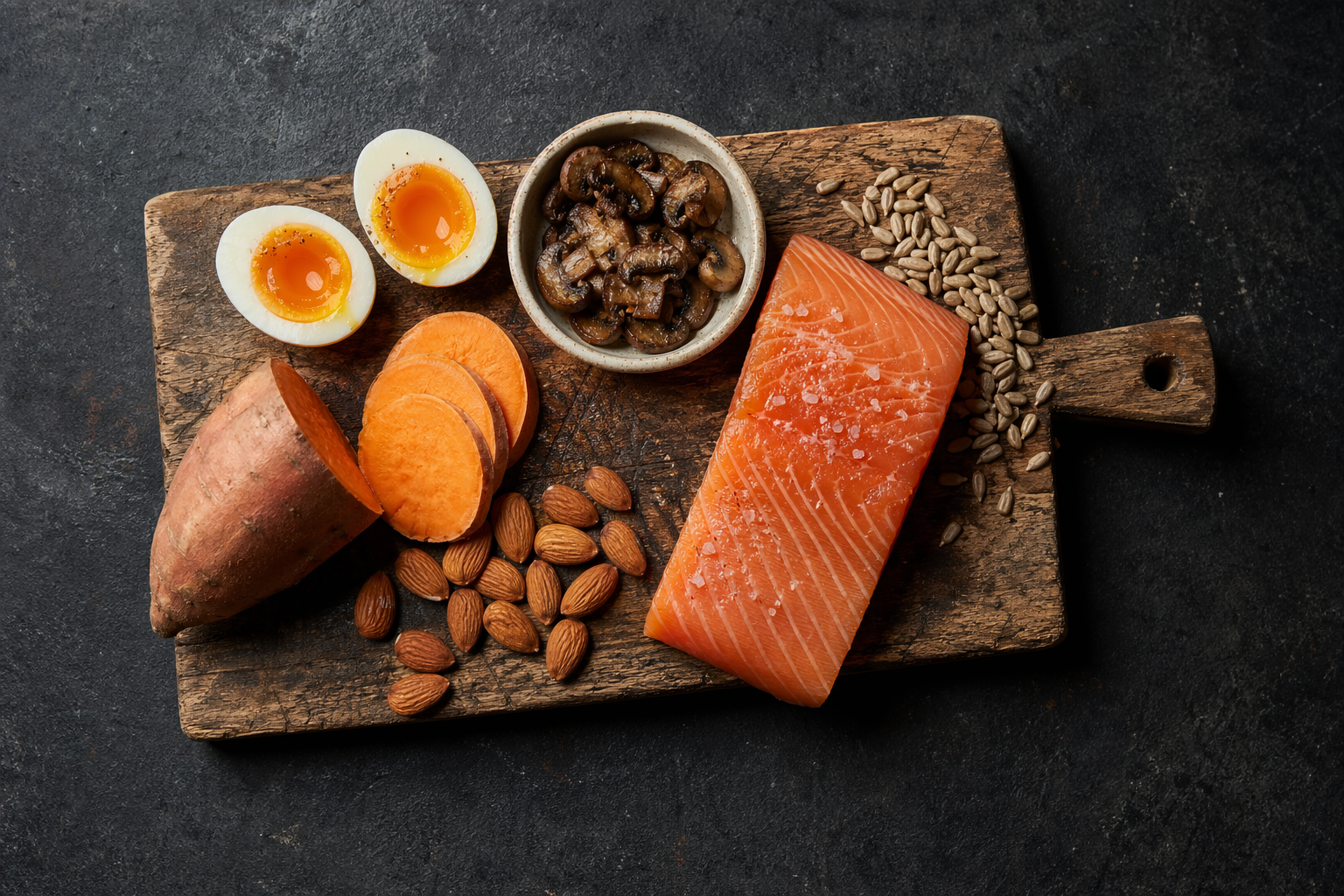
Biotin occurs in foods such as organ meats, cooked eggs, fish, meat, seeds, nuts, and some vegetables. Most food biotin is protein-bound and needs to be released during digestion before absorption. Supplements, by contrast, usually provide free biotin, which oral studies suggest is absorbed very efficiently. This difference helps explain why supplements can work well in deficiency states even though food remains sufficient for most healthy adults. NIH ODS — Biotin Fact Sheet
The same distinction also helps explain a modern safety issue: normal dietary intake usually does not cause meaningful assay interference, but milligram-dose supplements can raise circulating biotin enough to affect certain lab tests. Raw egg white is another important practical detail because it contains avidin, which binds biotin and can reduce absorption if consumed chronically; cooking denatures avidin and largely removes this problem. JALM — Guidance on Biotin Interference in Laboratory Tests NIH ODS — Biotin Fact Sheet
Deficiency is uncommon, but risk groups are recognizable
True biotin deficiency is uncommon in generally healthy adults eating mixed diets, yet several groups are clearly more vulnerable. These include people with inherited disorders such as biotinidase deficiency, those receiving long-term anticonvulsant therapy, people on total parenteral nutrition without adequate supplementation, chronic heavy raw egg white consumers, and some individuals with alcohol exposure or malabsorption-related problems. In these settings, biotin supplementation has a clear biologic rationale because the underlying issue is impaired intake, absorption, or metabolism of an essential vitamin. GeneReviews — Biotinidase Deficiency StatPearls — Vitamin B7 (Biotin) NIH ODS — Biotin Fact Sheet
Clinical signs in deficiency-prone states can include hair loss, red scaly rash, brittle nails, and neurologic symptoms such as lethargy, depression, hallucinations, or paresthesias. Pregnancy also deserves separate attention: controlled biomarker work suggests marginal biotin deficiency may be common during normal gestation even without obvious symptoms. That supports attention to adequacy and clinical assessment when needed, but it does not prove that routine high-dose cosmetic biotin is justified during pregnancy. PMC — Controlled-Diet Pregnancy Biotin Research NIH ODS — Biotin Fact Sheet EFSA — Dietary Reference Values for Biotin
Hair, skin, and nail claims vary greatly in evidence quality
Biotin's reputation in hair supplements is much stronger than its clinical evidence base. Dermatology reviews consistently conclude that reported benefits are mainly seen in people with identifiable pathology, including true deficiency, inherited disorders of biotin metabolism, insufficient intake, or selected hair-growth disorders. These findings support targeted use in special situations, not a general claim that healthy adults with adequate biotin status will grow thicker or faster hair by taking more of it. Skin Appendage Disorders — Review of Biotin for Hair Loss Journal of Clinical and Aesthetic Dermatology — Biotin for Hair Loss
Nails are the one cosmetic area with somewhat more supportive human data, but even here the evidence is not definitive. The classic 1989 brittle nail study used 2.5 mg/day and reported improvement, yet it was uncontrolled, had major dropout, and did not establish deficiency status. A later assessor-blinded trial found benefit when nail lacquer was combined with 10 mg/day of oral biotin, but there was no placebo or biotin-only arm, so the specific independent effect of biotin remained unclear. PubMed — Floersheim 1989 Brittle Nail Study PubMed — Chiavetta et al. 2019 Nail Trial
Product labels differ more by dose than by meaningful active form
From a chemistry standpoint, biotin exists in several stereoisomeric forms, but only D-biotin is biologically active. That is why some products are labeled biotin and others D-biotin. For ordinary oral supplements, this is usually not evidence of a superior premium form; it is mostly a more chemically explicit label. In practice, the main real-world differences between products are dose and whether biotin is sold alone, in a B-complex, or within a multivitamin. PMC — Chemistry and Sources of Biotin NIH ODS — Biotin Fact Sheet
Clinical dosing illustrates the gap between nutritional needs and supplement marketing. Basic nutrition targets are measured in micrograms, whereas older brittle-nail studies used 2.5 mg/day and deficiency treatment commonly uses 5 to 10 mg/day. GeneReviews recommends 5 to 10 mg/day for profound biotinidase deficiency and 2.5 to 10 mg/day for partial deficiency. For routine hair, skin, and nail use in non-deficient adults, no well-established evidence-based target dose exists because efficacy itself remains unproven. GeneReviews — Biotinidase Deficiency StatPearls — Vitamin B7 (Biotin) PubMed — Floersheim 1989 Brittle Nail Study
Laboratory interference is the most important modern caution
The best-established current safety issue with biotin is not classic toxicity but interference with biotinylated immunoassays. Doses of 5 mg or more can raise blood concentrations enough to affect some tests, and 10 mg/day for 7 days has been shown to interfere with multiple assays in healthy volunteers. Affected results can include thyroid markers, parathyroid hormone, NT-proBNP, 25-hydroxyvitamin D, some reproductive hormones, and certain troponin tests. FDA has specifically warned that falsely low troponin results can be dangerous in emergency cardiac care. JALM — Guidance on Biotin Interference in Laboratory Tests FDA — Biotin Interference with Troponin Lab Tests
This safety issue also helps explain why legal availability should not be confused with proof of broad benefit. In the EU, EFSA allows nutrient-function claims about normal hair, skin, nails, and metabolism, but these are not drug-style approvals for cosmetic improvement in all users. In the U.S., biotin is a lawful dietary supplement ingredient, yet FDA does not preapprove supplements for safety or effectiveness before marketing. The most evidence-based consumer interpretation is therefore modest: biotin is useful when needed, but claims for routine high-dose beauty use go beyond what trials have shown in non-deficient adults. EFSA — Health Claims Opinion on Biotin FDA — Dietary Supplements Overview
Regulatory Status (EU and US)
European Union
In the EU, biotin has a clear nutrient-function profile. EFSA has supported claims that biotin contributes to maintenance of normal hair, skin, nails, psychological function, reduction of tiredness and fatigue, and normal macronutrient metabolism. These are not drug-style efficacy approvals, and they should not be read as proof that high-dose biotin improves cosmetic outcomes in people who already have adequate intake. EFSA — Health Claims Opinion on Biotin EFSA — Dietary Reference Values for Biotin
United States
In the U.S., biotin is a lawful dietary supplement ingredient under the standard supplement framework, but FDA does not preapprove supplements for safety, effectiveness, or labeling before marketing. Companies remain responsible for compliance, and products cannot legally claim to treat, prevent, cure, or alleviate disease unless they meet drug requirements. FDA — Dietary Supplements Overview
The practical takeaway in both regions is that biotin is allowed and nutritionally relevant, but regulatory permission is not the same as strong clinical proof for every advertised beauty or wellness use. EFSA — Health Claims Opinion on Biotin FDA — Dietary Supplements Overview
Dosage and Standardization
Nutrition: 30–40 mcg/day for adults; 35 mcg/day in U.S. lactation.
Studied/clinical use: 2.5 mg/day for brittle nails; 5–10 mg/day for deficiency or biotinidase deficiency.
Safety And Interactions
Lab interference: Biotin is generally well tolerated, but milligram doses can distort biotinylated immunoassays, including thyroid markers, parathyroid hormone, NT-proBNP, 25-hydroxyvitamin D, some reproductive hormones, and certain troponin tests. FDA warns that falsely low troponin results can be dangerous. Tell clinicians and laboratories about biotin use before bloodwork; depending on dose and assay platform, waiting at least 8 hours may be enough for some tests after 5–10 mg, while others may require up to 72 hours or longer. JALM — Guidance on Biotin Interference in Laboratory Tests FDA — Biotin Interference with Troponin Lab Tests
Other interactions: Long-term anticonvulsant therapy may lower biotin status, and chronic raw egg white intake can reduce absorption because avidin binds biotin. No formal U.S. upper limit has been set, but that does not prove high doses are risk-free or necessary. NIH ODS — Biotin Fact Sheet StatPearls — Vitamin B7 (Biotin)
Conclusion
Biotin is an essential nutrient with clear value when deficiency is present or biotin metabolism is impaired. The strongest evidence supports correction of deficiency and treatment of inherited biotin-related disorders, with possible usefulness in other higher-risk states.
For non-deficient adults, evidence for routine hair and skin benefits is weak, and nail evidence is suggestive rather than definitive. The most important practical caution is that milligram-dose supplements can interfere with clinically important blood tests.
Disclaimer
Disclaimer: We attempt to do our best to find relevant, accurate and most up to date information available in both, the public domain and in the clinical and medical research community. We recommend reviewing scientific sources for official information on the subject. This post is not intended as medical advice. Each individual person's health conditions vary and we advise to consult a doctor before taking any supplements.