

 Deutsch
 Español
 Suomi
Suomi Français
 Bahasa Indonesia
 Italiano
 日本語
日本語 Português
 Tagalog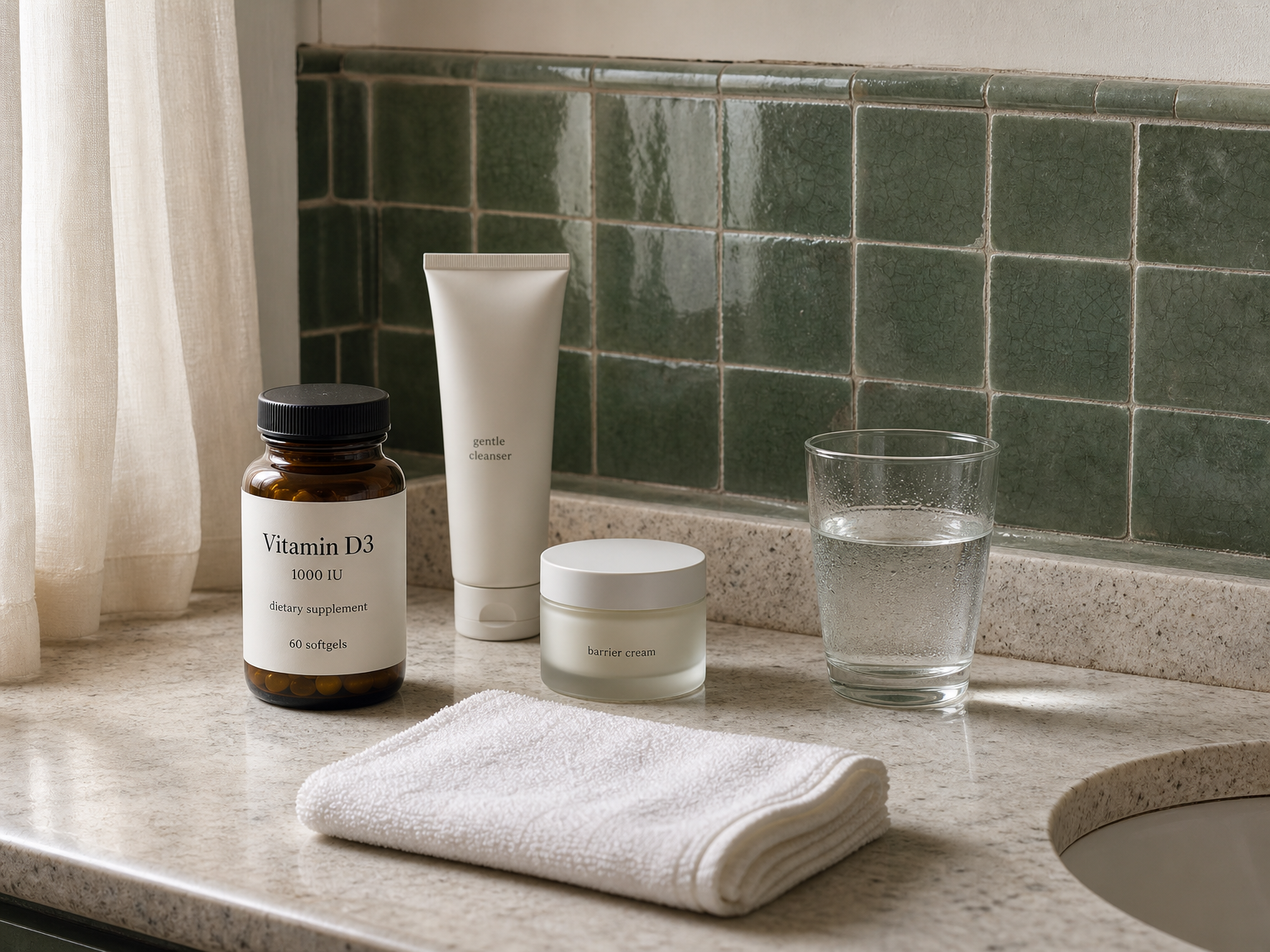
1. What vitamin D is, and why acne researchers are interested
Vitamin D is a fat-soluble nutrient that also acts a bit like a hormone. Your body can make it in the skin after sun exposure, and you can also get it from foods and supplements. Clinicians usually assess vitamin D status by measuring blood 25-hydroxyvitamin D, often shortened to 25(OH)D.
Acne vulgaris is not just “oily skin.” It involves blocked pores, excess sebum, changes in the skin microbiome and inflammation around the hair follicle. That inflammatory side of acne is where vitamin D starts to look interesting.
Human skin cells, including sebocytes — the oil-producing cells involved in acne — have vitamin D receptors and enzymes that help process vitamin D signals. In lab studies, vitamin D can calm inflammatory messengers, influence antimicrobial peptides such as cathelicidin, and may affect sebum production. That gives researchers a reasonable biological basis to study it.
Still, plausible is not the same as proven. Acne is common, vitamin D deficiency is common, and the two can overlap without one directly causing the other.

2. How vitamin D might influence acne
The most consistent proposed mechanism is its anti-inflammatory effect.
In acne, Cutibacterium acnes — formerly called Propionibacterium acnes — can trigger immune activity inside the pore. This can increase inflammatory molecules such as IL-1β, IL-6, IL-8 and TNF-α. The names are technical, but the basic idea is simple: they are part of the chemical “alarm system” that makes acne lesions red, swollen and tender.
In cell studies, vitamin D reduced several of these inflammatory signals in sebocytes exposed to C. acnes or ultraviolet B light. Other research suggests vitamin D may reduce Th17 and IL-17 immune activity, another inflammatory pathway linked with acne.
Vitamin D may also play a role in the skin’s antimicrobial defense. One study found that vitamin D increased cathelicidin expression in cultured sebocytes. Cathelicidin is an antimicrobial peptide, meaning it helps the skin respond to microbes. That does not mean vitamin D “kills acne bacteria” in the way benzoyl peroxide can, but it may help shape the immune environment around the follicle.
There is also a possible sebum angle. In one preclinical model, vitamin D reduced sebum production in C. acnes-treated sebocytes. That is intriguing, but it has not yet been shown to be a reliable real-world effect in people with acne.
3. What the evidence says
Observational studies generally find that people with acne are more likely to have low vitamin D levels, and that lower levels often track with more severe acne. A meta-analysis of 13 studies found that acne patients had lower average 25(OH)D levels than controls, and vitamin D deficiency was more common in acne. Another systematic review found that most included studies reported lower vitamin D levels as acne severity increased.
That pattern is useful, but it cannot prove cause and effect. People with acne may avoid sun exposure, use sunscreen more carefully, spend less time outdoors, have dietary differences or have inflammation that happens to correlate with vitamin D status rather than being caused by it.
The clinical trial evidence is smaller, but it is more directly useful:
- In a small randomized trial, acne patients with vitamin D deficiency took oral vitamin D3, also called cholecalciferol, at 1,000 IU per day for 8 weeks. Inflammatory lesion counts fell more in the vitamin D group than in the placebo group.
- In another randomized study, people with mild-to-moderate acne and inadequate vitamin D status used benzoyl peroxide and took either weekly vitamin D2 or placebo. Both groups improved, but vitamin D2 appeared to reduce relapse of inflammatory lesions after treatment stopped.
- A recent topical cholecalciferol trial added topical vitamin D to adapalene, a standard topical retinoid. The vitamin D group had a greater reduction in inflammatory lesions and lower IL-1β in acne lesions.
 Observational studies link acne with lower 25(OH)D, but cannot prove cause and effect.
 Small trials suggest fewer inflammatory lesions when vitamin D is added in people with low or inadequate status.
 The evidence is weakest for acne prevention and for blackheads or whiteheads.
Taken together, vitamin D looks most relevant to inflammatory acne in people with low vitamin D status. There is little convincing evidence that taking vitamin D prevents acne from developing in otherwise healthy people with adequate levels. It also has not earned a place as a core acne therapy in major acne guidelines, which continue to recommend treatments such as benzoyl peroxide, topical retinoids, selected antibiotics, hormonal therapy and isotretinoin when appropriate.
4. Which form works best?
For oral supplements, the two main forms are vitamin D2, or ergocalciferol, and vitamin D3, or cholecalciferol. Both can raise blood vitamin D. However, general vitamin D evidence suggests D3 tends to raise 25(OH)D higher and maintain it for longer than D2.
That makes vitamin D3 the most practical first choice if a clinician decides supplementation is reasonable. It also has direct acne trial evidence in vitamin D-deficient patients, using 1,000 IU daily.
Vitamin D2 is not useless. One acne trial used weekly oral D2 and found a benefit for preventing inflammatory-lesion relapse after benzoyl peroxide treatment. But that does not prove D2 is better than D3 for acne. It simply means D2 has some adjunctive evidence.
Topical vitamin D is the most experimental option. A topical cholecalciferol study is promising, especially because it measured a drop in IL-1β inside acne lesions. Still, topical vitamin D products are not standard acne medicines, and over-the-counter cosmetic “vitamin D” serums should not be assumed to match the studied preparation.
There is also no good evidence that gummies, sprays, liquids or capsules differ meaningfully for acne outcomes. The more relevant question is whether the product reliably provides vitamin D and whether it is taken with food. Because vitamin D is fat-soluble, it is usually absorbed better with a meal or snack containing some fat.
5. Practical considerations
If you have acne and suspect low vitamin D, the most sensible next step is to discuss testing or supplementation with a healthcare professional, especially if you have risk factors for deficiency. These include limited sun exposure, darker skin, covering clothing, malabsorption conditions, older age or a diet low in vitamin D.
For many generally healthy adults, routine vitamin D testing is not recommended without another indication. The Endocrine Society’s 2024 guideline also suggests against taking vitamin D above the standard dietary reference intake purely for disease prevention in generally healthy adults under 50.
For acne, vitamin D is best viewed as a possible add-on: something that may help correct deficiency and modestly improve inflammatory acne in some people. The same is true for skin health supplements more broadly: they should not replace treatments with stronger evidence, such as benzoyl peroxide, adapalene or other clinician-recommended options.
A common adult reference intake is 600 IU per day, though individual needs vary. Higher-dose treatment may be used for confirmed deficiency, but that is best supervised rather than guessed.
6. Safety
Vitamin D can be harmful in excess. The adult upper limit is 4,000 IU per day unless a clinician prescribes more for a clear reason, such as documented deficiency. More is not better for acne.
Too much vitamin D can raise calcium levels in the blood, a condition called hypercalcemia. Symptoms can include nausea, vomiting, thirst, frequent urination, weakness and confusion. Severe toxicity can contribute to kidney stones, abnormal heart rhythm and kidney failure. Toxicity is usually caused by high-dose supplements, not normal sun exposure.
Use extra caution if you have a history of kidney stones, kidney disease, high calcium levels, sarcoidosis or other conditions that affect calcium handling. If you are pregnant, trying to conceive, breastfeeding or taking regular medication, check with a clinician before using higher doses.
Vitamin D can interact with some medicines, including orlistat, steroids, thiazide diuretics and some statins. If you take any of these, do not self-prescribe high-dose vitamin D for acne.