

 Deutsch
 Español
 Suomi
Suomi Français
 Bahasa Indonesia
 Italiano
 日本語
日本語 Português
 Tagalog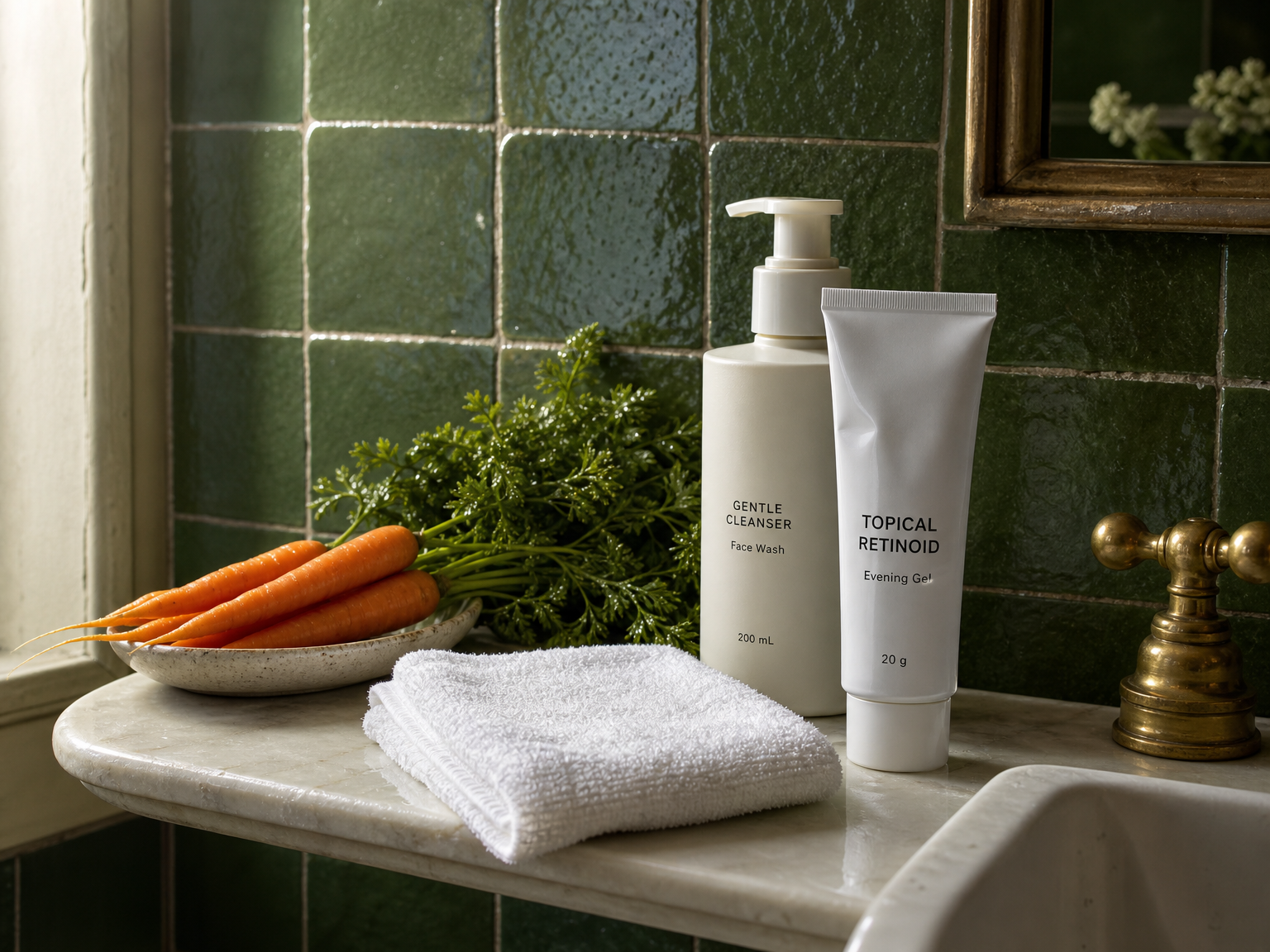

1. What vitamin A has to do with acne
Acne begins when pores get blocked with sticky skin cells and oil. Bacteria and inflammation can then add the redness, swelling, and soreness many people recognize as spots, pustules, or deeper nodules.
Vitamin A comes into the picture because the skin uses retinoid signaling to guide how cells grow, mature, and shed. In acne-prone follicles, skin cells do not shed as smoothly as they should. They can clump together, mix with oil, and form microcomedones — the tiny blocked pores that appear before visible blackheads, whiteheads, and inflamed spots.
So yes, vitamin A is biologically plausible for acne. But there is an important distinction: retinoid medicines are targeted treatments with acne evidence behind them. Ordinary oral vitamin A, retinol creams, retinyl esters, and beta-carotene supplements are not the same thing.

2. How retinoids work in the skin
Topical retinoids work mainly inside the follicle. They help skin cells shed more evenly, which reduces clogged pores. They also quiet inflammation and make it harder for new microcomedones to form.
That is why retinoids are useful both for active acne and for maintenance. They do not just dry out pimples that are already there. They help reduce the next wave of blocked pores, which is why dermatologists often keep them in a long-term routine after acne improves.
Oral isotretinoin is different, and much stronger. It is also a vitamin A derivative, but it works throughout the body. Its biggest acne effect is on sebaceous glands: it reduces gland size and sebum output, while also influencing clogged pores, bacteria-friendly conditions, and inflammation. That is why it can produce long remissions in severe nodular acne, and also why it comes with a much heavier safety burden.
3. What the evidence says
Current acne guidelines from the American Academy of Dermatology recommend topical retinoids such as adapalene, tretinoin, tazarotene, and trifarotene. They also recommend oral isotretinoin for severe acne, or for acne that has not responded to standard topical or oral treatments. The same guideline summary says the evidence is insufficient for vitamin supplements and plant-based alternative therapies.
The clinical evidence broadly follows that pattern:
 Mild-to-moderate: topical retinoids are well established; a 35-trial network meta-analysis found combinations often beat single ingredients.
 Long-term control: retinoids cut microcomedones and prevent new lesions — evidence for the skin, not for vitamin A pills.
 Severe acne: oral isotretinoin has the largest effect, with 15–20 week courses producing lasting remission.
Plain oral vitamin A has a much weaker case. A review of historical studies found improvement in most studies, but the studies were old, often poorly controlled, and used very high doses — commonly around 100,000 IU per day and sometimes far higher. That is well above the adult upper limit for preformed vitamin A.
4. Which forms work best?
The best form depends on acne severity, pregnancy risk, skin tolerance, and whether the acne is mainly on the face, trunk, or both. In practical evidence terms, the forms rank like this.
1. Oral isotretinoin: best supported for severe acne
Oral isotretinoin is the strongest vitamin A-related acne treatment. It is usually reserved for severe nodular acne, scarring acne, or acne that has not improved with standard treatments. It is not a casual supplement and should only be used under medical supervision.
Its strength is also its limitation. Isotretinoin can cause very dry lips and skin, changes in blood lipids, liver test abnormalities, headache, and other adverse effects. It is highly dangerous in pregnancy and is restricted through pregnancy-prevention programs such as iPLEDGE in the United States.
2. Topical adapalene: strong evidence and often better tolerated
Adapalene is one of the most practical topical retinoids. It is available over the counter in some countries and tends to be less irritating than older retinoids for many people. In a comparative trial, adapalene 0.3% gel was noninferior to tazarotene 0.1% gel for lesion reduction and caused less redness, dryness, scaling, stinging, and burning.
Adapalene often works especially well when combined with benzoyl peroxide. This combination targets clogged pores, inflammation, and acne-associated bacteria without relying on an antibiotic.
3. Topical tretinoin: effective, but often more irritating
Tretinoin is a classic prescription retinoid with a long history in acne care. Older comparative reviews suggest tretinoin can be somewhat more effective than adapalene at certain strengths, but also more irritating.
That trade-off is common with retinoids. A more potent product is not always the best choice if the skin becomes too irritated to keep using it.
4. Trifarotene: useful when face and body acne are involved
Trifarotene is a newer topical retinoid. A 52-week study found it was safe, well tolerated, and effective for moderate facial and truncal acne, with irritation peaking early and then declining. It may be especially relevant for people who have acne on the chest, shoulders, or back as well as the face.
5. Tazarotene: potent, but irritation and pregnancy precautions are important
Tazarotene is another prescription retinoid. It can be effective, but it may be more irritating for some users. It also carries a clear pregnancy warning: FDA labeling states that tazarotene may cause fetal harm and is contraindicated during pregnancy.
6. Retinaldehyde: promising, but much thinner evidence
Retinaldehyde is a precursor that the skin can convert toward retinoic acid. Small studies suggest it may help mild-to-moderate acne, especially in combination formulas such as retinaldehyde plus glycolic acid. Another small pilot study found fewer comedones after 4 weeks of a retinaldehyde nanoemulsion.
That is interesting, but it is not comparable to the evidence base for prescription retinoids. Retinaldehyde may be a gentler option for some people, but it should not be presented as equal to adapalene, tretinoin, trifarotene, tazarotene, or isotretinoin.
7. Retinol, retinyl esters, and beta-carotene: weakest for acne
Retinol is common in cosmetic skincare. Retinyl palmitate and retinyl acetate are preformed vitamin A esters used in supplements and some skincare products. These forms may have skin benefits in some contexts, but they are less direct and less studied for acne than acne-specific retinoids.
Beta-carotene is a vitamin A precursor found in colorful plant foods. There is no good evidence that beta-carotene supplements treat acne, and high-dose beta-carotene supplements have been linked with higher lung cancer risk and mortality in smokers and some former smokers.
5. Practical considerations
Retinoids take time. Many people need 8–12 weeks before judging results, and irritation is often worst in the first few weeks. NICE guidance suggests starting in a way that reduces irritation, such as alternate-day use or short-contact application, then increasing as tolerated.
A simple topical routine usually works better than a crowded one: gentle cleanser, moisturizer, sunscreen in the morning, and the retinoid as directed. Benzoyl peroxide may be paired with adapalene or used in other acne regimens, but layering too many actives at once can make skin sore and lead people to stop.
To help prevent relapse, a topical retinoid may be continued after acne improves. That is different from saying vitamin A pills prevent acne. In well-nourished adults, routine vitamin A supplementation has not been shown to prevent acne onset.
6. Safety
Safety is the main reason not to treat acne with high-dose vitamin A supplements. The NIH Office of Dietary Supplements lists the adult upper limit for preformed vitamin A as 3,000 micrograms RAE per day, equal to about 10,000 IU. Historical acne studies often used 36,000 to 500,000 IU per day, with 100,000 IU daily being common.
Too much preformed vitamin A can cause dry skin, cracked lips, headache, joint pain, liver abnormalities, mood symptoms, and birth defects. Taking vitamin A supplements alongside retinoid medicines can also raise the risk of hypervitaminosis A, meaning vitamin A toxicity.
Pregnancy precautions are especially important. Oral isotretinoin must not be used during pregnancy. Tazarotene is contraindicated during pregnancy. NICE guidance also advises that topical retinoids are contraindicated during pregnancy and when planning pregnancy. If you are pregnant, trying to conceive, or could become pregnant, speak with a clinician before using any retinoid or high-dose vitamin A product.