

 Deutsch
 Español
 Suomi
Suomi Français
 Bahasa Indonesia
 Italiano
 日本語
日本語 Português
 Tagalog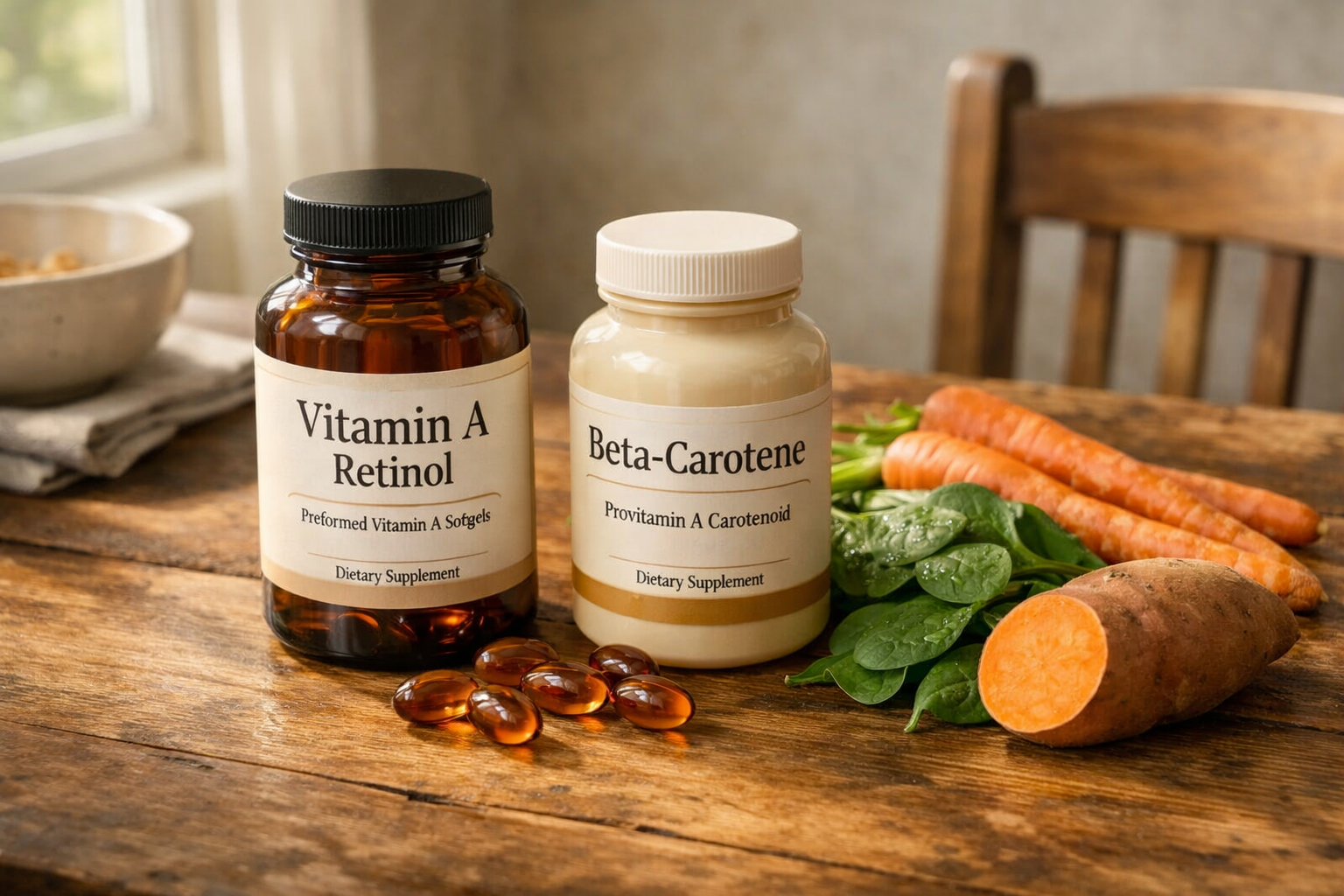
Summary
Vitamin A is a family of fat-soluble compounds that includes preformed vitamin A such as retinol and retinyl esters, plus provitamin A carotenoids such as beta-carotene. It supports vision, immune function, normal cell differentiation, and the health of skin and mucous membranes, but the source and form strongly affect how the body handles it.
The best evidence for supplementation is in preventing or correcting deficiency and in selected public-health or clinical settings. In well-nourished adults, routine high-dose use has limited proven benefit and important safety concerns. Excess preformed vitamin A can be toxic and teratogenic, while high-dose beta-carotene is not appropriate for smokers or former smokers because of lung-cancer risk.
Quick Facts
What is it useful for?
Vitamin A is essential for vision, immunity, and normal tissue maintenance. Supplements are mainly useful when dietary intake or body stores are inadequate.
Supplement types
Common forms include retinyl palmitate and retinyl acetate as preformed vitamin A, plus beta-carotene or mixed carotenoid formulas.
Interactions
It can interact with prescription retinoids, and orlistat can reduce absorption of fat-soluble vitamins. Zinc status also affects vitamin A metabolism.
Side effects
Too much preformed vitamin A can cause headache, nausea, dizziness, liver problems, bone-related symptoms, and pregnancy-related birth-defect risk.
Other possible benefits
Benefit is clearest in deficiency-endemic child programs, selected measles-care settings, and AREDS-type eye formulas for people at high AMD risk.
Regulatory status
In the U.S. and EU, vitamin A supplements are regulated as food supplements, while disease-treatment claims require drug-level authorization.
What We Already Know About It
Vitamin A is a family, not one molecule. Preformed vitamin A includes retinol and retinyl esters from animal foods and many supplements, while provitamin A carotenoids such as beta-carotene come mainly from plant foods and must be converted into retinol. Retinal is central to the visual cycle, and retinoic acid acts as a signaling molecule that regulates gene expression in many tissues. NIH ODS — Vitamin A and Carotenoids Fact Sheet; Linus Pauling Institute — Vitamin A
Form changes biology and risk. Preformed vitamin A is absorbed and used more directly, and it is stored mainly in the liver. That makes it potent, but also the main form linked to toxicity when intake stays too high. Beta-carotene is generally less likely to cause classic hypervitaminosis A because conversion is regulated, yet it is less predictable as a vitamin A source and is not nutritionally identical to retinol. Nutrients review on vitamin A biology; Human metabolism study on beta-carotene conversion; Study on carotenoid absorption and conversion
Best-supported supplementation is targeted. The clearest evidence-based use is preventing or correcting deficiency, especially in children living where deficiency is a public-health problem. Vitamin A also has a specific role in measles management in selected settings. By contrast, routine high-dose use in well-nourished adults has limited evidence of benefit, and safety becomes less favorable because high-dose beta-carotene raises lung-cancer risk in smokers and former smokers. WHO guideline on vitamin A supplementation; Cochrane — Vitamin A for measles in children; Meta-analysis on beta-carotene and lung cancer
Summary of Relevant Scientific Research
Defining Vitamin A and Its Limits — NIH Office of Dietary Supplements
The NIH fact sheet explains the difference between preformed vitamin A and provitamin A carotenoids, outlines retinol activity equivalents, and summarizes intake targets, upper limits, supplement forms, benefits, and risks. NIH ODS — Vitamin A and Carotenoids Fact Sheet
Vitamin A Biology Is More Complex Than One Label — Linus Pauling Institute and Nutrients review
These sources distinguish retinol, retinal, and retinoic acid, and explain why prescription retinoic-acid medicines should not be treated as the same intervention as ordinary dietary supplementation. Linus Pauling Institute — Vitamin A; Nutrients review on vitamin A biology
Blood Tests Do Not Tell the Whole Story — BOND Vitamin A Review
The BOND review shows that serum retinol can remain normal until liver stores are depleted and can also drop during infection or inflammation, so status assessment needs context. BOND review on vitamin A biomarkers
AREDS2 Supports a Specific Eye Formula — AREDS2 randomized clinical trial
In people at high risk of progression to advanced AMD, benefit came from an AREDS-type multi-ingredient formula rather than vitamin A alone, and beta-carotene was not required. PubMed — AREDS2 randomized clinical trial
High-Dose Beta-Carotene Is Not Universally Safe — Systematic review and meta-analysis
Across high-risk groups, beta-carotene supplementation did not prevent lung cancer and was associated with increased risk in smokers and some other exposed populations. Meta-analysis on beta-carotene and lung cancer
Public-Health Benefit Is Context Specific — WHO and Cochrane reviews
WHO supports periodic high-dose vitamin A for children 6-59 months in deficiency-endemic settings, while Cochrane evidence supports measles-related use but not vitamin A as a general pneumonia remedy. WHO guideline on vitamin A supplementation; Cochrane — Vitamin A for measles in children; Cochrane — Vitamin A for non-measles pneumonia in children
Beliefs, Myths & Unproven Claims
More Vitamin A Always Means Better Immunity
Vitamin A is essential for immune function, but the clearest supplementation benefits appear when deficiency is present or likely. In people who already meet their needs, taking much more is not a proven way to strengthen immunity and may increase harm with preformed vitamin A. WHO guideline on vitamin A supplementation; NIH ODS — Vitamin A and Carotenoids Fact Sheet
Plant-Based Beta-Carotene Supplements Are Always Safe
Plant foods rich in carotenoids are not the same as high-dose beta-carotene supplements. Trial evidence shows these supplements do not prevent lung cancer and can increase risk in smokers, former smokers, and some other exposed groups. Meta-analysis on beta-carotene and lung cancer; NIH ODS — Vitamin A Consumer Fact Sheet
Vitamin A Supplements Prevent Cancer or Improve Pregnancy Outcomes Broadly
Current evidence does not support routine vitamin A supplementation as a general cancer-prevention strategy, and reviews do not show significant overall improvement in major pregnancy outcomes from routine supplementation. Systematic review of vitamin A or carotenoids in pregnancy; Meta-analysis on beta-carotene and lung cancer
Oral Vitamin A Works Like Prescription Retinoids
Evidence for skin benefits such as photoaging improvement belongs to prescription retinoic-acid treatments like topical tretinoin, not to routine oral vitamin A supplementation. The biological overlap does not make them clinically interchangeable. Review on topical tretinoin for photoaging; Mayo Clinic — Vitamin A overview

Detailed Research Observations
Forms and Food Sources Are Not Interchangeable
Historically, liver and cod liver oil were recognized as concentrated sources of what is now classified as preformed vitamin A, while orange, yellow, and dark-green plants supplied carotenoid precursors. Modern nutrition science confirms that these categories differ in potency. Animal foods provide retinyl esters that can be used more directly, while plant carotenoids must first be absorbed and converted into retinol. That difference helps explain why some traditional foods were effective against deficiency, but it does not mean larger amounts provide extra benefit once needs are already met. NIH ODS — Vitamin A and Carotenoids Fact Sheet; Nutrients review on vitamin A biology
This distinction matters on supplement labels as well. Retinyl palmitate and retinyl acetate are preformed vitamin A ingredients, while beta-carotene and mixed carotenoids are provitamin A sources. They should not be treated as nutritionally identical, which is why labeling relies on retinol activity equivalents rather than simple weight matching between sources. NIH ODS — Vitamin A Consumer Fact Sheet; NIH ODS — Vitamin A and Carotenoids Fact Sheet
Biology, Absorption, and Storage Explain Both Benefit and Risk
Vitamin A is often spoken about as if it were one substance, but the underlying biology is more specific. Retinol is the main circulating and storage-related form, retinal is essential to vision, and retinoic acid acts as an active signaling molecule that regulates gene expression. Because vitamin A is fat-soluble, absorption depends on the food matrix and dietary fat. Cooking can improve carotenoid bioavailability from some vegetables, but carotenoids still need conversion into retinol before they become usable as vitamin A. Linus Pauling Institute — Vitamin A; Human metabolism study on beta-carotene conversion
Preformed vitamin A is absorbed more efficiently and stored mainly in the liver. That storage system is useful because it buffers short-term variation in intake, but it also explains why chronic excess can accumulate slowly and eventually become toxic. Beta-carotene is less likely to cause classic hypervitaminosis A, yet conversion is variable and influenced by dose, existing vitamin A status, and other dietary factors. Study on carotenoid absorption and conversion; NIH ODS — Vitamin A and Carotenoids Fact Sheet
Status Assessment Is More Complicated Than a Single Blood Test
The BOND review highlights an important limitation in vitamin A research and clinical interpretation: serum retinol is homeostatically controlled. It can remain in the normal range even when liver stores are already low, and it can also fall during infection or inflammation without reflecting severe long-term depletion. That means a single blood value may not neatly correspond to total body stores or actual supplement need. BOND review on vitamin A biomarkers
This measurement problem affects how supplementation studies should be read. If baseline status is unclear, outcomes can be easy to overinterpret. The article’s evidence base repeatedly points to context, dietary history, and population risk as central to understanding who is likely to benefit from supplementation and who is more likely to face unnecessary exposure. BOND review on vitamin A biomarkers; NIH ODS — Vitamin A and Carotenoids Fact Sheet
Where Supplementation Clearly Helps and Where It Does Not
The strongest evidence-based role for vitamin A supplementation is prevention and treatment of deficiency. WHO recommends periodic high-dose vitamin A for children aged 6-59 months in settings where deficiency is a public-health problem, and those programs are associated with meaningful reductions in morbidity and mortality. This is a major public-health success, but it is population-specific and should not be generalized to well-nourished adults in regions where deficiency is relatively uncommon. WHO guideline on vitamin A supplementation; WHO implementation resources on vitamin A; NIH ODS — Vitamin A Consumer Fact Sheet
The infection evidence is also selective. WHO and Cochrane sources support vitamin A use in measles management in certain settings, but Cochrane does not support vitamin A as a general adjunctive treatment for non-measles pneumonia in children. The broader lesson is that an essential nutrient can be clinically important in targeted contexts without being a universal remedy. Cochrane — Vitamin A for measles in children; Cochrane — Vitamin A for non-measles pneumonia in children
Eye Health, Pregnancy, and Retinoid Therapy Need Specific Reading
Vitamin A is genuinely important for vision, but supplement claims about eye health are often oversimplified. The AREDS2 trial supports a multi-nutrient formula for people at high risk of progression to advanced age-related macular degeneration, not vitamin A alone for the general public. Beta-carotene was not necessary in the updated formulation, and replacing it with lutein and zeaxanthin improved safety for smokers and former smokers. PubMed — AREDS2 randomized clinical trial; Linus Pauling Institute — Vitamin A
Pregnancy is another area where context matters. A large review found no significant overall improvement in outcomes such as birthweight, preterm birth, stillbirth, miscarriage, or fetal loss from routine vitamin A or beta-carotene supplementation during pregnancy, while excess preformed vitamin A remains teratogenic. Likewise, evidence for improved photoaging belongs to prescription retinoid treatments like topical tretinoin, not to ordinary oral vitamin A supplements. Systematic review of vitamin A or carotenoids in pregnancy; Review on topical tretinoin for photoaging; Mayo Clinic — Vitamin A overview
Labels, Potency, and Product Quality Matter More Than Many People Realize
Most vitamin A supplements on the market use retinyl palmitate, retinyl acetate, beta-carotene, or mixed formulas. The current U.S. Daily Value is 900 mcg RAE, yet some stand-alone products provide around 3,000 mcg RAE in one serving, which is already at the adult upper limit for preformed vitamin A. Many multivitamins also supply substantial amounts, so consumers can reach high totals more easily than expected when food, fortified products, and supplements are combined. NIH ODS — Vitamin A and Carotenoids Fact Sheet; FDA — Daily Value for vitamin A
Quality programs such as USP Verified and NSF/ANSI 173 can help confirm that a supplement contains listed ingredients at the declared potency and meets certain manufacturing or contaminant standards. Those seals are useful for comparing products, but they do not show that a high-potency product is necessary or biologically safe for a specific person. In well-nourished adults, the article’s evidence base remains much stronger for needs-based use than for routine megadosing. USP Verified Mark program; NSF nutrition product certification; Meta-analysis on beta-carotene and lung cancer
Regulatory Status (EU and US)
United States
In the U.S., vitamin A supplements are regulated as dietary supplements, which places them in the food category rather than the drug category. Manufacturers may use properly substantiated structure/function claims, but they cannot legally claim that a vitamin A supplement diagnoses, treats, cures, or prevents disease without drug-level authorization. The current U.S. Daily Value for vitamin A on labels is 900 mcg RAE. FDA — Structure/function claims for supplements; FDA — Daily Value for vitamin A
European Union
In the EU, vitamin A supplements are generally allowed within the food-supplement framework as concentrated sources of nutrients or other substances with a nutritional or physiological effect. Member States may require notification before marketing. EFSA has evaluated vitamin A-related claims for areas such as vision, immune function, cell differentiation, and maintenance of skin and mucous membranes, but this does not authorize disease-treatment language. Retinoic-acid medicines such as tretinoin and acitretin remain drug products, not supplements. European Commission — Food supplements; EFSA opinion on vitamin A health claims; Review on topical tretinoin for photoaging
Dosage and Standardization
Adults: 900 mcg RAE/day for men and 700 mcg RAE/day for women.
Pregnancy/lactation: 770 and 1,300 mcg RAE/day.
Upper limit: 3,000 mcg RAE/day for preformed vitamin A; some stand-alone products reach this in one serving, so total intake and form matter.
Safety And Interactions
Excess preformed vitamin A is the main safety concern. Acute or chronic hypervitaminosis A can cause headache, nausea, dizziness, liver abnormalities, bone or musculoskeletal symptoms, and in severe cases serious neurologic effects. Because vitamin A is stored in the liver, toxicity can build gradually with chronic overuse. NIH ODS — Vitamin A and Carotenoids Fact Sheet; NIH ODS — Vitamin A Consumer Fact Sheet
Pregnancy requires special caution because high-dose preformed vitamin A is teratogenic. By contrast, beta-carotene does not carry the same teratogenic profile, but high-dose beta-carotene supplements have been linked to increased lung-cancer risk in smokers, former smokers, and some asbestos-exposed groups. NIH ODS — Vitamin A Consumer Fact Sheet; Systematic review of vitamin A or carotenoids in pregnancy; Meta-analysis on beta-carotene and lung cancer
Relevant interactions include orlistat, which can reduce absorption of fat-soluble vitamins, and retinoid medicines such as acitretin or bexarotene, which can increase the risk of excess vitamin A effects when combined with supplements. Zinc status also affects vitamin A metabolism. People with liver disease, those using prescription retinoids, and anyone considering high-dose products should seek individualized advice. NIH ODS — Vitamin A and Carotenoids Fact Sheet; Linus Pauling Institute — Vitamin A
Conclusion
Vitamin A is an essential nutrient, but the evidence supports a targeted rather than casual approach to supplementation. The clearest benefits are in preventing or correcting deficiency and in selected public-health or clinical settings, including deficiency-endemic child programs, some measles-care contexts, and AREDS-type formulas for people at high risk of progression to advanced AMD.
For well-nourished adults, routine high-dose supplementation has limited evidence of benefit and meaningful safety concerns. Preformed vitamin A is more potent and more hazardous in excess, carotenoid supplements are safer from classic hypervitaminosis A but less predictable, and retinoic-acid medicines remain a separate therapeutic category.
Disclaimer
Disclaimer: We attempt to do our best to find relevant, accurate and most up to date information available in both, the public domain and in the clinical and medical research community. We recommend reviewing scientific sources for official information on the subject. This post is not intended as medical advice. Each individual person's health conditions vary and we advise to consult a doctor before taking any supplements.