Selenium and cancer prevention looked promising for decades. SELECT and later reviews changed the story: essential nutrient, not a proven cancer shield.
SELECT turned selenium from a prevention hope into a cautionary evidence story.
The Claim in Context
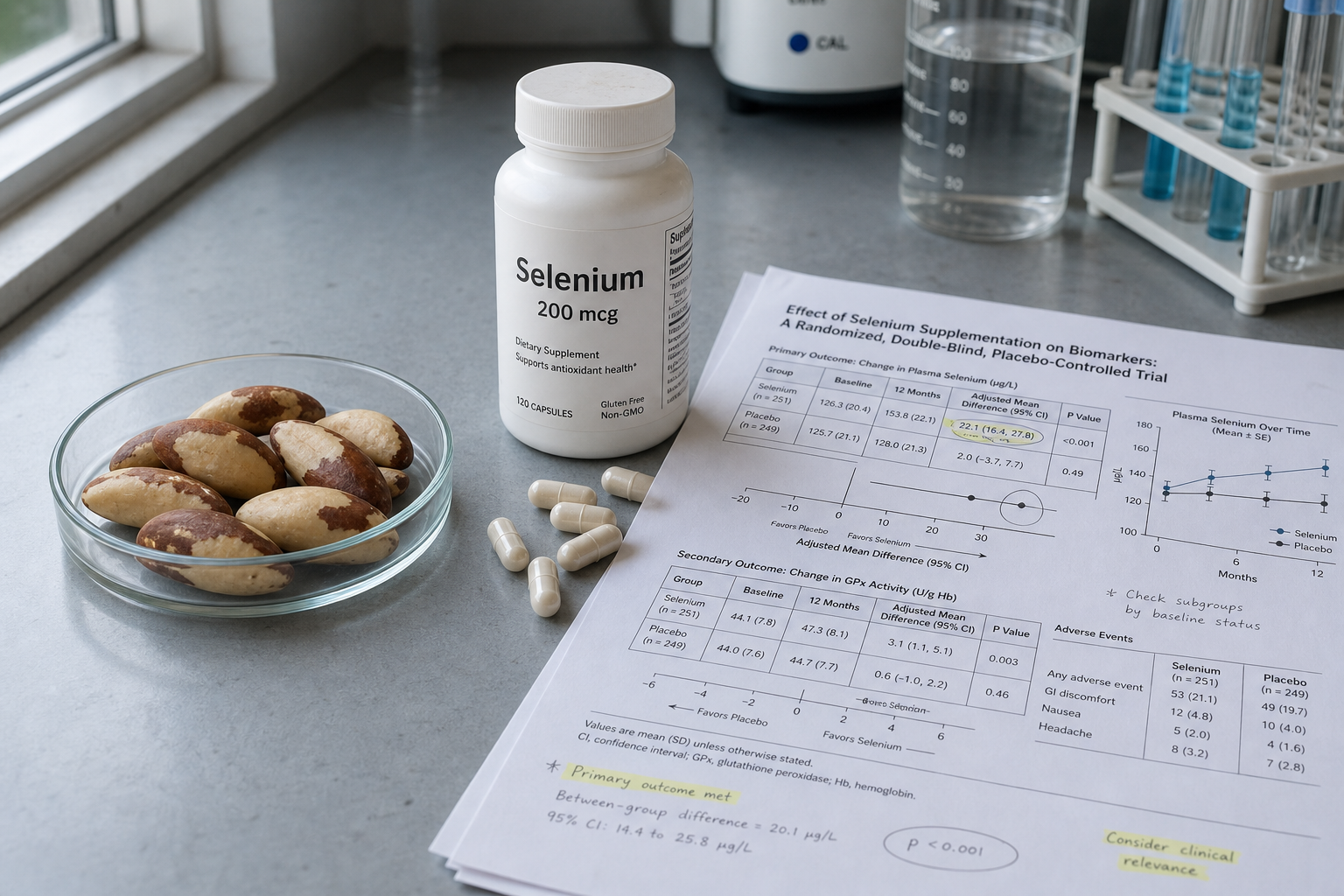
Selenium sits at the intersection of nutrition science, antioxidant biology, and cancer-prevention claims. It is an essential trace mineral, so the idea that it might protect cells has always had a plausible foundation. But prevention claims ask for a higher standard than biological plausibility. This review follows how that question moved from early signals into large trials and systematic review.
The evidence ladderHow the selenium-cancer claim was tested
Ecological SignalsRegional selenium patterns raised the question
Trial OptimismSecondary findings made prevention seem plausible
Baseline HypothesisSelenium status looked like it might matter
SELECT TrialA large randomized prevention test
Current ConsensusEssential, but not proven for cancer prevention
A plausible nutrient. A demanding claim.
The appeal of selenium supplements was easy to understand. Selenium is essential, it helps build selenoproteins, and those proteins support antioxidant defense, immune function, thyroid hormone metabolism, and normal cell health. That made the cancer-prevention question worth testing, not automatically true. The key issue is whether extra selenium protects people who already get enough. The answer depends less on marketing claims and more on how the early signals held up when large, controlled trials asked the question directly.
An essential nutrient does not automatically become more protective at higher doses.
Why the Theory Made Sense
The cancer-prevention theory around selenium grew out of real biology. Selenium is incorporated into a group of proteins called selenoproteins, which help regulate antioxidant enzymes, thyroid hormone metabolism, immune function, DNA synthesis, reproduction, and other processes involved in normal cell health. Because oxidative damage can affect DNA and cell signaling, researchers had a reasonable basis for asking whether better selenium status might lower cancer risk. The difficulty is that biology is not the same as clinical benefit. Selenium-dependent systems appear to have an adequacy threshold: once the body has enough selenium to support these proteins, extra intake may not add meaningful protection. That makes baseline selenium status central to the question.
Selenoprotein Foundation
Selenium is built into proteins that support antioxidant defense, thyroid function, immune activity, and cell maintenance.
Oxidative Stress Link
Some selenoproteins help manage oxidative stress, which can influence DNA damage and cell signaling.
Narrow Adequacy Curve
Once selenium-dependent proteins are adequately supplied, extra selenium may add little measurable function.
Status and Form
Low status and different selenium compounds remain scientifically relevant, but neither proves a prevention benefit.
What the Evidence Shows
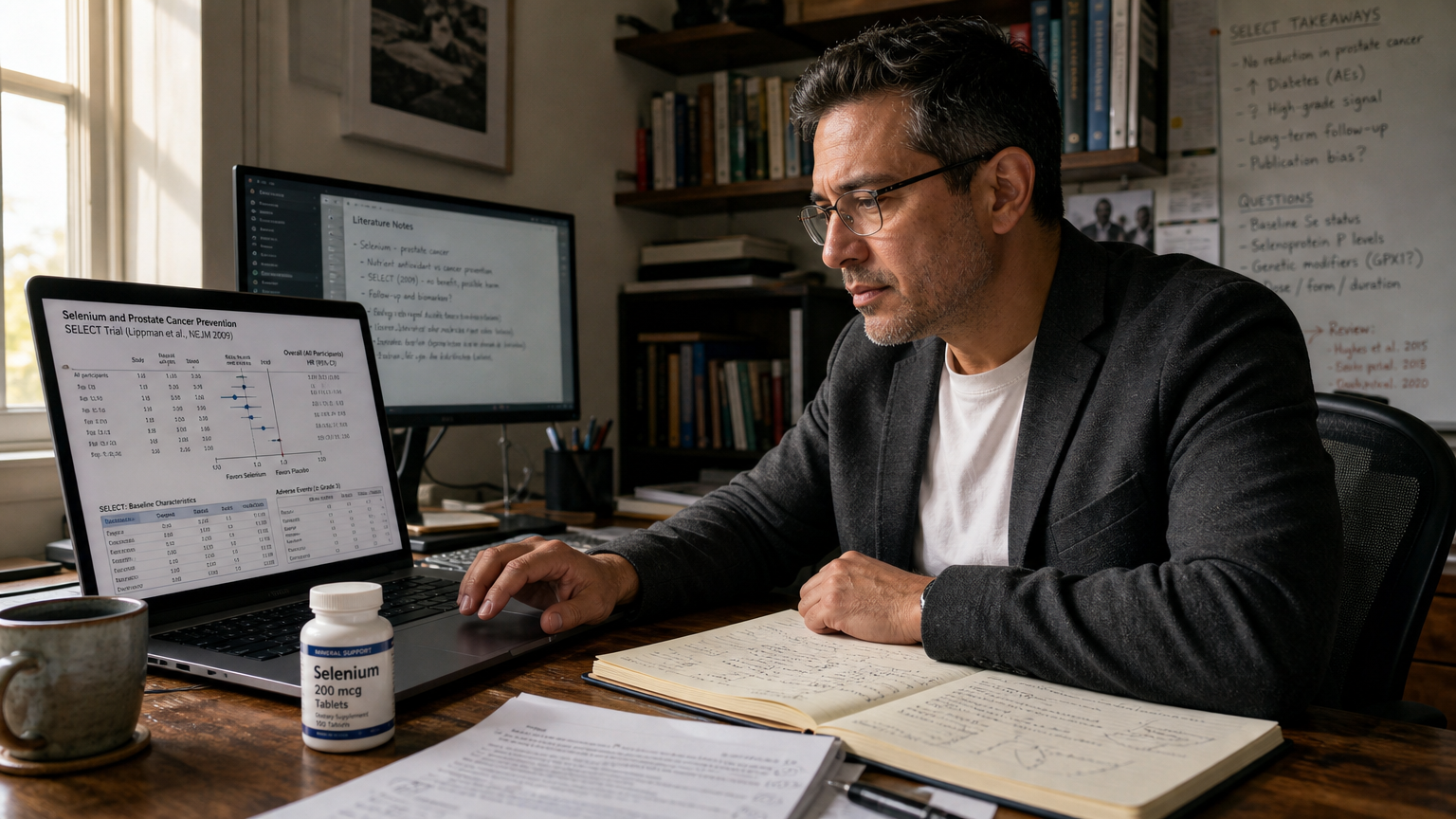
The selenium story is best read as a progression from plausible early signals to more rigorous tests. Ecological patterns and secondary trial findings helped create the hypothesis, especially around prostate cancer, but neither could settle cause and effect. The SELECT trial was designed to test prevention directly in a large randomized population, using selenium, vitamin E, both, or placebo. Its results changed the interpretation of the whole field. Later analyses and systematic reviews did not revive the prevention claim, and they added a more cautious view of higher selenium exposure in people who were already replete.
Early Signals
Regional selenium patterns helped launch the hypothesis, but ecological findings could not prove selenium caused lower cancer rates.1
Trial Optimism
The NPC trial missed its skin-cancer endpoint, but secondary cancer findings made prevention look more persuasive than the trial was designed to test.2
SELECT at Scale
In SELECT, 200 mcg/day selenium did not reduce prostate cancer or other prespecified cancer endpoints in 35,533 men.3
Consensus and Caution
Later analyses, reviews, and official guidance found no routine prevention role and kept higher-exposure risks in view.4, 5, 6, 7, 8, 9
How to Use the Evidence
The practical takeaway is not that selenium is unimportant. It is that selenium should be treated like an essential trace mineral with a safe range, not like a high-dose cancer-prevention drug.
Do not take selenium solely for cancer prevention unless a clinician has identified a specific reason
If deficiency is suspected, test status rather than guessing from symptoms
Count total exposure from food, multivitamins, standalone selenium, and Brazil nuts
See the selenium quick facts →
Selenium Quick Facts
Selenium’s evidence is easiest to understand when adequacy, prevention dosing, and total exposure are kept separate.
55 mcg/dayAdult Recommended Dietary Allowance
200 mcg/dayDose used in SELECT and several prevention trials
35,533 menSELECT trial population
Adequacy is not high-dose benefit
Selenium is required for normal physiology, but once selenoprotein needs are met, extra selenium may not improve function. Replete populations are therefore less likely to benefit from supplementation.
SELECT was purpose-built
Earlier positive signals were partly secondary or subgroup findings. SELECT was designed specifically to test prostate cancer prevention, and it did not confirm the hypothesis.
Safety depends on total exposure
Selenium has a narrower margin than many popular supplements. Total intake includes food, multivitamins, standalone products, and very selenium-rich foods such as Brazil nuts.
Selenium’s cancer story is not a simple case of a weak idea being disproved. The early case rested on plausible biology, suggestive population patterns, and a trial that produced striking secondary findings. That was enough to justify serious research. It was not enough to justify routine supplementation for cancer prevention.
Why Selenium Looked So Promising
The early rationale had three parts. First, selenium supports enzymes involved in oxidative stress and immune defense, both relevant to cancer biology. Second, ecological studies suggested that areas with different selenium exposures had different cancer patterns. Third, the Nutritional Prevention of Cancer trial reported lower total cancer incidence and mortality in secondary analyses, even though the main skin-cancer endpoint was not reduced.
Those findings were scientifically interesting, but they were also vulnerable to overinterpretation. Secondary endpoints and subgroup analyses can generate useful hypotheses, but they often look stronger than they prove to be. Cancer-prevention claims around antioxidant nutrients need randomized evidence because associations can be shaped by diet quality, smoking patterns, socioeconomic factors, screening behavior, and many other sources of confounding.
What SELECT Changed
SELECT mattered because it asked the question directly. It enrolled a very large population, randomized participants, used placebo control, and was designed around prostate cancer prevention rather than discovering cancer effects after the fact. Selenium was given as 200 mcg/day L-selenomethionine, alone or with vitamin E, and the trial did not show a reduction in prostate cancer.
Longer follow-up did not reveal a delayed benefit. That matters because supplement claims often survive negative trials by arguing that the study was too short or that benefits would emerge later. In SELECT, extended observation did not turn selenium into a cancer-prevention supplement, and later analyses raised more caution in men who already had higher selenium exposure.
The Deficiency Argument Is Real but Limited
One of the fairest arguments is that selenium might help people who are genuinely deficient. That is biologically plausible. If selenium status is too low to support normal selenoprotein activity, correcting the deficiency is sensible for health.
But that is different from saying selenium prevents cancer in the general population. In many selenium-replete settings, supplementation is less likely to increase key selenium-dependent proteins because those systems are already adequately supplied. The honest approach is to test when deficiency is suspected, correct a documented deficiency appropriately, and avoid assuming that more selenium is protective.
The Final Lesson
Today, selenium is best understood as essential, but not as a proven cancer-prevention supplement. For people with low status, correcting deficiency may be appropriate under clinical guidance. For people who are already replete, routine high-dose selenium is unsupported and may carry risks, including diabetes signals in some trial analyses and toxicity concerns at excessive intakes. More is not better; enough is the goal.
References
Shamberger, R. J. et al. (1969). Relationship of Selenium to Cancer. Journal of the National Cancer Institute.
Clark, L. C. et al. (1996). Effects of Selenium Supplementation for Cancer Prevention in Patients With Carcinoma of the Skin. JAMA.
Lippman, S. M. et al. (2009). Effect of Selenium and Vitamin E on Risk of Prostate Cancer and Other Cancers: The SELECT Trial. JAMA.
Kristal, A. R. et al. (2014). Baseline Selenium Status and Effects of Selenium and Vitamin E Supplementation on Prostate Cancer Risk. Journal of the National Cancer Institute.
Stranges, S. et al. (2007). Effects of Long-Term Selenium Supplementation on the Incidence of Type 2 Diabetes. Annals of Internal Medicine.
Vinceti, M. et al. (2018). Selenium for Preventing Cancer. Cochrane Database of Systematic Reviews.
NIH Office of Dietary Supplements. Selenium: Fact Sheet for Health Professionals.
National Cancer Institute. Prostate Cancer, Nutrition, and Dietary Supplements (PDQ®).
EFSA Panel on Nutrition, Novel Foods and Food Allergens. (2023). Scientific Opinion on the Tolerable Upper Intake Level for Selenium. EFSA Journal.
Disclaimer
Disclaimer: We attempt to do our best to find relevant, accurate and most up to date information available in both, the public domain and in the clinical and medical research community. We recommend reviewing scientific sources for official information on the subject. This post is not intended as medical advice. Each individual person's health conditions vary and we advise to consult a doctor before taking any supplements.

 Deutsch
 Español
 Suomi
Suomi Français
 Bahasa Indonesia
 Italiano
 日本語
日本語 Português
 Tagalog